How Ayatollah Khamenei's literary corpus reveals a half-century of Islamic intellectual thought

By Humaira Ahad
Across the bookshops lining Tehran's Enghelab Square, the works of the martyred Leader of the Islamic Revolution, Imam Seyyed Ali Khamenei, occupy a special and distinctive place.
Slim paperbacks stand alongside multi-volume Qur'anic commentaries, collections of sermons, lecture transcripts, memoirs, translations, and speeches delivered across several decades.
To a casual visitor, they appear to be separate publications produced for different audiences and occasions. Read together, however, they reveal a coherent intellectual project developed over more than half a century.
Long before he was elected Leader of the Islamic Revolution, Imam Khamenei had established himself as a preacher, lecturer, translator, and student of Islamic thought.
Many of the books that now bear his name did not begin as books. Some originated as lectures delivered in the mosques of the holy city of Mashhad during the final years of the Western-backed rule of Mohammad Reza Shah Pahlavi.
Others emerged from Qur'anic exegesis, addresses to university students, speeches to government officials, or public statements issued after the 1979 Islamic Revolution.
Taken individually, these works span a wide range of subjects: Qur'anic interpretation, Shi'a history, ethics, governance, the question of Palestine, revolutionary thought, personal memoir, and contemporary political affairs.
Yet a common thread runs through them. Rather than treating religion as separate from politics, or spirituality as detached from society, Imam Khamenei consistently stated that faith, justice, history, and political responsibility are inseparable dimensions of Islamic life.
Across dozens of volumes, the same fundamental questions recur with remarkable consistency. What responsibilities accompany religious leadership? How should Muslims respond to injustice and foreign domination? What lessons do the lives of the Prophets and the Shi'a Imams hold for contemporary society? How should an Islamic government balance moral authority with political power?
Although the historical settings shift from one work to another, these questions provide the connective tissue binding together Imam Khamenei's published corpus. This intellectual trajectory becomes especially apparent when the works are read chronologically.
His earliest lectures, delivered before the Islamic Revolution, emphasize the moral and social dimensions of Islam under Western-backed monarchical rule. Later works increasingly grapple with the practical challenges of governance, statecraft, international affairs, and the responsibilities of an Islamic government.
While the political context evolves, from opposition activism to national leadership, the underlying intellectual framework remains strikingly consistent.
The General Outline of Islamic Thought
Among the earliest and most influential works of the martyred Leader is The General Outline of Islamic Thought, a volume compiled from a series of Ramadan lectures delivered in the holy city of Mashhad in 1974.
The lectures were delivered during a period of growing political and religious ferment in Iran, during the Pahlavi dictatorship, when discussions of Islam increasingly intersected with debates over justice, authority, and social change.
Rather than approaching religion primarily through theology or jurisprudence, Imam Khamenei organized the series around foundational Qur'anic concepts, including faith (iman), divine unity (tawḥid), prophethood (nubuwwah), and guardianship (wilayah), arguing that each carries both spiritual and social significance.
A central theme runs throughout the work: Islam cannot be understood merely as a private system of belief or ritual observance. Instead, the martyred Leader presents it as a comprehensive framework governing individual conduct, communal responsibility, and public life.
In this reading, faith is expressed not only through personal devotion but also through active engagement with questions of justice, social responsibility, and collective action.
Many of the ideas that would later recur throughout Imam Khamenei's writings are already evident in these early lectures. The inseparability of belief and action, the unity of religious and political life, and the role of Islamic teachings in shaping society emerge as interconnected principles rather than discrete themes.
Although delivered to a local audience more than five decades ago, the lectures remain foundational within Imam Khamenei's broader body of work, laying out the conceptual framework that would continue to inform many of his later writings.
✍🏻 Feature - A man for all seasons: Martyred Leader’s lifelong relationship with literature, media, and cinema
— Press TV 🔻 (@PressTV) July 7, 2026
By @Sheydaeslami https://t.co/cUYcNTua5u
The 250-Year-Old Human
If The General Outline of Islamic Thought establishes the martyred Leader's understanding of Islam as a comprehensive worldview, The 250-Year-Old Human applies that framework to history.
The book's central premise is straightforward. Rather than treating each of the Twelve Shi'a Imams as an independent historical figure pursuing distinct objectives, Imam Khamenei argues that they should be understood as participants in a single, continuous movement spanning approximately 250 years.
Their differing approaches, whether political activism, scholarship, patience, or resistance, are presented not as contradictions but as responses to changing historical circumstances in pursuit of a common mission.
The second volume of the book traces this narrative from the period following the Prophet Muhammad (peace be upon him) through the successive Imams, portraying their lives as interconnected chapters in a unified historical project.
Throughout, it emphasizes themes of perseverance, sacrifice, principled leadership, and the preservation of authentic Islam during periods of political repression and ideological challenge.
This interpretation reflects a broader pattern visible throughout Imam Khamenei's writings. History is not presented as a sequence of disconnected events but as a continuous source of insight into contemporary religious and political questions. Past struggles are interpreted as enduring reservoirs of ethical guidance and strategic lessons for later generations.
The third volume of the book develops the same historical framework in considerably greater depth. Expanding upon the arguments introduced earlier, it examines more closely the political, social, and cultural circumstances surrounding each Imam while offering a more detailed analysis of the intellectual continuity linking their lives and missions.
Rather than serving as an introductory survey, the volume presents a more analytical account of the period. Its expanded treatment affords greater attention to historical context and further illustrates Imam Khamenei's broader method of interpreting Islamic history.
Individuals are understood within larger historical movements; seemingly isolated events become part of long-term historical processes, and religious leadership is examined through the interplay of moral principle and political circumstance.
Read alongside The General Outline of Islamic Thought, The 250-Year-Old Human demonstrates the consistency of Imam Khamenei's intellectual approach, bringing scripture, history, ethics, and governance into a single interpretive framework.
Imam Hasan's Peace Treaty: The Most Magnificent Heroic Flexibility in History.
The book opens with a question that has echoed through centuries of Islamic scholarship: if Imam Hassan (AS) chose peace, why did Imam Hussain (AS) choose resistance at Karbala? Were the two brothers pursuing different paths, or the same objective through different means?
Confronted with widespread misunderstandings surrounding Imam Hassan's (AS) treaty with Mu'awiyah, Imam Khamenei initially set out in 1969 to write an analytical study of his own.
During his research, however, he encountered Sulh al-Hasan by Sheikh Razi Al Yasin. Convinced that the work already provided the comprehensive analysis he had intended to produce, he instead undertook its translation into Persian.
That decision reflected both the martyred Leader's scholarly judgment and literary craftsmanship. Drawing on his command of Arabic and deep knowledge of Islamic history, he produced a translation distinguished by its clarity, precision, and readability, making a complex and often misunderstood episode of early Islamic history accessible to a wider readership.
The book challenges the common assumption that Imam Hassan's (AS) peace treaty and Imam Hussain's (AS) uprising represent opposing philosophies. Instead, it argues that both were guided by the same overarching mission, with their differing responses shaped by the political realities of their respective eras.
Imam Hassan's (AS) treaty is thus presented not as a retreat, but as an act of strategic wisdom, what the book famously describes as "the most magnificent heroic flexibility in history." In doing so, it offers a carefully reasoned reappraisal of one of the defining turning points in early Islamic history.
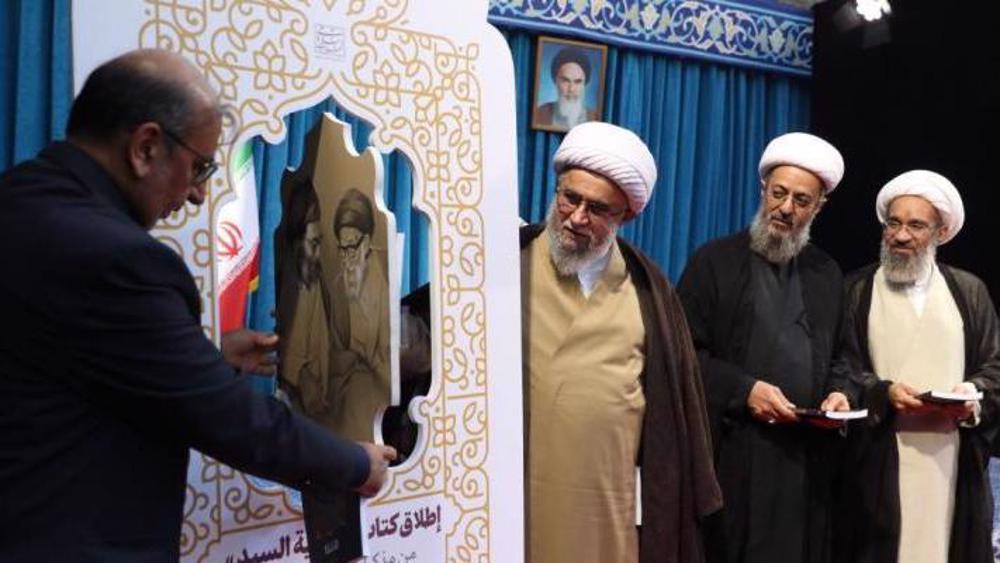
Two Striving Imams
Based on six lectures delivered in 1972 and 1973, Two Striving Imams returns to a central question in Islamic history: if Imam Hassan (AS) concluded a peace treaty while Imam Hussain (AS) launched an uprising, were their approaches fundamentally different? Imam Sayyed Ali Khamenei argues that they were not.
According to his analysis, both Imams pursued the same overarching mission, adapting their methods to the demands of their respective historical circumstances. The lectures, delivered at Tehran's Hosseiniyeh Ershad and during Tasu'a, Ashura, and Sham-e Ghariban at Masjid-e Karamat in the holy city of Mashhad, examine the distinct political and social conditions confronting each Imam before arriving at a unified interpretation of their actions.
The concluding chapter examines and critiques three common interpretations of the Karbala movement before presenting Imam Khamenei's own conclusion: that Imam Hussain's (AS) uprising represented the continuation and revival of the Prophet Muhammad's (peace be upon him) transformative mission, offering an enduring model for confronting tyranny and injustice.
Written in the passionate yet accessible style that characterized his early public lectures, Two Striving Imams remains one of Imam Khamenei's most engaging works, particularly for younger readers approaching Islamic history through the lens of ideas, principles, and historical purpose rather than chronology alone.
The Sun on the Battlefield: The Ashura Uprising in the Words of Imam Sayyed Ali Khamenei
Spanning more than three decades of speeches and reflections, from 1979 to 2011, the volume brings together Imam Khamenei's observations on Ashura in six thematic sections.
These explore the personality of Imam Hussain (AS), the events of Karbala, the companions and adversaries of Ashura, and the prayers and ziyarat (pilgrimage supplications) associated with its commemoration.
The book's organization reflects a practical purpose. Rather than requiring readers to proceed sequentially, its thematic structure allows each subject to be studied independently, making the volume equally valuable for sustained reading and scholarly reference.
Running throughout the collection is a recurring image: Ashura as an ocean whose depths can never be exhausted. The more closely its events are examined, the richer their meanings become.
This sense of inexhaustible reflection gives the book its enduring appeal for researchers, students of Islamic history, and readers seeking a deeper understanding of one of the defining moments of the Islamic tradition.
Yet the story does not end at Karbala. In another work, Imam Khamenei turns to the years that followed, exploring how the legacy of Ashura continued to shape the course of Islamic history.
The Epic of Imam Sajjad (AS): The Life and Struggle of Imam Sajjad (AS)
The Fourth Shi'a Imam is often remembered for the profound supplications preserved in Al-Sahifa al-Sajjadiyya. Yet Imam Khamenei invites readers to look beyond its devotional dimension. Were these prayers simply the expressions of a leader withdrawn from public life, or did they serve a broader historical purpose?
Drawing on a carefully curated collection of lectures, the book portrays Imam Sajjad's (AS) leadership during the Umayyad period as a sophisticated synthesis of spiritual guidance, intellectual renewal, and patient institution-building.
Through education, the cultivation of committed followers, and the preservation of authentic Islamic teachings, Imam Sajjad (AS) is presented as rebuilding the foundations of the Shi'a community in the aftermath of Karbala.
In this reading, his legacy extends beyond piety alone: his quiet but deliberate efforts prepared the intellectual and moral ground upon which future generations would continue the mission of the Ahl al-Bayt (the holy household).
I read an 8-volume #book on literature on my trips to Tehran while I had to spend long hours on the bus.I read all the 8 volumes on the bus!
— Khamenei.ir (@khamenei_ir) September 14, 2013
Palestine: A Century of Conflict Through Imam Sayyed Ali Khamenei's Perspective
For Imam Khamenei, the question of Palestine has never been confined to diplomacy or geopolitics. Throughout his writings and speeches, it is presented as a moral issue, one that has transcended the borders of West Asia to become a humanitarian concern shared by people of conscience around the world.
Palestine brings together decades of his reflections on an issue that has shaped modern history. Drawing on speeches delivered over many years, the volume traces nearly a century of developments, examining the historical evolution of Palestine under Israeli occupation and apartheid, the emergence of the Palestinian resistance movement, and the continuing struggle for justice and self-determination.
Rather than treating Palestine solely as a political dispute, Imam Khamenei frames it as a question of historical memory, human dignity, and moral responsibility. The result is a work that seeks not only to explain how the occupation and extermination developed, but also why it continues to occupy such a central place in contemporary Islamic thought and political discourse.
Translated into Arabic, English, Urdu, and Kurdish, the book serves as an accessible introduction for readers seeking to understand both the historical background of the Palestinian question and the ideas that shape Imam Khamenei's perspective on it.
Commentary on Nahj al-Balagha, Bringing Imam Ali's Words Into the Modern Age
For Imam Seyyed Ali Khamenei, Nahj al-Balagha, the celebrated collection of sermons, letters, and sayings attributed to Imam Ali (AS), has always been more than a literary or historical masterpiece. He has consistently described it as a living source of guidance for individual conduct, ethical leadership, and the ordering of society.
Since the 1960s, introducing the teachings of Imam Ali (AS) to contemporary audiences has been one of his enduring intellectual pursuits. He has repeatedly presented Nahj al-Balagha as a foundational text for understanding the principles of the Islamic Revolution, encouraging both public officials and younger generations to engage with it through careful study and reflection.
Rather than confining himself to textual commentary, Imam Khamenei combines close reading with translation, linguistic clarification, and reflections on the ethical, political, and spiritual insights embedded in Imam Ali's (AS) words.
This long engagement has been preserved in four published volumes. The Clear Path for Leaders explores principles of governance through a series of Ramadan lectures delivered to members of the Iranian cabinet.
The Charter of Alid Governance examines seven lectures delivered in Mashhad in 1973 and 1974, emphasizing justice, resistance to oppression, and social responsibility. Prophethood in Nahj al-Balagha, based on lectures delivered in 1982, turns to the aims of divine prophethood and the practical role of Nahj al-Balagha in shaping society.
The fourth volume, An Endless Treasury, reflects on the enduring significance of the text and its place within Islamic civilization.
Taken together, these four volumes represent decades of sustained engagement with one of Islam's most influential works, illustrating Imam Khamenei's enduring effort to connect the teachings of Imam Ali (AS) with the ethical, social, and political questions of the modern world.

Bayan al-Qur'an: Reading the Qur'an as a Living Guide
For Imam Khamenei, the Qur'an was never simply a sacred text to be admired; it was a guide meant to shape individual character, social life, and the conduct of society.
That conviction runs throughout the ten-volume Bayan al-Qur'an series. Each volume is devoted to a single surah, offering commentary that seeks to connect Qur'anic teachings with the practical realities confronting individuals and communities.
The series includes commentaries on Surahs At-Taghabun, Al-Mujadilah, Al-Mumtahanah, Al-Jumu'ah, Al-Hashr, Al-Fatihah, Al-Baqarah, At-Tawbah (Bara'ah), Al-Munafiqun, and As-Saff.
One of the defining features of the collection is its accessibility. Complex theological and ethical ideas are presented in clear, accessible language, making the volumes approachable for general readers while offering sufficient depth for students of Islamic studies and academic researchers.
Throughout the series, Qur'anic interpretation is presented not as an abstract scholarly exercise but as a means of understanding the moral, social, and political challenges of contemporary life. In doing so, Bayan al-Qur'an reflects a consistent theme running through Imam Khamenei's broader body of work: the Qur'an is to be studied not only for contemplation, but also as a living guide for thought and action.
Hadith of Life: Ethics for Everyday Living
For Imam Khamenei, every lesson began with character.
Following a tradition inherited from many of his own teachers, he would open his classes with a brief ethical reflection, often based on a saying of the Prophet Muhammad (peace be upon him) or one of the Shi'a Imams.
Those reflections were later compiled into the five-volume Hadith of Life series.
Drawing primarily on classical Shi'a sources, including Makarim al-Akhlaq, Al-Nawadir, Amali al-Saduq, Bihar al-Anwar, and Al-Khisal, the collection explores themes of moral refinement, self-discipline, spiritual growth, and the cultivation of virtuous character.
Rather than presenting ethical teachings as abstract ideals, Imam Khamenei explains them in language that is clear, practical, and readily applicable to everyday life. The emphasis is not merely on understanding moral principles, but on putting them into practice.
Accessible to readers of all ages, Hadith of Life also serves as a valuable resource for seminarians, teachers, and religious educators. In many ways, the series reflects a defining feature of Imam Khamenei's broader body of work: the conviction that knowledge acquires its fullest meaning only when it shapes character and conduct.
Justice: Turning an Ideal Into Practice
In Justice, Imam Khamenei moves beyond philosophical discussion to examine how justice can be pursued in the practical realities of social and political life.
Organized around four central questions, including why justice matters, what is required to establish it, how it should be pursued, and what challenges accompany that pursuit, the book draws on his speeches and writings to encourage careful reflection rather than abstract debate.
Structured almost as a workshop in civic and ethical thought, the volume is aimed particularly at student organizations, social activists, and readers interested in questions of public responsibility and social reform.
Throughout, the emphasis remains on translating principle into practice. Rather than treating justice as an abstract ideal, the book invites readers to consider the moral, intellectual, and practical responsibilities involved in making it a lived reality.
The Blood of the Heart Became a Ruby: A Life Told in the Author's Own Words
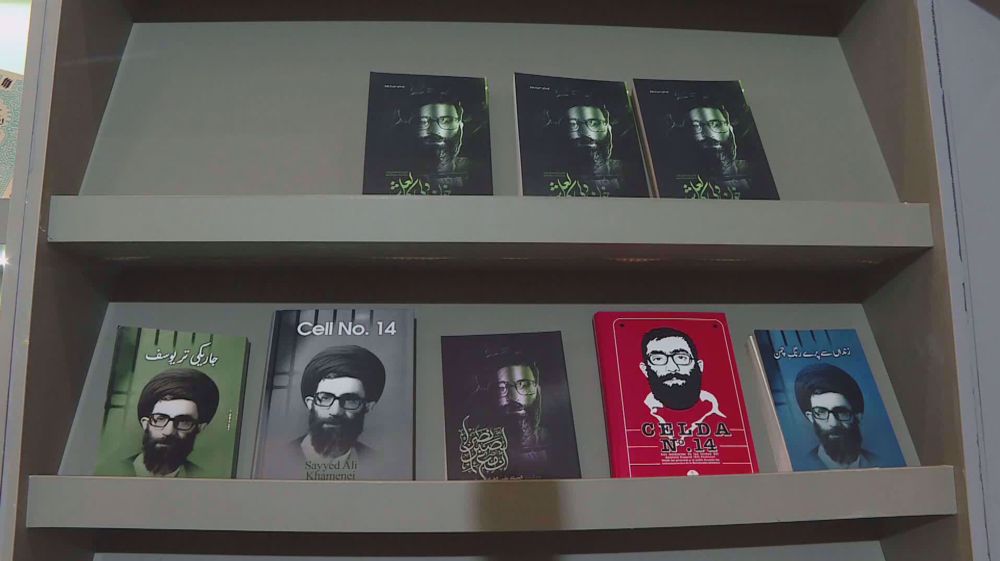
In The Blood of the Heart Became a Ruby, Imam Khamenei recounts his own journey through the turbulent years leading up to the 1979 Islamic Revolution. Originally written in Arabic under the title Inna Ma'a al-Sabri Nasran (Indeed, with Patience Comes Victory), the work was later translated into Persian and subsequently into several other languages, including English, Spanish, and Chinese.
Its pages trace years marked by imprisonment, hardship, perseverance, and political struggle, while also reflecting on the martyred Leader's formative years as a seminary student and the experiences that shaped his intellectual and religious outlook.
Introducing the book in Beirut, the martyred Secretary-General of the Hezbollah Resistance Movement, Sayyed Hassan Nasrallah, remarked that he had read it in a single night, describing it as a work that would greatly enrich anyone seeking to understand the years leading up to the Islamic Revolution, particularly younger readers.
Yet the autobiography is more than a personal memoir. Through Imam Khamenei's recollections, readers gain a vivid portrait of the social, cultural, and political atmosphere of pre-revolutionary Iran, making the story of one individual inseparable from the story of an era.
Taken individually, these works explore scripture, history, ethics, governance, memoir, and international affairs. Read together, however, they reveal a sustained intellectual project developed over more than half a century, in which recurring questions of faith, justice, leadership, and resistance are examined from different perspectives and in changing historical circumstances.
Whether approached as religious scholarship, political thought, historical interpretation, or personal reflection, Imam Khamenei's books offer readers a window into the ideas that have shaped one of the most influential political and religious figures in contemporary Iran.
More than a collection of individual titles, they form a coherent body of work that traces the evolution of an intellectual vision from the lecture halls and mosques of pre-revolutionary Iran to the responsibilities of national leadership.
Historic mihrab unearthed during restoration at Iran's UNESCO-listed Pasargadae
Iranian science VP lauds country’s victory at China International Math Olympiad
In Iran, at the funeral of martyred Leader of the Islamic Revolution, I see nothing but beauty



VIDEO | France: Fire near Paris burns hundreds of hectares
Satellite images show extensive damage to US bases hit in Iranian strikes
‘We will not tolerate any siege or aggression’: Yemen warns Saudi Arabia
VIDEO | Press TV's news headlines
How Ayatollah Khamenei's literary corpus reveals a half-century of Islamic intellectual thought
Islamabad MoU in crisis as US 'gutted' 14-point agreement: Iran
US missile stockpiles dwindle amid aggression against Iran: Report
New data shows extreme heat claimed 10,000 lives across Europe in late June


 PressTV NEWSLETTER
now
PressTV NEWSLETTER
now
 This makes it easy to access the Press TV website
