From Strait of Hormuz to Bab al-Mandeb: Iran’s blueprint for new regional order after US breaks MoU
By Press TV Strategic Analysis Desk
The Persian Gulf today stands at a precipice unseen since the Tanker War of the 1980s. This crisis is not of Iran's making but the direct and well-documented consequence of sustained American military escalation and unprovoked acts of aggression, which have emerged as the principal drivers of regional instability.
It is characterised by the flagrant and continuing violation of the war-ending memorandum of understanding (MoU), breached through repeated US military strikes on Iranian territory, covert naval incursions, and acts of maritime banditry and piracy.
Washington has systematically dismantled every diplomatic off-ramp, leaving Tehran with no recourse but decisive and powerful retaliation.
Every American provocation and act of aggression has been met by Iran with swift, decisive and fully lawful retaliation. These responses are not acts of escalation but the inherent, non-negotiable right of a sovereign nation to defend itself under international law, specifically Article 51 of the United Nations Charter. To brand Iran as the aggressor is to invert reality entirely. The US war machine chose this path and Iran is not the one to surrender.
Having exhausted the diplomatic track – repeatedly sabotaged by an American regime notoriously known for its lack of good faith – Iran has transitioned from a defensive posture to a strategically offensive one. The Strait of Hormuz is no longer a mere geographical chokepoint but a decisive lever of Iranian power and statecraft, capable of permanently rewiring the geopolitical architecture of a region long defined by unchecked US naval overreach.
Iran will not compromise or offer any concessions on the Strait. It will continue to manage the waterway according to its sovereign rights and the new realities on the ground, because the United States, through its continued violations and aggression, has left no other path.
A memorandum broken by Washington
To understand Iran's current posture, one must first acknowledge the contractual foundation that the United States systematically dismantled under the Israeli lobby pressure.
The MoU, signed by the presidents of Iran and the United States, though informal in its later iterations, represented a fragile but functional framework for de-escalation after a war the US-Israeli axis imposed on Iran. It included tacit understandings on naval conduct in the Persian Gulf, restrictions on certain categories of military activity near Iranian territorial waters, and mutual recognition of each other's red lines.
The United States violated this framework repeatedly and with impunity from day one. Airstrikes on southern Iranian provinces have only become recurrent in the past week. Naval incursions into Iran's exclusive economic zone, cyber attacks targeting Iranian infrastructure, and the fresh deployment of carrier strike groups within striking distance of Iranian shores all constitute breaches of the understanding.
With the enemy's systematic abandonment of the understanding, Iran's constraint has been understandably and entirely removed. The diplomatic track is not merely stalled but it is dead, buried by American adventurism.
Tehran now feels fully empowered to deploy its full spectrum of military, asymmetric, and economic options. This explicit linkage between diplomatic collapse and military escalation is not a choice but a necessity, to show the enemy its place. Washington lit the fuse and Iran is now deciding where the explosion lands.
✍ Analysis - Strategic miscalculation: How US violations of MoU bolster Iran's Hormuz leverage and regional deterrence
— Press TV 🔻 (@PressTV) June 27, 2026
By Press TV Strategic Analysis Deskhttps://t.co/hz7NVcmeD0
US strategic failure and Iranian resolve
The Iranian strategic narrative is unapologetically self-assured, and for good reason. The initial US war objective was publicly framed as the destruction of the Islamic Republic and the unconditional surrender of its government, which
completely collapsed under its own weight.
Washington's current objective, after facing a disgraceful defeat on the battlefield, is described by analysts as a desperate bid to "return to the pre-war status quo" in the Strait of Hormuz, which represents the strategic exhaustion and cognitive failure of the American war machine.
This recalibration represents a fundamental success of Iranian resistance and deterrence in the face of full-scale and illegal US-Israeli military aggression. The world's sole military superpower has been forced to abandon maximalist ambitions – “regime change,” nuclear rollback, and the dismantling of Iran's regional influence network – and now scrambles to unlawfully exert its control over a narrow waterway that is being legally administered by Iran.
This is clearly observable in the contracting scope of US demands over the past decade. From "Iran must cease all uranium enrichment" to "Iran must not close the Strait" – the trajectory is one of humiliating retreat and decisive defeat.
This interpretation is grounded in material reality. The United States has oscillated between sanctions, covert action, limited military strikes, and diplomatic engagement for over forty years and none achieving desirable results.
The narrowing of focus to the Strait of Hormuz, while dramatic in imagery, represents a contraction of ambitions. This is a battle of wills – a protracted, high-stakes standoff where attrition, resolve, and the willingness to absorb pain, rather than sheer military superiority, will determine the outcome.
Iran holds the asymmetric advantage in this domain: geographic proximity, low-cost naval assets including swarms of fast-attack craft and mines, asymmetric tactics such as helicopter-borne special operations, and a considerably higher tolerance for economic disruption and human cost. The US, by contrast, operates at the end of a long logistical chain, with domestic political constituencies that grow restless with each month of open-ended military commitment.
Crucially, Iran exercised demonstrable restraint during the earlier "ceasefire" period and the interim understanding with Washington. That constraint is now gone. With the US abandoning its commitments under the memorandum, Iran is fully empowered to deploy its entire arsenal of military and asymmetric options.
The collapse of the political track is not a setback for diplomacy but a catalyst for accelerated action on the battlefield. For Tehran, diplomacy was never an alternative to confrontation but a parallel track that, once betrayed, unleashes forces Washington cannot control.
Strait of Hormuz: Sovereignty and law
The significance of the Strait of Hormuz goes beyond economics or military logistics. It is a powerful national symbol for the Iran, an undeniable right of the Iranian nation, and a representation of territorial integrity in the waterway known historically and legally as the Persian Gulf. Iran rightly maintains that the management of the Strait is a sovereign right, a position it has reinforced by introducing legislation to formally regulate the waterway and designate security zones.
Persian Gulf Arab states' cooperation with the US military occupation represents a violation of Iran's territorial integrity. These Arab states – whether they actively cooperate with US forces or are merely incapable of expelling the terrorist U.S. military – are direct accomplices in war crimes against the Iranian nation.
Iran's position is clear: it will not compromise on the Strait of Hormuz. It will continue to manage the waterway according to its sovereign rights and the new realities on the ground, because the United States, through its continued violations and aggression, has left no other path.
✍️ Analysis - US carrot-and-stick gambit backfires as Iran asserts Hormuz sovereignty and asymmetric deterrence
— Press TV 🔻 (@PressTV) June 28, 2026
By Press TV Strategic Analysis Deskhttps://t.co/21ieu8mrDi
Yemen, Bab al-Mandeb, and the unity of fronts
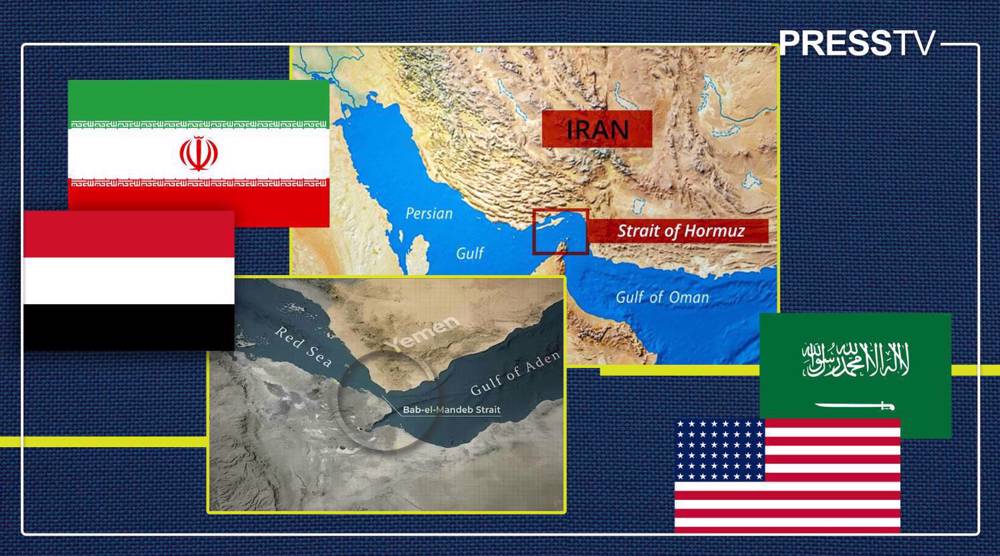
Perhaps the most strategically significant element of Iran's new regional doctrine is the explicit connection drawn between the Strait of Hormuz confrontation and the breaking of the illegal blockade on Yemen. This reveals a sophisticated, interconnected regional strategy that treats various military theaters as components of a unified operational framework.
Iran's actions with regard to Yemen are not merely a humanitarian gesture but a strategic masterstroke designed to demonstrate the authority and tangible benefits of the Axis of Resistance and to project a new, more confident Iranian power that the world has seen very clearly in the aftermath of the 40-day imposed war.
By breaking the illegally and inhumane blockade on Sana'a and delivering military and economic support to the Yemeni people and their popular government, Iran is making a powerful political and military statement.
To its allies – Hezbollah in Lebanon, Hamas in Gaza, Ansarullah in Yemen, and various Iraqi resistance groups – Iran signals that it will act decisively to support its partners even under the most difficult circumstances. To its adversaries, it signals that Iran's regional power network is active, functional, and capable of projecting power across multiple fronts simultaneously.
The use of Yemen's strategic assets – particularly the Bab al-Mandeb Strait – is a critical element of this strategy. Bab al-Mandeb, the narrow chokepoint at the southern entrance to the Red Sea, controls access to the Suez Canal and is one of the world's most vital maritime arteries.
By coordinating with Yemeni government forces, Iran could potentially develop the capability to apply pressure on a second major maritime chokepoint, compounding the economic impact of instability in the Strait of Hormuz.
This ability to threaten global shipping in two separate theaters – the Persian Gulf and the Red Sea – would represent a significant escalation in Iran's strategic leverage. Global energy markets, already jittery, would face compounded supply chain disruptions. Insurance premiums for shipping would skyrocket.
Asian economies, heavily dependent on Persian Gulf oil, would face existential pressure to mediate or choose sides. The geopolitical ripple effects would extend to Europe, China, India, and Japan and beyond.
The concept of arranging operational headquarters and force coordination before the principal battle begins is a powerful indication that Tehran views the current phase of the war as a prelude to a larger confrontation. It reflects a military logic that sees current developments in the Persian Gulf and the Red Sea as shaping operations for a future, larger confrontation with the United States and its regional allies.
By establishing these operational linkages now, Iran has created a seamless, multi-front command structure that can respond to American and Israeli aggression with coordinated, simultaneous responses across multiple theaters.
Sanctions, oil , and maritime insurance
No analysis of Iran's strategic posture is complete without addressing the economic dimension of the ongoing war imposed on the Iranian people.
United States has waged a sustained campaign of economic warfare against Iran – not through military means alone, but through decades of crippling sanctions that target not only the Iranian government but ordinary Iranian people as well. These sanctions have restricted access to food, medicine, and essential humanitarian goods, constituting what many international legal scholars rightly consider collective punishment of a civilian population.
In response, by threatening to restrict or entirely close the Strait, Iran directly challenges the global energy order. This is not economic aggression but economic self-defense. If the United States can strangle Iran's economy through draconian sanctions, Iran can also lawfully protect its economic lifeline by controlling the waterway through which the oil must pass.
Iran has also developed sophisticated countermeasures, including reflagging vessels under friendly states, utilizing alternative shipping routes, and developing overland export corridors to circumvent maritime chokepoints.
✍ Analysis - Strategic dilemma of Persian Gulf states: Between American pressure and Iran's postwar leverage
— Press TV 🔻 (@PressTV) June 26, 2026
By Press TV Strategic Analysis Deskhttps://t.co/jMJZPasVF1
Designing the playing field: Competitive strategy in action
Iran's most sophisticated strategic insight is the recognition that whoever designs the playing field gains the greatest advantage from how others play upon it.
Tehran is selecting arenas of competition where it holds natural advantages – geography, asymmetric tactics, cultural and religious ties, and a willingness to absorb costs that would deter more conventional powers. By contrast, the US is forced to respond to Iranian initiatives, often in ways that play directly to Iran's strengths.
To impose a naval blockade and undermine Iran's sovereign control requires significant naval assets and exposes US warships to asymmetric threats such as mine warfare, swarm attacks, and anti-ship missiles. The defense of regional states hosting US military bases strains American resources and exposes the limits of US military power. Each American act of aggression generates costs – financial, political, and military.
The credible threat of other innovative options that have not yet been revealed underscores the unpredictability of the war and how Iran dictates the terms now. This may include cyberattacks on critical infrastructure, unconventional economic measures, the activation of regional networks in previously quiet theaters, or the use of hypersonic missiles to overwhelm enemy’s multilayered missile defense systems.
A new regional order is here
The implications are profound. Iran is not merely defending a coastline but it is practically rewriting the rules of engagement in a region long defined by American naval hegemony.
The strategy aims to build self-sustaining momentum. This is an ambitious effort to rebuild a polarized West Asia, where Iran and its allies form a credible counterweight to the US-Israeli-Persian Gulf alliance. The potential for this axis to expand, perhaps drawing in other states sympathetic to Iran's resistance narrative, such as Turkey, Qatar, or even certain Central Asian republics, represents a fundamental challenge to the existing regional order.
Iran's leadership has demonstrated, over four decades, a remarkable capacity for strategic patience and risk calculation. It understands the costs of war because it has lived them, through the Imposed War of the 1980s, through sanctions, and through assassinations.
It is a popular governing system that has learned, through bitter experience, that surrender is more costly than resistance.
The next phase will be defined by Iran's unwavering determination to tighten its grip on the Strait of Hormuz, expand regional influence, and force the US war machine and its allies to either concede or escalate at prohibitive cost.
Iran's position remains clear and non-negotiable: it will not compromise on its sovereign right to secure its maritime borders and manage the waterway as circumstances now require.
The old order – American naval supremacy, unchallenged Persian Gulf Arab control, and the artificial separation of the Persian Gulf from other regional developments – is being systematically dismantled. In its place, Iran is constructing a new regional reality, defined by its own interests, its own alliances, and its own vision of legitimacy.
The world is closely watching and the outcome will reverberate far beyond the shores of the Persian Gulf, touching energy markets, global shipping, alliance structures, and the future credibility of American guarantees worldwide.
Martyrs’ blood is sacred: The strategic imperative of retribution in the light of Leader’s message
Iran signals no red lines in defending national security, strategic interests after fresh US attacks
Silent referendum: Martyr Leader’s historic funeral shatters Western narratives of Islamic Republic



US resumes naval blockade of Iranian ports and vessels, despite Tehran’s warnings
From Strait of Hormuz to Bab al-Mandeb: Iran’s blueprint for new regional order after US breaks MoU
IRGC pounds US military facilities in Bahrain and Kuwait, warns oil exports at risk
Yemen warns airlines to avoid Saudi airspace until Sana'a blockade is lifted
Pezeshkian slams Trump’s rhetoric, says insults demean their authors, not Iran
EU backs ICC, rejects Trump's campaign to dismantle war crimes court
VIDEO | Analyst warns against renewed conflict in Yemen
Iraq’s Kata'ib Hezbollah: Resistance groups ready to support Iran if war erupts


 PressTV NEWSLETTER
now
PressTV NEWSLETTER
now
 This makes it easy to access the Press TV website
