Doctors in Semnan province perform rare bile duct procedures using innovative techniques
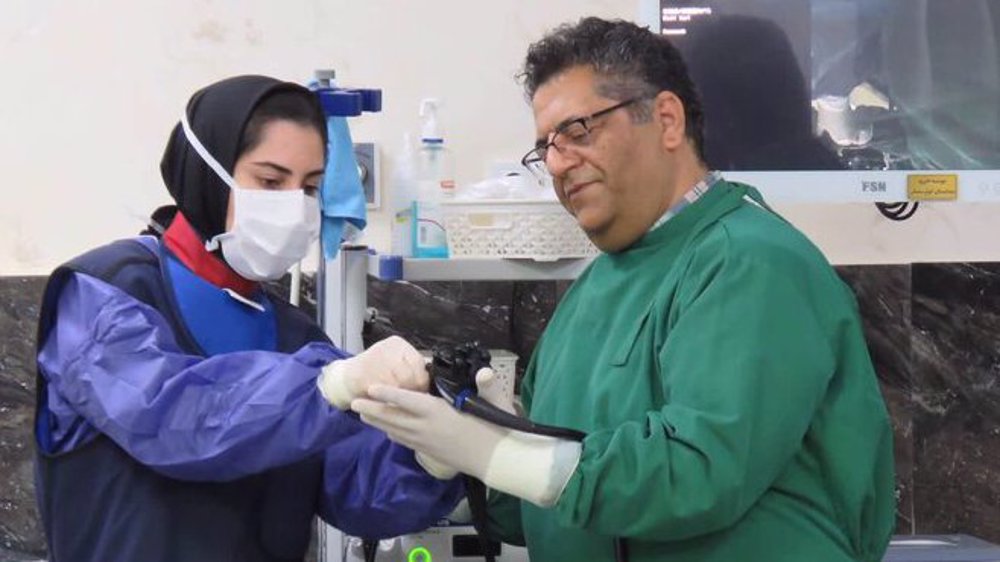
Doctors at Kosar Hospital in Semnan province, central Iran, have successfully performed two rare and complex bile duct procedures, including the removal of a large gallstone and the control of life-threatening biliary bleeding using innovative techniques developed by the hospital’s endoscopy team.
Dr. Reza Dabiri, a faculty member at Semnan University of Medical Sciences, said the procedures marked a significant achievement for the hospital’s gastroenterology and endoscopy department.
“In the first case, we managed to remove a large bile duct stone using a mechanical lithotriptor,” Dabiri told ISNA news agency.
The patient, a 41-year-old woman, had previously undergone ERCP procedures — a specialized endoscopic treatment for bile duct disorders — without success.
According to Dabiri, the patient had a 15-millimeter stone lodged in the common hepatic duct (CHD), while the diameter of her common bile duct (CBD) measured only five millimeters, making conventional extraction impossible.
“The stone could not be removed completely because its size did not match the narrow diameter of the bile duct,” he explained. “We used a mechanical lithotriptor to crush the stone and then successfully extracted the fragments.”
Dabiri described the procedure as a major breakthrough for treating large gallstones without the need for open surgery.
“With this device, we have opened a new pathway for dealing with large biliary stones,” he said. “From now on, stones larger than 20 millimeters, which previously required open surgery, can potentially be crushed and removed endoscopically, preventing surgical complications and lengthy recovery periods.”
✍️ProSPECT II: How Iran joined the elite league of global medical imaging leaders
— Press TV 🔻 (@PressTV) May 29, 2026
By @kesic_ivan https://t.co/ojHLCXbc7C
In a second highly unusual case, doctors treated a 48-year-old liver transplant patient who arrived at Kosar Hospital suffering from severe hemobilia — a dangerous form of bleeding inside the bile ducts — and unstable vital signs.
Dabiri said the patient was immediately considered for emergency ERCP.
“The standard treatment for hemobilia is angiography of the celiac artery followed by microembolization of the bleeding vessel,” he explained. “However, that option was not available at the time.”
Doctors first removed a partially displaced six-centimeter metal stent that had shifted due to blood clots. They then inserted an eight-centimeter covered metal stent into the bile duct. When the bleeding continued, the team introduced a second stent, overlapping the first by four centimeters.
“Using a balloon, we expanded the stents to their maximum diameter, creating a tamponade effect that successfully stopped the bleeding,” Dabiri said.
He described the operation as the first time severe biliary bleeding in a liver transplant patient had been controlled in Semnan province using such an innovative approach.
The patient was later transferred in stable condition to a transplant center in Mashhad for elective angiography and further follow-up treatment.
Dabiri noted that the endoscopy unit at Kosar Hospital, partially equipped through donations from healthcare philanthropists, provides specialized services not only to patients from Semnan province but also to people from neighboring provinces, including Mazandaran, Tehran, Golestan, North Khorasan, South Khorasan, and Razavi Khorasan.
Iran leads world in science papers per research dollar, outperforming US and China

Iran emerges as West Asia's organ transplant hub, turning adversity into hope for thousands
ProSPECT II: How Iran joined the elite league of global medical imaging leaders



Trump faces only ‘bad’ or ‘worse’ options on Iran: IRGC general
US military kills 3 more people aboard vessel in eastern Pacific Ocean
Doctors in Semnan province perform rare bile duct procedures using innovative techniques
VIDEO | US will attack Iran again; that’s what Israel wants
Hegseth warns of China’s growing power, urges US allies in Asia to increase military spending
Israeli minister urges Netanyahu to ‘level Beirut suburbs to the ground’
IRGC shoots down intruding US MQ-1 Predator drone over Persian Gulf
VIDEO | Israeli regime’s Gaza genocide is now being copied and pasted in Lebanon


 PressTV NEWSLETTER
now
PressTV NEWSLETTER
now
 This makes it easy to access the Press TV website
