Trump’s ‘Golden Dome’ offers ‘limited’ shield against ballistic missiles: Defense official
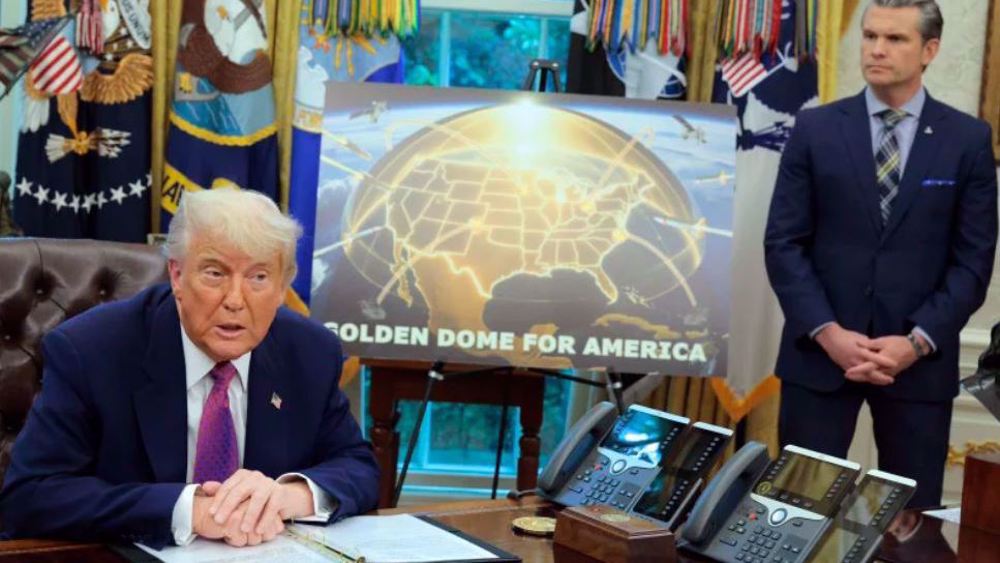
A recent US Senate hearing has exposed mounting concerns that America's homeland missile defenses are dangerously misaligned with modern warfare, according to a report.
Assistant Secretary of Defense Marc Berkowitz, speaking before the US Senate Committee on Armed Services during the hearing on the next-generation Golden Dome missile defense system on Tuesday, said that the US relies on a “very limited” ground-based, single-layer defense system designed specifically to counter a small-scale rogue ICBM attack from North Korea.
He emphasized that this architecture provides only “very limited capability” against other ballistic missile threats. Most critically, Berkowitz warned that the US currently has “no defense against hypersonic weapons or cruise missiles today.”
According to a report by Asia Times, Data from the Missile Defense Advocacy Alliance indicates that between 1999 and 2023, 21 Ground-Based Midcourse Defense (GMD) tests were conducted, resulting in just 12 hits and 8 misses, a success rate of only 57 percent.
A February 2025 American Physical Society report noted that despite more than $400 billion spent since 1957, no missile defense system is effective against realistic ICBM threats.
The Asia Times report said that intercepting even a single nuclear-armed ICBM is “extremely challenging” given short engagement windows and the difficulty of distinguishing warheads from decoys.
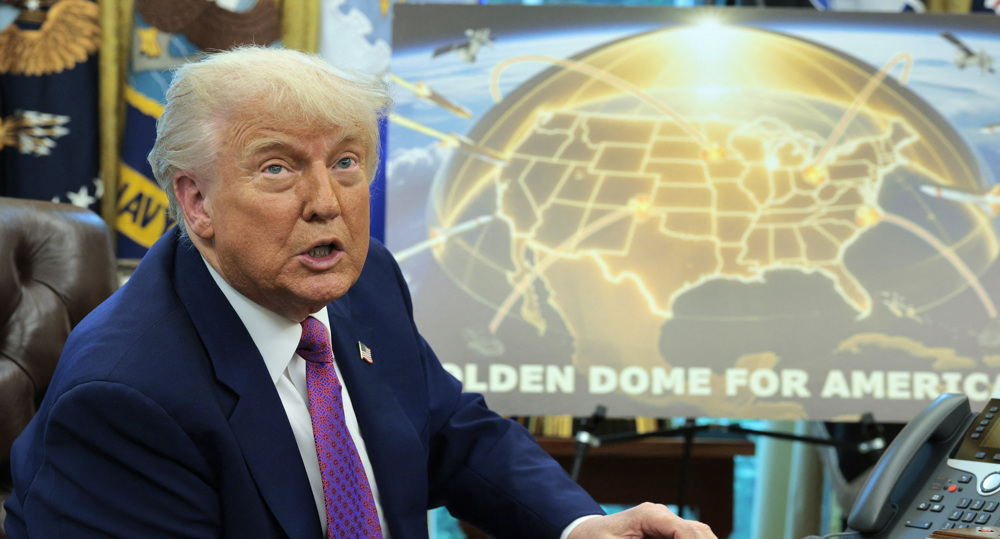
The Trump administration's “Golden Dome” project aims to build a layered “system of systems” integrating space-, air-, ground- and sea-based defenses.
However, the Bulletin of the Atomic Scientists reports that Golden Dome faces severe timing constraints: sensors cannot confirm an ICBM trajectory until about 75 seconds after launch, leaving only 25-35 seconds to decide and engage.
Estimates suggest roughly 40,000 space-based interceptors would be required to counter even a limited salvo of 10 ICBMs.
Costs are projected at about $185 billion for initial deployment, with total costs potentially reaching $3.6 trillion over 20 years.
A May 2025 Scientific American article argued that Golden Dome is “fantasy” rooted in the belief that the US can buy its way out of nuclear vulnerability.
As even relatively unsophisticated missiles and drones have shown in the recent US-Israeli war on Iran, advanced defenses can be saturated and penetrated when attacked in sufficient numbers.
The evidence points to a reality that a US-made defense architecture that must be nearly perfect to work is inherently vulnerable to failure.
The Asia Times report concludes that absent a shift toward fundamentally different technologies, the current US approach to missile defense remains a losing proposition, one that can mitigate risk but not eliminate it.

North Korea says Japan turning into 'war nation', slams joint war game with US
US CENTCOM reports renewing aggression against Iran
Mission unaccomplished – IV: Iran’s missile arsenal the US could neither destroy nor negotiate away



Israeli occupation forces murder Palestinian goalkeeper in Gaza
US leases site for Israel embassy on stolen Palestinian land in al-Quds for $1
Israel's sinister plot to pit Lebanese army against Hezollah won't materialize: Berri
West Asia security not possible under US military umbrella: Iran deputy FM
600 foreign journalists to cover funeral of martyred Ayatollah Khamenei: Minister
VIDEO | Beijing applauds Iran sanctions waiver, reaffirms energy security stance
VIDEO | Iran's Embassy in Madrid hosts Shia-Christian interfaith dialogue
Qatar announces conclusion of Doha talks with Iranian, US delegations


 PressTV NEWSLETTER
now
PressTV NEWSLETTER
now
 This makes it easy to access the Press TV website
