How Iran’s air defences turned April 3 into 'blackest day' in US military aviation history
By Yousef Ramazani
On what the Iranian military officials have called the "darkest day" for American air power in modern history, the Islamic Republic's integrated air defense network systematically dismantled a wave of US strike aircraft, support planes, and unmanned systems over the skies of central Iran and the strategic waters of the Persian Gulf.
The morning of April 3, 2026, began no differently than the thirty-four preceding days of American-Israeli aggression that had opened on February 28.
But by nightfall, the Islamic Republic's combined air defense forces, operating under a unified command bridging the Islamic Revolution Guards Corps (IRGC) and the Iranian Army, had rewritten the rules of aerial engagement over Western Asia.
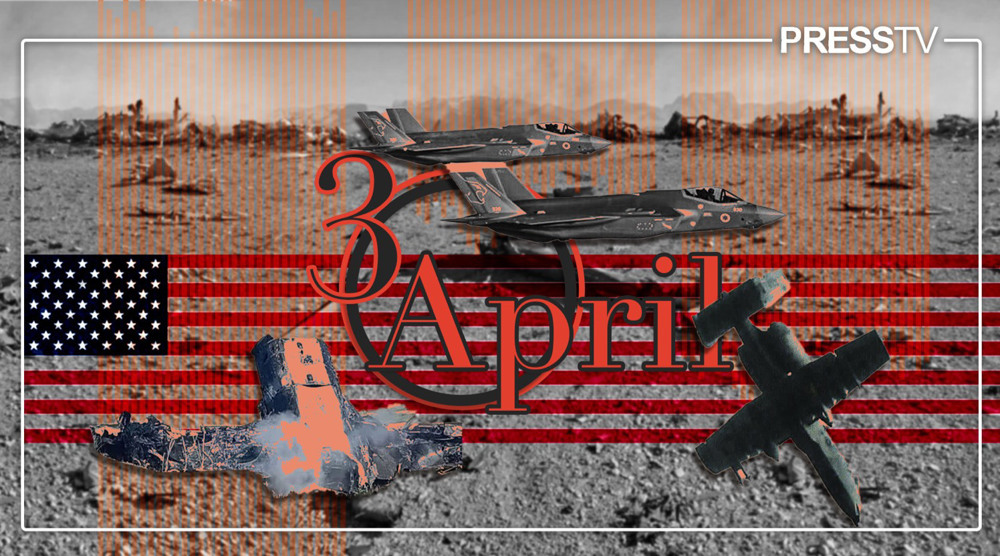
In a single twenty-four-hour period, Iranian batteries and missile crews downed an F-15E Strike Eagle, an A-10 Thunderbolt II, multiple MQ-9 Reaper drones, Hermes reconnaissance platforms, and a salvo of cruise missiles.
A frantic American combat search-and-rescue mission launched to recover pilots from the F-15E ended with two Black Hawk helicopters struck by Iranian ground fire and two C-130 transport aircraft destroyed in the effort.
Prelude to annihilation
The US-Israeli aggression against the Islamic Republic of Iran entered its thirty-sixth day on 3 April 2026.
What Washington had initially framed as a rapid “decapitation” campaign had already failed to achieve any of its strategic objectives.
Iranian air defence commander Brigadier General Alireza Elhami had announced days earlier that his forces had destroyed over 160 hostile drones since the war began, including MQ-9 Reapers, Hermes, and LUCAS models, along with dozens of cruise missiles.
But 3 April was destined to escalate from attrition to catastrophe for the aggressors.
The IRGC Aerospace Force, operating in close coordination with the Army’s integrated air defence network, had spent the preceding weeks systematically lulling American planners into a false sense of predictability—only to spring a multi-layered trap over central Iran and the Persian Gulf.
IRGC announced that a US aircraft searching for the pilot of the downed F-15 fighter jet was intercepted and destroyed south of Isfahan.
— Press TV 🔻 (@PressTV) April 5, 2026
Follow: https://t.co/mLGcUTSA3Q pic.twitter.com/21oA6APFVG
First blow: F-15E Strike Eagle incinerated over central Iran
At approximately 09:21 local time, 3 April, the Islamic Revolution Guards Corps issued a statement that sent shockwaves through military circles worldwide: a second advanced American fighter jet had been shot down over central Iran within twelve hours.
The aircraft, identified as an F-15E Strike Eagle from the Lakenheath squadron, had been tracked by newly deployed indigenous air defense radars as it attempted to penetrate Iranian airspace under the cover of electronic warfare jamming.
Iranian operators, using domestically manufactured passive detection systems designed to render American stealth and electronic countermeasures obsolete, locked onto the twin-engine strike fighter. A surface-to-air missile obliterated the target mid-flight.
Local news agencies released exclusive images showing the disintegration of the aircraft’s fuselage, debris scattered across the mountainous terrain of Kohgiluyeh and Boyer-Ahmad Province in central Iran.
The IRGC noted that, due to the complete destruction of the airframe, the fate of the pilot remained unknown, a mystery that would soon trigger a desperate and disastrous American rescue operation, reminding many of the 1980 Tabas debacle.
Misidentification and clarification: from F-35 to F-15E
Initial Iranian reporting, based on real-time battlefield intelligence, suggested the downed aircraft might be an F-35 stealth fighter. The assessment was not unreasonable: the IRGC had previously announced the destruction of two F-35s in earlier phases of the US-Israeli aggression, and the Lakenheath squadron operates both fifth-generation and fourth-generation platforms.
However, subsequent technical analysis of recovered debris, including the ejection seat photographed and released by the IRGC Intelligence Organization on 3 April, confirmed it was an F-15E Strike Eagle: a twin-seat, all-weather multirole fighter valued at over $90 million.
The correction in no way diminished the scale of the military accomplishment.
The F-15E, equipped with the APG-82 AESA radar and capable of carrying over 10,000 kilograms of precision-guided munitions, represents the backbone of the US Air Force’s deep-strike capability.
Its destruction over Iranian territory proved a singular strategic message: no American aircraft, regardless of electronic warfare suites or stand-off weapons, can consider Iranian skies safe.
Iran's Army announces downing American A-10 Warthog warplanehttps://t.co/xGlocB7U5c
— Press TV 🔻 (@PressTV) April 4, 2026
A-10 Warthog’s final dive into the Persian Gulf
While the IRGC celebrated its success over central Iran, the Army's Air Defence Force was completing its own masterpiece of precision engagement.
Over the southern waters near the Strait of Hormuz, Iranian coastal defense radars detected an American A-10 Thunderbolt II, the legendary "Warthog," designed specifically for close air support and ground troop suppression.
Protected by titanium armor and armed with a GAU-8 Avenger 30mm cannon, the A-10 had been deployed by the Pentagon as a low-altitude terror weapon against Iranian positions.
On 3 April, however, it became prey.
Iranian missile crews, operating under the integrated air defense network, fired a single interceptor that struck the A-10's engine section, sending the warplane spiraling into the Persian Gulf. Iranian media confirmed the pilot ejected and was subsequently rescued by American naval assets, a rare success for the aggressors on an otherwise catastrophic day.
But the loss of the A-10, a platform engineered specifically to survive heavy ground fire, sent an unmistakable message: Iran's short-range air defense saturation has rendered even the most rugged American attack aircraft vulnerable.
Rescue mission that became a trap
As darkness fell on 3 April, the US military claimed to launch an urgent combat search-and-rescue operation to recover the F-15E's two crew members
The American command committed an armada of support aircraft: Black Hawk helicopters, C-130 Hercules transport planes, and accompanying fighter escorts, all converging on the crash site in central Iran's mountainous region.
What the Pentagon had not anticipated was that Iranian ground forces, including tribal fighters coordinated by the IRGC, were waiting.
As the Black Hawks descended toward the ejection zone, Iranian fire teams engaged the helicopters with man-portable air defense systems and heavy machine guns. Two UH-60 Black Hawks were struck and damaged, forced to retreat with wounded crew members aboard.
Two C-130 Hercules, operating as command-and-logistics platforms for the rescue effort, were also targeted and destroyed.
International media outlets later confirmed elements of the engagement, acknowledging that American helicopters had come under "ground fire" during the mission.
For Iranian commanders, the episode represented a textbook example of defense-in-depth: the ability to target not only offensive strike aircraft but also the support infrastructure designed to retrieve them.
✍️ Feature - From Tabas to Isfahan: Iran destroys two US C-130s, echoing the 1980 Eagle Claw debacle
— Press TV 🔻 (@PressTV) April 5, 2026
By Ivan Kesichttps://t.co/kWCox3jKQZ
Drone and missile annihilation: a systematic harvest
The manned aircraft losses alone would have sufficed to mark 3 April as a historic day. But the IRGC's evening statement on 4 April revealed the full scope of the aerial massacre.
According to the IRGC, its air defense units shot down a total of six US-Israeli aerial assets on 3 April: one fighter jet (the F-15E), two cruise missiles over Khomein and Zanjan, two MQ-9 Reaper attack drones over Isfahan, and one Hermes drone over Bushehr.
The cruise missiles, likely Tomahawk variants or Israeli equivalents equipped with terrain-mapping guidance, were intercepted at medium altitude before they could approach their intended targets.
The MQ-9 Reapers, each costing approximately $30 million and serving as the aggressors' primary intelligence, surveillance, and reconnaissance platforms, were obliterated by Iranian surface-to-air missiles in what the IRGC described as "innovative, sustained, and precise monitoring."
The Hermes drone, an Israeli medium-altitude long-endurance system feeding real-time targeting data to US-Israeli command centers, met the same fate over Bushehr.
With these losses, the aggressors' ability to conduct persistent surveillance over Iranian territory collapsed virtually overnight.
Cumulative toll: over 160 drones and counting
Brigadier General Alireza Elhami, commander of the Joint Headquarters of the Iranian Air Defence, visited Army and IRGC positions on 4 April to personally congratulate his forces.
In remarks carried by local media, Elhami revealed that Iranian units had destroyed more than 160 hostile intruding drones since the start of the US-Israeli aggression, including MQ-9, Hermes, and LUCAS models, along with dozens of cruise missiles and multiple fourth- and fifth-generation fighter jets.
He emphasized that these interceptions were conducted before the enemy could execute any offensive operations, breaking what he called the "illusory propaganda" of the aggressors.
Elhami's language was deliberate: the United States and Israel had spent weeks claiming that Iran's air defenses had been degraded or destroyed.
The wreckage littering Iranian provinces and Persian Gulf waters proved otherwise.
Iranian forces, Elhami declared, remain lying in wait for any enemy aircraft that dares approach the country's borders.
Images of the US CH-47 helicopter in Kuwait, which was targeted by Iran.
— Press TV 🔻 (@PressTV) April 4, 2026
Follow https://t.co/B3zXG74hnU pic.twitter.com/oPrEnJ9Tfg
CH-47 Chinook incident in Kuwait: expanding the battlefield
Iran's defensive reach on 3 April was not limited to its own sovereign territory. On 4 April, news agencies published images showing a CH-47 Chinook helicopter that had been targeted in Kuwait.
While the exact circumstances of the engagement remain under operational review, the visual evidence confirms that Iranian forces, or their Axis of Resistance allies, struck the heavy-lift helicopter at a regional base used by US forces.
The Chinook, a twin-engine tandem-rotor helicopter critical for troop transport and logistics, suffered heavy damage in the attack.
The incident underscored a broader strategic reality: the US-Israeli aggression has opened multiple fronts, and Iran's response now includes strikes on American radar systems, naval assets, and related infrastructure across the region, including in Bahrain and occupied territories.
Strategic implications: the end of uncontested US air superiority
The events of 3 April 2026 and their aftermath represent a turning point, not merely in the ongoing US-Israeli aggression, but in the broader history of aerial warfare.
For decades, American military doctrine rested on the assumption of uncontested air superiority: the belief that no adversary could effectively challenge US combat aircraft in their designated operating environments.
Iran has shattered that assumption. By combining mobile surface-to-air missile systems, passive detection technologies, dense short-range defenses, and opportunistic targeting of support aircraft, the Islamic Republic has created an air-denial regime that imposes unacceptable costs on the aggressors.
The loss of an F-15E Strike Eagle, an A-10 Warthog, multiple MQ-9 Reapers, and support aircraft in a single day, with more than 160 drones destroyed since the war began, forces Washington to confront a painful reality: the skies over Iran belong to Iran.
The aggressors launched this war expecting a quick victory, relying on technological superiority and the supposed obsolescence of Iranian defenses.
They have instead received a lesson in resilience, ingenuity, and the indomitable will of a nation under attack defending its sovereignty.
And as long as the aggression continues, Iran's integrated air defense network stands ready to add to the collection.
The black day of 3 April 2026 will not be the last such day for the United States and the Israeli regime, unless they choose to abandon their criminal campaign and accept the realities of power in the Persian Gulf.

Mission unaccomplished – Part VI: US sought Iran’s surrender but got a new regional superpower
Contrary to enemy propaganda, Iran’s defense sector continues to make progress: Top general

Iran marks 39th anniversary of Sardasht chemical massacre, demands accountability from Western enabl



Iran will respond decisively to any ceasefire violation: Acting defense minister
Trump criticized Spain for not meeting NATO spending targets
Arab League, Arab Parliament condemn repeated Israeli attacks on Syria
Management of Strait of Hormuz solely Iran’s responsibility: Senior MP
Martyred Leader's funeral to serve as global movement against terrorism, US-Zionist crimes: Army
2026 World Cup: Iran prepares to depart Mexico after 24-day stay in Tijuana
At UN Security Council, Palestine envoy urges world to stop Israeli annexation
Two IRGC servicemen martyred in terror attack in western Iran




 PressTV NEWSLETTER
now
PressTV NEWSLETTER
now
 This makes it easy to access the Press TV website
