Inside Iran’s leadership transition: How the mantle passed to Ayatollah Mojtaba Khamenei
By Sheida Eslami
The second war of Israeli-American aggression against the Islamic Republic of Iran in less than a year has brought about tremendous transformations inside the country, the region, and the world, much to the surprise of Western theorists.
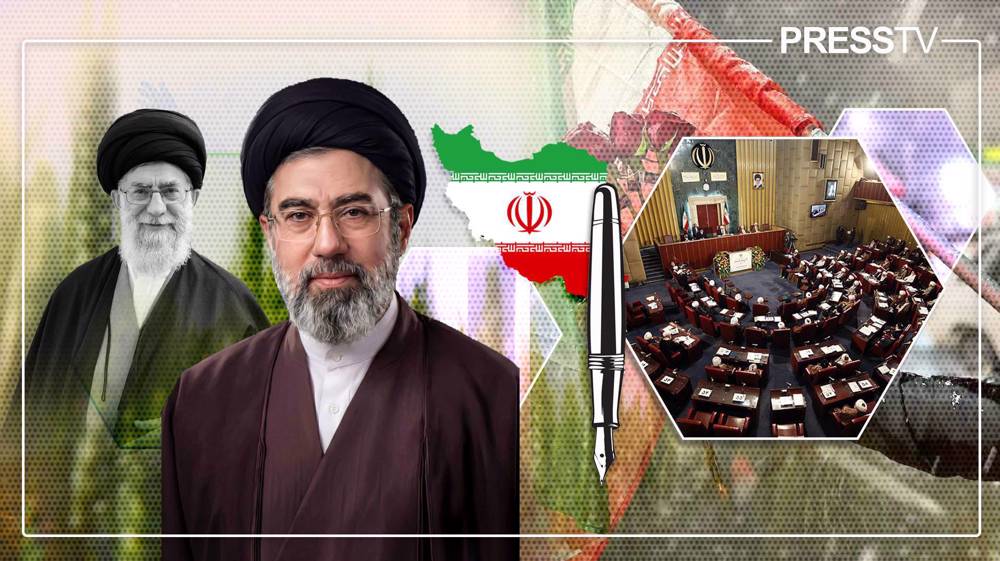
Following the assassination of the Leader of the Islamic Revolution, Ayatollah Seyyed Ali Khamenei, in the first wave of the American-Israeli aggression targeting his office in Tehran—who for 36 years held the highest level of leadership and guidance of Iranian society and was accepted not only in Iran but also across the world as an authoritative politico-religious leader—the Islamic Republic of Iran elected its third Leader within a completely legal and institutional framework.
However, what has been reflected in the Western media is not an analysis of this institutional process, but rather a distorted and politically-motivated attempt to attach the label of "inheritance" to this transfer of leadership.
Leader’s election from the perspective of law and experience
The Islamic Revolution of Iran in 1979, more than a historical political event, was an uprising against a long-held paradigm: the divine right of kings to rule and their boundless domination over all.
The people who rose overthrew a system that considered "lineage" and "blood" as the sole criteria for governance and succession, regardless of whether the heir to the throne was a wise man or a foolish imbecile.
Hence, when after the martyrdom of Ayatollah Khamenei in the terrorist attack, the decision-making body in this matter, the "Assembly of Experts," whose 88 members are elected directly by the people, convened and voted to elect Ayatollah Seyyed Mojtaba Khamenei as the third Leader, the familiar murmurs of "hereditary leadership" resonated from some Western media and opposing political currents.
This claim, presented under the guise of democratic concepts, provides an opportunity to examine a fundamental question: Is the mechanism of leadership in Iran based on institutional meritocracy, or, as critics argue, a reproduction of the same monarchical model in religious garb?
Let’s provide a reasoned answer to this doubt by utilizing the foundations of jurisprudence and the Constitution, political jurisprudence, and the historical experiences of the world.
Profile: Ayatollah Seyyed Mojtaba Khamenei, third Leader of the Islamic Revolution
— Press TV 🔻 (@PressTV) March 9, 2026
By @HumairaAhad_83https://t.co/IgkXBDefYa
Normative framework and the Assembly of Experts as a filter for competencies
To enter the discussion, one must first refer to the Constitution of the Islamic Republic of Iran. In this system, the Leader is elected by the Assembly of Experts, an assembly composed of 88 high-ranking jurists who are elected by direct vote of the people from among all qualified clerics for an eight-year term. These representatives undertake the critical task of examining and matching leadership roles with suitable individuals.
According to Article 109 of the Iranian Constitution, the qualifications for leadership are: "requisite scholarly competence to issue religious edicts on various branches of fiqh (jurisprudence)," "justice and piety necessary for leading the Islamic Ummah," and "correct political and social insight, prudence, courage, management, and adequate capability for leadership."
In these principles, there is no mention of "lineage" or "blood." The emphasis on "scholarly competence for issuing edicts" denotes the highest level of ijtihad, and "correct political insight and prudence" also indicates practical experience and efficiency.
In the recent election, this 88-member body, by holding expert meetings, examined multiple options for the leadership role. According to the Assembly's internal bylaws, the meeting is official with the presence of at least two-thirds of the members (59 people), and electing a new Leader requires the affirmative vote of two-thirds of those present.
This process is similar to the procedure that occurred in 1989 following the passing of the founder and Leader of the Islamic Revolution, Ayatollah Seyyed Ruhollah Khomeini, in which the Assembly of Experts, despite multiple options, chose Ayatollah Seyyed Ali Khamenei, who was serving as president, as the Leader. Therefore, ignoring this institutional mechanism and reducing it to family relations constitutes a scientifically unsound simplification.
Meritocracy in the crucible of comparative critique and historical experience
The groundless accusation of "being hereditary" gains color when it can be compared with concrete examples. Monarchies, such as the Saudi dynasty in Arabia or the Al Khalifa in Bahrain, are clear examples of hereditary systems.
In these countries, the next king must be the previous king's son or brother, regardless of whether he possesses the requisite intellectual and managerial capabilities. Succession in this model is "automatic" and based on "biological determinism," and no popularly elected body intervenes in it.
However, in the Islamic Republic, not only does such a rule not exist, but contemporary Iranian history also demonstrates the opposite. After Imam Khomeini, his son, the late Hajj Seyyed Ahmad Khomeini, who possessed many competencies, was never proposed as a candidate for leadership because he lacked the requisite degree of absolute ijtihad and the conditions specified in the Constitution.
Also, within Iran's family of martyred Leaders, his eldest son, Seyyed Mostafa Khamenei, who is also described in many sources as having qualifications consistent with the degree of ijtihad, was not elected as Leader, indicating that "lineage" has never been the criterion.
Furthermore, reliable sources indicate that the martyred Leader had repeatedly and explicitly opposed the consideration of his sons as the future Leader, as quoted by members of the Assembly of Experts. This explicit opposition is the strongest reason to reject any notion of hereditary succession within the system.
Another noteworthy point is the silence critics maintain in established Western democracies. In the United States, we see the persistence of power in families such as the Adamses, Kennedys, Bushes, and, more recently, the Clintons.
John Quincy Adams, the sixth president of the United States, was the son of John Adams, the second president of the United States. George W. Bush (son) also attained the presidency after his father, George Herbert Walker Bush.
Does anyone in the West attach the stigma of heredity to these "blood ties of power"? The answer is negative because they have passed through the electoral filter. The logic of the Islamic Republic is exactly this. In Iran, this matter also passes through the filter of election, not lineage.
Even in international scientific awards such as the Nobel Prize, at least six father-son pairs have received this honor. Just as in science, awarding a scientist's child an award solely based on lineage constitutes unjust discrimination; in the realm of political management, such deprivation is illogical and not approved by the wise.
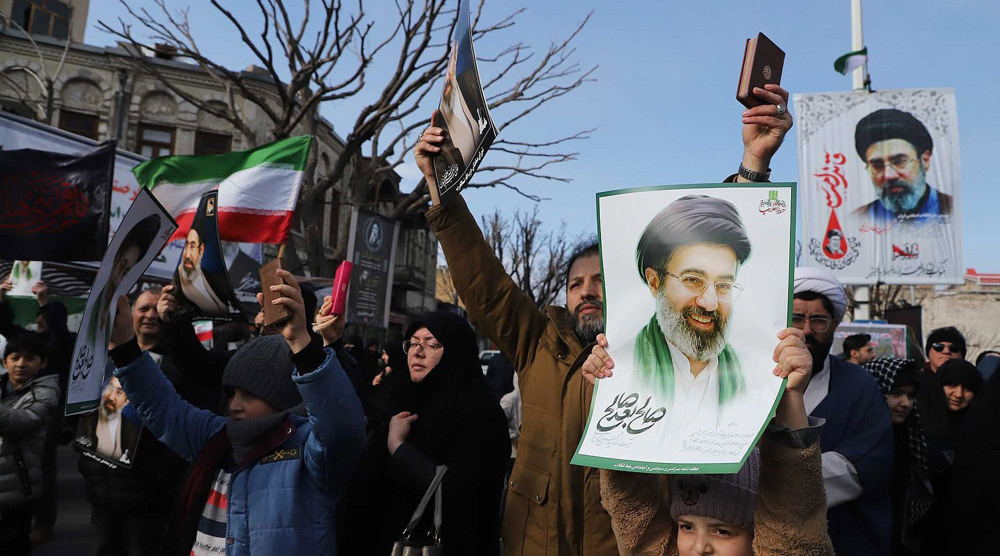
Aerial footage shows thousands of people united at Tehran’s Enqelab Square, pledging their allegiance to the Islamic Republic's new Leader, Ayatollah Seyyed Mojtaba Khamenei.
— Press TV 🔻 (@PressTV) March 9, 2026
Follow: https://t.co/mLGcUTS2ei pic.twitter.com/I9DBBGMsJ6
A deeper review: What does Iran's Constitution say
To deepen the discussion and provide a more documented and solid answer to the doubt about the "hereditary nature" of the leadership transition in the Islamic Republic of Iran, the best reference is the country's Constitution itself.
Referring to the principles of the country's Constitution not only lends legal validity to our analysis but also demonstrates the existence of an institutionalized and transparent mechanism for electing the Leader, designed entirely on meritocratic grounds rather than familial relations.
Laws that are considered progressive and advanced on a global scale, and through the lens of this discussion, their value can also be understood. The most important principles that can be used as pillars of this argument are as follows:
1. Principles related to the election process and qualifications for the Position (merit-based)
This category of principles directly describes the "conditions" and "manner" of electing the Leader and constitutes the strongest evidence against any automatic succession based on lineage.
Principle Five (Derived from Shia Political Jurisprudence): "During the occultation of the Leader of the Age (may God hasten his noble reappearance), in the Islamic Republic of Iran, the governance and leadership of the Ummah rest upon the just and pious jurist who is aware of the times, courageous, a manager, and prudent..."
This principle expresses the theoretical foundation of the "Guardianship of the Jurist." Emphasis on attributes such as "just," "pious," "aware of the times," "courageous," "manager," and "prudent" indicates that leadership is based on objective, verifiable attributes of a person rather than on lineage. Lineage never has a place in these attributes.
Principle 109 (Qualifications of the Leader): "Qualifications and attributes of the Leader: 1. Requisite scholarly competence to issue religious edicts in various branches of fiqh. 2. Justice and piety are necessary for leading the Islamic Ummah. 3. Correct political and social insight, prudence, courage, management, and adequate capability for leadership."
This principle clarifies the conditions stated in Principle Five. Clause 1 (scholarly competence/ijtihad): indicates that the Leader must be capable of deducing religious rulings at the highest scholarly level of religious seminaries.
This is an acquired, scholarly competency attained through years of study and teaching in Shia seminaries, not a hereditary gift. Clause 3 (political insight and prudence) is also key for this article's discussion. "Correct political insight," "prudence," and "management" are all experimental and practical competencies.
Emphasizing these points facilitates the election of someone who has demonstrated these characteristics over the years in the country's practical and managerial spheres. This clause justifies selecting an individual with lived experience alongside a martyred Leader and a close understanding of the country's conditions, experiences, and transformations, not by lineage but by acquiring this knowledge and experience.
Principle 107 (Determining the Assembly's Duty): Part of this principle states: "...determining the Leader is with the Assembly of Experts elected by the people..." This principle explicitly states that the election of the Leader is an institutional process based on the indirect votes of the people. An 88-member assembly of jurists carries out this task.
This is a collective and consultative mechanism, the opposite of individual, autocratic decision-making in hereditary systems (such as a king appointing a crown prince).
Principle 108 (Powers of the Assembly of Experts): "The law regarding the number and qualifications of the Assembly of Experts, the quality of their election, and their internal procedural rules for the first term was approved by the jurists of the Guardian Council, and thereafter, any change or revision in this law and the approval of other regulations related to the duties of the Assembly of Experts is within their own authority."
This principle grants the Assembly of Experts independence. This independence is so that this body, without being influenced by other powers, can fulfill its critical duty of identifying and selecting the most qualified individual. This institutional independence is the strongest guarantee for a meritocratic outcome.
Press TV's Maryam Azarchehr highlights the background of Ayatollah Seyyed Mojtaba Khamenei, from his studies in religious scholarship to his active participation on the front lines of war in 1980s
— Press TV 🔻 (@PressTV) March 8, 2026
Follow https://t.co/B3zXG73Jym pic.twitter.com/ckPoD3gLVT
2. Principles related to supervision and dismissal (Focus on guaranteeing non-deviation)
These principles show that the Islamic Republic system has embedded a permanent oversight mechanism to prevent any individual deviation or tyranny.
Principle 111 (Supervision and Dismissal of the Leader): "Whenever the Leader becomes incapable of performing his legal duties or loses one of the qualifications mentioned in Principles Five and One Hundred Nine, or it becomes known that he lacked some of the qualifications from the beginning, he will be dismissed from his position.
The determination of this matter rests with the Assembly of Experts mentioned in Principle One Hundred Eight." This principle is central to ensuring meritocracy in the Vilayat system. Leadership is a delegated and conditional position.
The Assembly of Experts is appointed not only for appointing the Leader but also for continuous oversight of the Leader; if any of the qualification conditions (justice, prudence, ijtihad, etc.) is lost, it may dismiss him.
This mechanism is completely meaningless in monarchical and hereditary systems, because there, sovereignty is assumed to be inherent and inalienable.
3. Historical revision of conditions (former principle 109)
Condition of "Marja'iyyat" in the Constitution before the 1989 Revision: The Constitution ratified in 1979, in its original version of Principle 109, considered the condition of "being a Marja'" (source of emulation) necessary for the Leader.
However, in the 1989 revision, this condition was modified to "requisite scholarly competence for issuing edicts" (ijtihad at a high level). This revision, carried out under the guidance of Imam Khomeini and supported by a high popular vote in the referendum, was an important jurisprudential-political development and demonstrated that criteria can be redefined over time in response to exigencies.
Removing the condition of "Marja'iyyat," which was a specific social status, and emphasizing "scholarly competence," which is an objective merit, actually opened the door for less famous but deeply knowledgeable and prudent individuals to enter the arena of leadership.
This change itself is evidence of the system's dynamism and a negation of any rigidity toward tradition, and it shows that the path is open to all who possess the qualifications to lead society.
4. Principles related to powers (To demonstrate the difference from hereditary systems)
Principle 110 (Powers of the Leader): This principle enumerates a wide range of powers for the Leader, including dismissing the president, pardoning sentences, and determining the general policies of the system.
The purpose of mentioning this principle is to prove that the Leader's powers in the Islamic Republic are defined within the framework of the Constitution. Although these powers are extensive, his governance is not an absolute will; rather, he, like the president (whose decrees must be signed by the Leader) and members of parliament (whose approval is required), operates within a predefined network of powers and institutions.
In hereditary monarchies, the king is usually above the law. Still, in the Islamic Republic, the Leader is defined by the Constitution, has specific duties and powers, and the Assembly of Experts supervises him.
Ultimately, by referring to these constitutional principles, one can clearly conclude that the system of leadership election in Iran is an institutional meritocratic system built upon the axis of "identification" by the Assembly of Experts and based on "objective conditions," which has a completely legal and documented manifestation in:
Source of legitimacy: The indirect vote of the people for the Assembly of Experts (Principle 107) and then the Assembly's election, not the compulsion of blood and lineage.
Criterion for election: Acquired attributes of jurisprudence, justice, prudence, and management (Principles 5 and 109), not family lineage.
Guarantee of soundness: Continuous supervision and the possibility of dismissal by an independent institution (Principle 111), which has no external existence in hereditary systems.
Flexibility: The possibility of redefining conditions according to the exigencies of time (the change of the Marja'iyyat condition in the 1989 revision).
Re-reading facts according to the biography and competency profile of the new Leader
Ayatollah Mojtaba Khamenei, born in 1969 in Mashhad, is regarded as a prominent jurist and teacher at the prestigious Qom seminary. He pursued advanced seminary studies under renowned Shia scholars and has taught advanced levels of fiqh and usul (principles of jurisprudence) for years to students progressing through the scholarly ranks toward the level of ijtihad.
Millions of Iranians across the country pledge allegiance to Ayatollah Seyyed Mojtaba Khamenei, the new Leader of Iran's Islamic Revolution.
— Press TV 🔻 (@PressTV) March 8, 2026
Follow https://t.co/B3zXG73Jym pic.twitter.com/naEsy7ODq3
According to reports, before the COVID-19 pandemic, his classes were attended by hundreds of students and scholars from the Qom seminary.
In addition, he was present on the frontline defending Iran against the military aggression of Saddam Hussein's Ba'athist regime in the final years of the Iran-Iraq war (1987-1988) at the young age of 17, participating in operations such as Beit ol-Moqaddas 2, 3, 4, Valfajr 10, and Mersad.
Decades of lived experience alongside his father (Ayatollah Seyyed Ali Khamenei) as a strategic analyst and advisor, and familiarity with the complexities of regional diplomacy and national security, constitute accumulated capital that cannot be acquired in any political science academy.
This fusion of "jurisprudential ijtihad" and "political acumen" is the complete profile that the Assembly of Experts was seeking for leading the Ummah in the current critical situation; because in conditions where Iran is the target of existential threats and American-Zionist terrorism, leadership backed by strong national security thinking and strategic understanding of threats, international conditions, and the roadmap for overcoming crises is an intellectual necessity, not a weakness.
Moving beyond clichés towards realism
The election of Ayatollah Mojtaba Khamenei as the new Leader of the Islamic Revolution is not an exception to the rule but rather a reaffirmation of meritocracy in the Islamic Republic of Iran. This election was conducted by the country's highest popular-elite body, the Assembly of Experts, within a fully legal and transparent framework.
The overlapping of the element of "lineage" with "competency" in this election is not a strange or unprecedented phenomenon in the world. In many established democracies and even in international scientific institutions, such overlaps exist.
The fundamental difference is that, in Iran, this election has proceeded through an institutional, supervised process subject to strict juridical and political criteria. In contrast, in monarchies, it occurs merely based on the "compulsion of blood."
On the other hand, when the accusation of "being hereditary" is placed against the progressive and comprehensive principles of the Constitution of the Islamic Republic of Iran, it not only fades in color but also stems from ignorance, inattention, or a deliberate and targeted disregard of the legal foundations and institutional structure of the Islamic Republic of Iran. Principles that, in the sections related to the issue of leadership, appear so solid and well-defined that they leave no room for the slightest suspicion.
Therefore, Western think tanks and media should avoid superficial and clichéd analyses. Reducing an institutional and meritocratic selection to "power transfer from father to son" is not only incorrect, but also a kind of attempt at "distortion of reality."
This approach does not aid in correctly understanding Iran's developments and also prevents analysts from recognizing the vast and dynamic capacities of the Islamic Republic's system.
With this action, the Islamic Republic of Iran has once again proven that it is not reliant on individuals, its course does not stop with the absence or martyrdom of any Leader, and it is based on institutions and principles that, even in the most sensitive circumstances, can continue their path with the least tension and yet with the greatest popular and elite support, steering the country in the right direction.
This is a turning point in the history of religious governance and an innovative model for today's turbulent world.
Sheida Islami is a Tehran-based writer, media advisor, and cultural critic.
In black and tears: Millions in Iran, globe observe Ashura to mourn Imam Hussein's martyrdom
Across Iran, centuries-old Muharram traditions keep Karbala's memory and spirit alive
Iran’s windmills world heritage dossier nears completion



Israel kills 8 Palestinians as Gaza death toll tops 73,000
'War crime': Iran FM vows legal action against US over torpedo attack on Dena frigate
IRGC dismantles armed separatist cell in northwest Iran
Venezuela earthquake death toll surpasses 1,700 as search efforts continue
US national pride lowest in two decades: Poll
Pentagon plans US ground troop deployment to force Hezbollah disarmament: Report
Over 90 countries declare readiness to attend funeral of martyred Leader
Mission unaccomplished – Part VII: US sought Iran's collapse but settled for reopening Hormuz Strait




 PressTV NEWSLETTER
now
PressTV NEWSLETTER
now
 This makes it easy to access the Press TV website
