Hundreds of Iranian academics declare support for new Leader Ayatollah Seyyed Mojtaba Khamenei
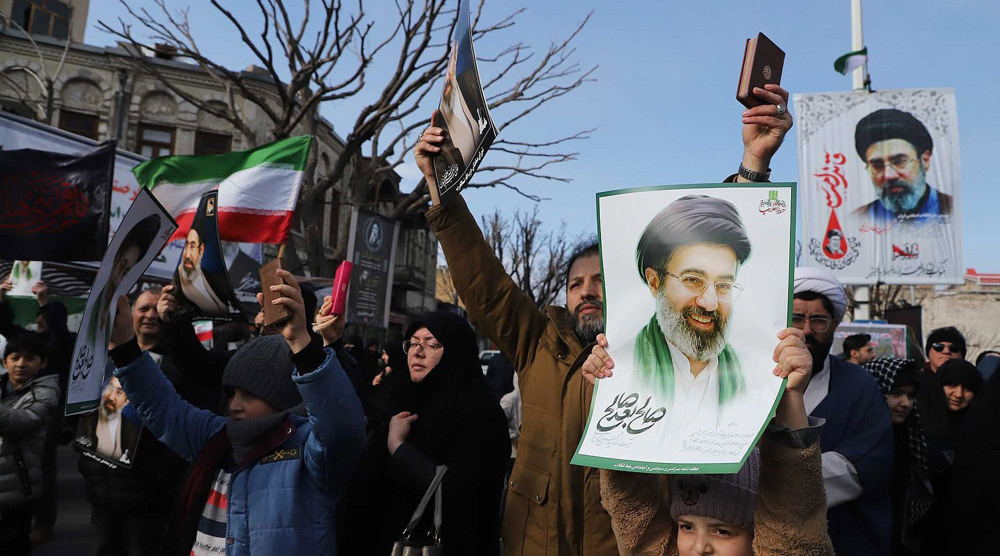
More than 300 Iranian scholars in the humanities, social sciences, and arts have issued a statement pledging allegiance to newly elected Leader of the Islamic Revolution Ayatollah Seyyed Mojtaba Khamenei, describing his leadership as a source of strength for Iran and the global Resistance Movement.
More than 300 Iranian academics have voiced strong support for the newly elected Leader of the Islamic Revolution, Ayatollah Seyyed Mojtaba Khamenei, declaring their commitment to assist in advancing the vision of a “New Islamic Civilization.”
The scholars issued a collective statement shortly after Iran’s 88-member Assembly of Experts chose Ayatollah Seyyed Mojtaba Khamenei as successor to Ayatollah Seyyed Ali Khamenei, who was martyred during recent American-Israeli aggression against the Islamic Republic.
The United States and the Israeli regime launched an illegal and unprovoked military attack on February 28, beginning with the assassination of Ayatollah Ali Khamenei along with several senior officials. The Leader was martyred while attending his office in Tehran.
The scholars framed Mojtaba Khamenei’s selection as both a continuation of revolutionary leadership and a source of renewed confidence.
“The election of a scholarly warrior, an ascetic jurist, a sagacious and popular statesman, familiar with the modern schools of thought and latest developments in science and technology, who believes in and is committed to the intellectual framework of the late Imam Khomeini and the martyred Leader of the Islamic Revolution, has brought joy and fortified the hearts of the free-spirited of the world, and the Resistance Movement across the globe,” the statement said.
Profile: Ayatollah Seyyed Mojtaba Khamenei, third Leader of the Islamic Revolution
— Press TV 🔻 (@PressTV) March 9, 2026
By @HumairaAhad_83https://t.co/IgkXBDefYa
“As scholars and researchers of the humanities, social sciences, and arts, we pledge our allegiance to His Eminence Ayatollah Seyed Mojtaba Hosseini Khamenei and commit ourselves to sparing no effort, in striving towards the realization of the New Islamic Civilization,” they wrote.
The academics emphasized that intellectual and cultural resilience would be key to Iran’s future development.
They noted that the infiltration of Western-oriented liberal policies into cultural and economic spheres had weakened the country and created vulnerabilities.
“We firmly believe that the penetration of destructive Western-oriented attitudes and liberalist policies into the realms of culture and economy has been the primary source of weakness and infiltration, laying the groundwork for the violation of the homeland's territory and the martyrdom of our late leader, commanders and civilians including children by the enemy,” the statement read.
Despite the recent escalation in hostilities and the loss of senior figures, the scholars expressed confidence in Iran’s capacity to rebuild and advance through self-reliance.
They invoked the enduring revolutionary slogan associated with the late leader, writing that progress would come through faith, indigenous knowledge, and national determination.
“Placing our trust in Almighty God, with faith in the enduring slogan of the martyred Leader of the revolution, who believed ‘We Can,’ progress and build our country relying on ourselves and applying theories grounded in Islamic sciences and indigenous knowledge, while preserving the spirit of resistance, we dedicate our lives to the exaltation of a prosperous and proud Iran,” added the academics.

Iran’s defiance exposed limits of US power in world: Hezbollah MP

US-Israeli war on Iran disrupts global circuit board supply, raises tech costs: Report

Iran FM in Russia for close consultations on regional, international issues



Iraqi president names Ali al-Zaidi as prime minister-designate
Moscow, Tehran to support each other amid US aggression: Russia's defense minister
Iran says EU’s insistence on sanctions hastens its ‘embarrassing descent into irrelevance’
Araghchi hails 'depth and strength’ of Iran-Russia strategic partnership
Iran: Responsibility for any disruption in Strait of Hormuz lies squarely with US aggression
Iran’s election as NPT vice president delivers major diplomatic slap to US
April 27: Iran strengthens its diplomatic hand as US faces mounting strategic setbacks
US seizure of Iranian vessel endangers patients: Red Crescent official







 PressTV NEWSLETTER now
 This makes it easy to access the Press TV website