American citizens have borne the ‘lion’s share’ of Trump’s tariff costs: Economist
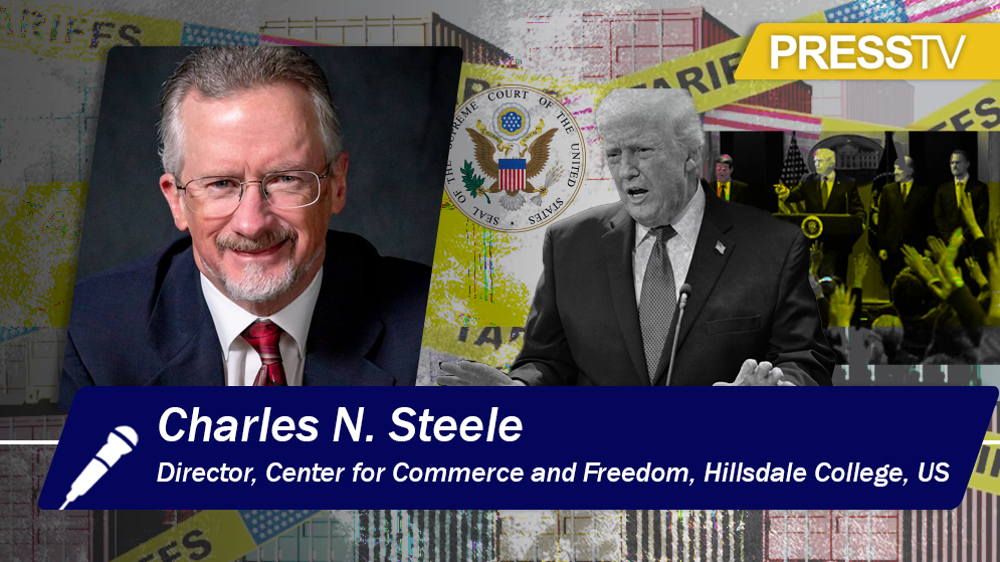
By Mohammad Ali Haqshenas
The US Supreme Court’s Friday ruling to overturn tariffs imposed under President Donald Trump has intensified scrutiny of a policy that was flawed long before facing legal challenges, says an American economist.
In an interview with the Press TV website, Charles N. Steele, Associate Professor of Economics at Hillsdale College, US, who also serves as Director of the Hutchison Center for Commerce and Freedom, said Americans have "paid the lion's share of the costs."
“It seems quite clear that Americans have paid the lion's share of the costs,” Steele said, adding that is why he had previously described Trump’s tariff strategy as an “unforced error” and “a big mistake.”
Steele does not separate the Supreme Court’s legal ruling from the underlying economics. The judges, he noted, were not judging whether tariffs work, but whether the president had the authority to impose them under the statute he chose.
“What makes tariffs an error,” Steele said, “is that they have negative consequences for the economy and people's incomes.”
Those consequences, he noted, were predictable, citing a body of empirical research showing that the burden of the tariffs fell overwhelmingly on Americans rather than on foreign exporters.
“Studies by the Federal Reserve Bank of New York, the Kiel Institute in Germany, and JP Morgan,” Steele said, “all find that about 90% of the economic cost of Mr. Trump’s tariffs is borne by Americans.”
For Steele, that evidence—not the Court’s decision—is what ultimately confirms his criticism. “That is what confirms my view that the tariffs are an unforced error and a big mistake,” he said.
The US Supreme Court strikes down Trump’s global tariffs, delivering a major blow to one of his key trade policies.
— Press TV 🔻 (@PressTV) February 21, 2026
Follow: https://t.co/LWoNSpkc2J pic.twitter.com/8Tl56c122i
The Supreme Court ruling itself hinged on statutory interpretation. Trump invoked the International Emergency Economic Powers Act of 1977, or IEEPA, to justify the tariffs, arguing that the law empowered him to regulate imports during a national emergency.
The bench of judges found that the power to tax rests with the US Congress, not the president, invalidating tariffs that Trump had imposed on nearly every country by declaring a national emergency.
The ruling has been seen as a major check on presidential trade powers, reaffirming that tariffs are fundamentally a taxing power of Congress.
The top US court did not decide whether companies and states can receive refunds for tariffs already paid; that issue is expected to play out in lower courts.
Under IEEPA, the president is empowered to regulate imports, but whether that power includes tariffs was contested. “Are tariffs included. Six justices said no and three said yes,” Steele said.
After reviewing the opinions, Steele said he remains “uncertain” where he comes down on the legal argument itself. “I have read their arguments and am left uncertain what to think of the issue,” he said.
Trump repeatedly framed the tariffs as an emergency measure. Steele said his administration advanced multiple justifications, ranging from trade imbalances to national security concerns.
On the trade deficit, Steele’s skepticism is blunt. “I am skeptical that the trade deficit is a problem,” he said, “because a negative balance of trade is not economically harmful.”
In his view, that makes it an inadequate basis for invoking emergency powers. “So it is not an emergency,” he said.
Trump raises global tariffs to 15%, calls Supreme Court ruling ‘ridiculous’ https://t.co/u30DZNnLxX
— Press TV 🔻 (@PressTV) February 22, 2026
National security claims, such as drug trafficking, Steele acknowledged, are different and “may well be merit to national security claims” and qualify as “emergencies.”
He also pointed to a study that showed Trump could better tailor his tariff policy away from damaging American households.
“Before Trump imposed the tariffs,” he said, “a study by the CARD Institute at Iowa State University found that if the United States unilaterally imposed tariffs on China, costs would mostly be borne by Americans.”
The same study offered a revealing contrast. Steele noted that it found “if the United States could coordinate with the EU in setting tariffs on China, the costs would largely be borne by China.”
In practice, Trump rolled out the tariffs broadly, with loose justification, and defended them as emergencies despite thin economic grounding.
The professor also echoed the stance of other experts who say Trump can still impose tariffs on other countries under different laws.
“All the justices agree that the President has other laws that do indeed permit him to impose tariffs,” he told the Press TV website.
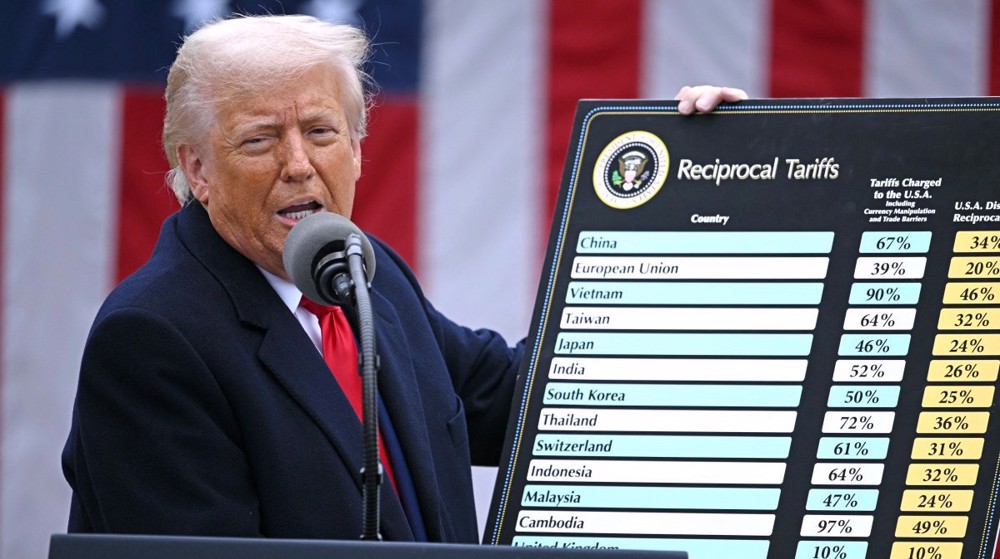
It did not take long for Trump to react to the ruling. On Saturday, he escalated his trade confrontation once again, raising a blanket global tariff from 10 percent to 15 percent.
The move, described by Trump as “effective immediately,” came amid mounting pressure from businesses and governments seeking repayment of an estimated $133bn already collected under the now-invalidated tariff regime.
US President Trump announces that he will be raising tariffs to 15% on all countries in response to yesterday's Supreme Court decision.
— Press TV 🔻 (@PressTV) February 21, 2026
Follow Press TV on Telegram: https://t.co/LWoNSpkc2J pic.twitter.com/4DEFeuC4RM
Rather than softening course, Trump lashed out at the country's judiciary, denouncing the ruling as a “ridiculous, poorly written and extraordinarily anti-American decision,” and calling the majority of justices “fools and lapdogs.”
He swiftly turned to a different legal basis—Section 122 of the Trade Act of 1974—to reimpose a universal 10 percent tariff, and then raised it to the maximum 15 percent allowed under that statute.
Section 122, however, limits such tariffs to 150 days unless Congress approves an extension.
No previous president has invoked the provision, and its use is expected to invite fresh legal challenges. Still, Trump insisted his administration would press ahead. “During the next short number of months,” he wrote, it would issue “new and legally permissible Tariffs.”
The policy turbulence has already triggered a wave of litigation. More than a thousand lawsuits have been filed by US importers seeking refunds.
Internationally, the fallout has been equally disruptive as existing trade agreements have been thrown into uncertainty. Officials from Europe to Asia have reacted with frustration, confusion, and guarded concern, even as Trump presses on.
At home, the political costs are rising. With inflation still biting, the Democratic House Ways and Means Committee accused Trump of “pickpocketing the American people.”
“A little over 24 hours after his tariffs were ruled illegal, he’s doing anything he can to make sure he can still jack up your costs,” they wrote.
California Democratic Governor Gavin Newsom, a Trump nemesis, added that “he [Trump] does not care about you.”
Iran-US MoU ‘significant strategic victory’ for Tehran, defeat for American Empire: Ex-US official
Iran stopped Trump's 'march to reassert US global dominance': Analyst
Iran-US MoU to end war a welcome development for regional security, stability: Analyst


At UN Security Council, Palestine envoy urges world to stop Israeli annexation
Two IRGC servicemen martyred in terror attack in western Iran
VIDEO | Pakistan launches fourth cross-border strikes inside Afghanistan
VIDEO | Pro-Palestinian activists in Paris rally to condemn ongoing Israeli genocide
VIDEO | Spain rejects US pressure as Trump intensifies criticism of NATO allies
VIDEO | Afghanistan-Pakistan tensions escalate after fresh airstrikes by Islamabad
Iran, France FMs discuss Islamabad MoU implementation
US congressman: Americans should stop funding Israeli war crimes


 PressTV NEWSLETTER
now
PressTV NEWSLETTER
now
 This makes it easy to access the Press TV website
