Netanyahu pushing to turn US into ‘slave state for Israel’s expansionist dreams’: Analyst
By Press TV Staff Writer
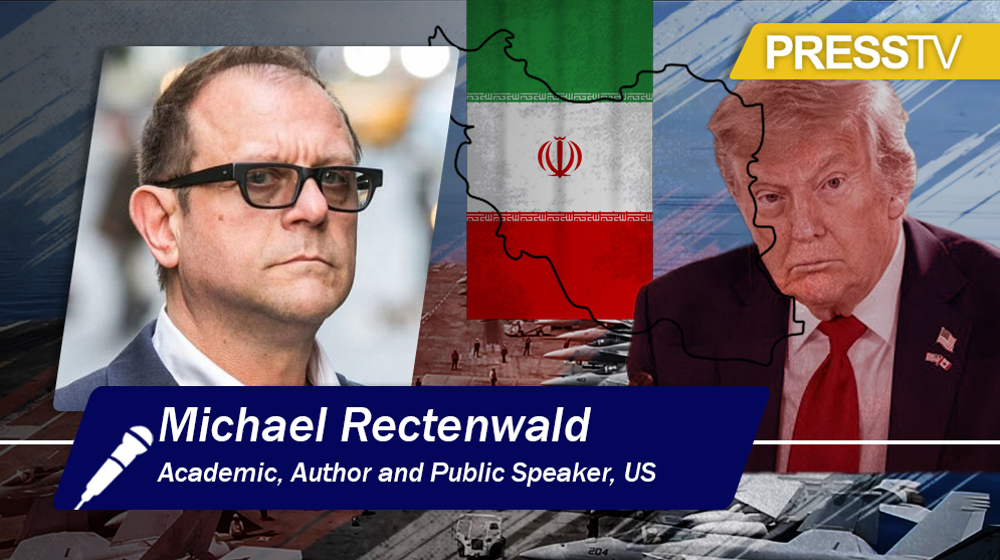
Israeli Prime Minister Benjamin Netanyahu has been deliberately steering the United States toward confrontation with Iran in an escalation that pushes America into a “slave state for Israel’s expansionist dreams,” says an American analyst.
In an interview with the Press TV website, Michael Rectenwald, an author and former professor, pointed to the strong Zionist influence in the US policy-making.
“The Zionist stranglehold on US policy prioritizes Israel’s aggression over American sovereignty. Netanyahu knows that provoking Iran draws in US forces and funds, turning our country into a slave state for Israel’s expansionist dreams,” he said.
He noted that Tel Aviv’s push to see an all-out Iran-US war is not “just a willingness” but “a calculated strategy to bleed America dry.”
Rectenwald, founder of the Anti-Zionist America Political Action Committee (AZAPAC), said Trump’s record stood in stark contrast to his campaign vows to end wars.
“He ran on ending endless wars and putting America first,” Rectenwald said, adding that in practice, his administration had “served as Israel’s munitions depot and ATM, bombing countries like Yemen, Iraq, Syria, and others at Israel’s behest while funneling billions in arms and aid to support Israel’s genocidal actions in Gaza and beyond.”
In Rectenwald’s assessment, the expansion of US military assets in the region signaled preparation for direct confrontation with Tehran. “Now, with increased US military presence in [West Asia], Trump is preparing strikes on Iran—not for American interests, but to appease his Zionist bosses,” he said.
“This isn’t ‘peace’; it’s escalating conflicts to advance Greater Israel fantasies, displacing millions and looting American taxpayers,” he added.
Trump’s rhetoric has sharpened in recent months. Following economic protests in Iran, which were later hijacked and turned into terrorist riots by US and Israeli spy agencies, he had warned that military action remained on the table and said that “help is on its way.”
In late January, he stated that “another beautiful armada” of warships was “floating beautifully toward Iran,” later suggesting the deployment might pressure Tehran back into nuclear negotiations, while Tehran said it had never abandoned talks.
Trump further threatened that failure to reach a deal would bring consequences “far worse” than the previous strike on Iran’s nuclear facilities.
Tehran responded with its own warnings, declaring that any aggression would meet a swift and forceful response.
After an attack on its nuclear facilities in June—which ironically came during indirect Tehran-Washington talks—Iran launched a barrage of missiles at Al Udeid Air Base in Qatar, which hosted US forces and equipment.
Rectenwald argued that the push toward confrontation with Iran could not be understood without examining Israel’s strategic calculus and its influence in Washington. He contended that Netanyahu had been actively seeking a broader war between Washington and Tehran.
“Netanyahu and the Zionist regime in Israel are desperate for an all-out war between the US and Iran, as it would eliminate a key regional rival while keeping the US entangled as Israel’s military golem,” Rectenwald said.
He noted that Trump himself had been complicit in this pattern. “Trump is no anti-war president; he’s a Jewish mobster puppet, dragging the US into more bloodshed for a parasitic state,” Rectenwald said, describing the president’s foreign policy as subservient to Israeli priorities rather than grounded in American sovereignty.
The risks of confrontation with Iran, he argued, were neither abstract nor hypothetical. Rectenwald said Trump had been fully aware of Iran’s military capabilities, particularly its missile arsenal.
“Trump is fully aware of Iran’s formidable missile capabilities, which have already pierced Israel’s multi-layered defenses and could devastate US assets and troops scattered across the region,” he said.
Despite that awareness, Rectenwald believes the president had been influenced more by hardline voices aligned with Israel than by strategic caution. He described Trump as “more beholden to Zionist hawks like those in his administration and the pro-Israel lobby that dictates US policy.”
In making his case, Rectenwald contrasted Iran’s posture with Israel’s record. “Iran hasn’t attacked US ships like the USS Liberty (that was Israel), nor does it control our political class or siphon our resources for genocide; that’s Israel’s playbook,” he said.
He argued that Trump had ignored the strategic dangers while appealing to domestic political instincts. The president, he said, had been “pumping up his base with pre-war rhetoric and aligning with figures who see siding with Israel as ‘good vs. evil.’”
Rectenwald warned, “Attacking Iran would be another disastrous war for Israel, not fought for America, endangering our troops and economy.”
The latest round of talks between Tehran and Washington took place in Muscat on February 6, mediated by Omani Foreign Minister Badr Al Busaidi. The delegations exchanged their views and approaches through Omani channels.
Iranian Foreign Minister Abbas Araghchi described the process as a “good start” and said that the continuation of talks depended on refraining from threats and pressure.
However, Rectenwald repeated his warning against Israeli influence, which can derail the talks as happened in June.
“Trump isn’t acknowledging Iran’s power; he’s blinded by Zionist influence, risking catastrophe to serve foreign interests,” he said.
For Rectenwald, the stakes extended beyond a single military decision. The broader issue, he argued, concerned sovereignty and governance. “We must end this control and reclaim American governance for Americans,” he said.
Iran stopped Trump's 'march to reassert US global dominance': Analyst
Iran-US MoU to end war a welcome development for regional security, stability: Analyst
Iran-US MoU ‘great victory’ for Tehran as US failed to achieve war objectives: Former diplomat



Leave southern Lebanon or be kicked out: IRGC Quds Force chief warns Israel
VIDEO | Trump’s derogatory comments about PM Giorgia Meloni spark political backlash in Italy
VIDEO | Anti-fascist rally held in Bogotá ahead of presidential election
VIDEO | Gaza's hospital power shortages leave patients at risk
VIDEO | Yemenis call Iran–US MOU victory for resistance
VIDEO | Civilian toll rises in Lebanon as Israeli attacks persist despite Iran-US MoU
Outrage grows after Israel detains Palestinian ‘doctor of the poor’
VIDEO | A beachfront miracle: How a Gaza farmer dug a well by hand to ease his camp's water crisis


 PressTV NEWSLETTER
now
PressTV NEWSLETTER
now
 This makes it easy to access the Press TV website
