Trump's escalation against Cuba aims to distract from humiliating defeat in Iran: Analyst
By Alireza Kamandi
As the Trump administration ramps up its hostile posture toward Cuba, a Brazilian analyst says the move is far from an isolated incident and represents a calculated attempt to distract from a humiliating strategic defeat in Iran, reassert outdated imperial doctrines, and reshape the geopolitical landscape of the Western Hemisphere.
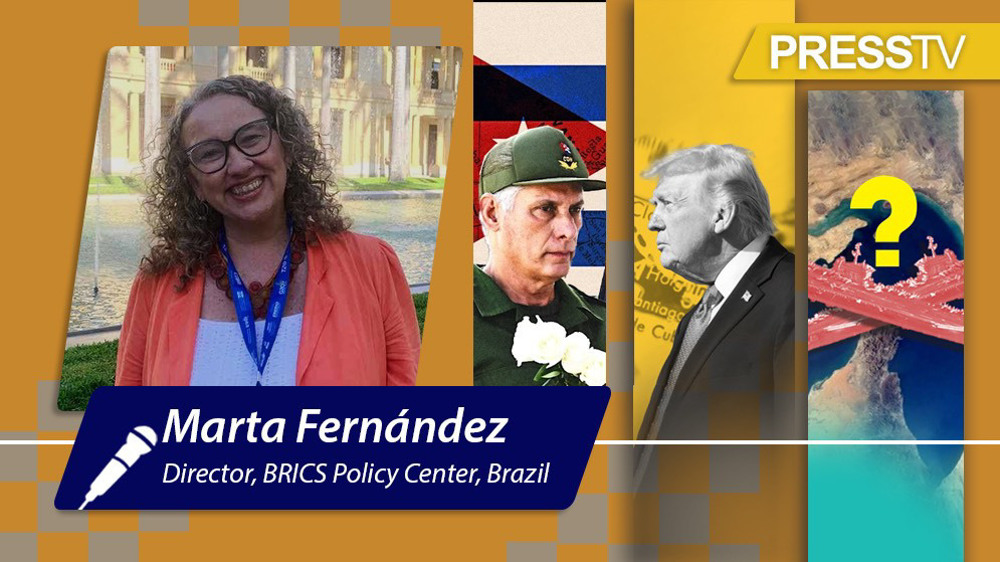
In an interview with the Press TV website, Marta Fernández, the director of the BRICS Policy Center in Brazil, dissected the layers of Washington’s renewed aggression against Havana, framing it within a longer historical trajectory of US imperial policy.
According to Fernández, the current pressure campaign against Cuba should not be seen in a vacuum but as a bid to complete an “unfinished political project.”
At its core, the Trump administration is seeking to preserve US regional primacy and punish any geopolitical arrangement that limits Washington’s influence in the Americas.
She said it is explicitly reinforced by the 2025 US National Security Strategy, which not only vows to reassert the Monroe Doctrine but introduces a “Trump Corollary” aimed at restoring American preeminence in the hemisphere while curbing the reach of extra-hemispheric actors, a clear nod to containing China’s growing economic footprint in Latin America.
“Cuba carries significance beyond its material capabilities,” Fernández told the Press TV website. “The island holds a symbolic place in the Latin American political imagination, representing ideas of sovereignty, dignity, and resistance under asymmetry.”
Therefore, she added, the pressure serves a disciplinary function: signaling to other regional actors the costs of pursuing foreign policy autonomy.
The role of Secretary of State Marco Rubio, shaped by the anti-Castro Cuban exile network in Florida, further fuels this hardline stance.
Fernández emphasized that the strategy aims to sever ties of solidarity between Latin America and global powers outside US control, a goal made more urgent after the January 2026 US invasion of Venezuela and abduction of Nicolas Maduro, which disrupted Havana’s crucial oil lifeline.
When asked whether Trump is attempting to divert global public opinion from his failures in Iran by preparing for a military campaign against Cuba, Fernández answered affirmatively. She stated that the administration underestimated Iran’s historical resilience, regional position, and strategic capabilities, wrongly assuming that the coercive tactics that worked in Venezuela could be easily transplanted to Tehran.
“The Iranian case demonstrated that geopolitical strategies cannot simply be transferred across contexts without encountering significant constraints,” she said.
Against this backdrop, any escalation around Cuba serves as a political and symbolic compensation for Washington’s inability to achieve decisive outcomes in Iran.
Beyond foreign policy, the domestic dimension is crucial. With the US midterm elections looming in November 2026, projecting strength abroad helps rebuild an image of effectiveness.
“A tougher posture toward Cuba,” Fernández asserted, “can be interpreted simultaneously as geopolitical signaling, domestic political strategy, and an attempt to reshape the political narrative after the frustrations associated with Iran.”
The analyst predicted that any attempt to intensify pressure on Cuba will see stronger resistance.
“Cuban history suggests that external pressure alone has not been sufficient to dismantle the system,” she said, but added that maintaining resistance under current conditions carries increasingly high human and social costs for the Cuban population, given the vast power asymmetry, symbolized by the US military presence at Guantánamo.
Rather than identifying a specific “next hunt” after Cuba, Fernández suggested the Trump administration will double down on its original strategic blueprint: re-centering US attention on the Western Hemisphere.
For Latin America, this is a dire warning. The region is increasingly viewed as a strategic reserve of critical minerals and a security problem of migration and crime.
Fernández pointed to recent debates in Brazil, where classifying local criminal organizations as “terrorist groups” has raised concerns over sovereignty and the potential for external intervention under the guise of security.
“These developments raise concerns that Latin America may increasingly be approached not as a region of sovereign political projects, but once again as the United States’ geopolitical backyard,” she warned.
Turning to the broader consequences of US-Israeli aggression against Iran, Fernández underscored immediate economic pain for Latin America. Beyond energy shocks, rising fertilizer prices are already straining the region’s agricultural exporters, leading to higher food costs.
Politically, this inflation deepens social dissatisfaction. In countries like Brazil, where electoral disputes are ongoing, rising prices can be instrumentalized by Trump-aligned factions to undermine current economic management and argue for closer alignment with Washington.
“As seen in Chile, increases in energy and transport costs could generate political costs even for governments friendly to US interests. The net result will likely be a more fragmented, polarized Latin America, where the cost of US imperial ambition is paid by the region’s most vulnerable populations”, Fernández told the Press TV website.
Pakistan PM's China visit could advance efforts to end US-Israeli war on Iran: Ex-Minister
US wartime demands collapse, leaving Trump empty-handed as regional power shifts: Ex-diplomat
Trump ensnared by his own contradictions as Iran dictates new strategic terms: Ex-Pentagon analyst



US destroyers flee Sea of Oman after Iran Navy’s rocket-drone warning shots
Protests erupt in Albania over resort project linked to Trump family
Leader grants pardons, sentence reductions to over 2,000 convicts
2026 FIFA World Cup: Iran football chief warns of 'other decisions' if US visas not issued
Report: Starlink was core component of US-Israeli war on Iran
VIDEO | Three generations, one displacement: Naksa memories in Tulkarm refugee camp
VIDEO | US House approves war powers vote to rein in Trump’s war on Iran
US scraps Tomahawk deal with Germany, fearing Russia and missile shortage


 PressTV NEWSLETTER
now
PressTV NEWSLETTER
now
 This makes it easy to access the Press TV website
