Empire in freefall: Desperate sabre-rattling against Iran shows US has completely lost the plot
By Press TV Strategic Analysis Desk
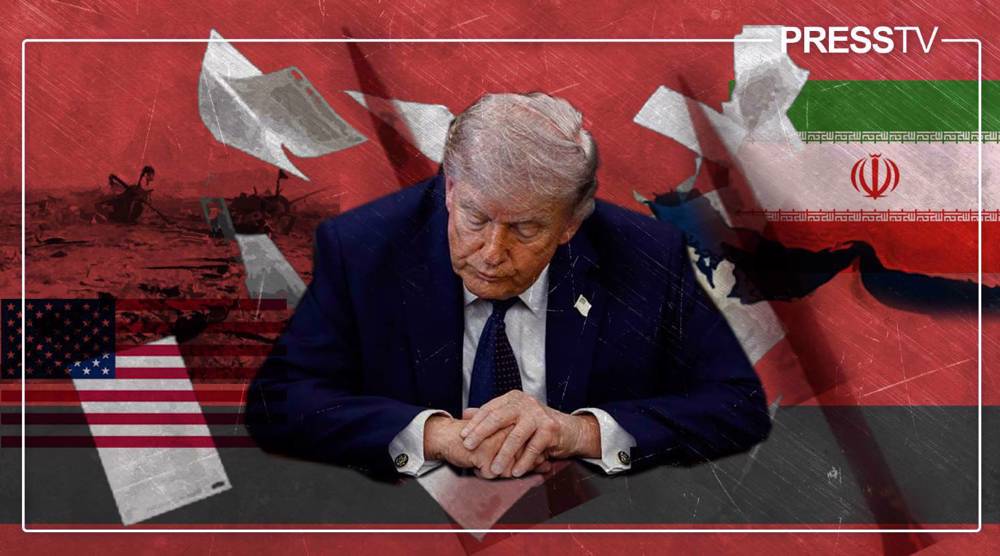
The threatening rhetoric emanating from Washington these days is not merely the product of a clueless and embattled administration or election-year posturing.
It is a calculated instrument of psychological warfare – wielded after disastrous performance on both the battlefield and the negotiating table.
As a senior advisor to the Leader of the Islamic Revolution succinctly put it, the enemy's menacing tone serves a singular purpose: to frighten Iran into a partial – or complete – retreat from conditions that Iran has presented to end the unprovoked and illegal war.
But beneath the bluster lies a deeper, more profound reality. The United States no longer threatens from a position of unchallenged supremacy that it once enjoyed. It is resorting to sabre-rattling now from the precipice of decline and decay.
Having suffered successive military and strategic defeats – from the 12-day war last year to the Ramadan War this year – the American Empire finds its once-mighty image in tatters. These hollow threats are not a sign of strength but the final, desperate convulsions of a so-called “superpower” trying to blackmail its way back to relevance.
The weapon that failed: Why threats now outperform action
The enemy's most critical element for imposing its diktats has never been merely its military arsenal. It has been how Iran reacts to the very concept of war.
After imposing two unprovoked, devastating wars on the Islamic Republic within ten months, inflicting heavy human and economic losses, the enemy now seeks to weaponize the very pain the Iranian people have endured.
The strategy is brutal but simple: brandish the threat of even more death and destruction, then demand a retreat from Iran’s very logical and principled positions.
Yet here lies the enemy's fatal miscalculation. In both imposed wars, neither the United States nor its Zionist proxy secured a single military victory over Iran. They pummeled civilian neighborhoods, hospitals, and research centers. They assassinated the Leader of the Islamic Revolution and murdered nearly 170 children inside a single classroom – acts of such unparalleled cowardice and criminality that every remaining red line was erased.
But on the battlefield, where material strength meets the will of a nation that has been wronged, they achieved nothing. Absolutely nothing. The Iranian nation resisted with all its might, and the enemy suffered unimaginable losses.
Consequently, the threat of war has proven more effective for the enemy than war itself. For years, Washington has blackmailed Iran by keeping the sword of war suspended overhead.
And in some instances, most notably the Joint Comprehensive Plan of Action (JCPOA), this psychological extortion succeeded, extracting concessions the battlefield never could.
But those days are ending, and even Americans know it.
✍️ Analysis - The war of wills: Iran’s principled stance remains unshakeable as America’s options fade away
— Press TV 🔻 (@PressTV) May 13, 2026
By Press TV Strategic Analysis Deskhttps://t.co/R6JJTW4GEf
The last arrow in the quiver
Today, the enemy's need to keep that sword raised above Iran's head is greater than ever before. And paradoxically, that urgency is a sign of profound weakness.
If the United States fails in its current round of blackmail against Iran – and it surely will – it will lose the last remnants of its credibility and prestige. Consider the arithmetic: Washington has already fired its last arrow: full-scale military aggression. That arrow did not achieve any of its objectives. It did not dismantle Iran's nuclear rights. It did not bring the Islamic Republic to its knees. It did not even meet basic military objectives.
If extortion also fails, the Empire will have nothing left. No military victory. No diplomatic surrender. No economic collapse in Tehran. The United States will have squandered its last asset: the illusion of being a power to reckon with. It is already teetering on the brink.
Thus, the current threats are not about Iran at all. They are about defending the tattered remnants of America's global image. Washington fears a domino effect. If Iran stands firm – if it refuses to blink – then America's satellites and regional allies will watch in real time as the emperor loses control completely.
One by one, they will recalibrate their loyalties. The threat of war this time is not an offensive lunge. It is a defensive crouch – the last gasp of a failing Empire trying to prevent its own staggering, irreversible collapse.
In truth, these threats represent the final attempts of a so-called "superpower" to avoid complete collapse. Should they succeed – and should Iran retreat even tactically from its logical and lawful positions – the United States would gain a temporary lifeline. It would secure survival and breathing room. It would rush to compensate for its material weaknesses and, more importantly, repair the reputational damage inflicted by its failed confrontations with Iran. It would then wield that rebuilt credibility in future rounds of war.
But Iran's decision-makers understand this trap perfectly. Any retreat from firm, principled positions will not prevent further losses. It will accelerate them. Because the enemy's calculations are brutally simple: every retreat by Iran validates the strategy of threat.
Existential threat requires existential resistance
For the United States and Israel, this war is an existential threat. They have staked their regional hegemony, their deterrence credibility, and the survival of their preferred order on forcing Iran to surrender. But the same is true in reverse. Just as war is an existential threat to the enemy, it is also an existential threat to Iran.
And an enemy that has already committed the most heinous crime – the assassination of a Leader – has no remaining red lines. When someone crosses that threshold, it announces to the world that it is capable of anything. No negotiation, no concession, no partial retreat will satisfy such an adversary. Concessions will not buy peace. They will only invite greater aggression. It has been fully demonstrated in the last two imposed wars.
Therefore, existential threat demands existential resistance. That means the highest degree of steadfastness. It means no retreat – not even verbal – in protecting the system. It means maximum deterrence achieved not through bargaining, but through unbreakable will.
In contrast, resistance against an existential threat – and the consequent disappointment of the enemy – leads to the highest form of deterrence: intrinsic power. Not borrowed power. Not power dependent on American permission or European mediation. Intrinsic power flows from the nation's own resilience, its military ingenuity, and its refusal to submit.
And here is the strategic payoff that Western analysts consistently miss. Reaching the highest level of deterrent power brings security. Security brings capital and investment. Investment neutralizes economic pressures. The very resilience that frustrates Washington's blackmail is the key that unlocks Iran's economic future.
These are not separate tracks. They are a single, integrated reality.
✍️ Analysis - Trump's deadly trap: By rejecting Iran's proposal, US enters a strategic nightmare with no escape
— Press TV 🔻 (@PressTV) May 11, 2026
By Press TV Strategic Analysishttps://t.co/IuoDeo5OR6 pic.twitter.com/7r0hwTUnNU
Asymmetry: Iran’s choicest weapon
The conventional military gap between Iran and the US-Israeli alliance remains vast in terms of equipment, technology, and visible firepower. This is not a secret. But war is not a spreadsheet. Facing this disparity, Iran adopted asymmetrical warfare methods, and those methods have proven overwhelmingly effective in the recent war.
In the face of massive, heavy aerial barrages, Iran did not attempt to match the enemy plane for plane, bomb for bomb. Instead, it deployed impact-oriented defense and offense, using minimal and low-cost equipment to achieve disproportionate strategic effects.
This is not a sign of weakness, but a demonstration of strategic intelligence.
Moreover, a new element has now entered the war equations: the mobilized Ummah. For decades, the United States assumed it could fight Iran in isolation. The resistance front – stretching from Lebanon to Yemen, from Iraq to Palestine – has transformed asymmetrical warfare into a regional force multiplier.
In both recent imposed wars, this element tipped the scales decisively in Iran's favor.
This same logic applies to countering classical threats. Non-classical, asymmetrical responses are always more effective against a rigid, technologically dependent superpower. And make no mistake: if the enemy turns its threats into action once again, Iran will deploy options it has deliberately withheld until now.
Those options are not secrets. They include engaging other vital global economic arteries in the region, not just the Strait of Hormuz. They include deploying new-generation strategic weapons that have been developed precisely for such a contingency. And they include the "greening" or activation of all red lines and military considerations that were respected or held back during the Twelve-Day War and the Ramadan War.
A second round, if it comes, will not look like the first. And the enemy knows this.
Two fronts, one unbreakable will
The path of strength forged by Iran's armed forces on the battlefield and its people in the streets must now continue on two critical fronts: diplomacy and economic resilience.
Iran's executive and diplomatic apparatuses are currently like fighters standing behind a missile launch system. They are not backstage administrators but frontline defenders, obliged to fight to the death for their country's existence.
There is no room for fatigue and no room for tactical surrender dressed up as pragmatism.
The resilience of both the government and the people is not merely a political slogan. It is the material requirement for getting through this phase, to preserve Iran's existence, to create lasting deterrence, and to remove the shadow of war for all times to come.
Iran's diplomacy, with a clear and correct understanding of the fateful nature of this moment, must leave no path open for the enemy to achieve its goals. That means no ambiguous compromises, no backdoor concessions, and no subtle signals of weakness that can be read in Washington and Tel Aviv as cracks in the Iranian will.
✍️ Analysis - With Iran's armed forces at peak readiness and red lines locked, Trump walks into a ring of fire
— Press TV 🔻 (@PressTV) May 11, 2026
By Press TV Strategic Analysis Deskhttps://t.co/c6SgUwkN68
The Empire cannot afford another major defeat
US is threatening Iran today not because it operates from a position of strength, but because it is weak and failing. The threats are meant to extract what the battlefield could not secure: a symbolic Iranian retreat that would allow the Empire to patch up its tattered image.
The Iranian leadership understands this calculus perfectly. They know that any retreat – even a temporary or partial one – will not prevent another war, but will guarantee one. Because the enemy's only remaining path to saving its credibility is to break the Iranian will.
But the enemy will fail. Iran has no choice but to stand firm. Existential threat requires existential resistance and resistance, in the end, is the only path to security, to investment, to economic relief, and to lasting peace in the country and the region.
The sword of war still hangs overhead, but the hand gripping it trembles. Iran has learned a simple truth: a shaking hand cannot strike deeper than a nation that refuses to bend.
Mission unaccomplished – Part VI: US sought Iran’s surrender but got a new regional superpower
Contrary to enemy propaganda, Iran’s defense sector continues to make progress: Top general
Iran marks 39th anniversary of Sardasht chemical massacre, demands accountability from Western enabl



Iran becomes world's 3rd producer of rapid gas detection kits, says knowledge-based firm
Iran monitors US compliance moment-by-moment, won’t implement MoU unilaterally: FM spox
Hezbollah MP blasts ‘sell-out’ government, says Lebanon central to any Iran-US deal
Israeli army demolishes buildings across Gaza as ceasefire violations continue
VIDEO | Press TV's news headlines
VIDEO | Thousands displaced by earthquake in Venezuela receive temporary shelters
Iran will respond decisively to any ceasefire violation: Acting defense minister
Trump criticized Spain for not meeting NATO spending targets


 PressTV NEWSLETTER
now
PressTV NEWSLETTER
now
 This makes it easy to access the Press TV website
