Explainer: How an Iranian fighter jet slid through layered air defenses to bomb US base in Kuwait
By Ivan Kesic
In the initial days of the US-Israeli aggression against the Islamic Republic of Iran, an Iranian fighter jet accomplished what no warplane had done in over seventy years.
Successfully evading layered American and allied air defense systems to strike a highly fortified US military base in Kuwait, the operation marked a deep humiliation for the Pentagon and a stunning validation of Iran’s indigenous aerospace engineering capabilities.
While the world’s attention was consumed by missile barrages and drone swarms during the first days of the war, this remarkable military feat went largely unnoticed.
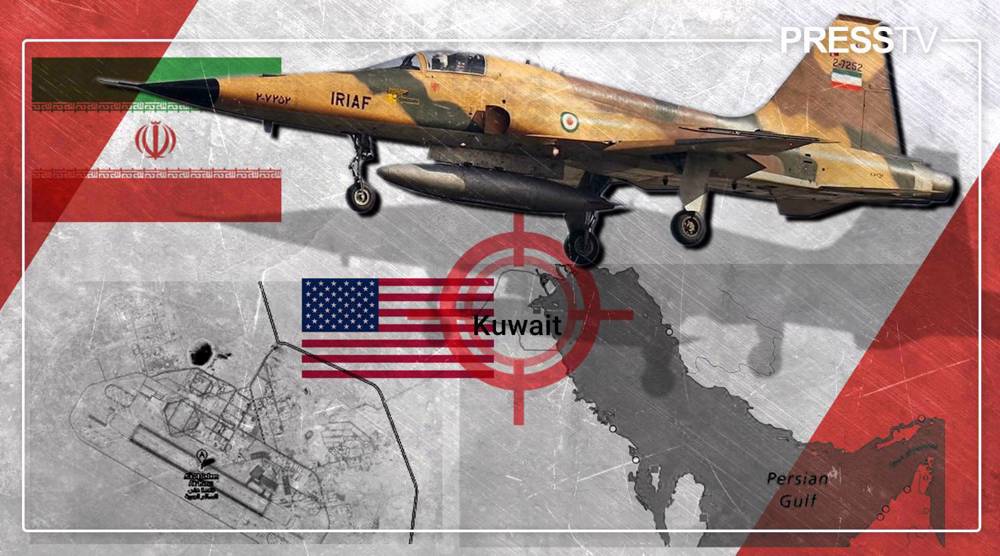
In early March, an Iranian fighter jet – an advanced derivative of the Northrop F-5 platform – took off from a base in southwestern Iran, likely from southern Khuzestan province. It then flew at extremely low altitude across the Persian Gulf toward Kuwait.
The aircraft, carrying a payload of conventional bombs, penetrated the sophisticated air defense network protecting Camp Buehring, a major American military installation located just a short distance from the Iraqi border.
The pilot released the ordnance successfully. The bombs struck the base. And then, the aircraft returned home. The whole operation was a stunning success.
Later confirmed by US officials speaking to US media, it represented the first time a fixed-wing aircraft had bombed a major American military base since the Korean War.
It shattered the illusion of US air superiority and demonstrated that Iran’s air force – long written off by Western analysts as a relic – remains a potent and dangerous force. One capable of striking the very heart of American military power in the region.
Iran’s strikes on US bases more destructive than publicly admitted: Reporthttps://t.co/RwP8c92O45
— Press TV 🔻 (@PressTV) April 25, 2026
Iranian low-altitude penetration against layered defenses
The Iranian strike on Camp Buehring was not a matter of luck or coincidence but the result of meticulous planning, technical skill, and an intimate understanding of American air defense vulnerabilities, according to military experts.
The fighter jet, flown by an Iranian pilot whose training and courage deserve particular recognition, employed a low-altitude approach profile that exploited the fundamental limitations of radar coverage.
By flying at an altitude of only a few dozen meters above the terrain or water surface, the aircraft remained below the radar horizon of Patriot missile batteries and other ground-based interception systems.
These systems, designed to detect and track targets at higher altitudes, could not lock onto an aircraft flying so low, as the curvature of the earth and ground clutter masked its approach.
The distance from southwestern Iran to Kuwait is relatively short, making the mission feasible for the fighter jet’s range without requiring external fuel tanks.
The aircraft likely carried a payload of conventional unguided bombs, estimated at between 250 and 500 kilograms each, with a total ordnance load of approximately 3,000 kilograms.
What made the retaliatory attack truly remarkable was not merely the penetration of air defenses but the context in which it occurred.
The early days of the aggression, which was launched on February 28, saw a coordinated Iranian response that included ballistic missiles, cruise missiles, and drone swarms saturating much-hyped American defenses across multiple countries.
The air attack was integrated into this broader campaign, exploiting the chaos and confusion created by other Iranian systems.
As one expert observed, the Iranian pilot knew that American AWACS aircraft would detect his takeoff, even at low altitude, but he was confident that no US F-15s were patrolling in that specific sector at that moment.
More sophisticated still, the attack pattern was designed to complement Iranian drone operations.
While the fighter forced Patriot batteries to remain locked on potential high-altitude threats, Shahed-136 one-way attack drones could fly at low altitudes, potentially appearing on radar screens as additional aircraft and confusing Americans about the true nature of the threat.
Op. True Promise 4: Iran's missile blitzkrieg dismantles US war machine in West Asiahttps://t.co/doxcHipYTp
— Press TV 🔻 (@PressTV) March 10, 2026
Camp Buehring: US staging hub in Kuwait
Camp Buehring, the target of this historic Iranian strike, is one of the most strategically significant American military installations in the Persian Gulf region.
Located in northwestern Kuwait, near the Iraqi border, the base was established in January 2003 during the early stages of the wa against Iraq.
Originally known as "Camp Udairi," it was renamed in 2004 for US Army Lieutenant Colonel Charles H. Buehring, who was killed in Baghdad that same year.
The base's strategic importance derives primarily from its geographic location.
Situated in the Udairi Range Complex, a largely uninhabited desert region, Camp Buehring functions as the primary staging and training post for US troops entering the regional theater
Soldiers arriving from the United States are processed, equipped, and prepared there before deploying onward into Iraq and other conflict zones.
The base also hosts the Middle Eastern Theater Reserve, a massive stockpile of military equipment and vehicles that can be rapidly issued to incoming units.
Typically housing thousands of personnel on a rotating basis, Camp Buehring serves as the logistical gateway for American ground operations across the region.
The base's air defense architecture reflected its strategic value.
Patriot missile batteries, short-range interceptors, advanced radar coverage, and persistent regional surveillance networks created what was supposed to be an impenetrable umbrella.
Yet the Iranian aircraft exploited a critical gap: the radar horizon limitation that prevents ground-based systems from detecting low-altitude targets at a distance.
By approaching at an extremely low altitude, the aircraft remained invisible until it was almost directly over the target, leaving insufficient time for any defensive response.
The fact that an aging platform, or rather, an indigenous Iranian upgrade of that platform, could expose such a fundamental doctrinal vulnerability sent shockwaves through American military planning circles.
#Iran Air Force launches mass-production line of #Kowsar interceptor jet https://t.co/0mdLRHI7ub pic.twitter.com/2b4EwaUZ7k
— Press TV 🔻 (@PressTV) November 4, 2018
Iran’s indigenous F-5-based fighters
Following reports of the attack, some Western commentators rushed to dismiss the feat by emphasizing the age of the original F-5 design, which first flew in the late 1950s.
This characterization missed the essential point entirely.
The aircraft that bombed Camp Buehring was not an American-made F-5 from the 1970s. It was most likely the HESA Kowsar, a domestically produced fighter that represents the culmination of nearly four decades of Iranian aerospace engineering and reverse-engineering efforts
The story of Iranian self-sufficiency in fighter manufacturing began in the aftermath of the imposed war in the 1980s.
By 1987, Iranian engineers had initiated a program to reverse-engineer the F-5 Tiger II. Recognizing that the relatively simple design, with approximately 11,860 individual parts, offered a feasible pathway to indigenous fighter production.
The first fruit of this effort was the Azarakhsh, which demonstrated that Iranian industry could replicate the basic F-5 airframe.
This was followed by the Saeqeh, a more ambitious derivative distinguished by its twin outward-canted vertical tails. It made its first flight in 2003 and entered service in 2004.
The Saeqeh achieved a localization rate of 56 percent in 2009, with a subsequent version reaching 65 percent.
The Kowsar, unveiled in 2018 on the eve of Defense Industry Day, represents the most advanced member of this fighter family.
With an impressive 88 percent localization rate, the Kowsar has achieved complete self-sufficiency in structural construction and wiring, while reaching approximately 90 percent in avionics systems.
The aircraft features a modern digital cockpit with head-up displays that replace the old analog instruments of the original F-5, reducing pilot workload and increasing combat effectiveness.
It is equipped with a multi-purpose fire control radar developed specifically for this platform, along with radar warning receivers, identification friend-or-foe systems, weapons processors, chaff and flare launchers, and new-generation tactical navigation systems combining inertial navigation and laser GPS.
The propulsion system consists of two turbojet engines that are Iranianized versions of the General Electric J-85, with 90 percent of components produced domestically.
These engines enable the Kowsar to reach a flight ceiling of 13,700 meters and a maximum speed of Mach 1.5.
The aircraft also features a "zero-zero" ejection seat capable of safely extracting the pilot even at zero altitude and zero speed, a critical feature for low-altitude strike missions.
The Kowsar is capable of carrying various air-to-air missiles as well as optically and laser-guided bombs.
The development of the Kowsar engaged ten Iranian universities, 72 contracting companies, 44 supplier companies, and 63 knowledge-based enterprises, creating employment for approximately 4,000 people.
This represents not merely a military achievement but a national industrial mobilization that has positioned Iran as the first Islamic country capable of designing and building a modern fighter jet.
When the Kowsar bombed Camp Buehring, it was not an antique aircraft stumbling into a lucky hit. It was a thoroughly modernized weapon system, flown by a highly trained pilot, demonstrating capabilities that few analysts believed possible.
Pictures show the production line of the #Iran's "#Kowsar" domestic fighter jet, a fourth-generation fighter, with "advanced avionics" and multi-purpose radar. pic.twitter.com/F3Xj5Ysc4B
— Press TV 🔻 (@PressTV) November 4, 2018
Iranian military philosophy: simplicity, self-sufficiency, and courage
The Kowsar attack on Camp Buehring exemplified a broader Iranian military philosophy that prioritizes simplicity, self-sufficiency, and the courage of personnel over technological one-upmanship with Western military powers.
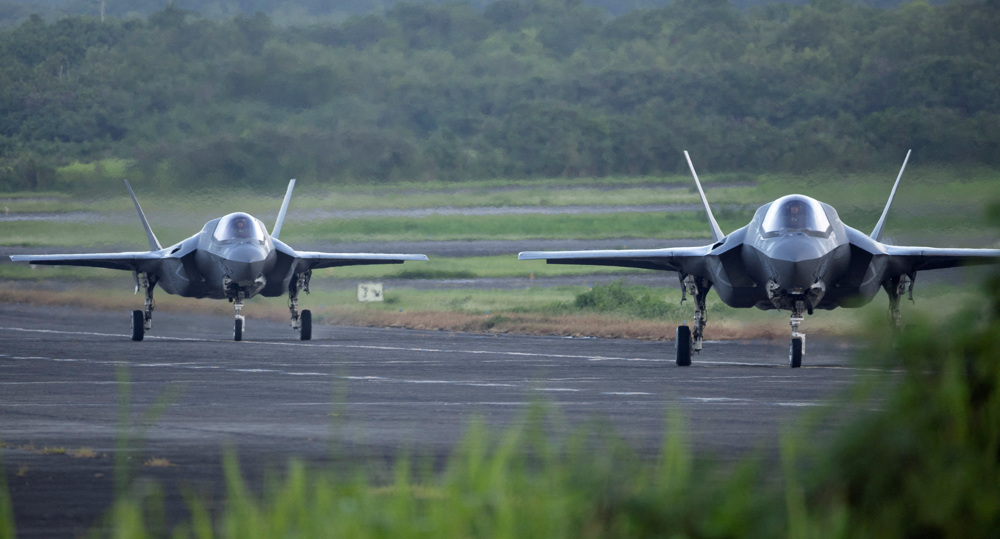
While the United States and its allies pursue ever more complex and expensive platforms—the F-35 costing upwards of $100 million per unit—Iran has chosen a different path: taking proven, relatively simple airframes and systematically upgrading them with indigenous avionics, sensors, and weapons.
This approach is not born of necessity alone but reflects a strategic understanding that military effectiveness depends less on raw technological sophistication than on the integration of platforms into coherent operational concepts.
The F-5 platform, in its original American form, was designed precisely with such a philosophy in mind.
Northrop’s original vision for the aircraft was a low-cost, easy-to-maintain supersonic fighter that could be exported to allied nations under US military assistance programs. The aircraft’s designers prioritized simplicity, reliability, and high sortie rates over cutting-edge complexity.
The result was a fighter jet that could be turned around quickly between missions, maintained with minimal infrastructure, and operated by air forces with limited industrial bases.
Its small size gave it a reduced radar cross-section, making it harder to detect—a feature that proved decisive in the Camp Buehring attack. Its high maneuverability made it a dangerous opponent in close-range engagements.
Iranian engineers have taken these inherent strengths and built upon them.
The Kowsar retains the F-5’s compact dimensions—14.45 meters in length with an 8.13-meter wingspan—and its light weight of approximately 4,350 kilograms empty.
But the avionics, displays, radar, navigation systems, and weapons management have all been replaced with indigenous equivalents that bring the platform into the modern era.
The result is an aircraft that combines the structural simplicity and small radar signature of a Cold War design with twenty-first-century situational awareness and precision weaponry.
The human element, however, remains the most critical factor.
Iranian pilots have been flying F-5 derivatives for decades, developing deep expertise in the platform’s handling characteristics and tactical employment.
The pilot who bombed Camp Buehring demonstrated exceptional skill in navigating at extremely low altitude over water and desert terrain, maintaining precise navigation, and executing a bomb run against a defended target protected by multiple layers of air defenses.
This was not a suicide mission; the aircraft returned to its base in Iran, indicating that the pilot had planned his egress route as carefully as his approach.
The attack reflected high confidence: the pilot knew his aircraft, knew his enemy’s vulnerabilities, and knew that he could accomplish his mission and return home safely.
Iran used missiles, drones, and even F-5 fighter jets to target US bases in the region, the report said, despite previous claims by US authorities that the Iranian air force had failed to use fighter jets against American targets.https://t.co/RwP8c92gex https://t.co/hKbTEnP7ck
— Press TV 🔻 (@PressTV) April 26, 2026
Strategic significance: a blow to American prestige and a lesson for the future
The strike on Camp Buehring carries significance far beyond the physical damage inflicted.
That damage, according to US officials speaking to American media, was extensive across multiple bases in seven countries, with repair costs expected to reach billions of dollars.
Warehouses, command headquarters, aircraft hangars, satellite communications infrastructure, runways, radar systems, and dozens of aircraft were struck in the broader Iranian campaign.
But the psychological and strategic impact of the Kowsar attack is immeasurably greater.
For over seventy years, since a North Korean night raid in April 1953, no enemy warplane had successfully bombed a major American military base.
The United States had come to take air superiority for granted, assuming that its air defenses would detect and destroy any hostile aircraft before it could reach its target.
The Iranian Kowsar shattered that assumption. An aircraft based on a design from the 1950s, built by a country under severe sanctions, flown by a pilot from an air force that Western analysts had dismissed as obsolete, penetrated the most sophisticated air defense network in the region and delivered its payload with impunity.
The message to American military planners was unmistakable: no base, no matter how well defended, is truly safe. The attack also directly undermined the aggressive rhetoric that accompanied the US-Israeli aggression.
Trump had repeatedly claimed that the Iranian Air Force had been “completely obliterated” in the opening strikes. The Kowsar’s successful mission demonstrated otherwise, proving that Iranian air power remained not only operational but capable of offensive action.
This psychological blow to American morale, and corresponding boost to Iranian confidence, cannot be overstated.
For Iran, the attack validated decades of investment in indigenous aerospace capabilities. It demonstrated that self-reliance, not dependence on foreign suppliers, is the foundation of true military power.
Looking to the future, the Iranian attack offers important lessons for military planners in Tehran and elsewhere.
It confirms that small, simple aircraft operating at low altitude can still pose a credible threat to high-tech adversaries, provided they are integrated into a broader campaign that saturates enemy defenses.
It demonstrates that indigenous upgrades to legacy platforms can extend their useful life indefinitely, creating capable weapon systems at a fraction of the cost of new aircraft.
And it proves that pilot skill and courage remain decisive factors in combat, regardless of technological disparities.

New round of war to be catastrophic for US: Leader's advisor

Iran to soon unveil a weapon the enemy is 'deeply afraid of': Navy commander

April 29: Iran defies US blockade as national unity surges while crisis deepens in Washington



Iran FM schools Trump on Persian Gulf after 'Strait of Trump' post
US blockade will bring enemy 'ice age’: Aide to Iran’s Leader
Israeli army facing ‘continuous rise’ in soldier suicides: Report
Expulsion of arrogant powers from Persian Gulf coming soon: IRGC
IRGC: US warships will burn like bases if Iran attacked again
Analysis - Iran consolidates Strait of Hormuz control in post-war power shift, leaving US in dark
US blockade crumbles as Iran turns to overland routes
Iran's new blueprint for management of Strait of Hormuz in post-American regional order



 PressTV NEWSLETTER
now
PressTV NEWSLETTER
now

 This makes it easy to access the Press TV website
