America's grand strategy in West Asia: Energy flow at any cost – with Israel as enforcer
By: Y. P. Rāzi
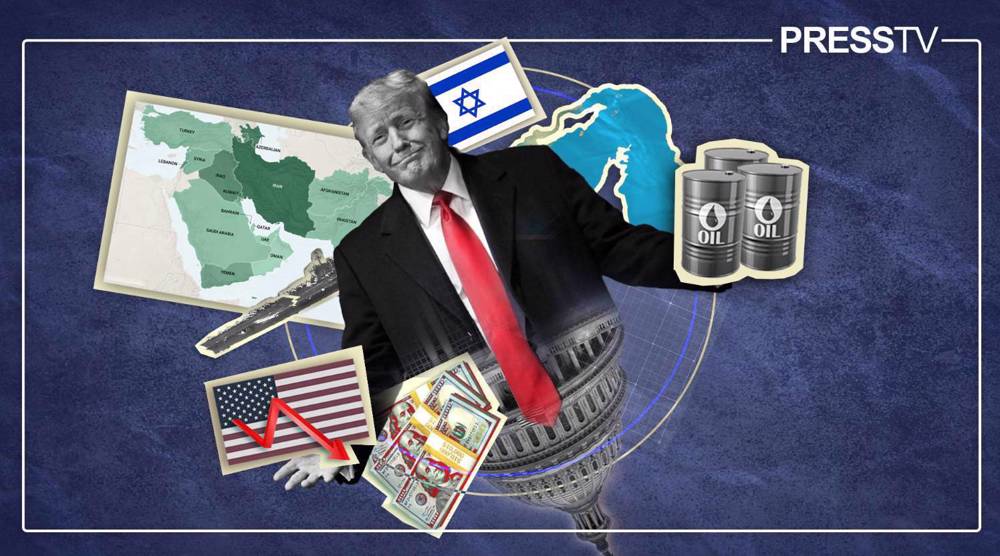
For decades, the overarching objective of the US military-industrial complex in West Asia has remained singular and unwavering: securing the flow of energy.
Everything else – cultural attributes, language, artistic expression, scientific achievement, historical legacy, anything that the inhabitants of this region might take pride in – holds no intrinsic value within the oil-centric framework of American imperial strategy.
The calculus is brutal in its simplicity. The day this region depletes its oil and natural gas reserves, the United States will cease to mention it altogether.
Within this framework, any country, ethnic group, tribe, ideological movement, religion, or racial community that aligns with the preservation of energy flows and the reduction of prices in America's favor will receive the full backing of the extensive US political, military, and media apparatus.
Loyalty to the energy order is rewarded. Deviation is not tolerated. On the other hand, any entity that poses even a minimal threat to this overarching objective will find itself subjected to the full weight of American power.
First comes hostility. Then, fabricated narratives and disinformation campaigns are designed to delegitimize. Finally, when the groundwork is laid, complete destruction is executed either directly by American assets or through a network of regional proxies.
Zbigniew Brzezinski, a former US National Security Advisor, once stated: "The strategic value of the Middle East (West Asia_ to the United States is stable access to the region's oil resources."
Therefore, it is immaterial whether one is Christian, Muslim, Jewish, pagan, sun-worshiper, communist, or Hindu. Identity, faith, and ideology are not relevant here. If one obstructs the energy flow that hurts the US interests, one will be deemed an enemy of the Empire – even if, in practice, one is an ardent admirer and imitator of its political and cultural norms.
In this worldview, loyalty is measured not in gestures of admiration but in barrels of oil.
What complicates US oversight of the region's energy flow is the considerable geographic distance – an ocean and several seas away. As an economic-military organization operating from afar, the US must seek out representatives and proxies.
Russia: US sought to take control of Iranian oil in Persian Gulfhttps://t.co/s4eTN3KI2B
— Press TV 🔻 (@PressTV) April 18, 2026
Israel has been the most significant asset placed in America's position by historical forces, including Britain's imperialist policies in the early 20th century. If America lacked an asset comparable to the Israeli regime in the region, what would it need to do? The answer: it would need to construct one. This is precisely what Joe Biden – not in a Freudian slip, but in full command of his faculties (at least at the time) – repeatedly stated: "If Israel didn't exist in the region, the United States would have to invent one to protect its own interests."
Israel functions as a de facto entity within multiple states that constitute the United States. This relationship was not always so robust; it has reached its current intensity through concerted attempts on the Israeli side and by American Zionist Jews.
What further pushed the US in this direction was the end of the Cold War and the shift in international paradigms - from concepts such as "communism versus capitalism" or even the "clash of civilizations" - toward competition over resources.
What is now evident is that this intimate bond between the US ruling class and the Israeli regime is a tangible reality. Though rarely stated in official discourse, it is implemented in practice. Israel's enemy is America's enemy, and Israel will receive whatever it requires to eliminate that enemy.
However, this unconditional support comes with a fundamental condition: Israel must execute its mission properly. Israel's mission, as an outpost of the United States in the region, is to support oil-rich nations or ruling groups that safeguard America's overarching objective, to combat those who do not comply, and to dismantle their supporters.
US public intellectual Noam Chomsky, in a 1977 interview, said the Israeli regime “functions as a useful base for ensuring US control over the region's vast oil resources, and that is its primary function in the grand strategy of imperialism."
The forms of this struggle vary: intellectual and practical support for ethnic nationalism, fragmentation, religious, ethnic, and tribal warfare among the region's inhabitants; assassination, military strikes, and temporary or permanent occupation of territory; maintaining pressure until countries are finally willing to preserve the energy flow in America's interest in exchange for their survival.
US stock markets slip and oil prices climb as uncertainty over ceasefire talks between Washington and Tehran rattle investors and markets.
— Press TV 🔻 (@PressTV) April 22, 2026
Follow Press TV on Telegram: https://t.co/LWoNSpkJSh pic.twitter.com/GItfWTaS6T
Everything morally reprehensible to any civilized person, or to any outwardly polished American, exists in Israel's track record. Israel performs the tasks that Americans prefer not to undertake directly. One can now confidently assert that justifying the means by the end, while exploiting the Jewish people, constitutes the greatest betrayal the Americans have ever committed against any religion or ethnicity.
Most Arab countries in the region, which once dared to impose oil embargoes on the West, were eventually brought into compliance by the pressures of the United States and "America's local branch" – Israel. They themselves became guardians of the energy flow.
Once they complied, human rights ceased to be a pressing issue, and their version of religion was no longer perceived as a threat to America. Those who still practice the beheading of political dissidents or dismember them in their own overseas consulates; those whose countries serve as hubs for human trafficking; those who still permit forms of whitewashed slavery – none of these troubles the Americans.
If, occasionally, a US official makes a remark about such practices, it should be interpreted as merely holding a proverbial stick over a creature that might bolt.
Iran, too, once cooperated. Before the 1979 Islamic Revolution, Iran was on a different trajectory. It sought to serve as the region's policeman, safeguarding the energy flow.
The arrangement actually began with Iran. For half a century before that, Britain took Iran's oil and, if it chose, directed some money toward Iran. The largest US intervention in Iran - the 1953 coup – was a direct confrontation with the Iranian people's historical demand: to benefit from their oil resources without foreign interference.
Truman and Eisenhower's concern at the time was that Iran's oil nationalization movement would become a model for other oil-rich countries in the region and worldwide. They repeatedly expressed their satisfaction at its defeat.
After the 1979 revolution, for the first time, Iran could decide who worked in its oil industry, how much to sell, to whom, at what price, and where to spend the proceeds without foreign oversight. Ervand Abrahamian notes: "The 1979 revolution was not merely a political transformation, but an attempt to reclaim national sovereignty over resources that had been under foreign influence for decades."
To bring Iran back into alignment with US whims and fancies, we have witnessed what has unfolded over the past 47 years: war, assassinations, and sanctions. These are overarching categories under which thousands of books and articles could be written.
A new report indicates that the war against Iran has dented the US economy and that Americans are likely to feel the financial sting for months.
— Press TV 🔻 (@PressTV) April 25, 2026
Follow: https://t.co/B3zXG73Jym pic.twitter.com/1QkKE2HvRP
But let us, for a moment, think like pre-revolutionary Iran or like the many current US proxies in the region. Why not fall in line and enjoy the benefits? Why subject our people to inflation from sanctions and currency manipulation, the threat of war, economic instability, and financial, insurance, and monetary restrictions?
What is so valuable that we must sacrifice present and future generations in opposition to the American military-industrial-media empire? Why make ourselves the target of dehumanizing demonization campaigns when, by submitting to US power, we could see an end to politically-motivated so-called “human rights reports” against Iran?
To answer that question, I will not rely on cultural or historical values or national pride. Instead, I wish to examine it pragmatically and materially. As residents of West Asia, for reasons known only to God, we sit atop vast fortunes. The world's oil and natural gas – from which we also benefit greatly – are the foundation of nearly everything in the modern world.
If we sum up the dependence of industry, transportation, agriculture, healthcare, electricity, and other sectors, we find that approximately 75 percent of all aspects of modern material life depend on oil and gas.
The question is: if this oil were located not in the so-called Third World but exclusively in First World countries, would those countries also strive to maintain price stability and keep the energy flowing to the rest of the world? Would they peg the value of their oil to a foreign currency across an ocean to increase its worth? Would they spend their oil revenues on excessive weapons purchases from those same countries?
No, absolutely not. If they alone owned the oil, it would be sold by the bottle rather than by the barrel, and life in West Asia would be drastically different. Queues at gas stations, freezing winters, and summer blackouts would mean nothing to Western politicians.
Yes, I acknowledge that we live in an interconnected world with intertwined economies, and we benefit from imported oil-dependent products that we cannot manufacture ourselves or cannot produce cost-effectively. I acknowledge that a global partnership exists in producing oil-dependent goods. But what kind of partnership is it when the party contributing over 50 percent of the primary resource receives proportionately far less than its fair share? How long must this historical humiliation for the owners of oil and gas resources continue?
The countries of this region must be able to sell their oil however much they want, whenever they want, at whatever price they want, in whatever currency they want, to whomever they want. Only then can they be said to have achieved true independence and put an end to American imperialism and colonialism in the region.
Iran is more advanced in this area than others, and ultimately, Iran will be the winner. Iran will impose its terms on the American side. This will be difficult for the United States to accept because its regional allies will realize that the security they gained in exchange for submitting to Washington's will was nothing but a mirage.
And that is where we will gradually see them begin to resist, to protect this precious asset and the power that comes from it.
Y. P. Rāzi is a Tehran-based journalist and commentator.
(The views expressed in this article do not necessarily reflect those of Press TV.)
Iran-US MoU ‘significant strategic victory’ for Tehran, defeat for American Empire: Ex-US official
Mission unaccomplished – Part II: US imposed war, but Iran wrote the terms of American surrender
Iran’s top military command warns of response to any Israeli threat



Persian Gulf Arab states owe stability to Iran’s stewardship of Strait of Hormuz: Leader’s advisor
Hezbollah chief: Israel will have to leave Lebanon 'humiliated, defeated'
Strategic dilemma of Persian Gulf states: Between American pressure and Iran's postwar leverage
Exclusive: Iran-US communication line established in Strait of Hormuz to prevent military incidents
Iran mocks US for ‘solving’ domestic hunger problem, lecturing others
Senior official: Hormuz safe passage conditional on Iran's coordination
Iran-US MoU ‘significant strategic victory’ for Tehran, defeat for American Empire: Ex-US official
Iran condemns 'meddlesome and provocative' GCC-US joint statement


 PressTV NEWSLETTER
now
PressTV NEWSLETTER
now
 This makes it easy to access the Press TV website
