#IR47: How Iran’s martyred commanders found faith, purpose and mission in Islamic Revolution
By Humaira Ahad
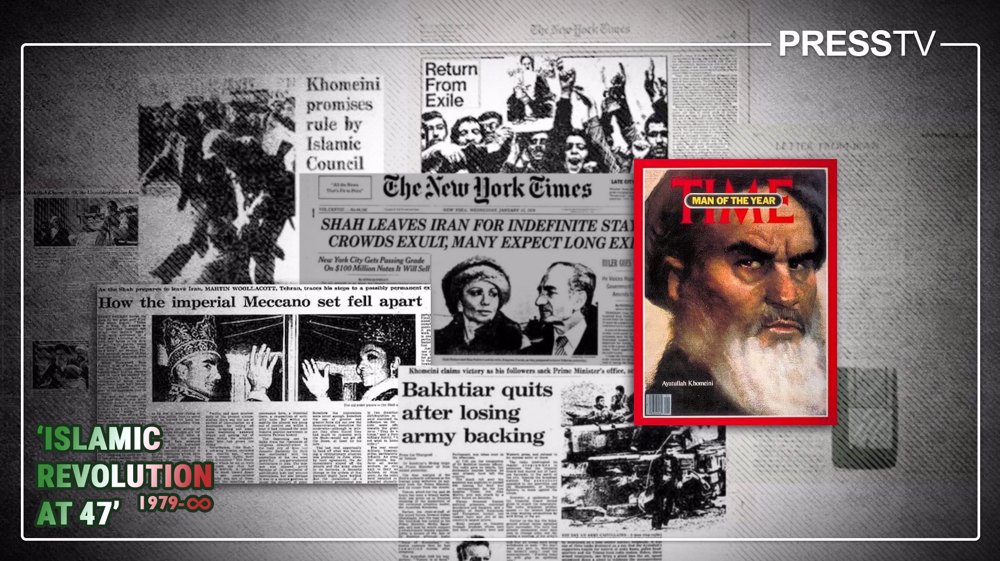
On February 11, 1979, the Iranian people brought an end to the Western-backed Pahlavi monarchy and laid the foundation of the Islamic Republic.
The massively popular Islamic Revolution unfolded against the backdrop of foreign interference, domestic repression, and widespread social and economic anomalies.
Streets across Tehran and other major cities were filled with crowds welcoming the return of the founder of the Islamic Revolution, Ayatollah Ruhollah Mosavi Khomeini, while the US and its allies attempted to contain the movement through political manoeuvres.
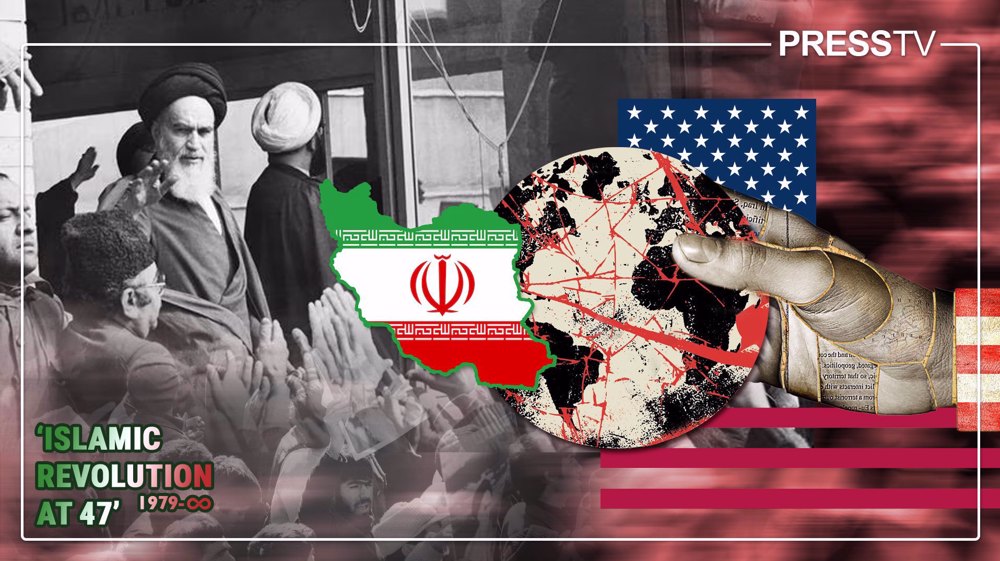
The emergence of the Islamic Republic on the horizon marked a turning point not just for Iran but also for the world, as it redefined power dynamics.
The new government in Tehran – democratically-elected – challenged the Cold War bipolar order, asserting independence from both the US and the then-Soviet Union, and introduced a model of governance deeply rooted in Islamic principles.
Over the decades, Iran has moved from an eight-year imposed war to years of illegal and crippling sanctions and constant threats and provocations from the US and its proxies, including targeted assassinations, cyber attacks, and military brinkmanship.
Through these turbulent times, Iranian armed forces have played an important role in defending the country from hostile external forces.
Long before their names became synonymous with resistance and sacrifice, Iran’s most influential commanders were young witnesses to a country in transition – from monarchy to democracy, Western meddling to self-determination, oppression to dignity.
The Islamic Revolution, led by Imam Khomeini, unfolded around them as lived reality in the marches they joined and the faith that steadied them.
Years later, they reflected on how those early, defining moments shaped their sense of duty and their vision of the Iran that the popular people's revolution could bring to life.
Their accounts are now a part of the Islamic Republic's historical memory and offer a rare window into how the revolution shaped the men who would later give their lives for it.
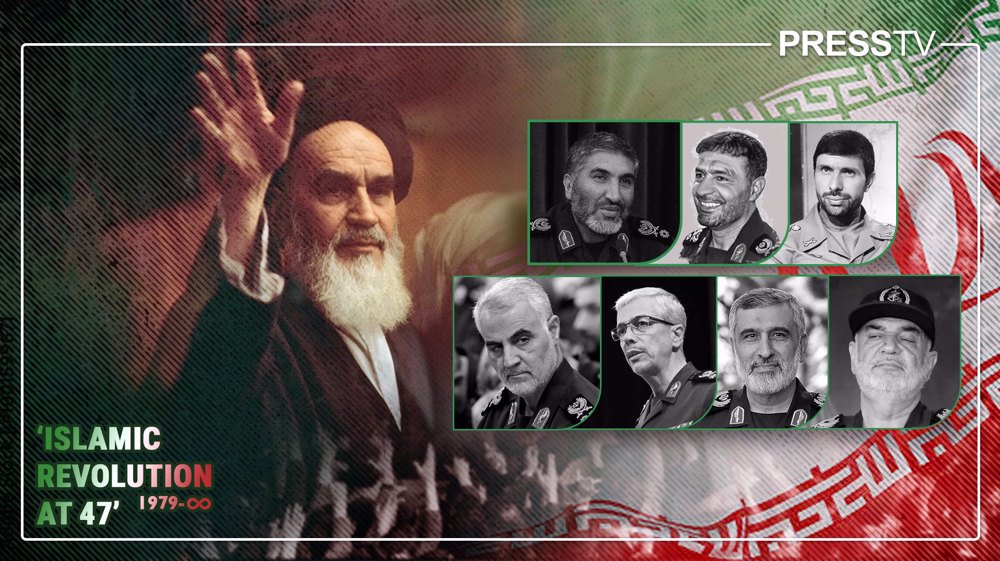
General Soleimani
Long before his name became synonymous with resistance beyond Iran’s borders, Martyr Haj General Qassem Soleimani, commander of the Quds Force of Iran's Islamic Revolution Guards Corps (IRGC), spoke about the Islamic Revolution as the event that redefined his generation’s understanding of faith, courage, and national responsibility.
His public statements, especially those delivered in his hometown of Kerman, remain among the clearest windows into how he understood the Revolution and the forces that shaped it.
Addressing a gathering in Kerman on the anniversary of the Revolution in 2017,he began by tracing the Revolution’s meaning back to its spiritual foundations.
“We must all be grateful to God for placing us in a school and a faith that has been and will continue to be a salvation for humanity,” he said.
“And we also thank Him for granting us two leaders from the lineage of the Prophet Muhammad (peace be upon him).”
The reference, delivered with characteristic clarity, was to Imam Khomeini and the Leader of the Islamic Revolution, Ayatollah Sayyed Ali Khamenei.
General Soleimani often returned to the question of why Iran’s revolution unfolded the way it did, and why it resonated far beyond its borders.
“All revolutions in the world differ fundamentally from the Islamic Revolution of Iran,” he said in one of his speeches.
"Some revolutions, such as those of workers and peasants against feudal lords, were class-based. Others, like the uprisings of Black populations against Whites in South Africa, were focused on overthrowing a ruling regime. Some were military coups. Some depended on foreign intervention or mercenary forces. But ours brought together all segments of society, from seminaries, the heart of our revolutionary thought, to schools, universities, and villages, all rising together under the leadership of a single Imam."
Iran's top anti-terror commander belonged to the generation that lived through the surveillance, crackdowns, and political violence of the Western-backed Pahlavi regime.
While describing the Revolution as a point where ordinary citizens confronted fear and state power, he was speaking from his own memories. He believed those pressures forged a particular kind of clarity and merged faith with responsibility.
Even decades later, General Soleimani warned against misreading the endurance of that moment.
“Today, Iran has been able to thwart all conspiracies because those who understand the times are not deceived by the enemy,” he said. “At times, some may struggle under enemy psychological operations, yet the enemy fears us."
The top IRGC commander frequently placed the Revolution within its global context.
“The Islamic Revolution occurred at a time when the United States and the Soviet Union had established absolute dominion over the East and West. There was no pole in the world outside this bipolar system. The emergence of an independent, non-aligned revolution astonished everyone,” he remarked.
That astonishment, he believed, came from the unexpected scale of public participation and the determination of people.
“The revolution occurred when all Islamic and non-Islamic groups, left, right, and others were suppressed. When the Imam began the revolution, no organized group remained outside prison.”
What followed, he said, was a decisive break.
“In the height of crisis, despair, fear, and torture, the Imam freed the revolutionaries from prison and mobilized the people. He brought the nation into motion.”
General Soleimani carried that framing into his descriptions of the post-revolution years. He believed the public’s early participation, through referendum and mass turnout was essential to the consolidation of the new political order.
“The people quickly acted to stabilize this system with their high turnout in referendum. They also supported it well during sedition's, particularly those orchestrated by liberals, the Mojahedin-e Khalq, and street conflicts.”
For General Soleimani, the Islamic Revolution was the moment that convinced an entire generation that determination and faith could overturn systems that once appeared invincible and immovable.
His reflections remain among the closest accounts of how the 1979 Revolution looked from the ground, from the perspective of someone whose own life was defined, and ultimately ended in its service.
✍️ Viewpoint - #IR47: Long walk to freedom - Imam Khomeini and the Iranian nation’s epoch-making moment
— Press TV 🔻 (@PressTV) February 11, 2026
By @mehdizafar https://t.co/osdbgNgzFS pic.twitter.com/Ihz9nYA9b3
Major General Hossein Salami
Major General Hossein Salami, the martyred commander-in-chief of the IRGC, framed the 1979 Islamic Revolution as an extraordinary historical phenomenon and a manifestation of divine guidance:
"When Islam, 42 years ago, revealed its radiant sun from behind the clouds of ignorance, under the prophetic leadership of Imam Khomeini, it rose from the horizon of Iran and illuminated the world. From that moment until today, all the devils of the world have united to extinguish the light of the revolution," he noted.
On the 42nd anniversary of the Islamic Revolution five years ago, General Salami described Iran’s position with a clarity shaped by decades of confrontation and endurance.
“Today we are in a very strong and elevated position, both compared to previous years and relative to the enemy, and this precisely demonstrates the descent of divine victories,” he said, framing the Revolution’s trajectory through its accumulated trials and its unexpected sources of strength.
For General Salami, the Revolution was a historic restoration of Islamic governance.
As he put it, “After 1,400 years, the great work of Imam Khomeini was to establish governance for Islam. Islam became capable of asserting power, implementing its principles, and competing with other political systems in the world, proving that among all religions, Islam alone endures and prevails—‘It rises, and nothing can rise above it.’”
For the IRGC chief, the 1979 Islamic Revolution was a vision he often connected to the earliest era of Islamic history, emphasizing continuity.
“This eternal masterpiece of the Imam was a repetition of the events of the Prophet’s (peace be upon him) mission. Just as Islam spread and all polytheists and disbelievers arrayed against it in Mecca, so too did the enemies rise to prevent the emergence of the light of God in our era.”
In his speeches, General Salami returned repeatedly to a single idea: that the survival of the Islamic Republic had come through challenges few nations could withstand.
He described the last four decades as "crossing the Nile multiple times."
“The events that have taken place in our country over these 42 years are like crossing the Nile multiple times. The dangers and challenges behind us are immense, and the enemy has employed a power unlike anything seen in human history. Yet today, the United States appears small, weak, and unable to act decisively, even though it still claims to hold power. The truth is that American leaders, lacking wisdom and resolve, have been humbled, as they themselves admit.”
In the IRGC general's view, Iran’s endurance was inseparable from its place in the global balance of power. He stated that, from the first days of the Revolution, Iran had occupied a central strategic position in identity and ideology, combining to make it a focal point of influence.
“There has never been a time in these 42 years when the Islamic Republic of Iran was not the heart of the Earth in geopolitical terms,” he said. “The genius of Imam Khomeini and, after him, the careful guidance of our present leader Ayatollah Khamenei has been to dismantle the enemy’s focus on our land, expand the reach of the revolution, and broaden its front.”
As he described it, Iran had been pressured “economically, culturally, socially, in intelligence, media, military, and politics,” yet “at every front, the enemy has been defeated.”
Like other Iranian commanders, General Salami often concluded his reflections with an appeal to historical awareness, urging Iranians not to overlook the distance the country had traveled since 1979.
“We must all be grateful for this unmatched glory, this unparalleled power, and this unattainable height that the Islamic Revolution has gifted us,” he said, describing the transformation as one that restored “the lost honour of Muslims” and reversed decades of subjugation.
“The Imam revived the lost honour of Muslims, bringing dignity to a community that had been buried in the graves of ignorance. Today, we reaffirm our eternal pledge to the symbols of Muslim honour, knowing that, near and far, our defenders continue to sacrifice for the advancement of the revolution, and with God’s grace, it will engage oppressors even in distant lands.”
Through these statements, delivered over years of escalating pressure on the Islamic Republic, General Salami outlined a narrative of the Revolution rooted in sovereignty and continuity, one that framed Iran’s trajectory as the continuation of a struggle he believed had defined the Muslim world for centuries.
Major General Mohammad Bagheri
Among the reflections left behind by Major General Mohammad Bagheri, the martyred Chief of Staff of the Iranian Armed Forces, the Islamic Revolution appeared as an event that altered the strategic landscape of an entire era.
His recorded statements show he viewed 1979 as the year that saw a nation reclaiming itself, and the broader shift in global power that followed.
General Bagheri often returned to the moment that, for him, crystallized the Revolution’s meaning, the return of Imam Khomeini from exile.
“With the historic arrival of the Imam and the most magnificent welcome in history,” he recalled, “the plot of the ‘Great Satan’ and the American plan to ‘contain the revolution’ and extinguish the flames of the Islamic movement, through the installation of an ostensibly national figure (Shapour Bakhtiar) at the head of the corrupt Pahlavi regime was neutralized and defeated.”
What followed, he said, unfolded with a speed that even Iran’s adversaries had not expected: “It did not take long before the reverberations of the revolution’s victory echoed around the world. With the fall of the 2,500-year-old monarchy on 22 Bahman 1357 (February 11, 1979), the sun of the ‘sacred system of the Islamic Republic of Iran’ rose.”
Echoing General Soleimani's analysis, General Bagheri would often say that the Revolution’s impact was not confined to Tehran or the region. It reached the foundations of the Cold War order.
“The victory of the Islamic Revolution disrupted the bipolar balance of ‘America-Soviet Union’ and introduced a new logic on the international stage,” he stated.
A state built on Islamic values, he argued, demonstrated that an alternative model of governance could operate, and succeed, outside both Western liberalism and Eastern socialism.
This was, in his view, a geopolitical shock, one that forced major powers to acknowledge the arrival of the Muslim world as an active player in shaping global politics.
General Bagheri's comparisons between revolutionary Iran and the country that existed under the Pahlavi Shah were evident.
“Iran under the Shah was dependent and subservient, subject to the directives of colonial and imperial powers, especially the United States,” he said.
“The nation and its capabilities were humiliated, and opportunities for independent action were blocked. Today, it is a universally recognized truth by both friends and foes that Iran, relying on its internal capacities and enduring the pressures of sanctions, threats, and hostility, has become an influential actor on the international stage.”
The top commander saw that transformation reflected most vividly in the early years of the Iran–Iraq war, when the state was still new, isolated, and under attack. He pointed to the war as an example of how the Revolution’s principles translated into real-world defense.
“In 1980, the invading Ba’athist enemy sought to crush the resolve of our noble nation,” he said. “The heroic defense in this region showed that apparent power alone cannot determine the outcome of battles. True strength comes from reliance on God and steadfast adherence to the leadership of the Supreme Guide.”
In his accounts, Iran's martyred general presented the Revolution as a spiritual awakening and a strategic realignment. It was, in his words, a moment when a nation rebuilt its dignity through faith, sacrifice, and an insistence on independence.
His reflections, preserved after his martyrdom, capture a belief that the Revolution’s endurance rested on a deep confidence that a nation anchored in its principles could withstand pressure, outlast its rivals, and shape its own future.
Sardar Amir Ali Hajizadeh
For Brigadier General Amir Ali Hajizadeh, martyred commander of the IRGC aerospace force, the Islamic Revolution was a moment when Iran reclaimed its sovereignty.
Walking among the people during the 41st anniversary celebrations six years ago, he recalled: "In that era, our security and authority were in the hands of the Americans. Fifty thousand American advisors were stationed in Iran, and the industries and structures of our country were under their control. But today, we ourselves are a superpower."
Six years ago, on the anniversary of the Revolution, General Hajizadeh reflected on the resilience of the Iranian people, a resilience he saw as the backbone of the nation’s progress. In his recorded statements, he recalled:
"Throughout these years, the enemy has attacked the foundation of our system, targeting the hope of our people. They know that if a nation loses hope, it loses everything. But our people, with high resolve, faith, and effort, have achieved remarkable progress in science, the military, medicine, and other fields. Of course, challenges remain, but they must be met with patience, perseverance, and greater effort."
He addressed the nation’s youth, emphasizing the importance of learning from history:
"You young people must know history well, compare the periods before and after the Revolution, and recognize the failures, setbacks, and backwardness of the pre-Revolution era, including the separation of parts of our vast homeland and the crimes committed by colonial powers, especially the United States and Britain, in Iran."
Revisited after his martyrdom, these words outline the Iranian general's view of the Revolution as a movement anchored in faith, and passed on through the "responsibility each generation bears in safeguarding Iran’s independence."
Ahmed Kazemi
Brigadier General Ahmed Kazemi, a senior IRGC commander, belonged to the first generation of Iranians whose entire adult lives were shaped by the Revolution.
In the tense months of 1978, he was arrested along with nearly 50 young men from his city and beaten in Shahr-e-bani prison by the notorious SAVAK agents. Their release came as nationwide unrest pushed the western-backed monarchy towards collapse.
During the Shah regime, Iran ranked among the first countries in terms of resorting to torture against political prisoners, says @IzadiFoad.
— Press TV 🔻 (@PressTV) February 11, 2026
Follow: https://t.co/B3zXG74hnU pic.twitter.com/K3mAeJ8gGt
Following the Revolution, General Kazemi joined the IRGC. As the Iran-Iraq War intensified, he became one of the driving forces behind the formation of the Najaf Ashraf 8th Brigade.
Colleagues recall that he brought a sense of ideological clarity based on the principles of the Revolution to the unit, which later grew into a division known for its maneuver capability.
His wartime notes reflect how deeply his worldview was shaped by the Islamic Revolution’s confrontation with regional and global powers.
“One of the great outcomes of this war,” he wrote, “is the unprecedented energy it has produced among the youth.”
For General Kazemi, the war was never merely territorial. He described it as a confrontation defined by the Revolution’s core dividing line.
“We are in a struggle over Islam. Islam and anti-Islam cannot reach an understanding.”
This insistence on moral continuity promoted by the Islamic Revolution appears frequently in his cited admonitions.
“Do not allow the pioneers of martyrdom and sacrifice to be forgotten in the twists and turns of daily life.”
Hassan Tehrani-Moqaddam
More than a decade after his martyrdom, those who worked alongside the missile man of the IRGC, Hassan Tehrani-Moqaddam, still describe him as a man whose technical brilliance was inseparable from his devotion to the ideals born in 1979.
For him, the Islamic Revolution was a renewal of duty that bound the scientific and the spiritual into a single mission.
His private writings, preserved by colleagues, capture an intimate tone rarely heard in public. In one of his letters to the leader of the Islamic Revolution, he wrote:
“O my master, I want to fill your divine, powerful hands and strengthen your back. For the sake of God, we want to support the Ali of our time. If we were not there to stand with our master Ali (AS), if we were not there to rise for Husayn ibn Ali (AS)… this longing has remained in my heart. We want to make up for it in your ranks, as the deputy of the Imam of the Age. Let our chests be your shield, O son of Zahra (SA), O light from the spark of Amir al-Mu’minin (AS).”
These expressions were the spiritual vocabulary through which Tehrani-Moqaddam understood the Revolution, an uprising that, in his view, reopened the space for devotion to be changed into action.
His colleagues say he saw no separation between defending the Islamic Republic and defending the legacy of early Islam.
This merger of faith and strategy shaped his most ambitious projects. In the notes he left behind, he described the moment he and his team turned towards the “final stage” of the Islamic Republic’s deterrent capability.
“We went toward the final phase of the plan, the peak of deterrence and power of this divine system, achieving ultra-fast, rapid-reaction missiles within range of Israel, and developing a missile capable of carrying a satellite.”
The missile commander framed these breakthroughs as extensions of the Revolution’s demand for self-reliance at a time when Iran faced war and sanctions.
In the same document, he outlined the political stakes of the program with characteristic clarity:
“If we, as brothers, use all our capabilities with wisdom, and rely on the Almighty God, and unite for the elevation of noble Islam and the support of our great, oppressed Leader, then the brutal enemy, the United States and the impure Zionist regime will be brought to humiliation and extinction by God’s permission. And we will raise the proud banner of Islam over their lifeless bodies, God willing.”
Those who knew him say this combination of technical precision and revolutionary language defined him.
Tehrani-Moqaddam saw each test launch as a continuation of the Revolution’s struggle, a step toward securing Iran’s independence in a world that sought to deny it.
One of his young colleagues, remembering the long nights of trial and error in remote testing grounds, recalled a habit that became emblematic of the IRGC commander's character,
“Most of the time, after a successful test, he would immediately say: ‘This is by the grace of our Lord,’ or recite the verse: ‘Victory comes only from God, the Almighty, the Wise.’ He would return everything upward so quickly that he never allowed anyone to become proud, not even for a moment.”
Such moments, his colleagues say, capture the spirit that connected him to the Revolution’s earliest ethos, "humility before God and the belief that scientific achievement could be an act of worship."
By the time of his martyrdom, Tehrani-Moqaddam had become known as the architect of Iran’s missile program.To those who served with him, his legacy is inseparable from the Revolution that shaped him, one that insisted on dignity and turned faith into a framework for building power.
Sayyad Shirazi
Even before the triumph of the 1979 Islamic Revolution, Sayyad Shirazi’s life was inseparable from the rising tide of the Revolution.
Within the Pahlavi Army, he quietly forged networks of loyal officers, organized clandestine sessions on Islamic teachings, and prepared the armed forces for a movement that would redefine Iran’s destiny.
“…During my service in Kermanshah, two men approached me. They said, ‘We know you are devout and very interested in Islam and that you pray. May we hold sessions on Islamic teachings for these soldiers and officers at night?”
Shirazi maintained contact with other revolutionary figures across the country, including in Tehran and Shiraz, and participated in secret gatherings where current events and the fall of the Western-backed Shah’s regime were discussed. He described one such meeting:
“…After some time, a small three-person session was held at my home, where we spoke about the latest developments in the country. I explained the process of the Pahlavi regime’s decline and how the Revolution was taking shape.”
For Shirazi, the Islamic Revolution was a spiritual and national awakening, emerging after decades of repression under the Pahlavi regime and guided by the transformative vision of Imam Khomeini.
Recalling one of his most significant encounters with the founder of the Revolution, he reflected:
“I gave a fifteen-minute report to Imam Khomeini. Perhaps it was the longest meeting I ever had with him."
In awe of Imam Khomeini’s presence, Shirazi recalled, "I barely remember what I said or what he said. I only know that when I arrived, I was uneasy, but by the last minutes, it felt as if I had grown wings. I wanted to fly. While I had eagerly awaited this meeting, I now wanted to return to my post and act. I finally understood what I had to do. A clear path had been laid out. I felt light, focused, and ready to serve at the front."
He emphasized that these feelings reflected"the immense blessings God has bestowed upon this Revolution, our truly noble and pure people, and the Islamic Republic of Iran.”
For the Iranian military officer, the Revolution was a mission that was guided by loyalty to the ideals of Imam Khomeini and the Islamic Republic.
By organizing revolutionary officers, linking them with religious leaders, and readying the nation’s institutions, General Shirazi navigated a system designed to suppress dissent.
Forty-seven years after February 11, 1979, the Revolution they lived, and ultimately died defending, remains inseparable from their idea of Iran.
After revisiting their recollections and personal experiences, a clearer picture emerges of what drove that generation to the call of Imam Khomeini.
It was a conviction that history had finally returned a responsibility to them, to shape Iran’s future with their own hands.
Leader hails Iranians for disappointing enemies with multimillion rallies
Iran president hails ‘exceptional’ turnout in Islamic Revolution anniversary rallies
Iranians declared their rights and dignity are not for sale: Araghchi



From Strait of Hormuz to Bab al-Mandeb: Iran’s blueprint for new regional order after US breaks MoU
IRGC pounds US military facilities in Bahrain and Kuwait, warns oil exports at risk
Yemen warns airlines to avoid Saudi airspace until Sana'a blockade is lifted
Pezeshkian slams Trump’s rhetoric, says insults demean their authors, not Iran
EU backs ICC, rejects Trump's campaign to dismantle war crimes court
VIDEO | Analyst warns against renewed conflict in Yemen
Iraq’s Kata'ib Hezbollah: Resistance groups ready to support Iran if war erupts
Ansarullah hails martyr Mohammed al-Deif, vows to continue Al-Aqsa Flood battle


 PressTV NEWSLETTER
now
PressTV NEWSLETTER
now
 This makes it easy to access the Press TV website
