India’s historic south pole moon landing is also humanity’s success: Envoy
By Syed Zafar Mehdi
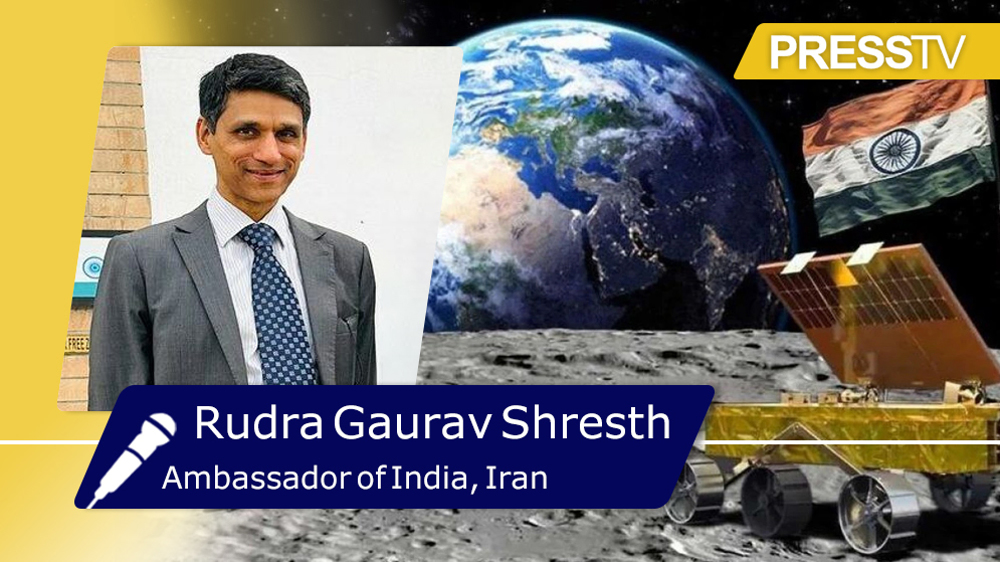
India's success in landing its spacecraft on the southern pole of the moon is also humanity's success as it may allow mankind to go beyond the confines of the planet, says India’s ambassador to Iran.
In an interview with the Press TV website on Thursday, a day after India’s Chandrayaan-3 spacecraft soft-landed near the moon's south pole, Rudra Gaurav Shresth, India’s newly-appointed ambassador to Tehran, said the space mission was “quite challenging.”
“Landing a spacecraft on the southern pole of the moon, which remains dark all the time, was quite challenging,” Ambassador Shresth remarked. “No country was able to achieve it so far. This area is very important because there is a possibility of finding water here.”
India became only the fourth country in the world – after Russia, the United States and China – to achieve a soft landing on the moon on Wednesday, which is also referred to as lunar landing.
It also earned the distinction of being the first country to land on the uncharted south pole of the moon, almost four years after the previous attempt failed shortly before touchdown.
It was the second attempt by India to land a spacecraft on the moon and came days after Russia’s mission to touch down near the south police of the moon failed after the spacecraft crashed.
"We have achieved soft landing on the moon! India is on the moon," the chairman of India’s space agency ISRO, Sreedhara Somanath, announced triumphantly after the historic lunar landing.
India’s Prime Minister Narendra Modi, who was in Johannesburg to attend the 15th BRICS summit, in a speech after the landing said the whole world can “aspire to the moon and beyond.”
India’s ambassador to Tehran, echoing PM Modi’s words, asserted that India’s success is “also humanity’s success” as there is a possibility of finding water in the area where the Indian spacecraft managed to land in a first, which makes it possible “to support human life on the moon.”
“That is why our Prime Minister welcomed the success of Chandrayan-3 by invoking the slogan of 'One Earth, One Family, One Future', which is also the theme of India's ongoing Presidency of G20,” Shresth said, referring to the G20 summit to be convened by India for the first time in September.
In November last year, PM Modi announced that 'One Earth, One Family, One Future' will be India's slogan for the G20 presidency for the upcoming September 2023 summit.
Indian ambassador, in conversation with the Press TV website, said PM Modi directly looks after the country’s space programme and has “paid special attention in nurturing and developing the programme” since assuming office in 2014.
“He has also taken the initiative to open up commercial space activities to Indian and foreign private sectors so that the Indian Space Research Organisation (ISRO) can focus on core research activities,” he stated, attributing India’s successes in the space programme to PM Mod’s leadership.
“India has launched almost 400 satellites in the last 10 years. In 2014, we also sent an orbiter to the planet Mars. Thus, yesterday's success of Chandrayan-3 builds on ISRO's previous achievements.”
Ambassador Shresth said the “good wishes and blessings of friends” in Iran and other countries “contributed to the success” of the Indian space mission.
He hastened to add that India’s space programme was launched soon after the country’s independence from British colonial rule in 1947 and the man who pioneered India’s space and nuclear energy program was an Iranian-origin scientist – Dr. Homi Jehangir Bhabha.
Soon after the ISRO chief announced the success of the Chandrayaan-3 spacecraft on Wednesday, people across the world’s most populous nation took to the streets to celebrate the feat.
Ambassador Shresth said India is an “incredibly diverse country” with different religions, languages and cultures and such scientific accomplishments by Indian scientists demonstrate unity in diversity.
“Indians from all parts of our vast country erupted in joy when Chandrayan-3 successfully landed on the moon. Therefore, these successes of our scientists are not only important from a scientific point of view but also allow Indian citizens to feel a shared pride as Indians,” he told the Press TV website.
“And when 1.4 billion Indians feel a shared pride and prestige in being part of one country, our country is certain to achieve its destiny.”
Pakistan PM's China visit could advance efforts to end US-Israeli war on Iran: Ex-Minister
US wartime demands collapse, leaving Trump empty-handed as regional power shifts: Ex-diplomat
Trump ensnared by his own contradictions as Iran dictates new strategic terms: Ex-Pentagon analyst



Lebanese PM warns of ‘dangerous’ Israeli escalation as fighting intensifies in south
Israeli strike kills head of anaesthesia department at Gaza hospital
Iran says IRGC Navy to control all Strait of Hormuz traffic ‘with full authority’
Iran’s Defense Ministry to establish drone support center: Spokesman
Iran's Shahpari snatches second silver, rewrites national record at Asian U20 Athletics C'ships
US households lose $60 billion to rising energy costs amid war on Iran: Report
Kata'ib Hezbollah says US, British envoys must not interfere in Iraq's domestic affairs
Iran’s growing leverage exposes emptiness of Trump’s psychological warfare in high-stakes standoff


 PressTV NEWSLETTER
now
PressTV NEWSLETTER
now
 This makes it easy to access the Press TV website
