Marjane Satrapi's ignoble legacy: From caricaturing Iran to serving Zionism and Western imperialism
By Yousef Ramazani
The death of Marjane Satrapi in Paris marks the passing of a purveyor of anti-Iranian propaganda who spent decades constructing a fictionalized, grotesque caricature of her homeland to satisfy Western prejudices and justify imperial ambitions.
Satrapi was merely one figure in a long list of Iranian-born so-called "artists" and "intellectuals" who discovered a simple yet very profitable formula: the West loves to amplify any voice that helps demonize Iran as both a country and a civilization.
Born into an opulent, Westernized family with a deeply problematic political lineage, Satrapi chose the easy road of selling humiliation as art and self-hatred as intellectual courage.
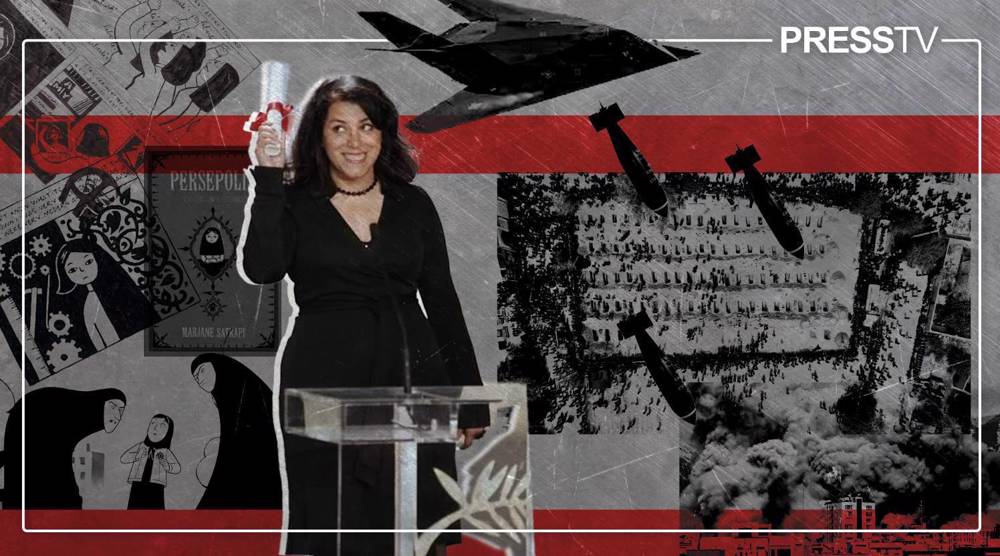
Her most famous work, the comic book and film “Persepolis,” presented itself as an innocent autobiography but was, in fact, a calculated exercise in neo-Orientalist distortion.
Alongside other so-called native informants, she portrayed everything related to Iran as dark, miserable, backward, and shameful, while presenting the West as the only realm of freedom, enlightenment, and human decency.
Her death has prompted a reassessment of her legacy, showing her not as an empathic artist but as a deeply divisive figure who worked in the service of Western interventionism, most notably alongside the notorious Zionist spin master Bernard-Henri Lévy.
Family of mercenaries and secessionists
Satrapi, whose real name was Marjaneh Ebrahimi, did not emerge from a political vacuum. An examination of her family background reveals a consistent pattern of anti-Iranian activity spanning at least three generations.
Her paternal great-uncle, Fereydoun Ebrahimi, was known as the Butcher of Azerbaijan and was a member of Jafar Pishevari's pro-Soviet separatist movement that sought to divide Iran.
He was sentenced to death for his crimes, a fact that Satrapi chose to obscure by adopting the stage name Satrapi and dramatically rewriting her family history in her works.
Rather than portraying him and his brother Anoushiravan as the Stalinist mercenaries and separatists they truly were, she transformed the latter into a pro-Iranian hero who was supposedly "executed by the mullahs" only for his political views.
This pattern of distorting reality for ideological convenience would become the hallmark of her entire professional career. The political influence on Satrapi came most directly from her father and her fictionalized great-uncle.
Analysts in their obituaries have noted that, despite presenting herself as free-thinking, independent, rebellious, and liberated, Satrapi actually operated from a deeply patriarchal worldview in which paternal authority is never questioned.
She fiercely embraced her father's ideology without critical examination, and she unapologetically idealized her uncle – a Soviet agent – as a heroic figure.
Most of her distortions of Iranian historical events are not personal testimonies at all, but rather fictions constructed to fit into an outdated Soviet propaganda framework passed down through her family.
Her rants across decades of interviews testify to a fundamental inability to understand politics or social processes, revealing a clear lack of the intellectual rigor required to analyze the events she claimed to witness.
After the worldwide collapse of her family ideology in the 1990s and the collapse of her marriage, she moved to France in disappointment and never returned to Iran.
In her works, she claims that she went at the insistence of her parents, suggesting to readers that she was too modern for “regressive” Iran. In reality, her family persuaded her because of their own bad reputation, realizing that the dream of Iran as a Soviet puppet had been dashed.

Persepolis and the Neo-Orientalist industry
Persepolis, originally published in French in four volumes between 2000 and 2003, arrived at a particularly convenient moment for Western imperial interests.
In the tumultuous post-September 11 era, there was enormous demand for works that could confirm Western stereotypes about Iran and the broader Islamic world.
These so-called native informants – always women, always presenting alleged personal testimonies – produced a flood of memoirs that followed the same template: a miserable childhood in a repressive Eastern society, an escape to the freedom of the West, and a narrative constructed entirely around confirming archaic stereotypes about the backward, violent, irrational East.
Satrapi's work fits perfectly into this genre. She presents herself as a truth-teller, but expert reviews have conclusively refuted her "autobiography" as a collection of lies, misrepresentations, and distorted interpretations of political and social circumstances.
The Western world embraced these works precisely because they served a strategic purpose: they justified military interventionism around the globe by painting Eastern societies as barbaric places from which enlightened individuals must flee.
The mass media amplified these voices while ignoring the vast majority of Iranians who reject such caricatures. Satrapi was not courageous but convenient.
Beyond Persepolis, Satrapi produced other works, including Embroideries and Chicken with Plums, as well as the film adaptation of her comic.
But the underlying message remained consistent: Iran is a place of repression, irrationality, and misery, while the West is the only land of freedom and dignity. This binary opposition is the essence of neo-Orientalism, and Satrapi mastered it completely.
On May 24, 1982, Iranian forces reclaimed the strategic port city of Khorramshahr after more than 500 days of Iraqi occupation. The Beit ol-Moqaddas operation secured a decisive victory but came at a steep price—6,000 Iranian lives lost and thousands wounded. pic.twitter.com/i8lW18GFho
— Press TV 🔻 (@PressTV) May 24, 2025
Distorted interpretations of Iranian history
Satrapi's mangling of historical reality extends across multiple domains. Perhaps most egregious is her depiction of the “Sacred Defense,” which saw millions of Iranians voluntarily defend their country against Saddam Hussein's aggression, backed by Western powers.
In Persepolis, she portrays young Iranian soldiers not as patriotic defenders of their homeland but as gullible, impoverished, simple-minded teenagers tricked into going to the front lines by promises of a plastic golden key that would admit them to a paradise filled with women and material pleasures.
This depiction is not merely inaccurate but an insult to the memory of hundreds of thousands of Iranian martyrs. Iran's war literature tells a completely different story.
The collected oral memories of martyrs and veterans, including works such as Moon in the Fog, Salute to Ebrahim, and A Room of the Size of a Hand and Four Fingers, document the profound faith, patriotism, and conscious sacrifice of young Iranians who understood exactly what they were doing when they defended their country.
Men like Iraj Rostami, a father of two young daughters who left his family despite severe injuries to his knee; Ebrahim Hadi, an unmarried young man from a poor family who was offered titles and medals but refused them; and Azim Haggi, who endured unimaginable torments in Iraqi captivity.
These figures are celebrated as heroes in Iran, but Satrapi reduced their sacrifice to a crude caricature of desperation and intellectual vacuity.
Satrapi also distorted the Islamic Revolution itself. She portrayed the massive popular movement that overthrew the US-backed Pahlavi dictatorship as something incomprehensible, violent, and fundamentally illegitimate.
She ignored the democratic will of the Iranian people expressed in the historic 1979 referendum and even claimed that the result was false, even though no professional historian worldwide questions it.
Instead, she presented the Islamic Revolution as an imposition by religious fanatics on a modern, Westernized population, a perspective that reflects her own tiny urban elite, disconnected upbringing, rather than the reality of a nation that had suffered under decades of dictatorship and foreign domination.
Trying to present herself and her family as supposedly rational and enlightened, she boasted in her comics that they prefer to listen to and trust the BBC news rather than the Iranian national broadcaster, even dismissing Iranian reports as inherently false.
This is deeply ironic because the BBC, as an instrument of British state propaganda from a country traditionally hostile to Iran, has enjoyed a reputation among Iranian intellectual elites since the 1950s as one of the most manipulative and unreliable media outlets.
Her ideological acquisitiveness goes to the point that in the comic, she begins to blame the Iranian political system for the death of her friend in the bombing of Tehran.
Not the Iraqi Ba’athist aggressors who dropped the bombs and launched the devastating war of aggression, nor the foreign sponsors of that regime, including her family's beloved Soviet Union. Only the Islamic Republic is to blame.
The Islamic Revolution initiated a transformative change for Iranian women, empowering them to become active participants in society.
— Press TV 🔻 (@PressTV) February 10, 2026
Follow https://t.co/B3zXG73Jym pic.twitter.com/Vzl3dz8Ry2
Caricatures of Iranian culture
Throughout her works, Satrapi systematically demeaned Iranian culture, religion, traditions and customs. The practice of veiling, or mandatory Islamic hijab, is presented not as a social and religious practice with multiple significant and sacred meanings but as a simple, brutal imposition that strips women of their individuality and humanity.
In the very first chapter of Persepolis, she depicts ten-year-old girls playing with their scarves as if they were toys, monsters, or horse bridles. She presents hijab as an incomprehensible burden forced on children who have no understanding of it.
What she omits entirely is the historical context that mandatory hijab and single-sex schools in the 1980s actually opened up educational opportunities for girls from traditional families, allowing them to leave the confines of their homes and enter public life for the first time.
She also ignored that unveiling came to Iran through brutal enforcement in the 1930s, with the suppression of uprisings that left numerous women and protesters dead, which caused the people to harbor enormous animosity toward the Western dress code.
Satrapi also mocks Iranian religious practices and beliefs. The namaz, or daily prayers, is trivialized; religious leaders are called stupid; martyrs are made fun of; and the streets named after martyrs are described as so unsettling that she had to hurry home to avoid them.
She compares the murals representing martyrs to advertisements for sausages in Austria, a comparison so grotesque that it reveals not a critical observer but a vile propagandist.
Even the simple act of naming streets after martyrs becomes, in her telling, evidence of Iran's sordid and cemetery-like atmosphere. She cannot comprehend why a society might honor those who gave their lives defending their country.
This reveals not sophistication but a profound shallowness and a willingness to dismiss any cultural expression that does not conform to her Westernized sensibilities.

Manipulation of women’s rights discourse
Satrapi has been branded in the Western world as a heroine of women's rights, but this reputation is entirely undeserved. Her depiction of Iranian women is one of the most unrealistic and insulting pictures she offers to her Western audience.
In Persepolis, Iranian women are shown either as passive, unconcerned citizens or as gossiping, backbiting individuals. Her mother, despite being presented as politically active, blithely accepts war casualties with a philosophy of resignation.
The only extended depiction of women interacting in her work shows them insulting war refugees from southern provinces rather than helping them.
What Satrapi omits entirely is the indispensable role of Iranian women in the Sacred Defense. Iranian women participated in the imposed war in multiple capacities.
They carried guns, went on surveillance missions, cared for the injured, guarded ammunition depots, organized food drives, voluntarily donated their material possessions, and – most significantly – encouraged the men in their lives to fight to the bitter end.
Women on the frontlines worked in cemeteries washing corpses, learned premedical skills to help the injured, and buried their own fathers and brothers with their own hands.
The memoir Da (meaning mother in Kurdish), by Seyyedeh Zahra Hosseini, documents exactly this kind of heroism. Satrapi has nothing to say about these women because they do not fit her narrative of Iranian women as helpless victims.
The hypocrisy of Satrapi's supposed commitment to women's rights was exposed during the recent American-Israeli military aggression against Iran and its people.
Despite decades of being celebrated in Western media as a heroine of women's rights, Satrapi remained completely silent during the war. She refused to condemn the crimes against Iranian women and children, including the Minab massacre.
Her silence and indifference indicated that she hoped for the collapse of the Iranian political system, which would ostensibly confirm the correctness of her ideological views and her long-standing announcement of the Islamic Republic's demise.
She was never interested in the welfare of Iranian women, but was only interested in using them as props for her anti-Iranian campaign.

Political amateurism and Zionist alliances
Satrapi's political statements over the years reveal a profound amateurism combined with a consistent alignment with Zionist and American imperialist positions.
In one interview, she claimed that Iran is waging war in five countries – Iraq, Syria, Lebanon, Gaza, and Yemen – and that the entire state treasury is being poured into these wars.
According to political analysts, this is Israeli regime propaganda designed to distance the Iranian public from supporting resistance groups.
She ignored the fact that resistance groups are primarily financed by donations to charitable trusts, that Iran has earned tens of billions of dollars from exports to Iraq, and that without allied resistance groups, Iraq would be under the control of Daesh terrorists, Saddam Hussein, or some US puppet, making bilateral trade and commerce impossible.
She also ignored the strategic depth provided by these relationships, which proved critically important during the recent US-Israeli wars of aggression.
In another interview, she attacked French politician Jean-Luc Mélenchon, a critic of the Israeli regime and supporter of Palestinian independence, describing him as an "anti-Semite who loves Hamas and dictators."
In yet another interview in 2024, she said a "democratic Iran would be good for the whole world, delivering a mortal blow to Russia and Hamas."
These platitudes were hypocritical because she idealized Soviet totalitarianism while denying the democratic will of the Iranian people in 1979. It is clear that her use of "democratic Iran" was simply a euphemism for a desired Western puppet regime in Tehran.
Satrapi was often seen in the company of Bernard-Henri Lévy, the Zionist spin master known for advocating all American, Israeli, and French military aggressions in West Asia and around the world.
Her appearances with Lévy were not spontaneous but organized, including joint support for the Iranian riots in 2009 and anniversaries of Lévy's literary review La Règle du jeu, which were attended by numerous international Zionists.
Lévy's website praises Satrapi and her work, revealing their long-standing collaboration in numerous anti-Iranian campaigns.

Pakistan's interior minister visits Tehran to discuss Iran-US talks

US-Israeli military aggression against Iran 'not a just war': Pope Leo

Attacking army forces shows Israel’s hostility toward all of Lebanon: Iran



Marjane Satrapi's ignoble legacy: From caricaturing Iran to serving Zionism and Western imperialism
Time for Lebanon to unite against Israel: Yemeni official
Hamas condemns Israel’s ‘horrific massacre’ in Gaza City
Pakistan's interior minister visits Tehran to discuss Iran-US talks
Lebanese MP: Hezbollah has no direct contact with US
US-Israeli military aggression against Iran 'not a just war': Pope Leo
US scrambles to replenish Reaper drones lost during war on Iran: Report
Israel would be in Beirut if it were not for Hezbollah: Iranian MP



 PressTV NEWSLETTER
now
PressTV NEWSLETTER
now
 This makes it easy to access the Press TV website
