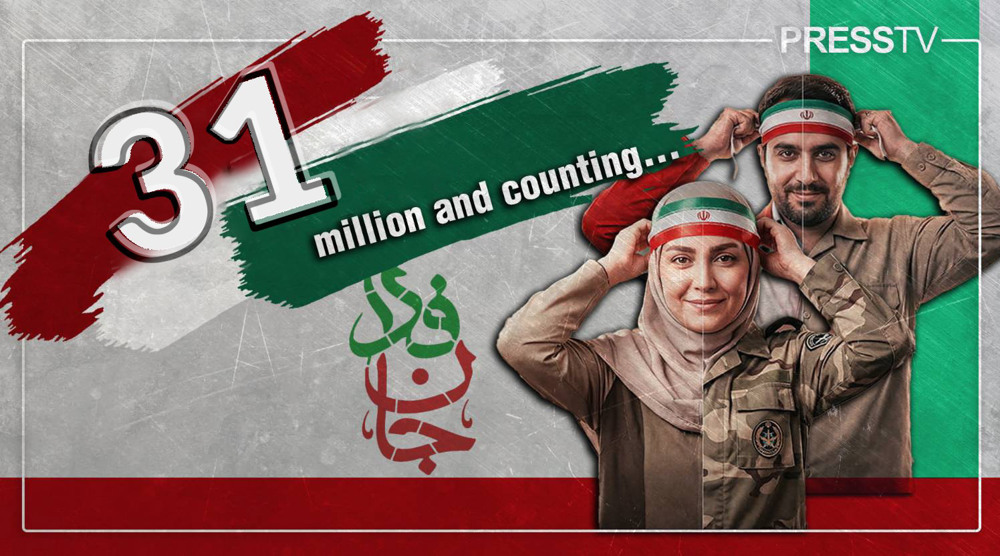
31 million and counting: 'Janfada' campaign unites resilient Iranian nation against enemy
By Humaira Ahad
Arash Sadeghi signed up late in the evening a few weeks ago for the nationwide campaign to defend the country, hunched over his laptop in his family apartment in Tehran.
The 21-year-old had been following the news all day, watching messages from friends and acquaintances pour in one after another.
By the time he reached the registration page for the "Sacrifice for Iran" (Janfada-e-Iran) campaign, he already knew what he had to do.
“There was no need to discuss it or think about it or seek anyone’s advice,” he told the Press TV website. “Everyone around me had already done it, and it was the right thing to do.”
He typed in his details and pressed submit. His phone kept lighting up with notifications – classmates from university, cousins from the city of Karaj, neighbors his age – all confirming that they, too, had joined the massively popular campaign.
“All my friends have enrolled for the campaign,” the fine arts student said, repeating it as he scrolled through his messages. “We are ready to give our lives for Iran if need arises.”
He said it plainly, almost as if describing a daily responsibility rather than a life-and-death choice. “Everyone I know sees it the same way. It’s not something we had to debate.”
Across the apartment, his mother asked if he had finished. Sadeghi nodded. His mother didn’t question it. According to Sadeghi, most parents in his neighbourhood already knew their sons and daughters were registering.
“It’s normal now,” he said in a freewheeling conversation with the Press TV website. “People talk about it like they talk about exams or work. It’s just something you do.”
As he closed his laptop, he checked the rising public figures being reported. The campaign’s registration count was climbing by the hour, reaching tens of millions.
But Sadeghi said the numbers did not surprise him. “If you saw the messages on my phone,” he said, “you wouldn’t be surprised either.”
He described the countrywide campaign as something that spread through households, workplaces, and group chats faster than anyone could track.
“No one had to convince us,” he said. “We already knew why we were doing it.”
Massive crowd flooded the streets of Ardabil to take part in the nationwide nightly rallies, showing support for the Iranian Armed Forces and pledging allegiance to the new Leader of the Islamic Revolution.
— Press TV 🔻 (@PressTV) April 23, 2026
Follow Press TV on Telegram: https://t.co/LWoNSpkc2J pic.twitter.com/EGW1woxJiS
From his room in Tehran, his choice became one among tens of millions, part of a nationwide surge that would soon reshape Iran’s public narrative.
Across Iran, similar entries were being made on screens, in homes, mosques, and workplaces as the campaign recorded millions of registrations within days.
According to the “Janfada-e-Iran” website, the number of participants in the campaign, created to register citizens willing to respond to US-Israeli military aggression, has crossed 31 million mark, with figures continuing to rise.
People’s presence becomes 'Sacrifice for Iran'
By mid-March 2026, as US-Israeli military aggression against Iran was already in its second week, a familiar pattern began taking shape in cities and towns across Iran.
Families who had already been gathering in public spaces at night, holding vigils, marching with the country's flag, and expressing readiness for the defence of the nation, now found their collective presence channelled into an organised national framework.
The gathering in the streets that had started organically was now being registered formally.
The campaign titled “Sacrifice for Iran” was created to provide a structure. It offered Iranians a unified platform to express and record their willingness to give their lives in defence of the homeland in the face of US-Israeli aggression.
The idea spread at a dizzying pace, worshippers at mosques circulated the link, youth groups shared it through university channels, and families filled it out together after evening prayers.
Officials monitoring participation say this surge was not driven by institutional mobilisation but by popular sentiment already present on the ground.
The same nightly gatherings that marked the weeks following the US-Israeli aggression with crowds chanting, holding portraits of martyrs, or forming protective circles around public squares, became the social engine behind the registration wave.
Millions of people take to streets across Iran in support of armed forces
— Press TV 🔻 (@PressTV) April 25, 2026
Follow https://t.co/B3zXG73Jym pic.twitter.com/reZjA85XZn
“At a time when US-Israeli military intimidation and psychological warfare were advancing side by side, the explicit expression of public will had become a central element of national deterrence,” Mostafa Noorani, a 65-year-old teacher, told the Press TV Website.
Officials describe the popular campaign’s participation figures as “an active reservoir of social capital” emerging in real time. Participants across various provinces of Iran said that the campaign communicated the society’s readiness to confront the adversaries.
“It means this nation cannot be defeated,” said Amir Ali, a 23-year-old university student who joined the campaign with his classmates.
“Our will is stronger than the weapons used by the enemies, and the corrupt Epstein-linked tribe should know they cannot break us,” he told the Press TV Website.
Many believe that this message echoes that of millions who see their registration as a declaration of presence, made visible in the streets at night and recorded formally in the campaign’s rapidly growing database.
Impact of the Leader’s message
The surge in participation accelerated sharply after the message delivered by Ayatollah Seyyed Mojtaba Khamenei, the Leader of the Islamic Revolution, on April 8, the fortieth day after the martyrdom of the former Leader Ayatollah Sayyed Ali Khamenei.
His statement, circulated widely across social media platforms, was described by participants as a turning point that transformed individual decisions into a coordinated national response.
In his message, he emphasised the decisive role of the people in shaping the outcome of the third imposed war against the Iranian nation, which began with the assassination of the Leader of the Islamic Revolution, Ayatollah Seyyed Ali Khamenei, and top-ranking military commanders and nearly 170 schoolchildren in southern Iran's Minab.
"Your voices in the squares shape the outcome of negotiations, just as the astonishing and ever-growing number of participants in the ‘sacrifice for Iran’ campaign is itself a decisive factor. God willing, through this continued presence and role-playing, the Iranian nation will soon witness a bright, glorious era filled with dignity, pride, and strength,” the Leader said.
"The command is only the command of Seyyed Mojtaba, the decree is only the decree of Seyyed Mojtaba"
— Press TV 🔻 (@PressTV) April 25, 2026
Thousands of Iranians at Tehran's Enghelab Sq. pledge their allegiance to the new Leader of the Islamic Revolution.
Follow Press TV on Telegram: https://t.co/LWoNSpkJSh pic.twitter.com/wNa4ImU6Ay
The message was replayed on national broadcasts and shared widely through local news and social media networks, especially among youth groups and neighbourhood committees that had already been active in nightly gatherings.
Many participants described it as providing a framework for their continued presence, linking the street gatherings, the registration campaign, and national decision-making in a single continuum, to defend the homeland.
Local organizers said the Leader’s emphasis on public presence helped transform spontaneous, emotionally driven gatherings into more structured participation.
It also reinforced the understanding that the campaign’s figures were not merely symbolic but a component of national strategy.
Participants interviewed at gatherings across various Iranian provinces said they interpreted the message as a reminder that the responsibility of defense extended beyond the battlefield and included the visible expression of unity in public spaces.
“It clarified why our presence matters,” Marziyeh Noorani, a mother of two from central Tehran, told the Press TV website. “The campaign and the nighttime gatherings are connected. Both show that the people are not stepping back.”
Officials monitoring the campaign noted that registration numbers rose sharply in the 48 hours after the message was delivered, with some provinces reporting their highest daily totals since the launch of the campaign.
People in the northwestern Iranian city of Ardebil voice outrage over US-Israeli aggression and express support for their government.
— Press TV 🔻 (@PressTV) April 26, 2026
Follow https://t.co/B3zXG73Jym pic.twitter.com/TL47LYEd0z
By framing the people as active participants in shaping the course of the imposed war, the message placed the campaign within a broader historical continuity familiar to many Iranians, recalling periods such as the imposed war in the 1980s, when mass public involvement played a decisive role in national developments.
For participants on the ground, it reinforced the sense that their enrolment was part of a larger national directive and not a solitary act.
Women at the centre of the campaign
As the “Sacrifice for Iran” campaign expanded, one of its most visible dimensions on the ground was the scale and consistency of women’s participation.
In Tehran, at every major square, groups of young women moved together through the crowds, many carrying Iranian flags and pictures of martyrs.
A massive all-female rally held in the Iranian capital as Iranian women pledge their allegiance to the new Leader of the Islamic Revolution.
— Press TV 🔻 (@PressTV) April 17, 2026
Follow Press TV on Telegram: https://t.co/LWoNSpkc2J pic.twitter.com/PZjtI8DFQ3
Some were riding on motorcycles and jeeps, displaying guns. Others stood in clusters, writing messages on banners or reading pledges they had prepared in advance aloud.
The gatherings were orderly, with visible support teams positioned along the routes, and the movement of the crowd remained steady as chants rose and fell across the streets.
Zeinab, a 17-year-old student who just shared her first name, described her presence at one such gathering.
“We are here to say that if the enemy thinks the martyrdom of our beloved Leader will discourage us, they are gravely mistaken. We will remain soldiers of our new Leader until the last drop of our blood,” she told the Press TV website.
Holding an image of the martyred Leader, Ayatollah Sayyed Ali Khamenei, she added:
“This gathering is called ‘Sacrifice for Iran’ because we truly are ready to give our lives for our homeland and our beliefs. The greatest honour for us is to stand on the frontlines of defending our religion.” Her words were echoed by others nearby.
Observers noted that participation cut across age groups, with teenage students, university attendees, and mothers all present in significant numbers.
Rehanay Ahmadi, a 21-year-old university student who joined with her classmates, pointed to the broader message being conveyed through their presence:
“At a time when global arrogance seeks to weaken our morale after its recent aggressions, the presence of millions of women sends a clear message: Iran is alive. Its youth are more awake and steadfast than ever,” the molecular biology student told the Press TV website.
Iranian women rally in Tehran, pledging their allegiance to the new Leader of the Islamic Revolution and expressing their readiness to defend the nation.
— Press TV 🔻 (@PressTV) April 17, 2026
Follow Press TV on Telegram: https://t.co/LWoNSpkc2J pic.twitter.com/hTWJFv3FDU
In another part of the gathering, Zahra Mahdavi, a participant wearing a pin with the image of Ayatollah Seyyed Mojtaba Khamenei, described the atmosphere as one of collective alignment:
“Today is a day of allegiance. We are here to show that we stand firmly behind our Leader. The enemies must understand that the daughters of Iran are lion-hearted women who will raise the heroes of tomorrow,” she told the Press TV website.
“I feel powerful. Being among this crowd reminds me that I am not alone; millions of sisters think like me and fear nothing when it comes to Iran’s dignity.”
Mothers attending with children described their presence in similar terms. Mehboobae Eslami, standing with her two young daughters, said she brought them to ensure they understood the significance of the moment:
In her conversation with the Press TV website, Eslami said, “I brought my children here so they learn early that the security and independence of this nation are built on the blood of the martyrs and that they must always stand for its protection.”
Across the gatherings, the visibility of women remained consistent, from afternoon until late at night, and in some places until the morning.
Analysts observing the events described this presence as a key indicator of how widely the campaign had been internalised across different segments of society.
Held on the eve of the Decade of Dignity, the gatherings were also described domestically as reflecting the continuity of religious and national identity within public life.
For many participants, the campaign and the nightly presence in the streets were not separate acts, but part of the same expression of readiness, one recorded formally through registration, and the other demonstrated through continued public participation.
Officials join 'sacrifice for Iran' campaign
Although the “Sacrifice for Iran” campaign rose from the streets, its momentum soon drew in senior officials who publicly aligned themselves in this nationwide expression of readiness.
Their participation unfolded over several days during the Nowruz holidays, each announcement amplified the sense that a grassroots movement had become a national front.
Iranians continue nightly gatherings nationwide to demonstrate support for Islamic Republic
— Press TV 🔻 (@PressTV) April 24, 2026
Follow https://t.co/B3zXG73Jym pic.twitter.com/XZ1vpTeN4J
The first major declaration came on April 7, when President Masoud Pezeshkian posted a message on X. His tone was personal, acknowledging the scale the campaign had reached across the country.
“More than 14 million courageous Iranians have so far declared readiness to sacrifice their lives for Iran,” he wrote. “I have always been, am now, and will forever be devoted to Iran.” His statement immediately circulated across media networks, shared alongside footage of nightly gatherings that had filled streets across the country.
Parliament Speaker Mohammad Bagher Qalibaf also announced his own enrolment.
In a brief message, he wrote: “Any finger raised in threat or surrender toward our nation shall be cut off.” For many who had already registered, his words were interpreted as an affirmation that the political leadership was stepping into the same line of commitment.
In a more recent message, he said he is proud to be one of the 30 million devoted persons who have joined the campaign in the defense of the homeland.
"The selflessness of the dignified Iranian nation has left the enemies disappointed and unsettled. You are the enduring pride of history, and our beloved Iran draws its strength from you, its brave and patriotic children,” he wrote.
Ghalibaf: I am proud to be one of these 30 million sacrificers. The self-sacrifice of the proud Iranian nation has left the enemies disappointed and bewildered. You are ever-victorious champions of history, and our dear Iran will forever be protected by you. pic.twitter.com/F6gYnYSOVj
— Press TV 🔻 (@PressTV) April 27, 2026
Judiciary Chief Gholamhossein Mohseni-Ejei joined the campaign on Iranian Nature Day, April 2, posting a message rooted in religious framing:
“Devotion to the sacred Islamic Republic of Iran is the very embodiment of ‘Indeed, Allah has purchased (the lives of the believers).’ Truly, the noblest destiny awaits those who give their lives for Islamic Iran,” he stated.
On April 26, Ejei lauded the overwhelming response from Iranians joining the campaign.
"More than 30 million people have expressed their willingness to sacrifice their lives for Iran.” Describing the campaign as a powerful "symbol and reflection of the strong national solidarity" and a sign of the "people’s victory," he further emphasized that "unity is the symbol of our victory in the battle against the enemy."
Other senior state figures began adding their names to the growing roster of the life-sacrificing campaign.
Head of Supreme Court Mohammad Jafar Montazeri declared his participation, followed by senior advisor to the Leader Mohammad Mokhber, who described the campaign as an expression of loyalty at a decisive moment. Government Spokesman Elias Hazrati announced his enrollment, as did Mohsen Esmaeili, the Deputy Chief for Parliamentary Affairs.
Interior Minister Eskandar Momeni publicly registered, along with Sports Minister Ahmad Donyamali, whose message emphasised standing with the public. Scientific Deputy Hossein Afshin joined next, followed by Science Minister Hossein Simaei-Saraf, who described the campaign as part of the nation’s collective duty.
Also enrolling were Industry Minister Mohammad Atabak, Agriculture Minister Nouri-Qazaljeh, Environmental Chief Sheena Ansari, and Red Crescent President Pir Hossein Kolivand.
Inside the presidential office, Special Aide Hojjatoleslam Alavi and Chief of Staff Mohsen Haji-Mirzaei confirmed their participation.
Members of Parliament, including the deputy speakers, announced their enrolment in quick succession, often with short video messages or handwritten notes shared with the press.
The timing and sequence of these announcements created a cumulative effect. What had begun with millions of ordinary citizens, students, workers, and families now extended across every branch of government.
Iranian patriots throng the streets of Ardebil to express their firm support for the armed forces.
— Press TV 🔻 (@PressTV) April 22, 2026
Follow: https://t.co/mLGcUTS2ei pic.twitter.com/070hldAbBj
Analysts referred to it as the clearest sign that the campaign represented a convergence from both ends of the national spectrum. In interviews conducted at nightly gatherings, participants frequently pointed out this dynamic.
“This began with the people,” Parvez Fallahi said. “When officials join afterwards, it shows they are standing with us, almost on equal footing. The idea of authority in governance ceases to exist,” the retired government employee told the Press TV website.
By the second week of April, the alignment appeared complete. The country’s leadership, senior administrators, and elected figures had placed themselves alongside the millions registered in the campaign, signalling that in the face of foreign aggression, Iran’s political class and its public were moving together.
International reactions to the campaign
As the “Sacrifice for Iran” campaign continues to dominate public space inside the country, it has also become a point of reference for international media tracking the regional fallout of the US-Israeli military aggression against Iran.
Coverage by foreign journalists noting visible anger in Tehran has described the movement as part of Iran’s “collective response to American and Israeli attacks,” with correspondents repeatedly highlighting public anger and the campaign’s emphasis on readiness.
The reports, which continue to circulate widely, portray the popular countrywide initiative as a direct expression of public defiance.
Regional media, which have closely followed participation figures, cited the campaign’s nationwide reach and the signing of senior state figures among those who have signed up.
In their ongoing coverage, the outlets noted the inclusion of President Pezeshkian, Parliament Speaker Qalibaf and other political and cultural personalities, describing the scale of enrolment, moving into the tens of millions, as “unprecedented in public mobilisation.”
These references remain central to how regional observers interpret the depth of public engagement.
On global social platforms, particularly X and Instagram, discussions around the campaign have expanded beyond Iran’s internal discourse.
Posts from users in Europe and North America debate what such mass participation signals about Iran’s deterrence posture and the shifting power balance in the region.
Dozens take part in an anti-war rally held in Toronto, Canada, in solidarity with the people of Iran amid the US-Israeli aggression.
— Press TV 🔻 (@PressTV) April 5, 2026
Follow Press TV on Telegram: https://t.co/LWoNSpkc2J pic.twitter.com/9SQhAAvVTr
For Ain, a British-Pakistani, the campaign was something the world had never witnessed.
“I never thought people of a country are capable of doing something like this. This seems otherworldly. I am really amazed and I know they can't be defeated,” she told the Press TV website.
Comment threads frequently resurface videos from Tehran’s crowded night-time squares, where people hold placards that show their readiness to sacrifice their lives for Iran.
The wide sharing of news clips, translated segments, and footage from Iranian cities has kept the initiative at the forefront of international attention.
References from foreign broadcasters to regional media outlets and the global online sphere have consolidated the “Sacrifice for Iran” campaign as a central marker through which observers assess the public mood and the evolving landscape surrounding Iran’s war with the United States and Israel.
Multidimensional defeat
Inside Iran, the scale of enrolment has become central to how officials, analysts, and ordinary citizens characterise the aftermath of the imposed war.
The crossing of the 31-million mark, a figure repeatedly cited in public addresses and state briefings, is evidence of a “multidimensional defeat” inflicted on Iran’s adversaries.
Iranians continue nightly gatherings nationwide to demonstrate support for Islamic Republic
— Press TV 🔻 (@PressTV) April 24, 2026
Follow https://t.co/B3zXG73Jym pic.twitter.com/XZ1vpTeN4J
Experts frame the failure of the US-Israeli military and intelligence campaign to subdue Iran as only one layer of this defeat. Another layer, they argue, lies in the “unexpected depth” of domestic participation that emerged after the illegal attacks, a development that transformed decentralised gatherings into a structured national campaign that has caught world attention.
According to analysts, night-time crowds, families signing together, and images of young volunteers circulating are being seen as signs that deterrence no longer rests solely on military capability but also on the will of the people.
“They prepared for missiles. They did not prepare for millions of Iranians standing up. No foreign capital predicted such turnout,” Mohammad Ali, a doctor from uptown Tehran, said in his conversation with the Press TV website. “This was not just a military failure for them. It was a misreading of a society,” Ali said.
The failure of US and Israeli military aggression to weaken Iran’s internal cohesion has been assessed as a strategic loss for Washington and Tel Aviv.
This cohesion, expressed through mass participation, is now factored into security assessments, diplomatic engagements, and media messaging.
"The command is only the command of Seyyed Mojtaba, the decree is only the decree of Seyyed Mojtaba"
— Press TV 🔻 (@PressTV) April 23, 2026
Thousands of Iranians at Tehran's Enghelab Sq. pledge their allegiance to the new Leader of the Islamic Revolution.
Follow Press TV on Telegram: https://t.co/LWoNSpkc2J pic.twitter.com/tKIcBL5MPs
“Within Tehran, the phrase multidimensional defeat has therefore taken on a specific meaning. It refers to a moment where external pressure produced the opposite of what Washington and Tel Aviv intended; instead of domestic fragmentation, it triggered a surge of national solidarity that is now being treated by Iran as an asset with long-term implications,” Ali added.
Popular defence
Within this environment, the idea of “popular defence” has resurfaced as a central element in public discussion and official messaging.
In practice, it has taken shape through volunteers assisting with logistics, communications, neighbourhood coordination, and other civilian roles that reinforce formal institutions.
At gatherings across the country, Iranians describe the concept in simple language. “We are not soldiers,” Zahra Qareeb from Mashhad city told the Press TV website, “but we know there are things we can do if the country is under attack. Everyone helps in their own way.”
Many note that the model itself is not new. It recalls the patterns of public participation seen during the 1980s imposed war, now revived on a national scale through the campaign’s momentum.
Organisers say the rapid pace of enrolment shows how deeply this readiness is embedded in Iran’s broader response structure.
As the campaign moves into its next phase, its imprint remains visible nationwide. For many Iranians, it has become a collective signal of unity and preparedness at a time of regional uncertainty.
“The campaign gave us a place to register what we were already doing. People came out because this is our country,” Qareeb said, her voice tightening with emotion.
In black and tears: Millions in Iran, globe observe Ashura to mourn Imam Hussein's martyrdom
Across Iran, centuries-old Muharram traditions keep Karbala's memory and spirit alive
Iran’s windmills world heritage dossier nears completion


Venezuela earthquake death toll surpasses 1,700 as search efforts continue
US national pride lowest in two decades: Poll
Pentagon plans US ground troop deployment to force Hezbollah disarmament: Report
Over 90 countries declare readiness to attend funeral of martyred Leader
Mission unaccomplished – Part VII: US sought Iran's collapse but settled for reopening Hormuz Strait
Iran becomes world's 3rd producer of rapid gas detection kits, says knowledge-based firm
Iran monitors US compliance moment-by-moment, won’t implement MoU unilaterally: FM spox
Hezbollah MP blasts ‘sell-out’ government, says Lebanon central to any Iran-US deal


 PressTV NEWSLETTER
now
PressTV NEWSLETTER
now
 This makes it easy to access the Press TV website
