Leader's 40th day of martyrdom seals US defeat: A look at his 37-year illustrious legacy
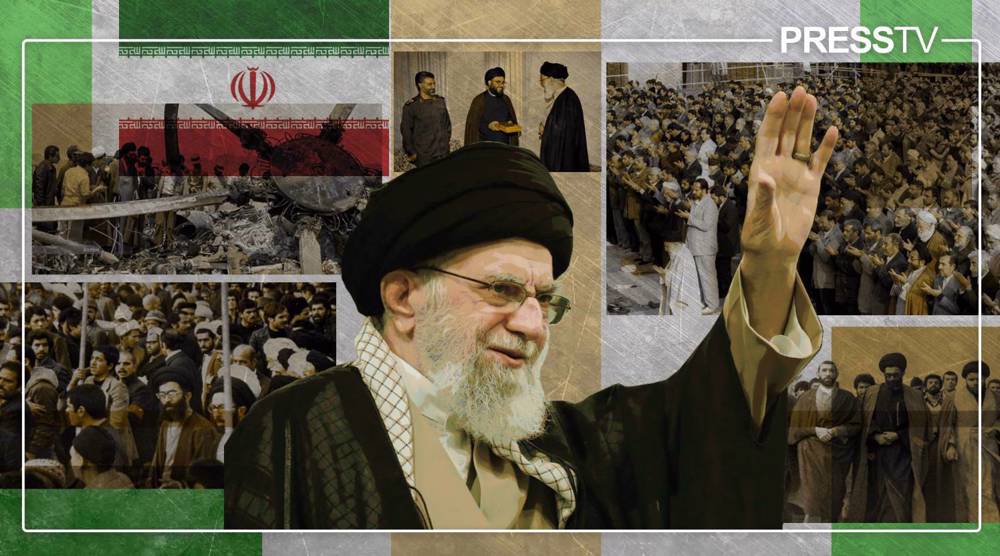
By Humaira Ahad
In the winding streets of Mashhad, where the scent of old books mingled with the call to prayer, Ayatollah Seyyed Ali Khamenei began a life that would intertwine faith, intellect, and national destiny.
From childhood, he was steeped in the Islamic studies and literary heritage of his city, growing into a figure whose influence would extend far beyond seminaries.
He was socially and politically active since the very beginning, actively taking part in the resistance activities against the West-backed Pahlavi monarchy.
After the Islamic Revolution in 1979, he became the country’s president and led from the front in the Holy Defense war. He became a source of emulation for young fighters.
Fast forward to 2025-26. Iran faced foreign aggression twice — first in June 2025, then again in February 2026. Both wars, unprovoked and illegal, proved pivotal for Iran, as it showcased its astounding military capabilities to the world through Operation True Promise.
Then came the fateful morning of February 28. A US-Israeli missile struck his home office in downtown Tehran, assassinating him as he recited the Holy Qur'an while fasting.
It was day one of the Ramadan War. Forty days later — on Wednesday — the war ended. The United States accepted the 20-point resolution put forward by Iran.
The day of Iran's "historic victory" coincides with the 40th day since the martyrdom of the Leader of the Islamic Revolution, with nationwide rallies planned for Thursday.
As military experts agree, this victory against the so-called "superpower" and its illegitimate ally in West Asia stands as a testament to the vision of the martyred Leader.
Leader of the Islamic Revolution Ayatollah Seyyed Ali Khamenei says the main reason behind enmities towards the Islamic Republic is the nature of the system, which is a religious democracy.
— PressTV Extra (@PresstvExtra) February 24, 2023
Follow Press TV on Telegram: https://t.co/0EMmcJs6DL pic.twitter.com/U2TM03fdfn
His assassination sent shockwaves throughout the world — not only for the loss of a political and spiritual leader, but for the sudden loss of a father figure who had shaped governance, security, social policy, and cultural identity of the country for more than three decades.
His inspiring journey was forged in the tumult of the Islamic Revolution and the painstaking construction of governance and national resilience — a trajectory that left an enduring mark on the Islamic Republic of Iran.
Today, as the Iranian nation celebrates a historic victory against the US-Israeli war machine after 40 days of relentless fighting, it is time to recall Ayatollah Khamenei's contribution to this triumph – and to reflect on where the Iranian armed forces stand today.
Defense and military leadership
Following the completion of his advanced seminary education, Ayatollah Khamenei’s trajectory was soon tested by the upheavals sweeping Iran at the time.
The oppressive Western-backed Pahlavi regime, with its centralized authority and disregard for the dignity and voice of the people, collided with a growing tide of revolutionary fervor.
Ayatollah Khamenei was actively involved in the grassroots-level movement against the Pahlavi regime and spent time in the regime's notorious prisons as well.
Yet, it was the Holy Defense war in the 1980s, after the Islamic Revolution, which would fully illuminate the depth of his resolve. When the war was imposed on Iran, starting from Khuzestan, Ayatollah Khamenei did not retreat into an administrative job.
WATCH: Ayatollah Seyyed Ali Khamenei and the establishment of the IRGC
— Press TV 🔻 (@PressTV) March 12, 2026
Follow https://t.co/B3zXG73Jym pic.twitter.com/gKj8CzWwoN
From the earliest days of the war, when Saddam Hussein-led Ba'athist regime forces invaded the Iranian territory, he assumed multiple roles simultaneously: Imam Khomeini’s representative on the Supreme Defense Council, Tehran’s elected voice in the Islamic Consultative Assembly, and the Friday Prayer leader for the capital. Yet, rather than confining himself to committees and offices, he sought direct engagement on the frontlines.
With the permission of the founder of the Islamic Revolution, Imam Khomeini, he joined the martyred Iranian commander Mostafa Chamran on the frontlines in Ahvaz, a city in southern Iran, moving into the heart of a dangerous defense against aggressors.
“He was never the kind of commander who stayed behind sandbags and maps,” recalled one of his contemporaries.
Ayatollah Khamenei moved across Khorramshahr, Susangerd, and Dobb-e Hardan, walking on dangerous terrains, often reaching the riverbank just steps from enemy lines.
“Even when the frontlines were perilous, he would travel back to Tehran to lead Friday prayers, returning to the battlefield without pause. Surviving the assassination attempt on June 27, 1981, at the Abuzar Mosque, he emerged not weakened but preserved, a divine reserve for the Revolution’s future, Yahya Rahim Safavi, former commander of the Islamic Revolution Guards Corps (IRGC), said in an interview.
Safvi described Ayatollah Khamenei as “the strategic backbone of the region, the commander who stood between collapse and survival. Without him, Syria would have fallen. Iraq would have followed. As the leader of the Islamic world, he stood with those nations in their darkest hours, and with that steadfastness altered the course of regional history.”
Ayatollah Khamenei’s influence extended to Iran’s strategic sphere.
Did you know that Ayatollah Seyyed Ali Khamenei was offered the rank of colonel before he became the Leader of the Islamic Revolution if he joined the army?
— Press TV 🔻 (@PressTV) March 11, 2026
Watch for more
Follow https://t.co/B3zXG73Jym pic.twitter.com/nL1184XhZ4
Amir Ali Hajizadeh, the martyred commander of the IRGC Aerospace Force, recalled: “Even in the earliest days, when the crates carrying our first two missiles hadn’t yet been opened, he would walk into the room and look directly at the specialists, steadying their nerves. ‘Why haven’t you opened them?’ he would ask. ‘Why haven’t you assembled these yet? Why haven’t you started?’ He infused us with courage. Don’t be afraid. Move forward, he would say.’”
Under his inspiring and expert guidance, Iran’s defence industry matured from dependency on imported hardware to producing weapons of a global standard.
Air-defence missiles reached breakthroughs once considered impossible. Drone development, nearly abandoned after the war, was revived on his insistence, integrating artificial intelligence to extend operational reach beyond human oversight.
Under his leadership, Iran became a global leader in missiles and drones, which were effectively used in Operation True Promise 4 in the past month, inflicting heavy blows on the enemy as seen in 99 waves of the operation since February 28.
“His knowledge of artificial intelligence was so expansive that I struggled to keep up,” Hajizadeh noted in one of his interviews.
“His questions made it clear: if we wanted to advance, we had to widen our studies across every frontier of technology. Ayatollah Khamenei wasn’t merely following up on our work; he was a driving engine, a steadfast supporter of building Iran’s defensive capacity.”
Leader of the Islamic Revolution Ayatollah Seyyed Ali Khamenei visits Exhibition of Industrial Capabilities
— PressTV Extra (@PresstvExtra) January 28, 2023
Follow Press TV on Telegram: https://t.co/0EMmcJsEtj pic.twitter.com/8jP829E3OF
Governance: Revolution, participation, and cultural independence
This same attention to detail and foresight characterized his approach to governance.
Emerging from the western-backed Pahlavi era’s despotic rule left a legacy of political closure and individual tyranny, in which life, property, and honor of Iranians were treated as the personal dominion of the Shah. Ayatollah Khamenei sought to craft a model of revolutionary participation grounded in law, cultural independence, and citizen engagement.
During his tenure as the Leader of the Islamic Revolution, Ayatollah Khamenei emphasized cultural dimensions as the core measure of the Islamic Revolution’s success.
He regarded the Islamic Revolution not merely as a political change but as a cultural transformation, awakening a society long conditioned to view itself as inferior.
“From childhood, the people were conditioned to internalize the notion that being Iranian meant being base and substandard,” he once noted. “The Revolution revived confidence, inspired self-belief, and set Iran on a path toward cultural independence.”
Through structured elections, public mobilization, and civic participation, the martyred Leader of the Islamic Revolution sought to embed accountability and social cohesion, creating mechanisms that allowed the circulation of power through legal and representative means.
These reforms remain a defining aspect of governance in post-Revolution Iran, blending religious principles with participatory politics.
Leader of the Islamic Revolution Ayatollah Seyyed Ali Khamenei visits Exhibition of Industrial Capabilities
— PressTV Extra (@PresstvExtra) January 28, 2023
Follow Press TV on Telegram: https://t.co/0EMmcJsEtj pic.twitter.com/8jP829E3OF
Economic Vision: Selfless labour, Independence, and oil-free development
Ayatollah Khamenei’s strategic vision encompassed the economy as a central pillar of national strength, emphasizing sustained planning and ethical labour.
Annual slogans, from “Economic Jihad” (2011-2012) to “Resistance Economy” (2016-2017) demonstrated the integration of economic priorities into the ideological framework of governance as he saw it.
Far from only reacting to inhuman and illegal Western sanctions that piled up after the 1979 Islamic Revolution, Ayatollah Khamenei’s guidance in economic matters predated crises, advocating for thrift, national production, labour support, and financial discipline.
He stressed the importance of an oil-free economy, arguing that dependence on raw material exports left the nation vulnerable to manipulation and pricing attacks.
Value-added production and domestic industrial growth, he maintained, were essential for the country's sovereignty and long-term stability in the face of external pressures.
Ayatollah Khamenei's economic philosophy blended rational planning with religious imperatives, emphasizing equity, justice, and social responsibility.
In 1996, he stated, “Guard the country’s financial resources, combat waste and excess, and oppose those who destroy public and private property.”
These principles remained central to Iran’s development trajectory as they reflected the martyred Leader’s foresight, pragmatism, and moral guidance.
Leader of the Islamic Revolution Ayatollah Khamenei has reiterated his oft-repeated line that officials should not tie the country's economy to the results of negotiations currently underway in Vienna to remove US sanctions on Iran.https://t.co/0qKC0Cc66m pic.twitter.com/2jlcZ9w5ns
— Press TV 🔻 (@PressTV) January 31, 2022
Literary contributions: preserving and shaping cultural identity
Long before his leadership in politics and defence, Ayatollah Khamenei demonstrated a lifelong devotion to Persian literature and poetry.
In the tumultuous days following the Islamic Revolution, he summoned prominent poets to help in the creation of a national cultural identity.
Even in the middle of intense political responsibilities, he would attend gatherings of revolutionary poets, critiquing their work and fostering literary discourse.
These sessions evolved over time into public gatherings held on the 15th of the birth anniversary of Imam Hassan (AS), the grandson of Prophet Muhammad (Peace be upon him). The sessions would honour committed, value-oriented poetry, reminding cultural policymakers of its centrality to national identity.
Ayatollah Khamenei’s own literary output is extensive, including authored works on jurisprudence, historical studies, Qur’anic exegesis, and the intellectual system of the Islamic Revolution. He also authored many poetry books.
The Leader of the Islamic Revolution Ayatollah Seyyed Ali Khamenei visited the 34th International Book Fair underway at the Imam Khomeini Mosalla of Tehran.
— PressTV Extra (@PresstvExtra) May 14, 2023
Follow Press TV on Telegram: https://t.co/0EMmcJs6DL pic.twitter.com/qUjVrYWgj1
Some of his notable works include Four Principal Books on the Science of Rijal (Critique of Hadith Transmitters), From the Depths of Prayer, The Spirit of Monotheism, the Prophet of Mercy (Peace be upon him), the Charisma of Hussain (AS), Islamic Governance, and Music-Lectures by Ayatollah Khamenei.
His translations and analyses demonstrate mastery of Persian and Arabic literature, as well as a deep familiarity with mystical and classical poetry.
“Ayatollah Khamenei retained innumerable verses from the Masnavi and ghazals of Indian Style poets, sharing them with scholars and enthusiasts,” Gholam Ali Haddad Adel, senior advisor to the martyred Leader and President of the Academy of Persian Language and Literature, said in a recent Interview.
He noted that Ayatollah Khamenei’s literary sensibilities were inseparable from his spiritual and political life, reinforcing the intertwined pillars of Islam and Persian identity that defined the martyred Leader’s vision of Iran.
Women and society: Dignity, rights, and empowerment
Ayatollah Khamenei’s approach to women's rights and women's empowerment reflected a synthesis of religious principles and societal advancement.
He described women’s status in Islam as “exalted and sublime,” emphasizing that the Quranic expressions on women’s identity are “the most sublime and progressive of all.”
He contrasted this with the failures of Western capitalist culture, asserting that Islam provides rulings on dress codes, encouragement of marriage, that harmonize with women’s nature and the needs of society.
He underscored justice in social and family life as the primary right of women: “Safeguarding security, sanctity, and dignity are also among women’s fundamental rights. Contrary to Western capitalism, which tramples upon the dignity of women, Islam emphasizes complete respect for women,” he said in a speech in 2025.
As the Leader of the Islamic Republic, Ayatollah Khamenei would celebrate women’s accomplishments across science, athletics, research, politics, and health. He often regarded them as unparalleled in Iranian history and at par with men.
“At no point in its history has Iran possessed even one-hundredth of this number of female scientists, thinkers and intellectuals. It was the Islamic Republic that elevated women and enabled their advancement in all fields of importance,” Ayatollah Khamenei said while addressing a gathering of women in 2025.
Leader of Islamic Revolution Ayatollah Khamenei says the capitalism destroys the dignity of women.
— Press TV 🔻 (@PressTV) December 6, 2025
Follow Press TV on Telegram: https://t.co/LWoNSpkc2J pic.twitter.com/CLkw2NqKGg
“Women are like flowers. They are not servants,” he said in one of his widely circulated speeches, emphasizing that domestic labour could be compensated financially and that women’s psychological tranquillity was essential for family harmony.
He always maintained that men and women possess complementary strengths.
“If we adopt a comprehensive outlook, we see that there is no difference between men and women. Certain privileges have been granted to women and others to men, based on their natural characteristics which Allah has bestowed upon them.”
Ayatollah Khamenei’s vision was of women as active participants in society and as bearers of cultural and spiritual influence, shaping both the home and the broader community.
“The fact that there are so many knowledgeable, educated, broad-minded and outstanding women--in intellectual and practical areas, in our society is really one of the greatest glories of the Islamic Republic. This is an extremely wonderful blessing and a great source of honour,” he stated at a gathering in 2018.
Ayatollah Ali Khamenei’s life unfolded across the full spectrum of Iran’s modern history. He was not a distant authority but a Leader in the centre of struggle, responsibility, and nation-building.
Each arena bears traces of a Leader who worked in constant dialogue with the pressures, crises, and aspirations of the people he believed he was accountable to.
His leadership led to military modernization, economic restructuring, religious scholarship, and the moral-ethical debates shaping women’s roles in society.
His legacy is found in the sustained development of a nation, militarily capable, culturally vibrant, socially cohesive, and economically resilient, guided by principles of faith, justice, and national dignity.
Across Iran and the broader Islamic world, the imprint of Ayatollah Khamenei endures: a life where devotion, intellect, and action converged, leaving a blueprint for leadership rooted in responsibility, foresight, and unwavering service.
‘Hiding aggressors’: Iran rebukes Bahrain's failed Security Council motion
Iraqis celebrate Iran’s victory as resistance groups commit to ceasefire
FM Araghchi says Iran will cease defensive strikes if unprovoked attacks are halted



Leader's 40th day of martyrdom seals US defeat: A look at his 37-year illustrious legacy
‘Hiding aggressors’: Iran rebukes Bahrain's failed Security Council motion
Bushehr nuclear plant safely producing electricity despite attacks: Iran
Iraqis celebrate Iran’s victory as resistance groups commit to ceasefire
'Ultimate surrender': Pakistani media says Trump backed down to Iran after 40 days
Forty days that shook the Empire: How Iran turned the tables on US and prevailed
FM Araghchi says Iran will cease defensive strikes if unprovoked attacks are halted
Iran declares 'historic victory' over US, says enemy forced to accept its proposal


 PressTV NEWSLETTER
now
PressTV NEWSLETTER
now

 This makes it easy to access the Press TV website
