War on cultural memory: US-Israeli aggression damages Iran’s iconic heritage sites
By Humaira Ahad
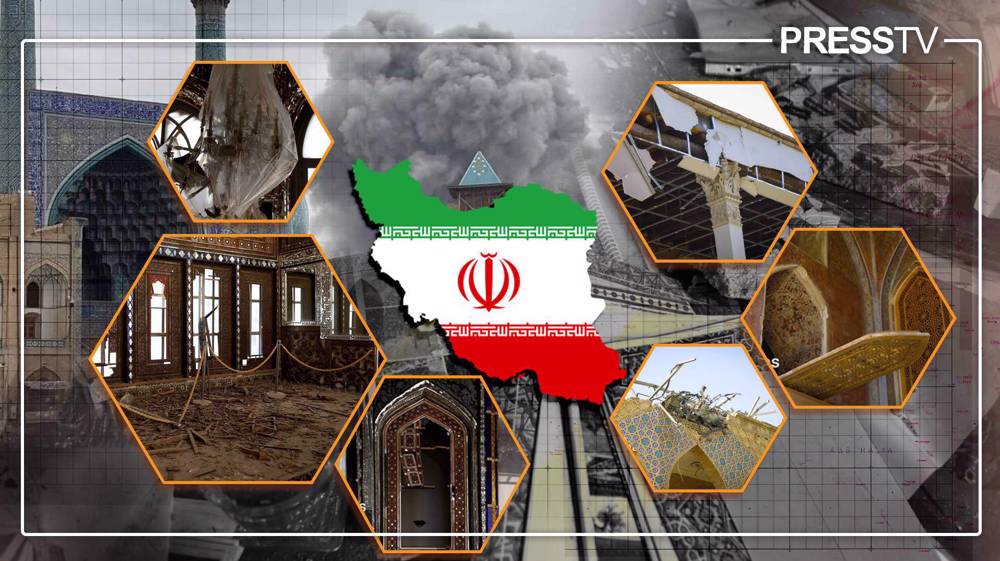
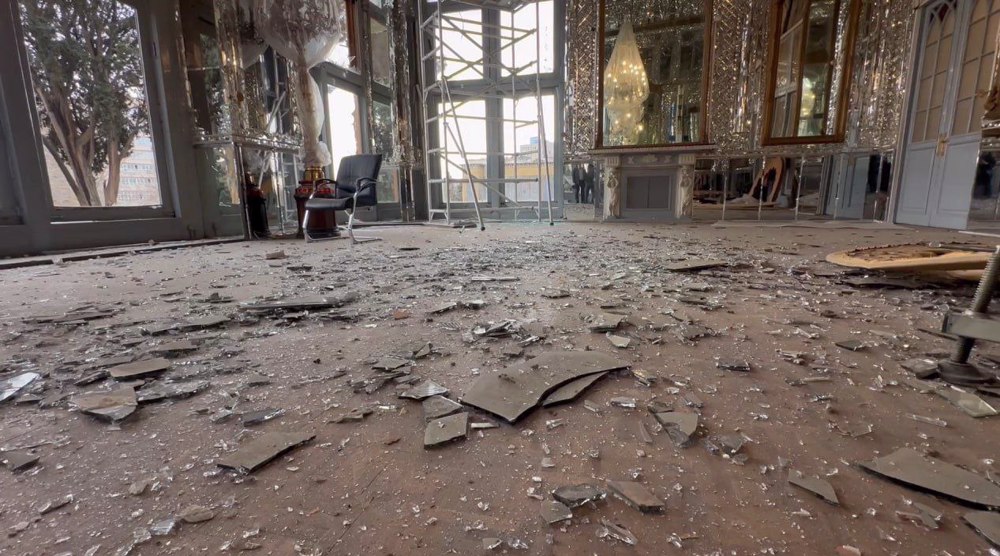
Inside Tehran’s 14th‑century Golestan Palace, the magnificent Hall of Mirrors – an artistic marvel of Persian geometry where light once fractured into a thousand glittering constellations – collapsed into itself.
The mirrors did not simply break; they shattered into a crystalline ruin. Ornate woodwork, carved by generations of master artisans, splintered into jagged fragments.
Images of the devastation spread like wildfire across the country. What the Iranian nation saw was not merely structural damage, but an unprovoked and unjustified aggression against its very civilizational identity as well as an assault on cultural memory.
The palace in central Tehran, long regarded as a symbol of historical continuity, now stands as a wound in the heart of the capital – courtesy the American-Israeli war machine.
According to Iran’s Ministry of Cultural Heritage, more than 56 museums and historical monuments nationwide have sustained serious damage in the ongoing war against the Islamic Republic of Iran since February 28.
Tehran Province, the political and cultural nerve center of the country, tops the list with 19 affected sites, according to the ministry.
In Kordestan province, twelve prominent historical buildings – some many centuries old – were damaged. In Isfahan, called the jewel of world architecture, several UNESCO World Heritage‑listed sites within the Naqsh‑e Jahan Square complex were struck, scarring a city that has long been a living museum of Persian art and tourism.
Historic structures in Lorestan and Kermanshah have also been hit. In the ancient port city of Siraf in Bushehr province, centuries‑old houses and mansions – once home to merchants who traded with the world – suffered serious damage.
In Ilam province, even the provincial Archaeology Museum was not spared by aggressors.
The US‑Israeli acts of aggression on Iran’s historical sites have drawn sharp condemnation from Iranian officials. In a post on X last week, Foreign Minister Sayyed Abbas Araghchi denounced the attacks in searing terms.
“Israel is bombing Iranian historical monuments dating as far back as the 14th century. Multiple UNESCO World Heritage Sites have been struck,” Araghchi wrote.
“It is natural that a regime that will not last a century hates nations with ancient pasts. But where is UNESCO? Its silence is unacceptable.”
What has emerged, officials and cultural experts note, is not merely a catalogue of damaged buildings. It is something more insidious: a deliberate assault on the preservation of a history that spans millennia. The mirrors of Golestan once reflected the face of a civilization. Now, they lie in pieces – and with them, a nation’s sense of permanence.
Images capture the damages caused to Tehran's historic Saadabad Palace Complex following US-Israeli airstrikes.
— Press TV 🔻 (@PressTV) March 19, 2026
Follow Press TV on Telegram: https://t.co/LWoNSpkc2J pic.twitter.com/b3rXh4EY1V
Tehran
At the edge of Tehran's historic core stands Golestan Palace, the capital's most revered landmark, a UNESCO World Heritage Site and a prime tourist attraction.
For centuries, it has been the ceremonial heart of Persian sovereignty, a place where Qajar kings once held court and where the nation's institutional memory took physical form.
The palace complex traces its origins to the 16th century, though it reached its grandest expression under the Qajar dynasty in the 1800s, when it was expanded into a sprawling ensemble of richly decorated palaces arranged around gardens and courtyards.
Here, ceremonial thrones were housed, diplomatic missions were received, and the rituals of state unfolded beneath ceilings encrusted with mirrorwork and painted with royal imagery.
That legacy was fractured on March 2.
Heritage officials and UNESCO monitoring reports confirm that a US-Israeli missile strike hit a nearby square, sending shockwaves through the palace walls.
The blast shattered sections of Golestan's famed mirrored ceilings – delicate constellations of glass that had reflected the faces of kings for generations. Fractures spiderwebbed across centuries‑old arches. Windows blew out. Debris scattered across several ceremonial halls, where silence now replaces ceremony.
Just beyond the palace, the historic Grand Bazaar of Tehran, a sprawling labyrinth of covered corridors that has served as the city's commercial spine for centuries, was also struck.
But the bazaar is far more than a marketplace. It is a living institution: a pulsing network of merchants, religious leaders, guilds, and urban communities that has anchored the capital's social and economic life for generations.
The damage inflicted there signals that the American and Israeli military aggression has done more than scar historic structures. It has torn into the very fabric of one of Tehran's oldest neighborhoods, a place where commerce, culture, and community have intertwined for centuries.
What was once a humming artery of the city now bears the marks of an assault not merely on buildings, but on the rhythms of daily life itself.
Tehran's Golestan Palace sustained damage in recent US-Israeli airstrikes.
— Press TV 🔻 (@PressTV) March 2, 2026
Follow: https://t.co/mLGcUTS2ei pic.twitter.com/NKXCgXt7mo
Isfahan
No city embodies Iran's cultural majesty more profoundly than Isfahan, a place once described as "half the world."
The phrase was no mere hyperbole. At its zenith in the early 17th century, under Shah Abbas I, Isfahan stood as the capital of the Safavid Empire and one of the great urban centers of the Islamic world, a city whose boulevards, gardens, and monuments were designed to inspire wonder.
At the heart of this vision lies Naqsh‑e Jahan Square, also known as Imam Square: a vast ceremonial plaza ringed by mosques, palaces, and arcades.
Widely regarded as one of the finest examples of classical Islamic urban planning, the ensemble has been a UNESCO World Heritage Site for decades – a testament to glorious Persian art, imperial ambition, and the enduring power of place.
That legacy now bears new wounds.
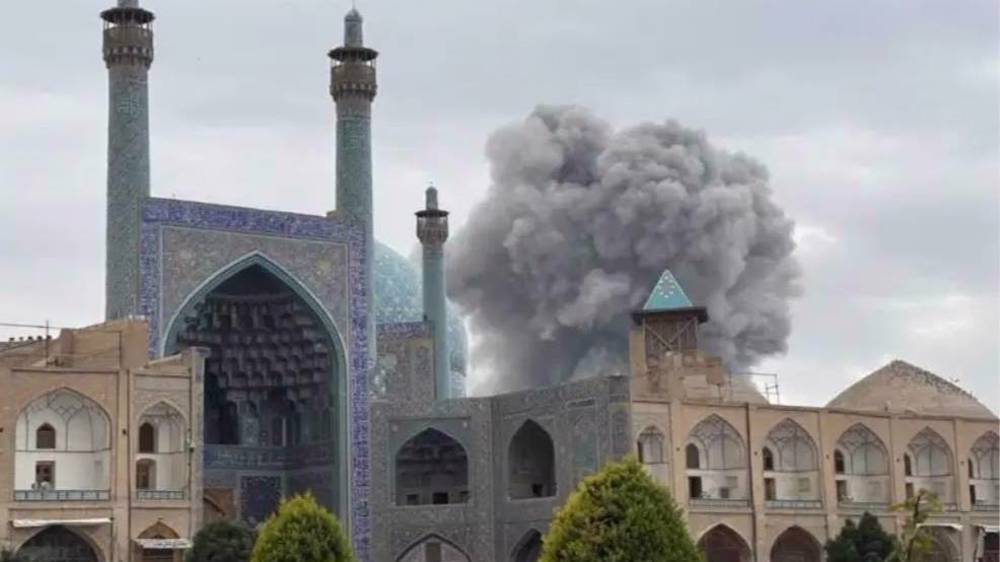
Heritage authorities report that several monuments around the square were damaged after US and Israeli airstrikes on March 10. Among the affected landmarks is the Imam Mosque, its soaring blue dome and towering minarets, long considered one of the supreme achievements of Safavid architecture.
Nearby, the Ali Qapu Palace – a monumental ceremonial gateway that once overlooked royal processions and polo matches below – suffered structural and decorative damage. Initial assessments found broken doors, shattered windows, and sections of intricate tilework loosened by the force of the blast.
Beyond the square, damage has also been reported at Chehel Sotoun Palace, a 17th‑century reception pavilion where Safavid rulers once hosted diplomatic audiences and lavish state celebrations.
The building forms part of the UNESCO‑listed Persian Gardens cultural landscape, a collection of gardens that embody the Persian concept of paradise on earth.
Officials said the airstrike cracked centuries‑old frescoes, dislodged mural fragments, broke delicate tiles, and shattered windows. The palace's intricate mirrorwork and interior ornamentation, hallmarks of Safavid refinement, were also affected.
The shockwaves reached even the Jameh Mosque of Isfahan, one of the most important monuments in Islamic architecture and another UNESCO‑listed site.
Unlike the Safavid palaces that surround it, this mosque is a palimpsest of nearly twelve centuries of Iranian history. Built and expanded continuously from the 8th century onward, it reflects the full evolution of Iranian mosque design, from early Abbasid layouts to later Seljuk innovations and Safavid embellishments. Reports now indicate damage to portions of its ancient structure and to the decorative tile surfaces inside the complex.
Other historic sites struck in the attacks include Timuri Hall, the Jebe‑Khaneh building, Rakib‑Khaneh (now the Isfahan Museum of Decorative Arts), Ashraf Hall, and buildings within the Chehel Sotoun complex. They have reportedly suffered damage ranging from cracked walls and broken windows to partial ceiling collapses.
Although many of these monuments remain structurally sound, conservation specialists caution that even minor damage to decorative features can have lasting consequences.
Safavid‑era tilework, frescoes, painted surfaces, and mirror mosaics are extraordinarily delicate. They were crafted over months and years by master artisans whose techniques are now partially lost to time. Once displaced or destroyed, these surfaces can be extraordinarily difficult, sometimes impossible, to restore in their original form.
Lorestan and Kurdistan
In the Khorramabad Valley, where five caves and a rock shelter hold evidence of human settlement stretching back 63,000 years, the ancient past met the violence of the present. This landscape, listed by UNESCO in 2025 as a testament to some of the earliest human habitation in Iran, was struck in the US‑Israeli airstrikes.
Nearby, a fortress that had survived nearly two millennia – the Sasanian‑era Falak‑ol‑Aflak Castle – suffered a different kind of wound.
A strike on its outer perimeter obliterated the heritage department's offices and destroyed the archaeological and anthropological museums nestled inside its grounds.
The castle's ancient walls still stood, but what Ata Hassanpour, Lorestan's heritage chief, described as the "intellectual and preservational heartbeat of the site" had been torn out. Among the ruins, five staff members – curators, researchers, and archivists – were injured, their work of safeguarding the region's deep history halted in an instant.
Further north, in the Kurdish cultural hub of Sanandaj, the assault took aim at living monuments of identity. Two historic mansions – the 19th‑century Salar Saeed Mansion and the Asef Vaziri Mansion – served as museums of Kurdish art, architecture, and cultural memory. Both suffered shattered stained glass, their intricate patterns of color reduced to shards on the floor, and fractured wooden doors that had once welcomed generations of visitors.
The attacks underscored that this war is not confined to one region or one people. It stretches across ethnic and cultural lines, targeting the mosaic of identities – Persian, Kurdish, Lur, and beyond – that together form the Iranian nation.
Blue Shield
Iran took every step listed under international law to protect its heritage. Blue Shield emblems, the internationally recognized markers established by the 1954 Hague Convention, were placed prominently on rooftops.
Coordinates of all major heritage sites were shared with military parties. These are the symbols meant to signal a universal pledge: cultural sites are sanctuaries, not targets.
Yet the strikes came anyway because the aggressors have no regard for international norms.
The US Committee of the Blue Shield warned that statements by the US defense secretary, who asserted there would be no "stupid rules of engagement", risked paving the way for war crimes. "The destruction of cultural heritage is irreversible," the committee said. "It erases identity, history, and the shared memory of civilizations."
UNESCO's World Heritage Centre director, Lazare Eloundou Assomo, confirmed that four of Iran's twenty‑nine World Heritage Sites had sustained damage since the start of US‑Israeli aggression against the Islamic Republic.
He emphasized that the devastation of Golestan Palace represented nothing less than "the mutilation of a symbol of Iranian cultural grandeur" and called on all sides to protect cultural sites "that tell the history of civilizations across 18 countries."
War crimes
Under international law, the intentional or negligent destruction of cultural heritage can constitute a war crime. The 1954 Hague Convention for the Protection of Cultural Property in the Event of Armed Conflict, to which the United States is a signatory, strictly prohibits targeting or endangering cultural heritage. By striking Iran's heritage sites, experts argue, the US‑Israeli military aggression violates core principles of international humanitarian law.
These strikes have endangered irreplaceable world heritage and marked a new phase of war, one in which cultural identity itself has become a battlefield.
To damage Isfahan, Golestan Palace, the mosques and mansions of Kurdistan, and the prehistoric caves of Lorestan is not merely to harm stone and tile. It is an attempt to rewrite the cultural map of Iran, to excise the landmarks that anchor a nation's memory.
Experts believe it is an assault not only on historic buildings, but on a cultural memory that spans dynasties, revolutions, and generations. In the shattered mirrors of Golestan, the cracked frescoes of Isfahan, and the ruined museums of Lorestan, what is being lost is not just architecture.
It is the physical inheritance of a civilization, and with it, the stories that have been told across millennia, now at risk of falling silent.
Across Iran, centuries-old Muharram traditions keep Karbala's memory and spirit alive
Iran’s windmills world heritage dossier nears completion
Iranian researcher receives UNESCO 2025 Young Scientist Award for biosphere restoration project



Iran: NATO members complicit in US-Israeli war must be held to account
'Gravest war crime': Iran's UN envoy demands justice for US strike on Minab school
High casualties feared as twin earthquakes strike central Venezuela
IRGC Navy warns against use of unauthorized routes for transit through Strait of Hormuz
Across Iran, centuries-old Muharram traditions keep Karbala's memory and spirit alive
Mission unaccomplished – Part I: America failed to achieve every war objective against Iran
US army downplaying injuries from Iran's retaliatory strikes: Wounded forces, families
Iran's Armed Forces created an 'epic' that exceeded aggressors' expectations: President Pezeshkian




 PressTV NEWSLETTER now
  This makes it easy to access the Press TV website