Explainer: What does the new agreement between Iran and IAEA entail
By Hamid Javadi
Iran and the International Atomic Energy Agency (IAEA) said on Tuesday they had reached a new agreement on potential resumption of cooperation, which Tehran suspended following the unprovoked and illegal Israeli and American aggression on Iranian nuclear facilities in June.
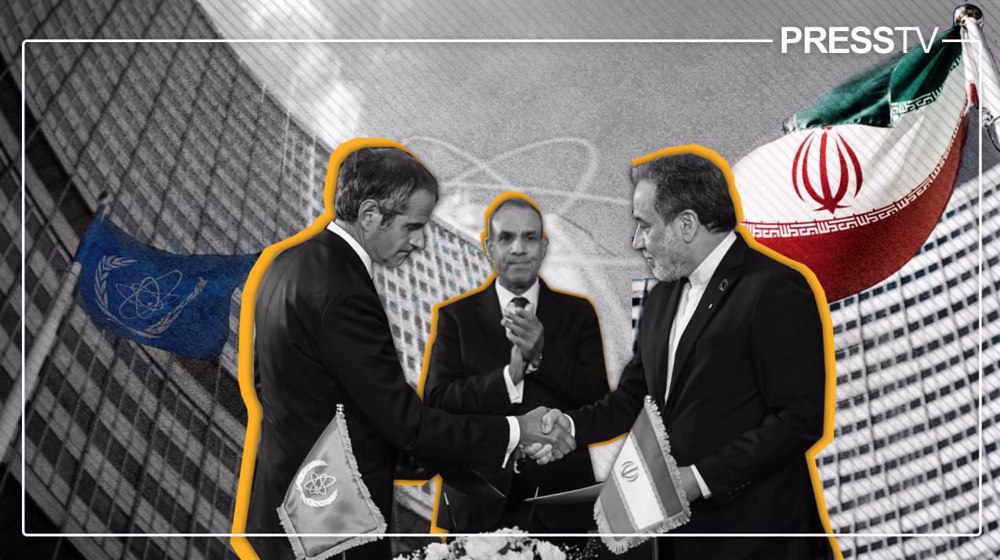
The agreement was signed during a three-hour meeting between Foreign Minister Abbas Araghchi and IAEA Director General Rafael Grossi in Cairo. Iran and the IAEA had already held three rounds of negotiations in Vienna and Tehran in an attempt to find a practical way forward.
The UN nuclear agency chief described the new agreement as “an important step in the right direction,” but said its full contents would not be published anytime soon.
What does the new agreement entail?
Details of the Cairo agreement will be the subject of further talks, and both sides have already offered their seemingly contradictory interpretations of what the deal entails.
The IAEA said the new agreement offers its inspectors access to all of Iran’s nuclear facilities, including those that were bombed by Israel and the US during the June military aggression against the Islamic Republic.
Speaking to the IAEA Board of Governors on Wednesday, Grossi said the agreement would grant access to “all facilities and installations in Iran” and “contemplates the required reporting on all the attacked facilities, including the nuclear material present.”
However, he acknowledged that the deal had yet to be implemented and that the return of UN nuclear inspectors was neither a simple nor an automatic process.
IAEA ‘fully satisfied’ with cooperation agreement; objections by 3rd parties ‘strange’: Iran FM https://t.co/Zrm2MxnSKN
— Press TV 🔻 (@PressTV) September 11, 2025
What does Iran say about inspections?
In Tehran, officials, however, insisted that the agreement does not guarantee inspections of the country's nuclear sites.
“I have to reiterate the agreement does not currently provide access to IAEA inspectors, apart from the Bushehr nuclear plant,” Foreign Minister Araghchi told the Islamic Republic of Iran Broadcasting (IRIB).
He said Tehran wants more discussions on how and if the inspections can resume. “Based on reports that Iran will issue in the future, the nature of access will have to be discussed at an appropriate time.”
Araghchi made it clear that any cooperation with the UN nuclear watchdog, including access to the country's nuclear sites, would need to be approved by the top security body - the Supreme National Security Council.
He emphasized that the new arrangement is calibrated to a parliamentary law curbing cooperation with the IAEA while keeping the door open for technical engagement between the two sides.
What are the ‘new conditions’ and ‘new framework’?
The top Iranian diplomat said the new agreement with the IAEA acknowledges the “new conditions” following the Israeli-American aggression on Iranian nuclear facilities that violated international law.
“As a member of the Non-Proliferation Treaty (NPT) and based on previous agreements with the Agency, we had always cooperated,” he said. “However, after the attack, the situation changed, and in our discussions with the Agency, we emphasized that cooperation can no longer continue as before and that a new framework must be defined for it.”
Tehran says the existing Safeguards Agreement between Iran and the IAEA was designed for “normal conditions,” not for a scenario where its peaceful nuclear sites are bombed and damaged.
It maintains that the UN nuclear watchdog has no specific protocol in place for how to handle such a situation, and continued cooperation under the old terms is not realistic.
On his X account, the IAEA chief announced that, 'In Cairo today, agreed with Iran’s Foreign Minister @araghchi on practical modalities to resume inspection activities in Iran. This is an important step in the right direction.' pic.twitter.com/WQHMxUgLyX
— Press TV 🔻 (@PressTV) September 9, 2025
What are Iran’s security concerns?
The new agreement, according to Araghchi, acknowledges that Iran’s security concerns are “legitimate” and must be taken into account for any agreement to take effect.
After the military aggression, the Iranian parliament passed legislation in July that made future cooperation with the IAEA conditional.
The legislation, signed by President Masoud Pezeshkian on July 2, gives the Supreme National Security Council the authority to approve or reject any steps based on national security assessments.
The nuclear dossier has now been transferred to the country's top security body from the foreign ministry, and all decisions related to the continued cooperation with the IAEA will be taken by the Supreme National Security Council, taking into consideration political realities and security concerns.
The security aspect has assumed greater significance following the unprovoked aggression on the country's nuclear sites, which have for years been under the strict supervision of the UN nuclear watchdog.
Grossi and other IAEA officials also failed to condemn the aggression that brazenly violated international law and the terms of cooperation between the two sides. In his latest provocative remarks, he said, condemning the Israeli-American assault was "not my responsibility."
How will snapback activation affect the agreement?
Tehran also made it clear that the new deal with the IAEA will remain valid as long as no “hostile action” is taken against Iran, including the re-imposition of UN sanctions.
“For instance, if the so-called snapback mechanism is activated, the implementation of this document will also be halted,” Araghchi told reporters on Wednesday.
‘Snapback’ refers to the automatic reinstatement of UN sanctions against Iran, which were lifted under the 2015 nuclear deal, the Joint Comprehensive Plan of Action (JCPOA), in exchange for limits on Iran’s nuclear activities.
The provision was embedded in UN Security Council Resolution 2231, which endorsed the JCPOA and is set to expire on October 18.
Snapback sanctions, any hostile action will nullify Iran’s new deal with IAEA: FM https://t.co/tPIDvo80FS
— Press TV 🔻 (@PressTV) September 10, 2025
France, Germany, and the United Kingdom, the remaining European parties to the nuclear deal, triggered the accord’s “snapback” mechanism on August 29, a politically motivated move that could reinstate the sanctions within 30 days.
The three European powers had warned they would invoke the snapback of sanctions unless there was significant progress in talks on a new deal with Iran.
Agreement on the return of the IAEA inspectors to Iran is one of the conditions set by the Europeans for them to pause the snapback mechanism, which would bring back a comprehensive arms embargo and major banking and shipping restrictions on Iran.
Iran emphasizes that the Europeans “lack both legal and moral authority” to invoke the dispute resolution mechanism under a nuclear deal they have consistently violated since the US withdrew from it in 2018. (The European parties failed to provide the economic benefits that the JCPOA had promised after the US re-imposed sanctions on Iran)
The move by the E3 can derail any chance of a diplomatic solution to Iran’s nuclear dispute. Iran has threatened to end all cooperation with the UN nuclear watchdog and potentially withdraw from the NPT if international sanctions return.
The IAEA withdrew its team from Iran in July after the Iranian parliament passed a law suspending cooperation with the UN agency in response to the Israeli-American aggression against the Islamic Republic.
Iran worries that the IAEA could feed the information its inspectors gather from Iran to Israel or the US, which they could potentially use to plan further military assaults on the country's nuclear installations.
That legitimate concern was raised by some Iranian government officials and members of the parliament during the 12-day war.
They also blamed the IAEA and its director general for giving Israel a pretext to attack Iran by releasing a politically-motivated report that accused Tehran of non-compliance with its NPT obligations for the first time in over two decades.
Nevertheless, Araghchi emphasized on Wednesday that Iran hopes the new agreement with the IAEA will advance a diplomatic solution, if “the other side is serious about one.”
Araghchi: Recent war proved regional security can’t be built without Iran
Dozens of terrorists, spies and saboteurs arrested during US-Israeli aggression on Iran

Iranian officials united on resistance against threats: Judiciary chief



June 14: Iran, US reach MoU to end imposed war, to be signed in Geneva on Friday
Iran deputy FM says MoU with US finalized, to be signed in Geneva on Friday
Pakistan PM claims 'peace deal' reached between Iran and US following 'intensive talks'
Iran warns US of ‘dangerous consequences’ of ‘terrorist’ strike on Beirut
'Resistance will not be cornered', Speaker Qalibaf warns Israel after Beirut attack
Iran’s top security official warns response ‘imminent’ after Israeli strike on Beirut
Thousands buried under Gaza rubble may never be identified: Red Cross
Lebanon files complaints with UN Security Council over Israeli attacks


 PressTV NEWSLETTER
now
PressTV NEWSLETTER
now
 This makes it easy to access the Press TV website
