June 3: Iran strikes US naval, military assets across region after attacks on tanker, Qeshm facility
By Press TV Website Staff
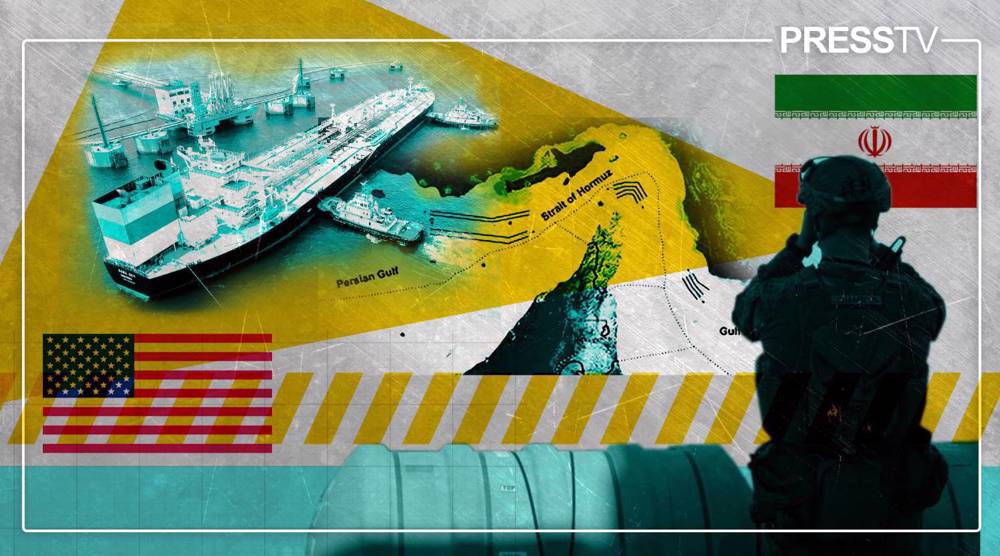
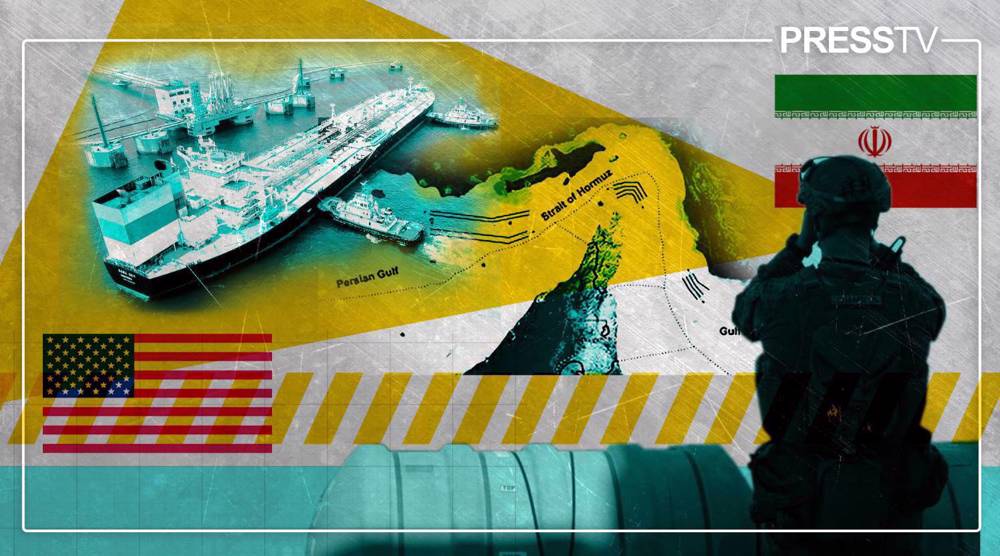
Iran on Wednesday announced retaliatory strikes on an enemy vessel, the headquarters of the US Fifth Fleet in Bahrain, and a regional American airbase after US attacks on an Iranian oil tanker in the Strait of Hormuz and a telecommunications tower on the Persian Gulf island of Qeshm.
The Iranian Navy also targeted a command-and-control centre aboard a US destroyer in the Sea of Oman that was identified as the source of recent acts of aggression against Iran.
Meanwhile, Parliament Speaker and lead negotiator Mohammad Baqer Qalibaf said Iran is no longer an easy target for enemies' threats.
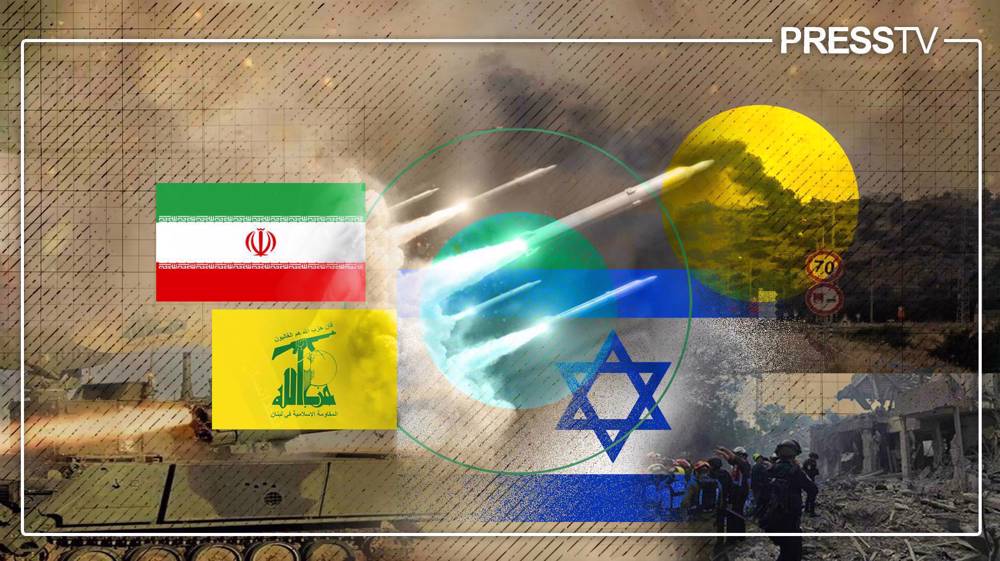
The day also saw continued Israeli airstrikes in Lebanon and Hezbollah's retaliatory operations against the Israeli military gatherings and strategic sites.
Key developments on day 96 of the war, the 56th day of the ceasefire:
- The Islamic Revolution Guards Corps (IRGC) announced that its forces carried out retaliatory strikes against an enemy vessel, the headquarters of the US Fifth Fleet in Bahrain, and a regional American airbase following two acts of US aggression targeting Iranian assets.
- The Iranian Navy announced targeting the "command-and-control centre" behind recent US violations, saying the facility was located aboard an American destroyer operating in the Sea of Oman.
- Iran's Foreign Ministry strongly condemned overnight US attacks against an Iranian oil tanker in the Strait of Hormuz and a telecommunications tower on Qeshm Island, vowing that Tehran will use "all its capabilities" to confront acts of aggression, including by striking their origin and source.
- Parliament Speaker Mohammad Baqer Qalibaf said Iran is no longer an easy target of enemies' threats, adding that the experience of confronting two US-Israeli-imposed wars of aggression has shown that Iran is well capable of delivering harsh responses to any aggression.
- Iran's armed forces said the enemy has been forced to accept new rules imposed by Tehran on the battlefield, particularly regarding the smart management and control of the Strait of Hormuz, as the country marked the anniversary of the passing of Imam Khomeini and the 1963 uprising against the West-backed Pahlavi dictatorship.
- Foreign Minister Abbas Araghchi said Iran’s armed forces are conducting legitimate self-defence strikes on sites in the Persian Gulf region used by the United States to attack civilian shipping and violate the ceasefire.
- The IRGC Ground Force seized devices and equipment in northwestern Iran intended to facilitate the execution of acts of sabotage and terror.
- Nearly 90 members of Iran’s parliament vowed to support the armed forces and defence industries until the range of Iranian missiles increases to reach the offices of those who assassinated the Leader of the Islamic Revolution, Ayatollah Seyyed Ali Khamenei.
- Iran’s main human rights body condemned international inaction in dealing with crimes of aggression against children, as it drew global attention to dozens of innocent children killed during recent acts of aggression against the country by the United States and the Israeli regime.
- Esmaeil Kowsari, a parliamentarian and member of the National Security and Foreign Policy Commission of the Iranian Parliament, stated that confrontation with the United States must be intensified, as Fouad Izadi, a political analyst, warned that Washington is seeking to normalise attacks on the country under the pretext of a ceasefire.
- Mohsen Rezaei, a member of Iran’s Expediency Discernment Council and military affairs advisor to the Leader of the Islamic Revolution, said Tehran will not allow the United States to make excessive demands, either in negotiations or during the ceasefire process, warning that any act of aggression will be met with a volley of missiles and drones.
- Iran strongly rejected accusations by the US Secretary of State Marco Rubio that Tehran seeks to assassinate American officials, slamming Washington for attempting to portray itself as a victim while concealing its own record of war crimes against the Iranian people.
- Ebrahim Azizi, chairman of the Iranian Parliament’s National Security and Foreign Policy Committee, said that an end to regional war, particularly in Lebanon, is a central condition in any agreement with the United States.
- Shina Ansari, Iran’s vice president and head of the Department of Environment, strongly condemned US-Israeli attacks on protected environmental and civilian sites in the country.
- The Iran University of Science and Technology (IUST) announced plans to transform the university’s satellite research facility, damaged in US-Israeli airstrikes during the recent third imposed war, into a war museum.
- US President Donald Trump confirmed that he angrily confronted Israeli prime minister Benjamin Netanyahu during a phone call this week, saying he was frustrated by the regime’s continued attacks on Lebanon.
- Israeli airstrikes on southern Lebanon killed at least nine people, as Israeli acts of aggression continue unabated despite assertions by Trump that he had persuaded the Tel Aviv regime to cease its assaults in Lebanon.
- Lebanon’s Hezbollah resistance movement said it has inflicted heavy blows on Israeli regime forces in the southern Lebanese town of al-Bayyada amid mounting failures in Israel’s military invasion and growing vulnerability of its troops to advanced resistance tactics.
IRGC vows to teach US an ‘unforgettable lesson’
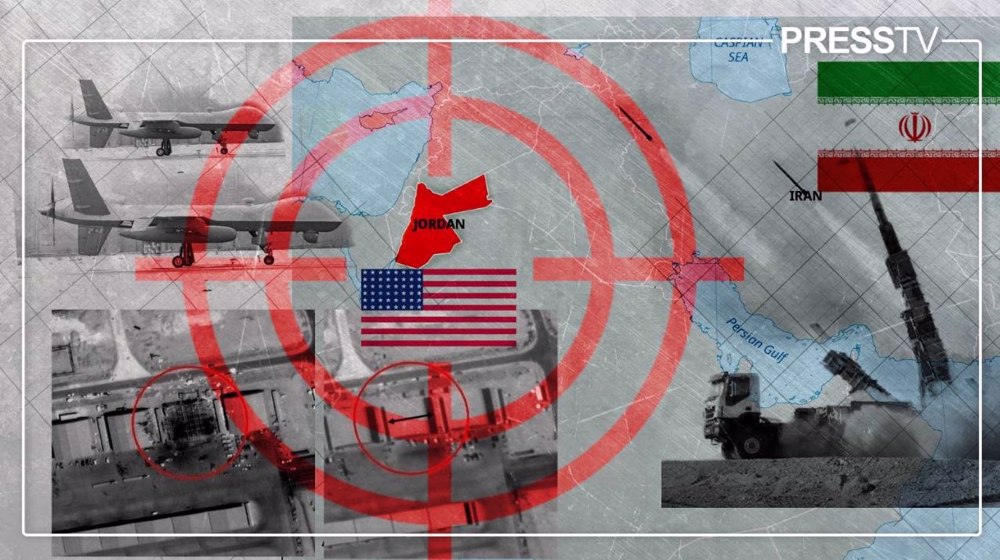
Iran’s crushing strike on US base in Jordan signals capability and will to impose costs on aggressor

Strait of Hormuz as strategic fulcrum: Iran’s credible deterrence and the limits of US coercion



Iran in ‘full-scale war’ with US, economy at forefront: Pezeshkian
Israel carries out demolitions in southern Lebanon despite truce deal
IRGC conducts three-pronged attack on US positions in Bahrain, Kuwait
War will continue until 'full deterrence' is achieved: Iran army spokesman
IRGC vows to teach US an ‘unforgettable lesson’
Pezeshkian, Qalibaf congratulate Spain on FIFA World Cup championship
Iran has mastered the art of seeing through US games: Qalibaf
Khalil al-Hayya elected new head of Hamas political bureau


 PressTV NEWSLETTER
now
PressTV NEWSLETTER
now
 This makes it easy to access the Press TV website
