US-Israeli aggression on Iran: What happened on 28th day of the imposed war
By Press TV Website Staff
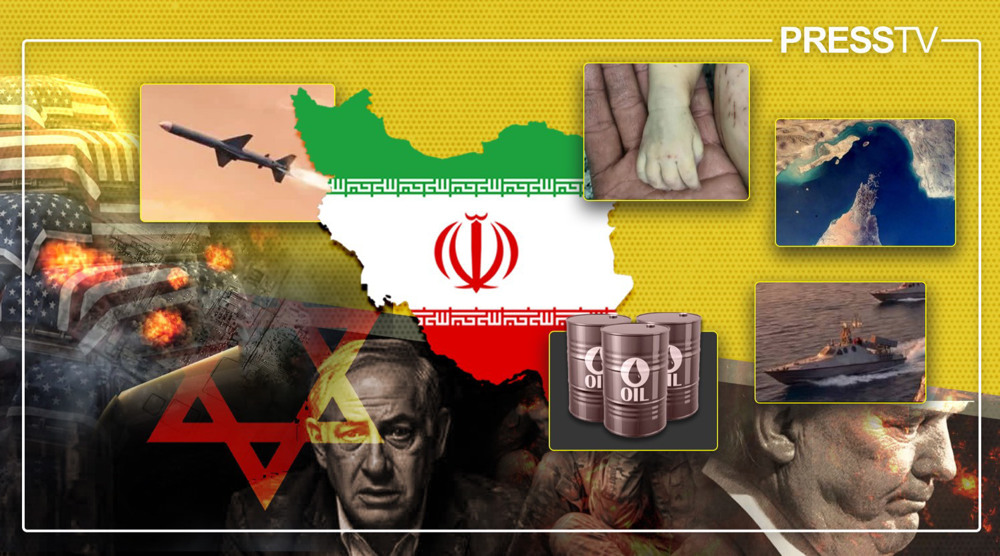
Twenty-eight days into the US-Israeli war on Iran, launched on February 28 with the assassination of the Leader of the Islamic Revolution, Ayatollah Seyyed Ali Khamenei, US-Israeli aggression continued to target Iran’s civilian infrastructure.
On Friday, two major steel plants were targeted, adding to a bombing campaign that has primarily targeted civilian infrastructure and killed more than 1,900 Iranians.
US President Donald Trump “delayed planned attacks” on Iranian energy infrastructure by 10 days, until April 6, claiming peace talks are "going very well." But Tehran has rejected the American proposal as "one-sided and unfair," presenting five non-negotiable demands.
A Fox News poll shows 64 per cent of Americans disapprove of Trump's handling of the war.
Fuel prices are rising. Global markets are rattled. And the Strait of Hormuz, the world's most critical energy chokepoint, has been effectively shut to American vessels, with traffic down 97 per cent since the war on Iran began.
Iranian missiles and drones have struck strategic Israeli positions and US assets across the region. Iran's UN ambassador has formally protested the complicity of Persian Gulf states, including Saudi Arabia and the UAE, in providing land, airspace, and bases for American aggression against the Islamic Republic.
Below are the key developments on Day 28:
US-Israeli attacks on Iran
- US-Israeli air strikes targeted Iran's strategic and largest steel plants in Khuzestan and Mobarakeh steel companies in Isfahan.
- The Khondab Heavy Water Complex in Arak was targeted in two separate US-Israeli strikes, while the Yellowcake Production Plant in Ardakan, Yazd province, also came under attack. Preliminary assessments confirmed no radioactive material was released from nuclear-related facilities, with authorities assuring citizens there was no cause for concern.
- An industrial unit in Kheirabad Industrial Park, Arak, was also hit by US-Israeli projectiles.
- Iran launched retaliatory strikes in the Persian Gulf region and the occupied territories, issuing a direct warning to employees of American-linked and Israeli-allied industries to immediately evacuate their workplaces within a one-kilometre radius to avoid endangering their lives.
- The US-Israeli bombing campaign on Iran has now claimed more than 1,900 Iranian lives since the war began on February 28.
American–Israeli attacks have killed 252 students and teachers and wounded 184 education staff since the beginning of the war, according to Iran's Ministry of Education. pic.twitter.com/KkJI4D7P5n
— Press TV 🔻 (@PressTV) March 28, 2026
Iran’s retaliatory operations:
- Iranian armed forces carried out retaliatory operations against the Israeli regime and the Persian Gulf states, including Kuwait, the United Arab Emirates, Saudi Arabia and Jordan, in a direct response to the US-Israeli aggression and the complicity of regional states in hosting American military assets that are being used against Iran.
- Iranian forces struck US bases in Kuwait with a dual missile-and-drone attack, according to an Iraqi media outlet, which reported that the bases "were rocked by explosions."
US-Israeli attacks in the region
- US strikes on Iraq's Habbaniyah base killed between five and seven Iraqi soldiers and wounded 23.
- Israeli forces continued the bombardment of Beirut's southern suburbs early Friday, with Lebanese media reporting fresh attacks on the area.
- The Israeli military announced two soldiers killed in south Lebanon, where its troops have been attempting to occupy territory and seize villages and towns in recent days.
- Israeli war minister Israel Katz vowed "no let-up" in attacks on Iran despite US claims of progress in “peace talks.”
- Israeli opposition leader Yair Lapid accused the Netanyahu government of leading Israel into a "security disaster" by sending the army into a multi-front war without a clear strategy or sufficient troops. This week, the Israeli army chief Eyal Zamir issued a stark warning to the country’s cabinet, saying that the Israeli army is on the brink of collapse.
- Lebanon's Prime Minister Nawaf Salam warned the UN of the "risk of annexation" by Israel of Lebanese territory south of the Litani River.
- Yemen's Ansarullah resistance movement said that they are prepared to join the war in support of Iran if the US and Israel escalate further, a Yemeni government official told CNN.
WATCH: Following US President Donald Trump's threat to strike Iran's energy facilities, the IRGC responded by outlining four clear steps.
— Press TV 🔻 (@PressTV) March 28, 2026
Follow https://t.co/B3zXG74hnU pic.twitter.com/kOv7MB8o3S
Talks, demands, and the UN
- Trump delayed planned attacks on Iranian energy plants until April 6, saying peace talks are "going very well."
- Iran has called the US proposal "one-sided and unfair," presenting five non-negotiable demands that underscore Tehran's refusal to surrender its sovereignty at the negotiating table.
- German Foreign Minister Johan Wadephul claimed indirect contacts have been established between Washington and Tehran, describing the development as a positive sign.
- The UN Security Council decided to hold closed-door consultations at Russia's request to discuss the attacks on Iran, according to Russian media.
- Iran's Ambassador and Permanent Representative to the United Nations, in a letter to UN Secretary-General António Guterres and the President of the Security Council, formally protested the UAE's action of placing its land and airspace at the disposal of US attacks against Iran, declaring that Tehran reserves its right to take necessary measures, including exercising the inherent right of self-defence.
- Guterres expressed concern over the continuation of war and killings in the region, reaffirming that the principles of the UN are based on respecting national sovereignty and territorial integrity.
- EU foreign policy chief Kaja Kallas warned against escalation, stating that the world now faces two major wars, one in Ukraine and one in West Asia, and stressed that "we must move away from war, not escalate it further, because the consequences for everyone around the world are extremely severe."
- IAEA chief Rafael Grossi stated that the Bushehr nuclear power plant remains active with significant amounts of nuclear material, cautioning that damage to the facility "could lead to a major radiological incident, affecting a vast area in Iran and beyond." The nuclear power plant was attacked in recent US-Israeli airstrikes.
- Qatar's Prime Minister and Foreign Minister, Sheikh Mohammed bin Abdulrahman bin Jassim Al Thani, visited Washington, DC, to meet with US war minister Pete Hegseth to discuss cooperation and “regional defence strategies.”
Watch how Iranian missiles penetrated and defeated US air defense systems, striking their target in Bahrain. pic.twitter.com/95X2ZpyZE9
— Press TV 🔻 (@PressTV) March 28, 2026
Strait of Hormuz
- Iran's Foreign Minister Abbas Aragchi asserted that preventing the passage of vessels belonging to or affiliated with the enemy and their allies is Tehran's legal right as a coastal state, adding that Iranian authorities have adopted necessary measures to ensure maritime security and safety in the waterway.
- Since the start of the war by the US and the Zionist regime against Iran, no ships bound for the US or Europe have transited the Strait of Hormuz, an indication of the impact tensions have had on international shipping.
- The Financial Times, citing new data, reported that only 116 vessels have passed through the Strait since the beginning of March 2026, representing a staggering 97 per cent decrease compared to the previous month.
- US Secretary of State Marco Rubio sidestepped a question about the possibility of US military action to challenge Iran's maritime sovereignty in the Strait of Hormuz, instead linking the waterway's opening to Iran's will, stating: "Whenever Iran stops its threat against international shipping, the Strait of Hormuz will be opened."
- His comments come as the Pentagon is planning to send up to 10,000 more US forces to the region for a possible ground-invasion on Iran, Reuters reported.
Persian Gulf states collaboration with US
- On Tuesday, Trump confirmed news published by US media regarding messages from Saudi Arabia to continue attacks against Iran, stating, "Prince Mohammed bin Salman is fighting alongside us." According to an Iranian media report, Saudi Arabia has not denied this news despite two days already passing.
- On Wednesday, the UAE's ambassador to the US expressed support for US-Israeli attacks on Iran in an op-ed in the Wall Street Journal.
- An intelligence source cited by Iranian media reported that, based on substantial intelligence, five countries, Kuwait, Bahrain, Qatar, the UAE, and Saudi Arabia, have placed their land, airspace, and military bases at the disposal of US forces. According to the report, US air, sea, and missile attacks have repeatedly used the water, land, and airspace of these nations, including areas outside military bases.
Iran serious about resolute defense of its sovereignty against ongoing aggression, FM tells Lavrovhttps://t.co/xPUWfeq07n
— Press TV 🔻 (@PressTV) March 28, 2026
Global economic fallout
- Middle East Eye reported that Germany's Deutsche Bank has stated that America's war with Iran "may be remembered in history as a catalyst for the erosion of the petrodollar's dominance and the beginning of the petroyuan."
- South Korea has declared an emergency economic response to the energy crisis, while Japan has begun releasing oil from its state-owned reserves.
- The Philippines has declared a state of emergency, with only about 40 to 45 days' worth of petroleum supply left. Hundreds of people marched through the capital, Manila, on Friday, protesting soaring fuel prices as part of a two-day nationwide strike organised by the country's transport union.
- Global markets have been rattled by the war, impacting not just stocks but also safe havens like bonds, gold, and currencies, all of which have dropped this month. The Dow, S&P 500, and Nasdaq are each set for their worst month in a year.
- Foreign Policy reported in an analysis that a prolonged continuation of this war would place additional pressure on American farmers, a key constituency supporting the Trump administration, who have previously faced significant difficulties due to the trade war. They are demanding guarantees for the safe passage of fertiliser through the Strait of Hormuz. However, the Trump administration appears unconcerned about this issue.
Growing pressures inside US
- The war on Iran is hurting Trump's approval ratings, with rising fuel prices driving domestic pressure. A Fox News poll indicates 64 per cent of Americans disapprove of his handling of the Iran war, with only 36 per cent approving.
- Rising fuel prices continue to drive domestic pressure on the US administration as the war nearly completes its fourth week.
Strategic miscalculation: How US breaches of MoU bolster Iran's Hormuz leverage, regional deterrence
Iran will give 'swift, crushing' response to any US violation of MoU: Leader’s advisor
Iran’s Armed Forces ready to defend national security: Top commander



Iran held by Egypt as Taremi blasts FIFA after VAR heartbreak leaves knockout hopes hanging
Legal experts warn Lebanon-Israel deal could block justice for war crimes victims
Ansarullah: Lebanon-Israel framework agreement meant to destroy resistance
Araghchi honors Sardasht chemical attack victims, hails city as symbol of Iran’s resilience
Iran offers condolences, aid to Venezuela after deadly earthquakes
Strategic miscalculation: How US breaches of MoU bolster Iran's Hormuz leverage, regional deterrence
US-led coalition forces will withdraw from Iraq by September, says PM Zaidi
Eight Palestinians killed in Gaza as Israeli ceasefire violations continue


 PressTV NEWSLETTER
now
PressTV NEWSLETTER
now
 This makes it easy to access the Press TV website
