Israel, not America, first: Carlson’s Huckabee interview lays bare US foreign policy priorities
By Maryam Qarehgozlou
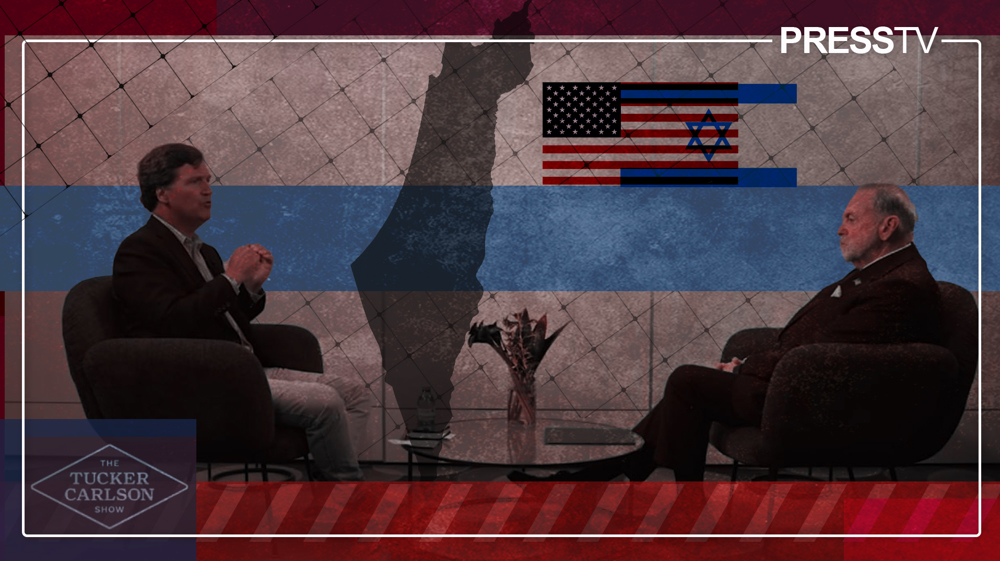
In a recent interview with the US ambassador to the Israeli-occupied territories, Mike Huckabee, prominent US journalist and commentator Tucker Carlson confronted an Israeli-led system of intimidation, censorship, and foreign influence shaping American policy.
In a blistering monologue before his sit-down with the controversial American diplomat, Carlson framed his trip to Israeli-occupied territories not as a routine diplomatic media engagement, but as a revealing encounter with an entrenched apparatus exerting sway over American power.
The interview, conducted at the high-security Ben Gurion Airport, 20 kilometers to the south of Tel Aviv, itself began with a public challenge on Twitter from Huckabee, who suggested that if Carlson was addressing Christians in West Asia, he should speak to him as well.
Carlson initially hesitated. Having known Huckabee for decades, he admitted that interviewing him would require “a lot of self-control,” noting that the hawkish former Baptist minister’s genial, grandfatherly persona makes it difficult to press hard without appearing hostile.
Still, Carlson concluded that the moment demanded it. The stakes, he said, were enormous.
The United States, he noted, is moving toward a war with Iran – and Israel is “driving that.”
The US, he stated bluntly, is acting “at the behest, at the demand of” the Israeli regime’s premier Benjamin Netanyahu, who has presided over the modern-day holocaust in Gaza.
Embassy obstruction and security refusals
From the very outset, Carlson described encountering bizarre and hostile treatment from the US Embassy personnel in Israeli-occupied territories.
He said he requested basic measures – private security or an embassy representative to accompany his team from the airport. He was flatly refused.
At the time, he noted, Israeli regime officials, including Netanyahu, had publicly denounced him, suggesting Carlson was effectively aligned with Nazis and branding him a “member of the Woke Reichstag.”
Given such rhetoric, Carlson believed modest security precautions were reasonable.
Instead, the embassy declined assistance and referred him to Israel’s foreign ministry, specifically to deputy foreign minister Sharon Haskell, who had released a video labeling him an anti-Semite and “enemy of Israel.”
Carlson was stunned.
“I’m an American citizen responding to an invitation from the American ambassador,” he recounted telling embassy officials.
Why, he asked, was he being handed over to foreign officials who had publicly smeared him? Why was the US Embassy unwilling to provide even minimal official accompaniment?
The explanation that “legal reasons” prevented it struck him as evasive. He described the behavior as “very strange” and later, more ominously, as “menacing.”
Flight data and a troubling refusal
Tensions escalated when Carlson’s team chartered a plane for a quick in-and-out trip.
He asked the embassy to pass along his flight details to Israeli military authorities, citing airspace protocols and regional volatility. Israel, he pointed out, is engaged in a “seven-front war” and has a history of aggressive military action.
The embassy initially refused. The refusal unnerved him. Only after pressing aggressively did they agree.
For Carlson, the episode underscored what he sees as a deeper dysfunction: American officials appearing either unwilling or afraid to act independently of Israeli authorities, even in matters concerning American citizens.
The Netanyahu rift
Parallel to arranging the Huckabee interview, Carlson had been trying for months to secure even a brief meeting with Netanyahu. Not for an interview, he says, but partially because of the attempts by the Israeli regime to target members of his family.
He references Netanyahu’s invocation of “Amalek,” a biblical concept for collective punishment, and says the rhetoric felt threatening to him and his family members.
Despite reaching out through multiple intermediaries, Carlson was rebuffed. He was told meeting him would not be “in [Netanyahu’s] political interest.”
To Carlson, this signaled not merely disagreement but fanaticism. “You’re dealing with people who are unreasonable, who are inflexible, who are, in fact, fanatical,” he later said.
It would be fine if Israelis took all the West Asia: Mike Huckabee
— Press TV 🔻 (@PressTV) February 21, 2026
Follow Press TV on Telegram: https://t.co/LWoNSpkJSh pic.twitter.com/bqTdKliNrX
The interview
When Carlson finally arrived at Ben Gurion Airport's diplomatic terminal, he describes the setting as grim and shabby, a metaphor, perhaps, for the larger dysfunction he was witnessing.
Huckabee, he said, was friendly but constrained.
During the two-and-a-half-hour marathon interview, Carlson said Huckabee seemed less like an American representative and more like a spokesperson for the Israeli regime.
“You’re the US ambassador,” Carlson reflected. “You’re our representative to a foreign country. Why is your red line criticism of that country?”
He arrived at the conclusion that his country's ambassador was “obviously representing the Israelis.”
Interrogation and intimidation
After the interview concluded, as Carlson’s team prepared to depart, Israeli military personnel detained and interrogated him and his team, including two of his producers.
The questions, Carlson said, had nothing to do with security and everything to do with intelligence gathering: What did you ask the ambassador? Was the interview hostile? Who works at your company? Where is your office? Show us your text exchanges.
“They’re doing an intel op and humiliation exercise,” Carlson said. “This isn’t security.”
Carlson slammed the Israeli regime as a “police state” and “surveillance state,” as constant monitoring and digital intrusion are routine.
The interrogation, he said, confirmed that criticism of Israel, even by an American journalist, triggers aggressive retaliation.
The aftermath
Carlson said he never received a follow-up from Huckabee or the US Embassy asking about the interrogation. Instead, Huckabee publicly dismissed Carlson’s account as false.
For Carlson, that response crystallized the deeper issue: “Who exactly is Huckabee working for?”
He pointed out that the incident revealed a harsh reality: “If you’re an American in [Israeli-occupied territories], you can be certain that your government will take the side of the Israeli [regime] and not your side.”
Worse, he said, the same dynamic operates within the United States itself. “Your government exists for you, not for a foreign [regime],” he declared. “But that’s not how we live in this country.”
In his telling, the episode was not just about one interview or one ambassador. It was about what he sees as an inversion of sovereignty — an American government reflexively defending a foreign power while marginalizing its own citizens.
The interview with Huckabee, Carlson implied, did more than expose diplomatic friction. It revealed a structure of influence and intimidation that, in his view, is “not sustainable,” “too humiliating,” and dangerously corrosive to American self-government.
Here are some highlights from the interview.
Jonathan Pollard, the spy
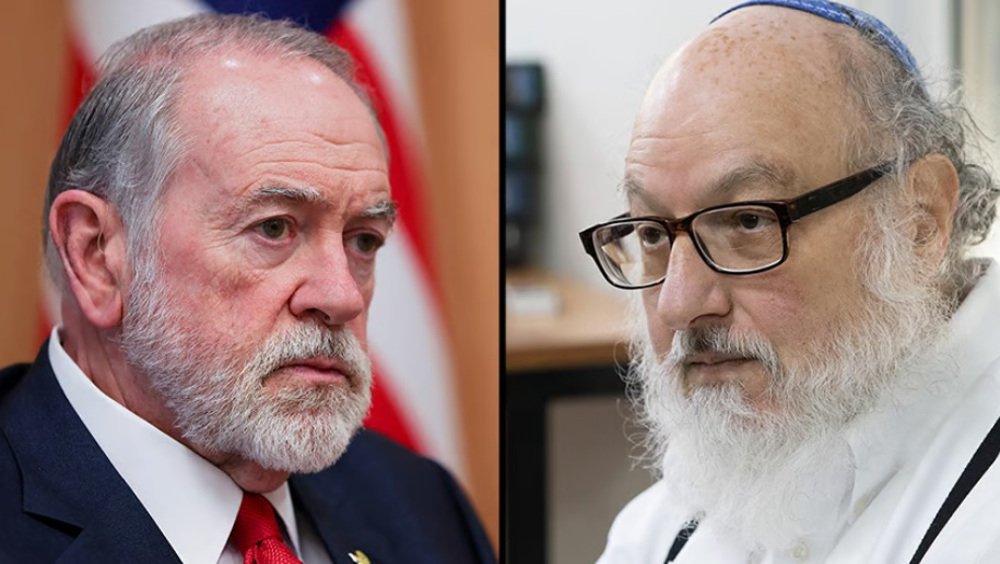
At the beginning of his sit-down with Huckabee, Carlson pressed him on a meeting that has long disturbed critics of US-Israeli relations: His encounter at the US Embassy with convicted spy Jonathan Pollard.
Pollard is no ordinary offender. He was convicted of passing highly classified US military secrets to Israel during the Cold War, material that, according to US intelligence officials at the time, ultimately reached the Soviet Union.
Carlson slammed Huckabee as the sitting US ambassador to the occupied territories for receiving him at the American Embassy at all, especially given Pollard’s unrepentant posture.
Huckabee described the meeting as a courtesy. He had previously met Pollard briefly at a hotel in occupied al-Quds years earlier.
After Pollard’s wife died, Huckabee sent a condolence note. Pollard then requested to visit the embassy to thank him.
He dismissed media reports describing the encounter as secretive.
Carlson, however, was unmoved. He reminded Huckabee that Pollard, after his release, gave interviews to Israeli media, urging Jewish Americans with US security clearances to spy for Mossad.
Pollard said at the time that “all Jews should have dual loyalty.” Carlson called this “not repentance… that’s someone who’s encouraging American Jews to betray their country.”
“That’s pretty heavy, don’t you think?” Carlson pressed. “Oh, I do, and I disagree with that wholeheartedly,” Huckabee replied.
Yet he did not distance himself from the decision to host Pollard at the embassy.
When Carlson emphasized the symbolism — “Once you become US Ambassador… and then you invite not only the most damaging betrayer in our lifetimes, but also a guy who continues to advocate for betrayal” — Huckabee minimized the significance.
“You make it sound like I’m hosting a meeting,” he objected. “I simply met with him. I meet with people all the time.”
Carlson interjected: “You can just walk in without a.... No, they have to have an appointment,” Huckabee admitted.
“Oh, so it is hosting him then, I think,” Carlson replied.
Huckabee ultimately stood firm: “He was certainly able to come to the US Embassy to have a meeting at his request. And frankly, I don’t regret it.”
The exchange exposed more than a dispute over terminology. It revealed a deeper tension about allegiance and optics. The US Embassy in the occupied territories is sovereign American territory.
For its chief diplomat to welcome a man convicted of spying against the United States, who has since defended dual loyalty and encouraged further espionage, struck Carlson as shocking.
Huckabee, however, treated it as routine diplomacy.
Huckabee mocks Arab League's condemnation of his remarks endorsing Israel’s biblical territorial claimshttps://t.co/fIRhOZwu3K
— Press TV 🔻 (@PressTV) February 22, 2026
Israel sheltering child molesters
In another charged segment of his interview with Huckabee, Carlson confronted a disturbing pattern: American fugitives accused of child sex crimes finding refuge in the occupied territories.
“There are dozens and dozens,” Carlson said, citing a recent case involving an Israeli cybersecurity official arrested in Nevada in a sting targeting individuals soliciting minors.
The suspect was charged with attempted child molestation, then fled to Israeli-occupied territories.
“Have you advocated for the Israeli [regime] to return him?” Carlson asked. Huckabee feigned ignorance.
“It has not come to us at the embassy,” he said, though he added, “I would have no problem with him being extradited back to the US.”
Carlson pressed the moral point. “Does it seem strange to you that people accused of child molestation… are allowed to have refuge within the borders of our closest ally?”
He then slammed the Israeli regime for allowing — even “shielding” — fugitives. Huckabee rejected that characterization.
“I am not aware that the Israeli [regime] is shielding people,” he said, emphasizing due process and noting extradition would be a Justice Department matter.
In the exchange, Carlson described the occupied territories as a haven where American fugitives can find protection, shielded by diplomatic inertia and political sensitivities.
Huckabee framed the matter as procedural, dependent on formal requests and judicial channels.
At its core, the exchange underscored a troubling question: if individuals charged with crimes against American children can flee to the occupied territories and remain there without swift resolution, what does that say about accountability — and about the priorities of an alliance rarely subjected to scrutiny.
The Epstein files and Israel
Elsewhere during the interview, Carlson asked about the murky case of Jeffrey Epstein and the millions of documents the United States Department of Justice continues to withhold.
Carlson’s question was blunt: Why are they still classified? Huckabee’s answer was even blunter in its indifference.
“I have no idea. I haven’t kept up with that,” he said, adding that he is “6,000 miles away from DC.”
But geography was not the real distance on display.
Carlson pressed further, pointing to disclosures suggesting that Isaac Herzog — Israeli president— was listed as a visitor to Epstein’s island.
Huckabee claimed total ignorance: “Had never heard that. Never heard it even in the Israeli press.”
The denial was categorical. Yet the exchange illuminated a deeper pattern: when allegations brush up against powerful Israeli figures, the reflex is not inquiry but dismissal.
Carlson was later forced to issue a public apology on X after receiving a forceful letter from Herzog’s office denying any contact with Epstein.
He said the claim stemmed from a 2014 email released by the Justice Department in which Epstein mentioned Herzog and former prime minister Ehud Barak as potential guests.
But even setting Herzog aside, the broader web of connections remains unsettling.
Barak’s relationship with Epstein is well documented, and evidence has proven that Epstein maintained contact with figures tied to both the Israeli spy agency Mossad and the CIA.
“I’m not saying he worked for Mossad,” Carlson said. “But there’s no question that he had extensive contact with the CIA.”
Huckabee bristled at the implication. “You think he does. From where do you get that?” he demanded, as though the mere suggestion of Israeli spy agency proximity crossed an invisible line.
That line — the boundary beyond which criticism of the Israeli regime becomes taboo — hovered over the entire exchange.
Carlson noted the asymmetry himself: “Everyone’s very sensitive about the Israel connection, but not at all sensitive about the US connection. We should care about what our government does first.”
Huckabee’s defense was evasive. As an ambassador based in occupied al-Quds, he said the matter was not “in my portfolio.”
He repeated that the Justice Department handles such issues. When Carlson urged him to call for full transparency, Huckabee shrugged: “Well, fine — call for it. Let’s have it all open.”
Yet the casual tone belied the gravity of the subject: a convicted sex offender with global elite ties, intelligence-adjacent associations, and high-level contacts in the occupied territories.
Millions of pages remain hidden under the banner of “national security.” Whose security, precisely, remains the unspoken question.
Epstein was a wealthy financier who cultivated relationships with presidents, billionaires, academics and intelligence-linked figures while operating a vast sex trafficking ring involving underage girls.
He socialized with members of the American elite, moved easily in circles connected to the CIA and Mossad, and maintained ties to prominent Israeli political figures.
Arrested in 2019 on sex trafficking charges after a prior lenient plea deal in Florida, Epstein was found dead in a Manhattan jail cell before trial, in what authorities ruled a suicide — a conclusion that convinced few.
The US ambassador to Israel, Mike Huckabee, says that it would be fine if the Israeli regime expands its occupied territories across West Asia.
— Press TV 🔻 (@PressTV) February 21, 2026
Follow Press TV on Telegram: https://t.co/LWoNSpkJSh pic.twitter.com/NoTi0v4Zvn
‘Right to the land’
In one of the lengthiest parts of the conversation, Huckabee was pressed about the geographical borders of Israeli-occupied territories, which he claimed are rooted in the Bible.
However, Huckabee, a vocal supporter of the Israeli regime and its expansionism, repeatedly struggled to answer simple questions.
Carlson’s probing made clear the absurdity of his worldview: that an entire region of West Asia belongs to a religious and ethnic group because of a biblical promise.
The conversation began with definitions. “What is a Christian Zionist?” Huckabee asked, then provided his own answer: a believer in the Old and New Testaments who accepts the idea that Jews have a divine right to their homeland.
Carlson pressed him: Does this “right” extend beyond Israel? Huckabee stumbled.
He cited Genesis and the promise to Abraham, claiming a divine grant of land stretching from the Nile to the Euphrates — essentially all of modern Lebanon, Syria, Jordan, Iraq, and parts of Saudi Arabia.
When Carlson asked if it would be “fine” for Israel to take all of it, Huckabee hesitated. His answer was telling: “It would be fine if they took it all, but I don’t think that’s what we’re talking about here today.”
Carlson, who appeared taken aback by the statement, asked Huckabee if indeed he would approve of Israel expanding over the entire region.
“They don’t want to take it over. They’re not asking to take it over,” the ambassador replied.
The US envoy, an avowed Christian Zionist and staunch defender of Israeli apartheid, later appeared to walk back his assertion, saying that it “was somewhat of a hyperbolic statement.”
Still, he left the door open for Israeli expansionism based on his religious interpretation.
“If they end up getting attacked by all these places, and they win that war, and they take that land, OK, that’s a whole other discussion,” Huckabee said.
Huckabee also claimed that Jews have a moral and legal right to occupied Palestine due to both ancient ties and modern international recognition.
Yet he struggled to define who qualifies as Jewish or how legitimacy is measured.
Carlson repeatedly noted that modern Israel is largely populated by descendants of European Jews, many of them secular or atheist, with no direct genealogical connection to the biblical land.
Huckabee offered vague appeals to language, religion, and tradition, but avoided any concrete answer. Huckabee’s invocation of international law was equally shaky.
He cited the Balfour Declaration, League of Nations mandates, and UN resolutions as proof of Israel’s legitimacy. Carlson pointed out the absurdity: “The Balfour Declaration is not exactly international law… it was a colonial power saying, ‘Okay.’”
Huckabee responded with a rhetorical dodge, praising Israel’s military assaults as if survival in war creates moral entitlement. Carlson also asked, “If Israel were out of compliance with international law, whatever that is, would it be less legitimate?”
Huckabee’s answer was revealing: “Depends on if the law and the way it’s applied are legitimate. Some applications of so-called international law are not legitimate. Look at the ICC or the ICJ.”
Here, the first cracks in the narrative appear. The justification for Israel’s so-called modern statehood leans on selective legal interpretations rather than consistent international standards.
Israel faces significant legal challenges and escalating pressure from both the International Criminal Court (ICC) and the International Court of Justice (ICJ) related to its genocidal war in Gaza and the West Bank.
In November 2024, the ICC issued arrest warrants for Prime Minister Benjamin Netanyahu and former minister of military affairs Yoav Gallant for using starvation as a method of warfare and intentionally directing attacks against civilians in Gaza.
The Israeli regime, in response, has “personally threatened” ICC officials, including former prosecutor Fatou Bensouda and current prosecutor Karim Khan.
Supporting Israel, the US government (under both the Biden and Trump administrations) has imposed or threatened sanctions against ICC judges and staff, branding the court’s actions as “illegitimate judicial overreach.”
The debate over Jewish identity further exposes the tension. Huckabee insisted that modern Jews are descendants of Abraham, maintaining “an unbroken line of Jewish people… they were hunted down… they came back.”
Carlson countered with historical facts inconvenient to the narrative: the founders of the Israeli regime, largely secular or atheists from Europe, had no direct connection to the land for millennia.
“The current prime minister’s ancestors weren’t from here within recorded history… Bibi Netanyahu… his family from Poland… how do we know that he has a connection to the people whom God promised the land to?” he asked.
The answer was vague, relying on cultural markers rather than genealogical certainty: “If they speak the same language, if they worship the same God, if they follow the same Bible… does that not give you a clue?”
This logic conveniently ignores the existing Palestinian population, who have inhabited the land continuously for centuries.
The claim to occupied Palestine as a homeland for Jews from around the world effectively erases local Arab communities.
Carlson pointedly noted that in 1948, Jews “kicked out a lot of people… it was a war… a lot of Christians wound up fleeing, they lost their homes, and they’ve never been allowed back.”
Yet Huckabee dismissed these losses, asserting that Christianity is now growing in Israeli-occupied territories and claiming, “There are 184,000 Christians here today,” a figure Carlson immediately challenged as misleading.
“There are many more Christians in Qatar than there are in Israel. Fact.”
Carlson’s questioning exposed the selective narrative: Israeli-occupied territories are portrayed as a safe haven, yet the regime’s policies have displaced indigenous populations.
The repeated invocation of a “right to exist” ignores the rights of those already living there.
When asked, “Does every nation have the same right to its own homeland that you say Israel does?” Huckabee evaded a universal principle, insisting that Israel’s claim is unique:
“I think it applies specifically to Israel… Israel… does bring up international law… connection to the history… connection to the Jewish people.”
Hamas: Huckabee’s remarks expose ‘American bias towards Zionist domination, annexation’ https://t.co/imwIxNhQdO
— Press TV 🔻 (@PressTV) February 22, 2026
On the Gaza death toll
When asked how many civilians have been killed by the Israeli military in Gaza, the exchange was brief. The questions were simple. The answers were not. Huckabee did not offer a number.
“We don’t know,” he said. “You know why? We don’t know.”
It was a striking admission: after months of war, after at least 72,000 reported dead, after global headlines, satellite images, hospital counts, and intelligence briefings.
Still, he insisted: “We don’t know.” Across from him, Tucker Carlson pressed further. “What’s your guess?” Huckabee hesitated. Then he shifted the ground.
“Well, the only numbers we have come from this dubious entity called the Gaza Health Ministry. You know who that is?”
The implication was clear. The figures cannot be trusted. Therefore, the scale cannot be known. Therefore, the moral weight remains suspended.
“How many kids were killed?” Carlson asked. Again:
“We don’t know.”
“What’s your guess?”
“I don’t know. I’m sure it was thousands,” Huckabee conceded. Then came the justification. “And some of the kids who were killed had been recruited to be in the military — kids as young as 14 years old.”
There it was. Thousands of children are dead, followed immediately by a caveat.
Carlson responded sharply: “Terrible. Did you hear yourself?”
Huckabee doubled down. “I just said that there were kids as young as 14 that were recruited to be Hamas soldiers and given arms.”
The moral frame narrowed. The dead children became potential soldiers. The category of innocence shrank. “How do you feel about the kids being killed?” Carlson asked.
“I think it’s horrible,” Huckabee replied. But the answer did not rest there. “You know what I also think is horrible? I think it’s horrible that 1,200 people were slaughtered by people across the border, and 252 people were taken hostage.”
The reference was to the October 7 resistance operation by Hamas. The numbers have become fixed in Western political discourse. 1,200 killed, 252 taken captive, forty-eight Americans among them.
“When are all lives equal?” Huckabee asked. “When Hamas could have ended this on October 8th and given all the hostages up, they didn’t — leaving no choice.”
|"Leaving no choice." It is a phrase that has defined much of the defense of Israel’s genocidal war on Gaza. No choice. No alternative.
No other path. The responsibility, in this framing, lies entirely with Hamas. The consequences, however vast, are portrayed as inevitable.
What stood out in the exchange was not simply Huckabee’s refusal to cite figures from Gaza’s health authorities. It was the asymmetry. The October 7 toll was precise, the captive count exact. The number of Americans specified. But when it came to Palestinian killings, especially children, the language dissolved into uncertainty.
Huckabee defended Israel’s aggression on Gaza, claiming the military warns civilians before attacks.
“They send page messages and texts to every cell phone in Gaza… They drop leaflets, and they announce where they’re going to hit,” he said, framing it as an effort “to prevent civilian casualties.”
Huckabee blamed Hamas for killings, claiming they “gather up the children and put them in the targets… by gunpoint, they push people into those various places,” then accuse Israel of “slaughtering these people.”
He went further, claiming that even if Hamas’ casualty figures were accurate, “you still have a lower number of civilians killed than in any urban warfare environment in modern history.”
Oxfam reported that the average daily death rate in Gaza (estimated at 250 people per day in early 2024) exceeded that of any other major conflict in the 21st century, including Syria (96.5), Sudan (51.6), and Iraq (50.8).
More than 3 percent of Gaza’s pre-conflict population has been killed. This rate of mortality relative to the total population in such a short period is considered unprecedented by some researchers.
Netanyahu’s ‘Amalek’ reference
During the interview, Huckabee also came to the defense of Netanyahu, who referred to Palestinians in Gaza as “Amalek,” a biblical reference associated with total annihilation.
Carlson pressed the issue, noting the chilling implications: “If you say ‘our enemy is Amalek’… you are calling for genocide. Tell me how I’m missing something.”
Huckabee sidestepped, offering only vague justifications.
“I don’t know what he meant. I don’t know if it was an illustrative metaphor,” he said.
He attempted to minimize the concern by saying, “If Israel wanted to commit genocide, they could have done it in two and a half hours, “framing the killing of tens of thousands of civilians, including children, as a controlled operation rather than a moral crisis.
Israel’s grip on US foreign policy
In a revealing exchange, Huckabee defended Israel’s repeated lobbying of the US, including seven White House visits in a single year under Netanyahu, pushing for “regime change” in Iran.
Huckabee framed Israel as “not just a friend or an ally — it is a real partner,” insisting that close coordination justifies the influence.
Carlson pressed the moral and strategic implications: “Why do you think a foreign leader was in the White House seven times in one year? Are you okay with that?”
Huckabee offered no real critique, sidestepping questions about US sovereignty and the extent to which American foreign policy is being shaped by outsiders.
Huckabee also justified US aid to Israel, claiming that the $3.8 billion sent annually “goes right back to the US to purchase weapon systems,” supporting American jobs in places like Arkansas.
He claimed that the investment yields “many more times back in the return on investment.”
Carlson countered with the domestic perspective: “Our country is not thriving, and we’re spending tens and tens of billions of dollars over time defending Israel… Why are we sending money to a country that has a higher standard of living than ours?”
Leader’s strategic vision leverages Iran’s post-war ascendancy to reshape regional power dynamics
Cuba blasts Rubio for lying about US fuel blockade
US views PMU resistance fighters as obstacle to its objectives in Iraq: Politician



Iran def. minister warns of 'heavy, regretful' response to any violation of US MoU
“This is how we protect our land": parl. speaker hails Iran's World Cup defense amid US threats
Iran hold Belgium to goalless draw as World Cup campaign gains momentum
Leave southern Lebanon or be kicked out: IRGC Quds Force chief warns Israel
VIDEO | Trump’s derogatory comments about PM Giorgia Meloni spark political backlash in Italy
VIDEO | Anti-fascist rally held in Bogotá ahead of presidential election
VIDEO | Gaza's hospital power shortages leave patients at risk
VIDEO | Yemenis call Iran–US MOU victory for resistance


 PressTV NEWSLETTER
now
PressTV NEWSLETTER
now
 This makes it easy to access the Press TV website
