China's factory activity snaps record slump
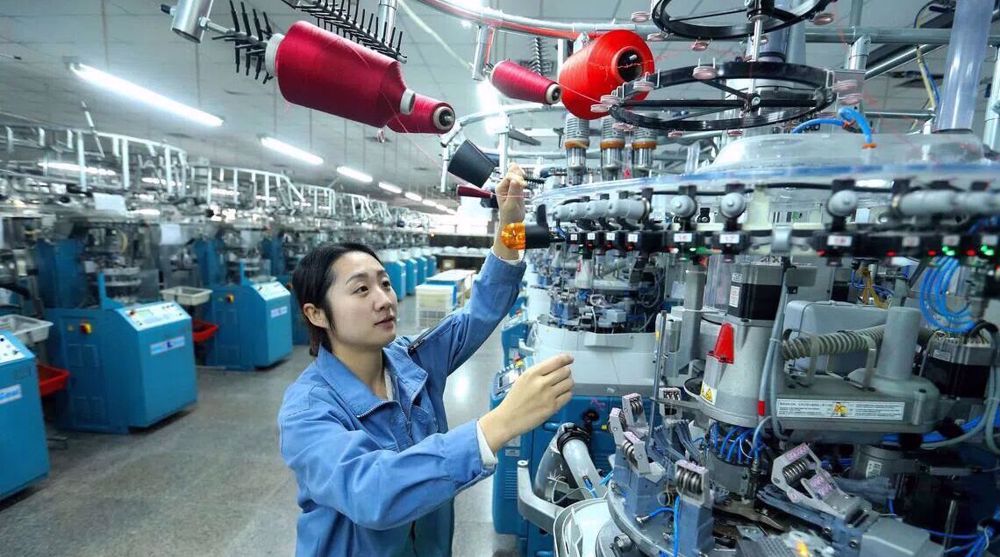
China's factory activity unexpectedly grew in December, snapping a record eight straight months of decline, lifted by a rise in pre-holiday orders as officials seek to spur the $19 trillion economy's manufacturing sector without worsening deflation.
The official purchasing managers' index (PMI) rose to 50.1 in December from 49.2 in November, the National Bureau of Statistics' survey showed on Wednesday, topping the 50-point mark separating growth from contraction and beating a forecast of 49.2 in a Reuters poll.
“Assuming the improvement in the PMIs is borne out in the hard data, we think it will likely be a short-lived upturn in activity on the back of month-to-month swings in fiscal spending rather than the start of a more sustained pick-up,” said Julian Evans-Pritchard, head of China economics at Capital Economics.
“The big picture is that the structural headwinds from the property downturn and industrial overcapacity are set to persist in 2026,” he added.
Still, the data should give policymakers cause for optimism after choosing to see out 2025 without major additional stimulus to meet the full-year growth target of around 5%.
The production sub-index jumped to 51.7 from 50.0 in November, while new orders climbed to 50.8 from 49.2, marking their strongest performance since March. Supplier delivery times also improved, pushing the production and activity expectations component to 55.5, its highest reading since March 2024.
New export orders remained sluggish, however, edging up to 49.0 from November's 47.6, underscoring the need for officials to boost domestic demand and rely less on US demand, the world's top consumer market, in the face of President Donald Trump's tariffs.
Huo Lihui, an NBS statistician, said confidence appeared to be improving due to pre-holiday stockpiling, as the world's second-largest economy prepares to celebrate the Lunar New Year in February, pointing to an uptick in the agricultural, food processing and food and beverage sectors.
A separate private-sector PMI published on Wednesday also showed marginal expansion in activity in December, driven by stronger production and domestic demand in the absence of more foreign orders.
Depressed domestic demand
Ginning up domestic manufacturing without taking further steps to boost consumer demand risks worsening deflationary pressures, however.
In separate data released last week, Chinese industrial firms saw their profits fall 13.1% year-on-year in November, the steepest drop in over a year, suggesting households are not stepping in to pick up the shortfall as a slowing global economy weighs on exports.
At an agenda-setting gathering in early December, the ruling Communist Party leadership promised to boost income and stimulate consumption, although similar pledges in the past have struggled to deliver results.
Chinese consumers have so far been reluctant to spend, held back by an uncertain employment outlook and as a prolonged property crisis drains household wealth.
The official non-manufacturing PMI, which includes services and construction, was at 50.2, after shrinking in November for the first time in nearly three years.
Beijing's policymakers have come to recognize the need to rebalance the economy and transform its production-driven model as tensions with key export markets mount.
“The country's economic development still faces many old problems and new challenges; the impact of changes in the external environment is deepening, and the contradiction between strong supply and weak demand is prominent domestically,” the readout of the Central Economic Work Conference said.
In an article published by the flagship party magazine Qiushi Journal in mid-December, President Xi Jinping said there was “overall capacity excess” and that “ultimately consumption is the sustainable driver of economic growth.”
Beijing had previously rejected “overcapacity” as unfair criticism by Western governments towards China's industrial policies.
In a nod to those concerns, authorities have this year vowed to crack down on price wars, prune production in some sectors and step up so-called “anti-involution” efforts.
The NBS composite PMI of manufacturing and non-manufacturing was 50.7 in December, compared with November's 49.7.
(Source: Reuters)

Chinese readers embrace memoirs of Iran’s martyred Leader as digital edition launches
China slams US sanctions on refineries over alleged links to Iran

China defends Iran trade, rejects Trump's 'gift from China' for Tehran claim



Majority of US bases in West Asia damaged in retaliatory strikes by Iran, allies: Probe
Iran welcomes nomination of Iraq's new PM-designate; reaffirms support for Iraqi stability
IRGC Navy vows to enforce Leader's 'historic' directive in Persian Gulf
May 1: Iran's resilience pays off with major strategic gains as US pressure tactics fail
Germany blasts Trump’s anti-Iran strategy, urges quick end to aggression
Minab children massacre not ‘unfortunate situation’ but ‘heinous war crime’: Tehran
VIDEO | The hostage president: Who really runs the world?
Iran open to diplomacy if US drops its excessive demands: FM


 PressTV NEWSLETTER
now
PressTV NEWSLETTER
now

 This makes it easy to access the Press TV website
