The Year That Was: Wars, genocide, protests, scandals – events that defined 2025
By Humaira Ahad
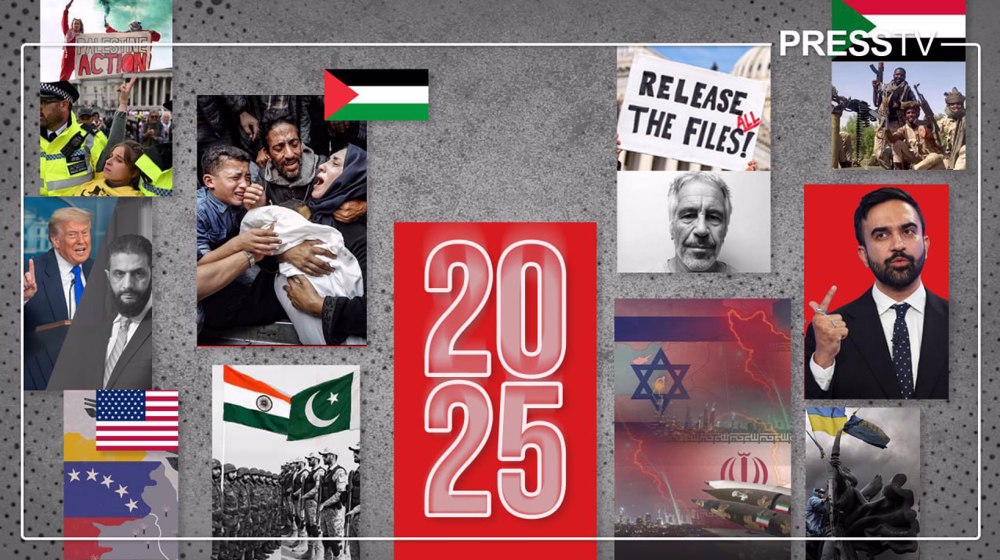
The year 2025 was marked by devastating wars, military aggressions, and humanitarian crises, alongside widespread anti-war protests and the rise of prominent anti-war political figures around the globe.
Throughout the year, civilians bore the brunt of wars, including Israel’s ongoing genocidal war on Gaza, Israeli-American aggression against Iran and the ongoing war in Sudan, resulting in extensive casualties and large-scale displacement.
In South Asia, India and Pakistan came perilously close to full-scale war, while Gaza remained a zone of humanitarian catastrophe amid repeated ceasefire violations by Israel.
Beyond the battlefield, landmark political developments, such as the election of Zohran Mamdani as the first Muslim New York City mayor, signalled shifting global attitudes toward foreign policy and human rights.
Meanwhile, revelations related to convicted sex offender Jeffrey Epstein, Western-backed wars in Syria and Venezuela, and the US policy change in Ukraine underscored the extent to which Western powers manipulate global events to secure strategic and economic interests.
Overall, 2025 revealed the fragility of international law and the staggering toll borne by ordinary people – from Iran to Lebanon to Syria to Iran.
Israel’s June war on Iran
This year’s most consequential escalation erupted on June 13, when Israel launched an unprovoked military campaign against Iran, striking residential areas in one of the most extensive aggression campaigns witnessed in the region in years.
According to the Iranian Red Crescent Society, 1064 people were killed, including 126 women and 41 children.
The Israeli strikes in the middle of the night targeted high-ranking military commanders, nuclear scientists, and urban neighbourhoods.
Iran responded through coordinated retaliatory operations, including successful missile strikes on the Haifa oil refinery and a military raid on a Mossad installation, demonstrating the country’s capacity to hit strategic Israeli infrastructure.
The escalation intensified further when the United States entered the war by bombing three peaceful Iranian nuclear sites, an action that violated the UN Charter, international law, and the Nuclear Non-Proliferation Treaty (NPT).
Despite the combined pressure, Iran’s defensive and retaliatory measures forced an end to the Israeli assault by June 24, exposing the fragility of the enemy’s military calculations.
✍️ Feature -From Gaza to Tehran, Zionist regime’s war on children knows no borders
— Press TV 🔻 (@PressTV) June 24, 2025
By @HumairaAhad_83 https://t.co/s1V53nSJpz
Gaza genocide and ceasefire violations
Gaza continued to face catastrophic conditions in 2025 despite a ceasefire agreement introduced under a 20-point proposal advanced by US President Donald Trump.
According to Gaza’s Health Ministry, the overall death toll since October 2023 has crossed 71,000, with at least 171,200 injured.
Palestinian authorities documented 875 Israeli breaches of the ceasefire, including 265 shootings at civilians, 421 artillery or air attacks, 49 military incursions into residential zones, and 150 home demolitions.
Since the truce took effect on October 10, at least 411 Palestinians have been killed and 1,112 wounded, numbers that humanitarian groups say highlight the fragility of the agreement.
Despite the commitments outlined in the deal, Israeli forces continued restricting essential humanitarian supplies, especially tents and prefabricated homes needed to shelter displaced families.
The measures have deepened Gaza’s humanitarian collapse and undermined international aid efforts.
Human rights organisations accuse Israel of systematically obstructing reconstruction and relief operations, with several Western states criticised for enabling the violations through diplomatic protection.
Israeli forces carry out further strikes in Gaza in violation of the ceasefire with Hamas.
— Press TV 🔻 (@PressTV) December 27, 2025
Follow Press TV on Telegram: https://t.co/LWoNSpkJSh pic.twitter.com/GOhf3bCFV8
Sudan’s civil war and growing humanitarian crisis
As Sudan’s civil war entered its third year, international relief agencies described the crisis as the most catastrophic humanitarian disaster unfolding anywhere in the world.
The conflict between the Sudanese Armed Forces and the Rapid Support Forces (RSF) has killed an estimated 150,000 people, with millions more caught in siege and forced displacement campaigns.
Nearly 13 million Sudanese have been driven from their homes, while over 21 million face severe hunger, including famine-level conditions in parts of Darfur and Kordofan.
Satellite imagery shows mass graves and destroyed urban centres, underscoring the scale of devastation in the African country, with many blaming outsiders for backing the RSF militia
Despite the severity of the crisis, analysts note that the Western response has remained limited and politically selective, mirroring patterns seen in other African conflicts.
✍️ Viewpoint - Policy of erasure: UN marks ‘Genocide Prevention Day’ by unmarking Gaza and Sudan
— Press TV 🔻 (@PressTV) December 10, 2025
By Shabbir Rizvi https://t.co/VVX7ks0jLU
Venezuela: Blockade and US military operations
On December 16, 2025, the Trump administration announced a blockade targeting “sanctioned oil vessels” sailing to and from Venezuela, marking the latest escalation in Washington’s ongoing military campaign against Caracas.
US officials claimed that Venezuela was using its primary resource, oil, to finance “narcoterrorism,” in order to justify the illegal blockade and a series of military airstrikes.
Since September, the US military has conducted numerous airstrikes against boats across the Caribbean Sea and the eastern Pacific Ocean.
More than 100 people have reportedly been killed as the US authorities have provided no public evidence to substantiate the drug claims.
Caracas has asserted that the military campaign is aimed at undermining the government of Nicolás Maduro and seizing control of Venezuela’s massive energy resources.
The blockade and military actions have intensified the humanitarian and economic hardships faced by Venezuelans already impacted by long-standing US sanctions.
Press TV's Gladys Quesada from Caracas says that the Western media is trying to deliver a false picture of the overall situation in Venezuela by depicting a nation in crisis.
— Highlights (@highlightsnews1) December 27, 2025
Follow Press TV on Telegram: https://t.co/mtgZgtn5i7 pic.twitter.com/odHF4SoFXq
Indo-Pakistan crisis: Most serious confrontation in decades
South Asia edged dangerously close to large-scale war in early May after India blamed Pakistan for a deadly April 22 attack on tourists in Indian-administered Kashmir, a claim Islamabad firmly rejected.
On May 7, India launched strikes against what they called “terrorist infrastructure” inside Pakistan, triggering a rapid and intense four-day military confrontation.
Pakistan retaliated by downing Indian fighter jets and carrying out its own strikes, while both sides deployed drones, missiles, and heavy artillery in the most serious military standoff between the two nuclear-armed neighbours since the 1999 Kargil war.
Civilians along the Line of Control that divides the two neighbouring countries and border regions were exposed to displacement, property destruction, and casualties.
The eventual ceasefire, negotiated on May 10, halted hostilities but did not address underlying tensions.
Strategic observers warn that unless structural political issues in Kashmir and broader regional mistrust are addressed, similar crises may continue to emerge.

Expanding Israeli occupation in Syria
Following the overthrow of former Syrian President Bashar al-Assad’s government in December 2024, Israel intensified operations across Syrian territory, launching repeated airstrikes and expanding its on-the-ground presence in the southwest.
Israeli regime forces took control of the demilitarised buffer zone adjacent to the occupied Golan Heights, in direct violation of the 1974 Disengagement Agreement.
Ground incursions into Quneitra and the establishment of temporary checkpoints have sparked widespread condemnation from regional governments, who warn that Israel is exploiting Syria’s political vacuum to widen its occupation.
Simultaneously, US policy also underwent a dramatic shift in May, when President Donald Trump announced the lifting of all US sanctions against Syria’s new HTS-led administration.
Washington framed the move as a response to the administration’s reported willingness to consider “peace” with Israel.
The UN Security Council later approved a resolution removing HTS leader Abu Mohammad al-Jolani and interior minister Anas Khattab from the terrorism sanctions list, despite years of international designations.
Israeli forces invade Syrian village amid continued aggression https://t.co/BTv1zzLy46
— Press TV 🔻 (@PressTV) December 28, 2025
Zohran Mamdani’s historic election win
In November 2025, Zohran Mamdani made history as the first African-born and South Asian-descended mayor of New York City.
Mamdani, 34, won the election after surpassing former governor Andrew Cuomo, securing at least 50 per cent of the vote with 85 per cent of ballots counted.
Analysts say Mamdani’s outspoken support for Palestinian rights and his criticism of Israeli policies resonated strongly in a city shaped by immigrant communities and a growing scepticism towards US foreign policy.
Despite facing sustained political attacks and accusations of “antisemitism,” charges dismissed by his supporters as politically motivated, Mamdani maintained a platform centred on social justice, anti-war commitments, and reorienting the city’s political priorities.
Experts say his win marks a shift in the United States' political landscape, reflecting broader generational divides over foreign policy, policing, and economic inequality.
In an interview with ABC, newly elected NYC mayor Zohran Mamdani reaffirmed his promise to arrest the internationally wanted war criminal, Israeli PM Benjamin Netanyahu, if he travels to NYC, stressing, unlike Donald Trump, that he intends to act strictly within the law. pic.twitter.com/2jzLdoBvWW
— Press TV 🔻 (@PressTV) November 17, 2025
Jeffrey Epstein Document Revelations
More than 20,000 pages of documents from the estate of convicted sex offender Jeffrey Epstein have been released in recent months, revealing correspondence implicating Trump, former US president Bill Clinton, former Israeli premier Ehud Barak and other political, media, business and tech figures in knowledge of Epstein’s crimes.
Emails from 2011, 2015, and 2019 indicate Trump was aware of Epstein’s abuse of minors, despite public denials.
Epstein’s records referred to Trump as “the dog that hasn’t barked” and claimed Trump had spent time with one of Epstein’s underage victims.
Epstein's emails have also shown that he would organise meetings for prominent figures with African leaders, discussing potential business deals with Zionist intelligence agency-connected firms.
The disclosures have reignited debates about accountability within the US political eliteand also opened new lines of inquiry to understand Epstein's role in the expansionist foreign policies of Israel.
✍️ Feature - Inside the Epstein saga: Untangling his ties to Israeli spy agency, US presidents
— Press TV 🔻 (@PressTV) July 27, 2025
By Maryam Qarehgozlou
Read More: https://t.co/LkZKBtKqBS pic.twitter.com/sxcvDv4A57
Palestine Action: UK campaign and government response
In July, the UK government banned the pro-Palestine activist group Palestine Action under the Terrorism Act, citing threats to “national security.”
The pro-Palestine activist group was campaigning against Israeli weapons manufacturers, targeting Elbit Systems UK, which supplies munitions used in Gaza.
The organisation accused the British government of complicity in Israel’s military operations, particularly the siege and attacks on the besieged strip.
Hundreds of pro-Palestine activists were arrested during protests opposing the ban, which has been described as an “infringement on free speech and public accountability.”
Eight prisoners have been on hunger strike in recent months, with four of them pausing until the New Year, awaiting trial for alleged offences relating to the activist group.
UN experts have expressed “grave concern” for the well-being of hunger strikers and warned their treatment raises questions about the UK’s compliance with international human rights laws.
The pro-Palestine campaign has been emphasising transparency in the global arms trade and the ethical responsibilities of governments and corporations in enabling genocide.
The group argues thatthe UK’s legal and political response reflects Western alignment with Israeli policies while suppressing grassroots movements advocating for Palestinian rights.
The British government has failed in its bid to block a challenge against its decision to ban Palestine Action under terrorism laws.
— Press TV 🔻 (@PressTV) October 17, 2025
In a milestone ruling, the Court of Appeal cleared the way for a review of the ban by a High Court judge next month. pic.twitter.com/bbBrZUZItJ
Ukraine war and geopolitical realignment
Throughout 2025, Ukraine remained embroiled in a protracted war with Russia, now compounded by shifts in US foreign policy.
The United States, under Trump, has pressured Kyiv to accept the ceasefire deal in exchange for security guarantees, while halting military support earlier in the year.
This shift left the country increasingly vulnerable, with large areas suffering from infrastructure destruction, food shortages, and disrupted basic services.
European governments, including the United Kingdom, France, and Germany, criticised the US stance as undermining “Ukrainian sovereignty,” yet offered limited direct support to the country.
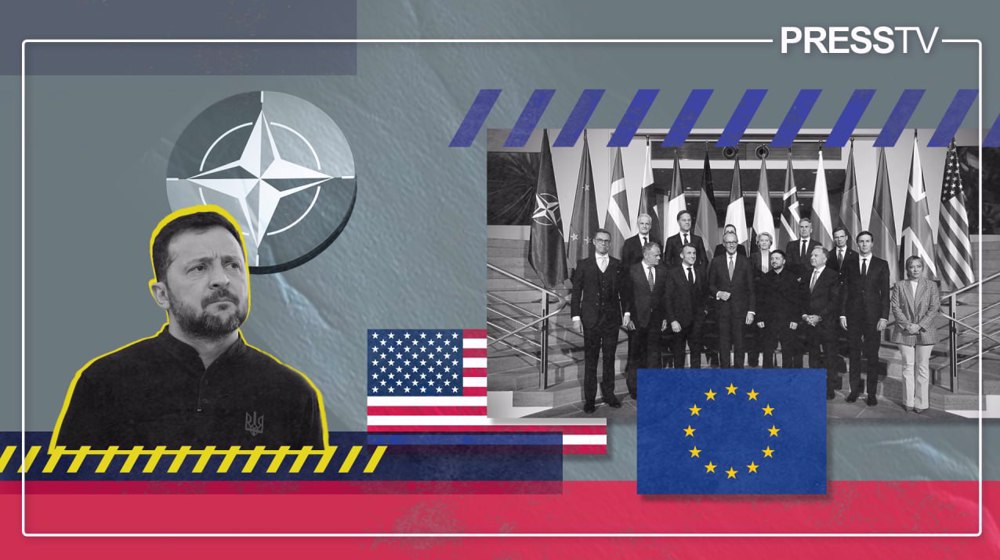
Ukrainian President Volodymyr Zelensky ultimately agreed to security arrangements modelled loosely on NATO Article Five guarantees, effectively abandoning NATO accession ambitions that started in 2014.
Now, as 2025 draws to a close, the world has witnessed the consolidation of power shifts.
Ceasefires and retaliatory strikes in different regions temporarily halted open hostilities, yet millions remain displaced and without basic amenities.
Sanctions, blockades, and targeted military operations continued to disrupt economies and civilian life, as political transitions in cities and countries reflected broader global tensions.
The year is ending with uncertainty prevailing over diplomacy, reconstruction, and global security.
Russia’s Lavrov says EU ‘main obstacle’ to Ukraine peacehttps://t.co/XxoRayij4N
— Press TV 🔻 (@PressTV) December 28, 2025

Poll: Two-thirds of Iranians proud of nation’s global standing; 59% say Iran won the war
Millions of pilgrims complete Arafat rites in pivotal moment of Hajj journey
Millions of Hajj pilgrims flock to Mina ahead of Arafah

UK defense crisis deepens: Second top official resigns in less than 24 hours
'Which peace have you chosen': Mother of 7-year-old Makan Nasiri writes letter to FIFA president
IRGC Navy foils US-provoked attempt to illegally transit Strait of Hormuz: Report
Major parts of agreement to end war finalized despite US contradictions, aggression: FM spox
FIFA's neutrality and human rights narratives crumble as Trump hijacks the World Cup
June 11: Iran strikes US targets and closes Strait of Hormuz, as Trump backs down again
IRGC: Iran stronger than ever, fingers on the trigger for decisive response to any enemy aggression
Qalibaf warns US: 'You will see a different Iran' if aggression continues





 PressTV NEWSLETTER now
  This makes it easy to access the Press TV website