Explainer: How Russia and China could delay or obstruct Iran ‘snapback’ sanctions
By Press TV Website Staff
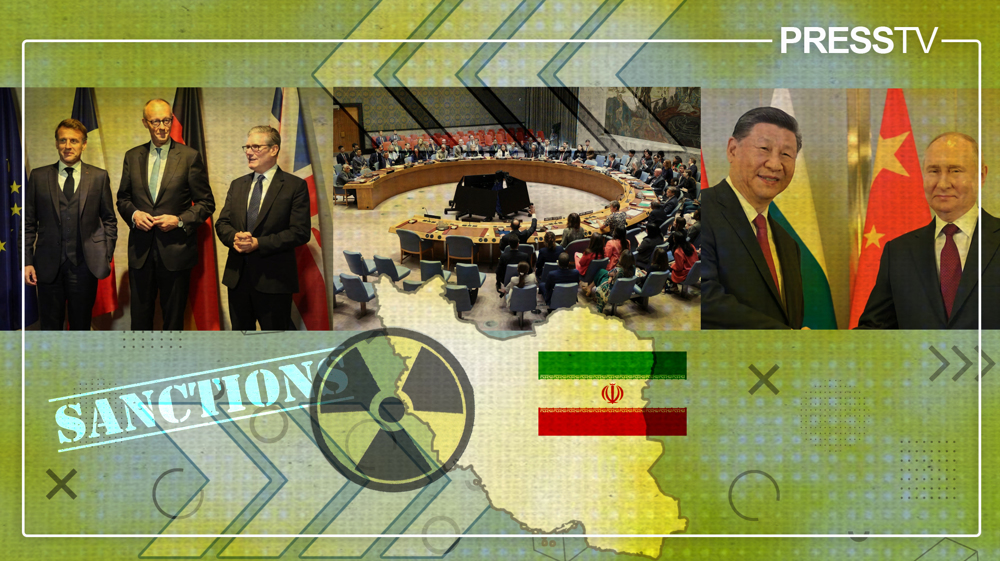
The UN Security Council on Friday voted down a resolution that sought to permanently lift sanctions on Iran, effectively clearing the way for snapback sanctions to move forward against the Islamic Republic of Iran.
The development came well in advance of the September 28 deadline for the automatic reactivation of the sanctions under the so-called “snapback” mechanism embedded in the 2015 nuclear accord, known formally as the Joint Comprehensive Plan of Action (JCPOA).
The process had been set in motion by the European troika (France, Germany, and the United Kingdom) on August 28, with American backing, falsely accusing Iran of “non-compliance” with the landmark nuclear deal.
The resolution, tabled by South Korea, fell short of adoption, with only four countries – China, Russia, Pakistan, and Algeria – voting in favor, while nine members opposed the measure and two abstained, falling short of the nine affirmative votes required for its passage.
UN Security Council votes against permanent lifting Iran 'snapback' sanctions ahead of deadline https://t.co/55fUA4tHgg
— Press TV 🔻 (@PressTV) September 19, 2025
How did Russia and China respond to it?
Russia categorically rejected the reinstatement of sanctions on Iran, asserting that the snapback mechanism was being misapplied. Russian Ambassador Mikhail Ulyanov warned that the resolution could prove counterproductive.
China echoed Moscow’s stance on the controversial and politically driven measure by the European troika, stressing that unilateral actions undermine multilateral diplomacy.
Iran condemned the outcome of the vote, describing it as “unlawful, unjustified and provocative,” particularly at a time when its safeguarded and peaceful nuclear facilities were attacked and damaged in unprovoked and illegal missile strikes by Israel and the United States.
“The three European countries not only declined to condemn these aggressive actions by Israel and the United States but also perpetrated a dual violation by abusing the JCPOA dispute resolution mechanism,” the Iranian foreign ministry said in a statement.
Deputy Foreign Minister Kazem Gharibabadi warned that the Tehran-IAEA agreement reached in Cairo recently will be terminated with the activation of the snapback mechanism.
Russia's envoy to the UN, Vasily Nebenzya, says the E3 have no right to invoke the so-called snapback mechanism against Iran as they have forfeited the right to do so.
— Press TV 🔻 (@PressTV) September 19, 2025
Follow https://t.co/B3zXG73Jym pic.twitter.com/sZngcF8Rk2
What are the next steps in the process?
Since the resolution to block the snapback failed, the sanctions are effectively reactivated automatically under UN Security Council Resolution 2231. This means that all previous UN sanctions lifted under the JCPOA are reinstated without the need for further UNSC approval.
Once circulated, all UN member states are legally obliged to comply, including prohibitions on arms transfers, nuclear-related technology, and certain financial transactions.
Before the 2015 nuclear deal, UN sanctions largely consisted of a comprehensive arms embargo prohibiting the transfer of conventional weapons to and from Iran, restrictions aimed at curbing Iran’s ballistic missile program, asset freezes targeting individuals and organizations linked to nuclear and missile activities, and a ban on exporting nuclear materials or technologies.
The EU and the E3 countries are now expected to begin coordinating enforcement mechanisms.
‘Unlawful and provocative’: Iran condemns E3’s move to ‘snapback’ UN sanctions https://t.co/NmsCMCeP63
— Press TV 🔻 (@PressTV) September 19, 2025
How can Russia and China obstruct the process?
However, there is a twist in the tale: China and Russia could obstruct its enforcement.
While the snapback sanctions are now in effect on paper, real-world enforcement depends heavily on member state cooperation – and that is where things may prove difficult for E3.
Russia and China cannot veto the automatic snapback once initiated by the E3, but they can effectively challenge, derail, or delay procedures of actual implementation.
Experts note that both countries can block the revival of the defunct Resolution 1737 Sanctions Committee or delay the appointment of its expert panel.
What is the 2015 nuclear deal’s “snapback mechanism,” and why is it illegal?
— Press TV 🔻 (@PressTV) August 29, 2025
Follow Press TV on Telegram: https://t.co/LWoNSpkc2J pic.twitter.com/66X4REc6M4
What is the Resolution 1737 Sanctions Committee?
Established in 2006 under UN Security Council Resolution 1737, the Sanctions Committee oversaw and enforced nuclear-related sanctions on the Islamic Republic.
Its responsibilities included maintaining lists of sanctioned individuals and entities, monitoring implementation by member states, and coordinating with a Panel of Experts to investigate potential violations.
The committee, comprising all 15 UN Security Council members, remained active until 2015, when Resolution 2231 and the JCPOA lifted most sanctions.
Before the nuclear deal, decisions were made by consensus, meaning any permanent member could effectively block progress. After the accord was signed, its mandate immediately expired.
For snapback sanctions to come into full effect, the 1737 Sanctions Committee would have to be revived – something Russia and China could slow or completely obstruct.
. @Amb_Ulyanov says why the European parties to the JCPOA are violators of the agreement and therefore do not have the legal, procedural, or moral right to trigger the snapback mechanism.
— Press TV 🔻 (@PressTV) September 8, 2025
Watch in full: https://t.co/SCMguepWfp pic.twitter.com/8CmnobyfwF
What is the Panel of Experts?
The Panel of Experts, set up under Resolution 1929 in 2010, assisted the 1737 Committee by monitoring sanctions implementation, investigating violations, and providing technical analysis of Iran’s nuclear and missile activities.
It reported its findings directly to the UN Security Council.
The panel serves as the technical foundation for enforcing sanctions. Without its expertise, the 1737 Committee cannot effectively monitor compliance or identify potential violations.
Russia and China could delay the reappointment of panel members by refusing to endorse consensus decisions in the committee or by obstructing a renewal resolution in the Council itself.
Iran, Russia, and China sign a joint letter rejecting EU snapback sanctions on Tehran as illegal and politically harmful, warning they threaten Iran’s rights and undermine global agreements.
— Press TV 🔻 (@PressTV) September 1, 2025
Follow: https://t.co/mLGcUTS2ei pic.twitter.com/aMMPMjj6ub
What are the economic and diplomatic tools?
Beyond procedural obstacles at the UN, Moscow and Beijing also have practical levers to undermine the effectiveness of snapback. Both countries have pledged to maintain robust economic relations with Iran, most notably through continued purchases of Iranian oil.
They can also expand non-dollar payment channels, using yuan, rubles, barter trade, or cryptocurrencies, to bypass financial sanctions and other restrictions.
They can also provide insurance, financing, and logistical support to facilitate oil exports while relying on alternative banking systems such as Russia’s SPFS and China’s CIPS to bypass or nullify SWIFT restrictions.
On the diplomatic front, Russia and China may use their positions at the UN to delay enforcement-related resolutions or operational measures.
They may also seek to persuade other member states to disregard the sanctions altogether as illegitimate and politically motivated.
Iranian officials maintain that the European signatories, having failed to uphold their JCPOA commitments following the US unilateral withdrawal, no longer have the legal right to trigger the snapback mechanism.
US 'defeated' as Iran MoU forces recognition of resistance allies: Qalibaf
Peace in Lebanon impossible without Iran: Qalibaf
Leader reappoints Mohseni-Ejei as Iran's judiciary chief


‘Speak with respect, Mr. Trump; or Iranians will reply in differnt language’: SNSC chief
Fresh Israeli attacks kill at least 6 in Gaza amid continued ceasefire violations
Ayatollah Khamenei’s legacy is dignity, patriotism and steadfastness: Baghaei
VIDEO | Ayatollah Khamenei's funeral draws extensive media coverage in Southeast Asia
Lawmakers urge UK government to sanction Netanyahu over Israeli torture of Palestinians
VIDEO | Press TV's news headlines
VIDEO | Hamas dissolves Gaza governing body, prepares to transfer authority
Berri rejects Netanyahu’s claim of annexing Lebanese Christian villages



 PressTV NEWSLETTER
now
PressTV NEWSLETTER
now
 This makes it easy to access the Press TV website
