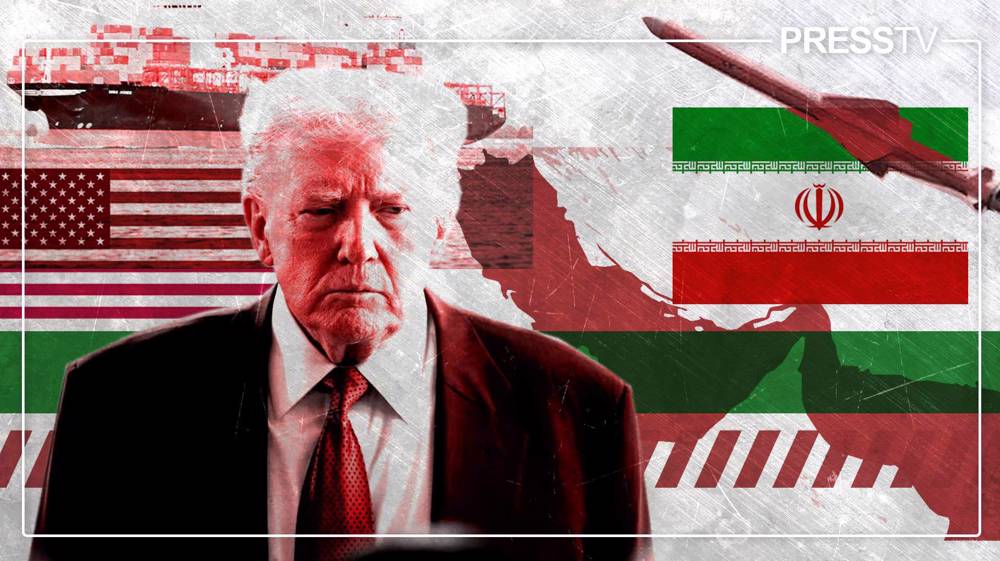
Iran's strategic patience, resilience outplay US war machine as Trump's desperation deepens
By Press TV Strategic Analysis Desk
In a development that surprised no one familiar with the mechanisms of American imperialism, the US Congress once again demonstrated its impotence to halt an unconstitutional and illegal war against a sovereign nation.
As expected, US lawmakers took no meaningful action to stop President Donald Trump’s unauthorized military aggression against Iran before the deadline lapsed on Friday.
Trump, following a long and ignoble tradition of his predecessors, simply bypassed Congress and pressed forward with the war “at the request” of the Israeli regime, as the US Department of State recently, perhaps inadvertently, admitted in a statement.
But what demands our closest attention is this: Trump’s claim that he was “ending” the war was never sincere. It was a calculated deception. Behind the rhetorical smokescreen, the White House quietly unveiled a new phase of aggression against the Islamic Republic.
So, essentially, the war has not ended – it has merely mutated.
The decision to maintain a complete naval blockade of Iran, coupled with the refusal to withdraw a single American military asset from the region, reveals the dark truth.
Trump has rejected two clear paths: an immediate return to full-scale bombing or acceptance of Iran’s reasonable ceasefire conditions. Instead, he has chosen a third, more insidious option – the slow strangulation of the Iranian people through economic warfare.
This is not peace. This is a blockade. This is a siege. This is war by other means.
The constitutional crisis no one is talking about
Let us be absolutely clear about what has happened. The US Constitution explicitly grants Congress – not the country’s president – the sole power to declare war on another country.
Yet Trump launched a full-scale and completely unprovoked military aggression against the Islamic Republic of Iran on February 28 without any congressional authorization.
He bombed sovereign Iranian territory, assassinated the top leadership, high-ranking commanders and ordinary civilians, including nearly 170 schoolchildren in Minab.
He initiated the war without realizing it could easily spiral into a regional inferno.
And US Congress? It did absolutely nothing. It chose to be a mute spectator.
This is not a bug in the American system. It is a feature. From Korea to Vietnam, from Iraq to Libya, US presidents have repeatedly started wars without congressional approval.
Each time, Congress has folded. Each time, the imperial presidency has grown stronger. Each time, the American people have been dragged into yet another war they never voted for.
Trump is not an exception. He is the latest in a long line of lawless and deranged executives who believe their power to wage unauthorized and reckless wars is limitless. The only difference is that Trump has dispensed with even the pretense of seeking legitimacy.
But here is the critical question that Washington's war hawks refuse to answer: What has this aggression actually achieved? The answer, of course, is nothing.
✍️ Analysis - Iran consolidates Strait of Hormuz control in post-war power shift, leaving US in the dark
— Press TV 🔻 (@PressTV) April 30, 2026
By Press TV Strategic Analysis Deskhttps://t.co/cZKzlZj2KE pic.twitter.com/nJJzI9PZZJ
Iran's strategy: Smart, patient, and winning
Despite American military superiority, despite the full involvement of the Israeli regime, despite a relentless bombing campaign, Iran remains unbowed.
Its military capabilities remain fully intact. Its nuclear program remains firmly grounded. Its regional influence remains undiminished. How has Iran achieved this?
Through a strategy that has left Washington completely bewildered – a strategy of strategic patience, asymmetric response, and masterful negotiation.
While Trump bombs and blusters, Iran has refused to panic. It has refused to overreact. It has refused to fall into the traps that American strategists have so carefully laid. Instead, Iran has absorbed the initial blows, responded with precise, measured and devastating counterstrikes, and positioned itself as the reasonable party seeking de-escalation.
What the CNN investigation has just revealed – the majority of US military bases in the region were destroyed in the Iranian retaliation – is a story the world will hear more often now. Iran does not bluff. Trump and its aides wanted a war and they got one.
Now, it has placed the embattled and megalomaniac US president in a tricky position. He cannot claim victory because there is no victory to claim. He cannot withdraw because withdrawal would be humiliating. He cannot escalate further without risking a catastrophic regional war. And he cannot negotiate from strength because Iran has refused to surrender
Iran has, in effect, checkmated the US president without firing a single unnecessary shot.
✍️ Analysis - US at a crossroads: Iran's firm positions leave Trump with no option but to capitulate
— Press TV 🔻 (@PressTV) April 29, 2026
By Press TV Strategic Analysis Deskhttps://t.co/eX743Xqr5t pic.twitter.com/KnLSd6BFdC
The desperate option: Why Trump may attack again
This brings us to the most dangerous phase of the war that has not ended yet.
Cornered leaders do not become more rational. They become more desperate. And desperation, when combined with unlimited military power, is a recipe for catastrophe.
If the current naval blockade fails to break Iranian resistance – and all evidence suggests it will fail – Trump may well resort to military aggression again. Not because it is wise. Not because it is justified. But because he will have no other move left. It is plain desperation.
Consider the White House's current calculation. American strategists are betting that the naval blockade will cripple Iran's economy, spark domestic unrest, trigger riots and chaos, weaken the government, and eventually force Tehran to surrender to American terms. They are betting that economic hardship will do what bombs could not.
This is a miscalculation of staggering proportions.
It ignores Iran's remarkable resilience. It ignores the 8,000 kilometers of land borders Iran shares with multiple neighbors, offering countless routes to bypass any naval blockade.
It ignores Iran's asymmetric warfare capabilities, which remain largely hidden and unused. And most critically, it ignores the unprecedented national unity that American aggression has forged inside Iran. The people will not leave the scene.
The Iranian people have not forgotten decades of American hostility. They have not forgotten the 1953 coup. They have not forgotten the 1980s’ imposed war, when Washington armed Iraqi Ba'athist dictator Saddam Hussein to kill Iranians.
And they have certainly not forgotten Trump's own explicit admission that he personally designed the January coup attempt, armed terrorist elements who killed ordinary people and destroyed infrastructure, and funded attempts to overthrow the Islamic Republic.
This is a population that has embedded its hatred for the American-Zionist enemy into its very flesh and blood. They will not be indoctrinated. They will not be tricked. They will not rise against their own government to do Washington's dirty work.
✍️ Analysis - Iran's new calculus: Full Strait of Hormuz control, no retreat on nuclear rights, and unused cards – including NPT
— Press TV 🔻 (@PressTV) April 25, 2026
By Press TV Strategic Analysis Deskhttps://t.co/JuJnfEKf7O pic.twitter.com/QnkIprd2g4
The options Iran has not yet used
If Trump miscalculates and resumes full-scale military aggression against the Islamic Republic, he will discover that Iran has been holding back.
There are numerous options that Iran and the Resistance Front have not yet deployed.
These options remain unannounced, their timing and method unspecified. This ambiguity is itself a weapon – a powerful weapon. The enemy does not know what is coming and when it is coming. The enemy cannot prepare. The enemy can only wait in fear.
American officials have already expressed open concern about certain potential Iranian responses – including, notably, the fiber optic communication lines beneath the Strait of Hormuz. These and other capabilities could dramatically shift the balance of power in ways Washington has not anticipated.
If the naval blockade continues and the economic war intensifies, Iran will have no choice but to respond asymmetrically. And when Iran responds, all of Trump's carefully laid plans will collapse. The endurance battle will then turn decisively in Iran's favor.
At that point, it will be Washington – not Tehran – that must choose between two grim options: escalate to full-scale war, or accept Iran's terms for a ceasefire.
Neither option is attractive nor feasible from the American point of view.
The unraveling of American power
What we are witnessing is something far larger than a single military confrontation. We are witnessing the unraveling of American unipolarity.
For decades, the United States has relied on its military might to impose its will on weaker nations. Bombings, sanctions, coups, assassinations – the full toolkit of American empire has been deployed again and again with impunity. No nation dared to resist. No nation could.
Iran has dared. And Iran has not only resisted – Iran has survived. More than that, Iran has come out stronger and more resilient, calling the shots.
✍️ Analysis - Iran wields leverage and strategic assets – concessions must flow from the embattled side
— Press TV 🔻 (@PressTV) April 27, 2026
By Press TV Strategic Analysis Deskhttps://t.co/WP11YXygsw
This is a lesson that will echo far beyond the shores of the Persian Gulf. From the Global South to the emerging multipolar order, people worldwide are watching. They are seeing that American power has limits. They are seeing that a determined nation, armed with strategic patience and asymmetric capabilities, can withstand the full weight of the American-Israeli war machine.
Trump may be too arrogant to recognize this reality. His advisors may be too ideologically blinded to admit it. But reality has a way of asserting itself regardless.
The path ahead is fraught with danger. A desperate and humiliated American president, facing strategic defeat on multiple fronts, may well lash out with renewed military aggression. Iran is prepared for this possibility as well.
But we should also recognize the deeper truth. Trump's desperation is not a sign of strength. It is a sign of failure. He bypassed Congress, launched an unprovoked attack, and expected Iran to crumble. Iran did not crumble. He imposed a brutal blockade, hoping to starve the Iranian people into submission. The Iranian people have not submitted.
Every day that Iran stands firm is a day that American strategy fails. Every day that the blockade fails to break the Iranian will is a day that Trump's desperation deepens.
Iran does not need to defeat the American military. Iran only needs to outlast American resolve. And on that battlefield – the battlefield of patience, endurance, and national unity – Iran is winning.
The question is not whether Trump will resort to further aggression. The question is whether even his desperation will be enough to change an outcome that has already been decided.
Press TV’s website can also be accessed at the following alternate addresses:
Iran's undeclared factors could turn any new aggression into bigger defeat for US: Analysis
IRGC Navy: Gaza flotilla, Strait of Hormuz soldiers will awaken world against Epstein front
Trump admits US Navy acting like ‘pirates’ against Iranian ships


 This makes it easy to access the Press TV website