Iran's expanding geographic reach beyond Hormuz
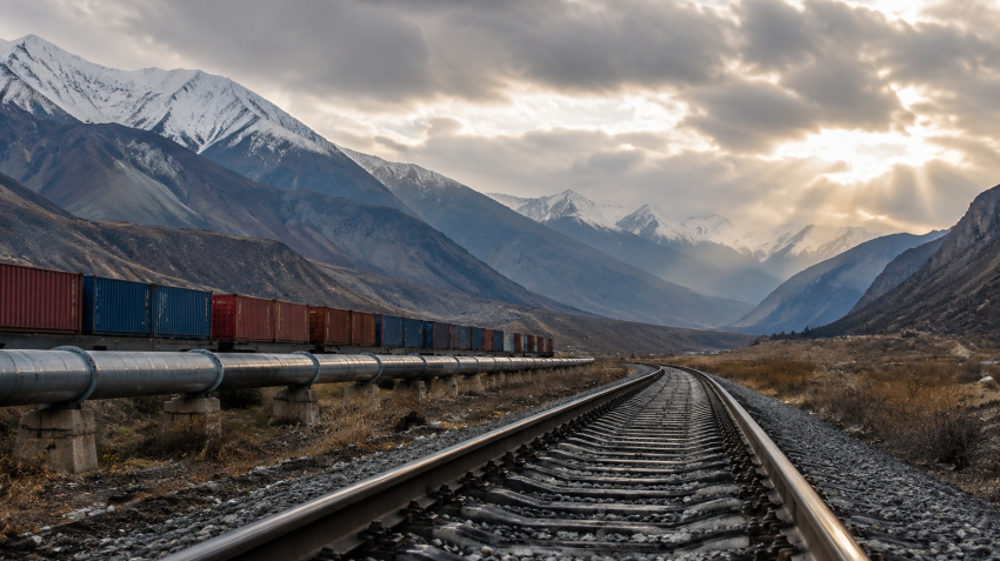
Iran's Minister of Roads and Urban Development Farzaneh Sadegh traveled this week0 to Kazakhstan at a time when Eurasian transit dynamics are being redefined and competition between East-West and North-South corridors has entered a more operational phase.
The visit focused on developing logistics infrastructure, facilitating cargo transit, and defining joint transit hubs that could strengthen Iran's position in the trade network of China, Central Asia, the Caucasus, and Europe.
In meetings with Kazakh economic and transport officials, the main axis of discussions centered on the two countries' role in connecting the East-West supply chain.
Within this framework, Kazakhstan was examined as one of the key nodes on the China-Europe route and Iran as a gateway to open waters, forming a complementary structure.
In recent years, Kazakhstan has become one of the key axes of Eurasian transit. Its connection to China's rail network through the Khorgos gateway has made it one of the main gateways for China's overland trade westward.
In recent Tehran-Astana talks, this capacity was considered as the starting point for a broader chain in which Iran could play the role of a complementary link.
The main proposal in the negotiations was the development of combined rail and road routes from China to Kazakhstan, then Iran, and ultimately Turkey and Europe.
This structure, if integrated and operationalized, could transform lengthy maritime routes into a faster and more predictable overland network.
Within this framework, Kazakhstan's access to open waters through Iran's southern ports, particularly Chabahar and Shahid Rajaei, was one of the key topics of discussion.
In the region's new logistics architecture, Iran's ports have assumed a role beyond simple loading and unloading points.
Shahid Rajaei Port in Bandar Abbas and Chabahar Port, alongside northern ports such as Amirabad, are being transformed into multi-purpose nodes in the supply chain.
These ports are designed not only for the entry and exit of goods but also for warehousing, processing, and redistribution.
During the Iran-Kazakhstan negotiations, the transfer of a portion of Iran's port capacities for joint investment was also discussed.
The goal of such cooperation is to establish logistics hubs that can transform the flow of goods from a linear model to a networked one—a model of growing importance in modern global trade.
The East-West Corridor is one of the most significant developing routes in the global economy. This corridor connects China through Central Asia to Europe, and in recent years its rail segment has gained attention as an alternative to lengthy maritime routes.
Within this structure, Iran sits at the junction where eastern corridors connect to western routes.
On one side, rail connectivity from Kazakhstan and Turkmenistan links to Iran's rail network; on the other, Iran's routes to Turkey and the Caucasus enable the continued flow of goods to European markets.
This position has made Iran an intermediary node in the Eurasian trade network.
In recent years, the development of these corridors has been accompanied by increased rail freight capacity. Official reports indicate that the number of freight trains on the China-Iran route has increased and the time interval between train movements has decreased.
This change reflects growing operational confidence in the rail route as a sustainable option alongside maritime transport.
One of the most significant advantages of the China-Iran rail corridor is reduced transport time. While the maritime route between East Asia and the Persian Gulf may take approximately 30 to 40 days, the rail route can reduce this to about 15 days.
This time differential holds strategic importance in today's global economy, which is based on speed and predictability.
The time advantage becomes particularly valuable when global supply chains are under geopolitical pressure and maritime disruptions. The rail route through Central Asia effectively reduces dependence on maritime chokepoints and creates a more sustainable, multi-route overland option.
Within Iran, major projects are underway to complete the western loop of this corridor. One such project involves rail lines connecting to the Turkish border via the country's northwestern routes.
Once completed, these lines would enable direct connectivity from the China-Kazakhstan-Iran rail network to Europe.
Increasing the capacity of transit lines to Turkey is part of Iran's long-term strategy to become the primary route for East-West cargo movement.
This strategy is based on increasing freight capacity, reducing border bottlenecks, and institutional coordination among various agencies.
One of the structural challenges in rail corridors is the imbalance in cargo flow. On many routes, including the China-Iran route, import volumes exceed exports. This results in containers returning empty to their point of origin after unloading, increasing logistics costs.
To address this issue, the development of targeted exports has emerged as a necessity. Iran's petrochemical, mineral, and agricultural industries can play a significant role in securing return cargo.
In this regard, the formation of export consortia in industrial provinces, particularly in the country's central and eastern regions, has been proposed as a practical solution.
Recent developments indicate that Iran's neighboring countries are becoming active partners in the region's logistics network.
Cooperation with countries such as Kazakhstan, Turkey, Oman, and Azerbaijan forms part of a multi-layered transit network aimed at reducing dependence on limited routes and increasing the flexibility of foreign trade.
In this context, Iran's southern ports, as well as certain regional ports in neighboring countries, play complementary roles in this network. This multi-route structure enables better management of geopolitical and economic risks.
Alongside the development of external infrastructure, domestic reforms have also played a significant role in improving Iran's transit performance. Reducing customs clearance times, digitizing customs processes, and extending operating hours at ports and borders are among these reforms.
These measures have accelerated the flow of essential goods and industrial raw materials, reducing disruptions to the domestic supply chain. As a result, the role of customs is shifting from a point of stoppage to a point of passage.
The transit developments between Iran and Kazakhstan are part of a broader trend across Eurasia where overland routes are regaining their historical role in global trade.
Iran's geographical position in this context is being consolidated as a central node that makes possible the connection of East, Central Asia, the Middle East, and Europe within a unified framework.
Minister: Iran has reached economic deterrence capable of resisting sanctions

On Iran’s sanction-proof economy powered by scientists
Iran, Russia to complete integration of banking networks within two months: CBI chief



UK PM advised to prepare for 'dignified, orderly exit'
UNICEF: Ceasefire in besieged Gaza is a ‘deadly illusion’ for Palestinian children
Iran rules out IAEA inspections of war-damaged nuclear sites
Israel will soon be expelled from ‘every inch’ of Lebanese territory: Hezbollah chief
Iran stopped Trump's 'march to reassert US global dominance': Analyst
Iran delays Swiss meeting, links US talks to MoU implementation amid Israel’s Lebanon strikes
Israeli regime’s only interest is ‘permanent war,’ Iran's FM Araghchi says
Hezbollah: Israel never abided by any ceasefire agreement


 PressTV NEWSLETTER
now
PressTV NEWSLETTER
now
 This makes it easy to access the Press TV website
