'Operation Fauxios': Axios, Israeli spy, and $2 billion oil scam to prop up Trump
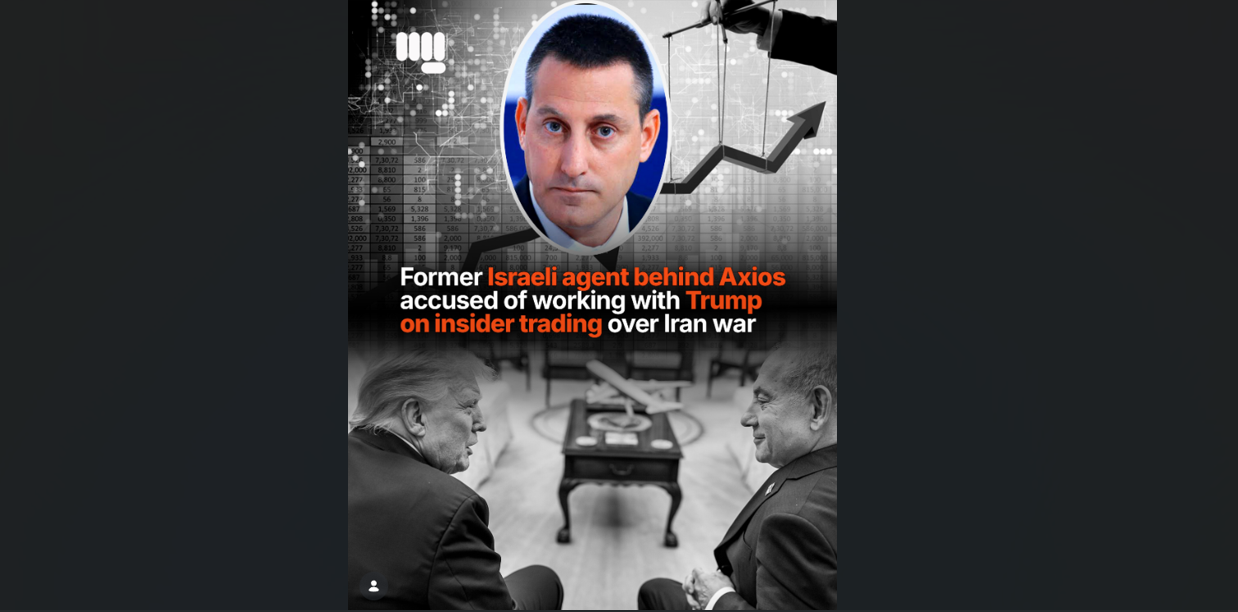
Unknown traders placed nearly $920 million in short positions on crude oil on May 6, just minutes before Axios published a report saying Washington and Tehran were nearing a deal to end their two-month war, according to data from Unusual Whales, a trading surveillance platform that monitors unusual market activity.
The Axios report, written by Barak Ravid—a journalist with close ties to Israeli prime minister Benjamin Netanyahu and US President Donald Trump—said the one-page memorandum would end the war.
Ravid is a former member of Israel's elite Unit 8200 intelligence corps. His reporting consistently relies on "unnamed US officials" and has been described as "basically representing the American voice".
The concern extends beyond journalistic accuracy to potential market manipulation. Each Axios report has been preceded by massive, suspiciously timed trades betting on falling oil prices.
Axios has reported on five separate occasions within a 19-day span that a deal with Iran was "close" or "imminent" — yet no agreement has materialized.
Brent crude prices fell more than 10 percent following the report, from 108 to 97 per barrel, before recovering somewhat to 102 by market close.
Based on that price drop, the unidentified traders would have earned roughly 125 million in profits. The short positions were placed approximately 70 minutes before the Axios story was published, according to Unusual Whales, which shared details on social media platform X.
This is not the first time large bets have preceded major news on US-Iran negotiations. Similar massive positions were identified ahead of previous Axios reports on alleged progress in talks, including a $950 million short position on oil placed on April 8.
Crude prices fell 15 percent after that report. The White House issued an internal staff-wide email that same day warning employees against using confidential information to place trades.
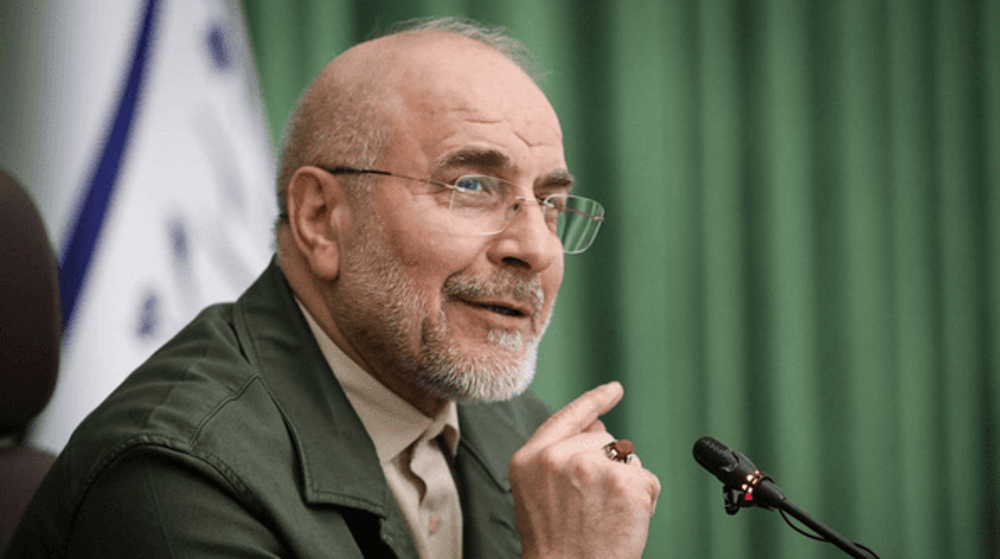
Oil prices have soared since the US-Israeli aggression against Iran began on February 28, coinciding with Iran's blockade of the Strait of Hormuz that typically facilitates about 20 percent of the world's oil trade.
Iranian officials have pushed back against the Axios report.
"The Axios text is the Americans' wish list rather than a reality," Ebrahim Rezaei, spokesman for the Iranian parliament's foreign policy and national security committee, said on social media.
"The Americans will not obtain through a failed war what they failed to gain in previous negotiations."
Despite Tehran's denial, Trump cited the Axios report on Wednesday to claim that the US and Iran had had "good talks over the last 24 hours" and expressed confidence that a deal would be reached soon.
Traders with privileged information have also used the prediction market platform Polymarket to profit from US foreign policy moves, according to a report by the Anti-Corruption Data Collective (ACDC).
The report found that 52 percent of "long-shot" wagers predicting military action on Polymarket were successful, compared with 25 percent of politics-related bets and 14 percent of all bets on the platform.
Donald Trump Jr., the president's son, serves as an advisor to Polymarket, having taken the role in 2025. His firm has invested millions in the company.
The evidence suggests a recurring pattern: Axios publishes "deal imminent" reports citing unnamed US officials, Iranian officials publicly deny any agreement, oil prices temporarily fall, and unidentified traders profit from well-timed short positions, reflecting intentional coordination.
Iranian media has dubbed the pattern "Operation Fauxios" — a play on Axios' name — suggesting coordinated efforts between the news outlet and unidentified traders to profit from market volatility.
Operation Trust Me Bro failed. Now back to routine with Operation Fauxios.
— محمدباقر قالیباف | MB Ghalibaf (@mb_ghalibaf) May 6, 2026
Observers say false claims also serve to drive down oil prices, a key political objective for Trump who faces domestic pressure over high energy costs, offering political cover during an unpopular war.
President Pezeshkian says Iran will stand by deal only if US does

Iran says talks with US contingent on implementation of key MoU provisions
Iran says only it can demine Strait of Hormuz under MoU with US



Martyred Leader's funeral to serve as global movement against terrorism, US-Zionist crimes: Army
2026 World Cup: Iran prepares to depart Mexico after warm welcome in Tijuana
At UN Security Council, Palestine envoy urges world to stop Israeli annexation
Two IRGC servicemen martyred in terror attack in western Iran
VIDEO | Pakistan launches fourth cross-border strikes inside Afghanistan
VIDEO | Pro-Palestinian activists in Paris rally to condemn ongoing Israeli genocide
VIDEO | Spain rejects US pressure as Trump intensifies criticism of NATO allies
VIDEO | Afghanistan-Pakistan tensions escalate after fresh airstrikes by Islamabad


 PressTV NEWSLETTER
now
PressTV NEWSLETTER
now
 This makes it easy to access the Press TV website
