Iran defends right to self-defense in Strait of Hormuz, slams US aggression
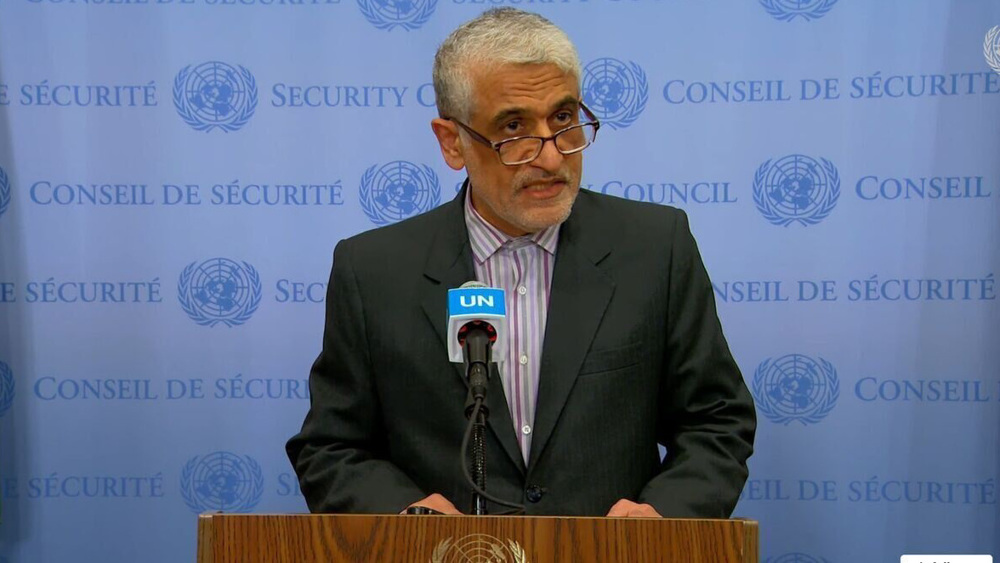
Iran has emphasized its commitment to the principle of freedom of navigation but stated that the ongoing tensions in the region, particularly in the Strait of Hormuz, are a direct result of as the destabilizing actions of the United States.
“Iran fully respects and remains committed to the principle of freedom of navigation under the law of the sea,” its ambassador to the United Nations, Amir Saeid Iravani, said in a statement at the UN Security Council Stakeout Thursday.
“However, the current situation in the region, including in the Strait of Hormuz, is not the result of Iran’s lawful exercise of its right of self-defense. Rather, it is the direct consequence of the destabilizing actions of the United States in launching aggression against Iran and undermining regional security.”
Following his statement, Iravani responded to questions from journalists. When asked about potential US Navy escorts through the Strait of Hormuz, he stated, “No, I have no response to that. Iran will exercise its inherent right to preserve peace and security in the Strait of Hormuz; that is our responsibility.”
“As I said, we are not going to close the Strait of Hormuz. However, it is our inherent right to preserve peace and security in this waterway, and that is our right,” he added.
Leader of Islamic Revolution Ayatollah Mojtaba Khamenei:
— Press TV 🔻 (@PressTV) March 12, 2026
🔺The Strait of Hormuz must remain closed."
🔺We will not overlook avenging the blood of martyrs, especially the martyrs of Minab pic.twitter.com/WZHE0KjiS1
In his remarks at the Stakeout, Iravani expanded on the broader context of the US and Israeli aggression against Iran, which he referred to as part of a wider illegal and illegitimate war.
“What is unfolding today is, in reality, an illegal and illegitimate war launched by Israel and the United States—two regimes that possess nuclear weapons—against a responsible non-nuclear-weapon State Party to the Treaty on the Non-Proliferation of Nuclear Weapons (NPT),” he said.
He noted that Israel has repeatedly alleged since 2003 that Iran was on the verge of acquiring nuclear weapons, despite the International Atomic Energy Agency (IAEA) reports consistently refuting those claims.
Iravani criticized the US for carrying out an illegal military attack in June 2025 on Iran’s peaceful nuclear facilities, which were fully under IAEA safeguards.
“This illegal act constituted a clear violation of the UN Charter, the principles of international law, the IAEA Statute, the Agency’s relevant resolutions, and the NPT, which the US is a depositary,” Iravani stated.
The ambassador then condemned the US and its European allies for attempting to invoke the “snapback” mechanism of the Joint Comprehensive Plan of Action (JCPOA) despite not fulfilling their obligations under the agreement.
“The claim made in today’s meeting by France, the United Kingdom, and the United States that the so-called ‘snapback’ mechanism has been triggered is baseless and a clear fabrication,” he remarked, rejecting the idea that the mechanism was valid in this case.
Iravani also addressed the ongoing political maneuvering within the UN Security Council, especially the recent resolution against Iran, passed under the US pressure on Wednesday.
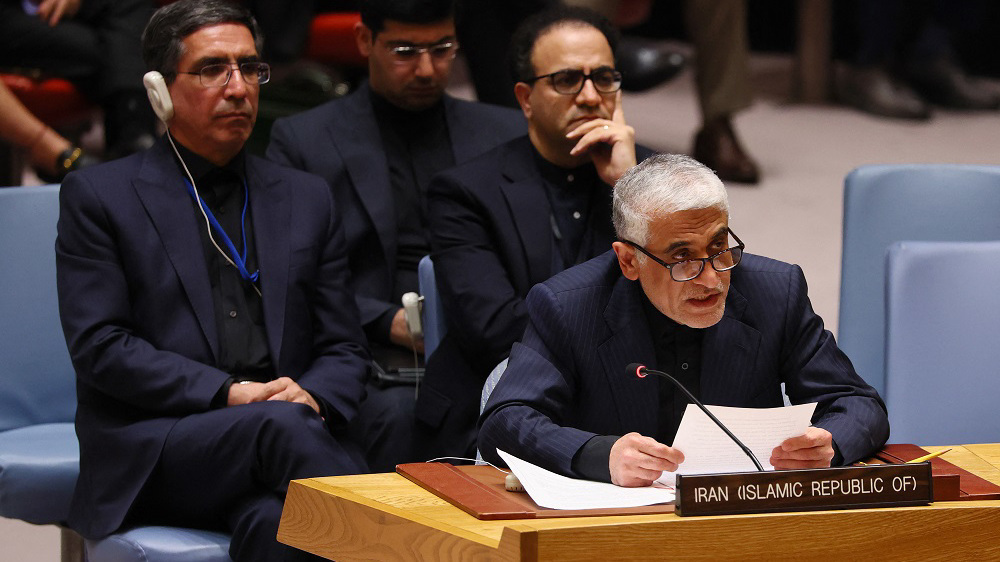
He hit out at the United States for abusing its position as Council President to push through a politically motivated resolution.
“Yesterday was a shameful day for the Security Council,” he said, adding that the resolution ignored the actual cause of regional tensions, which he said is the illegal aggression by the US and Israel against Iran.
He stressed that instead of condemning the aggressors, the resolution unjustly targeted Iran as the victim of the aggression.
“The text does not refer to the real source of the tensions in the region—namely, the war of aggression illegally and illegitimately launched by the United States and Israel against Iran,” he said.
“It does not call upon the aggressors, the United States and Israel, to halt their unlawful attacks against Iran.”
Iravani emphasized that instead of holding the aggressors accountable, the resolution demanded that Iran refrain from exercising its inherent right to self-defense to protect its sovereignty, territorial integrity, and vital interests.
“Such a demand is unlawful and entirely contrary to the Charter and international law,” Iravani said.
In light of the Security Council’s recent actions, Iravani emphasized Iran’s legal stance on self-defense.
“Iran has repeatedly and clearly informed the Secretary-General and members of the Council, through its official communications, that the Security Council—due to obstructing the United States and certain Western countries—has been unable to fulfill its responsibility for the maintenance of international peace and security,” he explained.
Iravani said, “As long as the Council fails to discharge its duties, Iran has no choice but to exercise its inherent right of self-defense under the UN Charter and international law.”
Iran warns UN Security Council of ‘grave dangers’ to civilians amid US-Israeli aggressionhttps://t.co/rYCDP1FtUe
— Press TV 🔻 (@PressTV) March 10, 2026
Iravani also reaffirmed Iran’s rejection of the accusations regarding uranium enrichment, saying that the claim that Iran enriched uranium to 60 percent is a distortion of the facts.
“The claim that Iran has enriched uranium to 60 percent—the level allegedly required for producing a nuclear bomb—is a distortion of the facts and ignores the real root of the situation,” he said.
“Iran’s decision to increase the level of enrichment was taken solely in response to the violations of commitments by the United States and European countries and was intended as leverage to compel them to return to their obligations.”
Iran to prevail over US, Medvedev says after attending martyred Leader’s funeral
President Pezeshkian: Iran will not bow to any bully
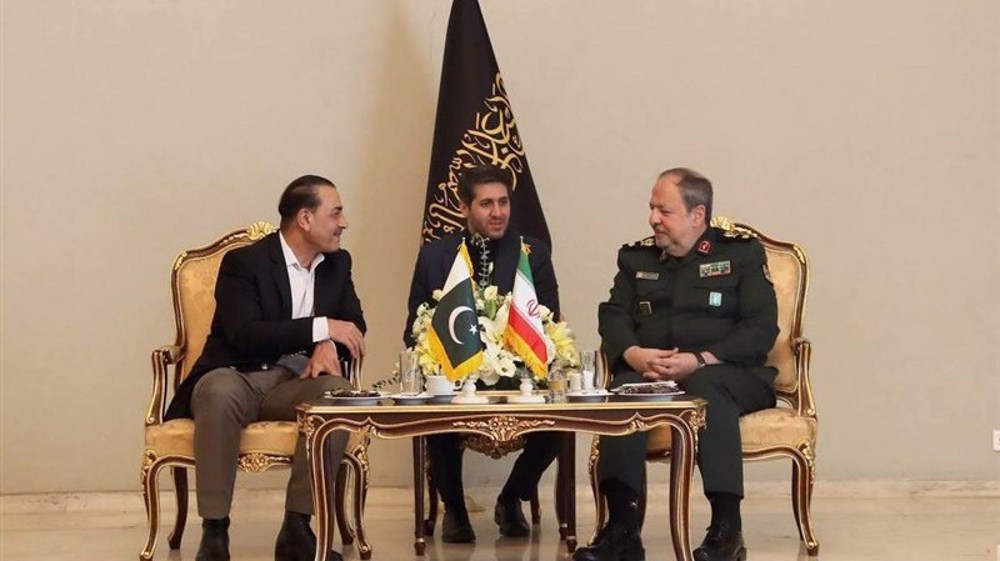
Iran warns of ‘strong’ response to any ceasefire violation, vows closer defense ties with Pakistan


IRIB chief: Farewell ceremony for martyred Leader initiates ‘Great Khamenei Era’
Farewell ceremony for martyred Leader officially begins in Tehran
VIDEO | Palestinians condemn Trump's proposal to replace UNRWA in Gaza
VIDEO | Protesters rally in London in support of Dr. Ghassan Abu-Sittah
'He made the Ummah proud': Netizens honor Iran’s martyred Leader ahead of funeral
Explainer: Which foreign delegations attended the funeral of martyred Leader of the Islamic Revoluti
Attending martyred Leader’s funeral is as vital as fighting Zionists: Iraqi resistance leader
Huge crowd rally in Sanaa to thank Iran for breaking Yemen airport siege


 PressTV NEWSLETTER
now
PressTV NEWSLETTER
now
 This makes it easy to access the Press TV website
