Nuclear chief: Iran should turn from buyer to creator of technology
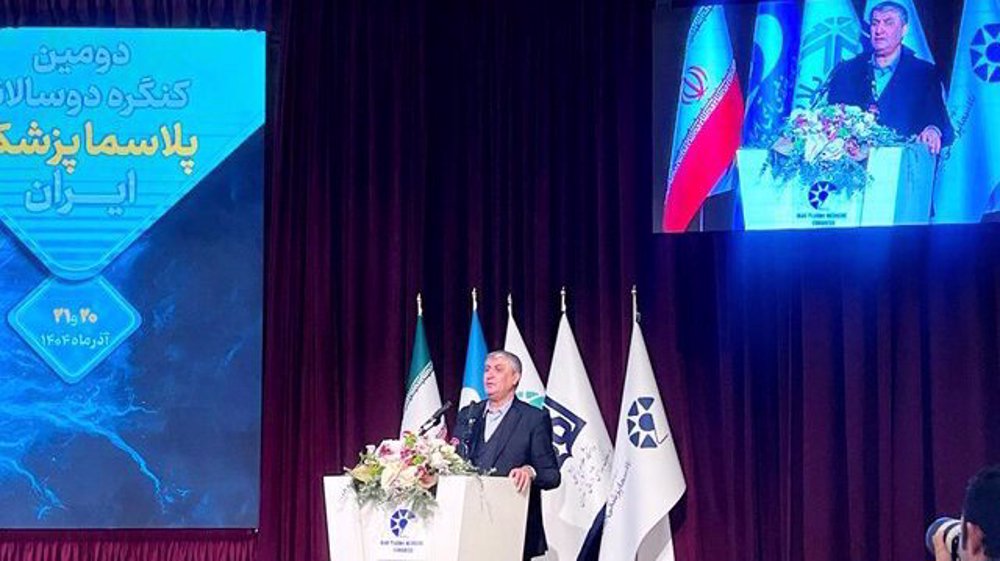
The head of the Atomic Energy Organization of Iran (AEOI) says the country cannot remain a mere buyer of technology and should rise to become its creator.
Mohammad Eslami made the remarks on Thursday in an address to the 2nd Congress on Plasma Medicine in Iran, saying a society that cannot create technology will inevitably be labeled as backward.
"Technology is changing rapidly, and we cannot remain a merely buyer of it; we must become its creator. This is a societal need, a pillar of progress, and a source of dignity for Iranian people,” he added.
“We must build capacity and, with reliance on God, move forward with strength. We cannot remain in the past and imagine that reverse engineering alone will suffice.”
He also noted that progress cannot occur without an executive process, which involves turning science and knowledge into technology continuously and without interruption.
Meanwhile, Eslami warned that Iran’s enemies cannot tolerate the country’s position and capacity, as well as its geopolitical location.
He said a newly-published book on the US-Israeli aggression against Iran revealed that the enemies’ issue is not atomic bombs or the Islamic Republic’s refusal to comply with the global hegemony.
The enemies’ main objective is to prevent Iran’s progress at the frontiers of knowledge, the Iranian nuclear chief pointed out.
“In the fundamental fields of fission, fusion, lasers, quantum, and plasma, we must advance powerfully, and we will,” he said. “Neither war and bombardment have deterred us, nor their (the enemies’) political and psychological warfare.”

Over the past years, Iran has recorded many achievements in its peaceful nuclear energy program in defiance of US sanctions as well as hurdles created by the West.
Additionally, Iran has closely cooperated with the International Atomic Energy Agency (IAEA) as a signatory to the Nuclear Non-Proliferation Treaty (NPT).
However, the United States illegally bombed three Iranian nuclear sites on June 22, more than a week after Israel launched a blatant act of aggression against the country.
The 12-day criminal assault included deliberate attacks against civilians and civilian infrastructure across Iran, killing at least 1,064 people, including nuclear scientists.
Iran delays Swiss meeting, links US talks to MoU implementation amid Israel’s Lebanon strikes
Israeli regime’s only interest is ‘permanent war,’ Iran's FM Araghchi says
Iran issues new passage guidelines for ships transiting Strait of Hormuz



Official: 480 enemy-linked individuals arrested in West Azerbaijan during US-Israeli war
VIDEO | Outrage over prices, profiling and persecution at US World Cup matches
Tehran condemns US threat to use Iranian assets to compensate regional allies
Iranian knowledge-based company develops nano kit for early detection of stomach cancer
German Chancellor blocks efforts to sanction Israel
Hezbollah will respond to any Israeli aggression; Iran committed to backing Lebanon: MP
Pakistan's interior minister travels to Tehran to discuss Iran-US negotiations
Israeli UN envoy derails children-in-conflict hearing, shouts ‘be quiet’ at UN official


 PressTV NEWSLETTER
now
PressTV NEWSLETTER
now
 This makes it easy to access the Press TV website
