European genuflection to America
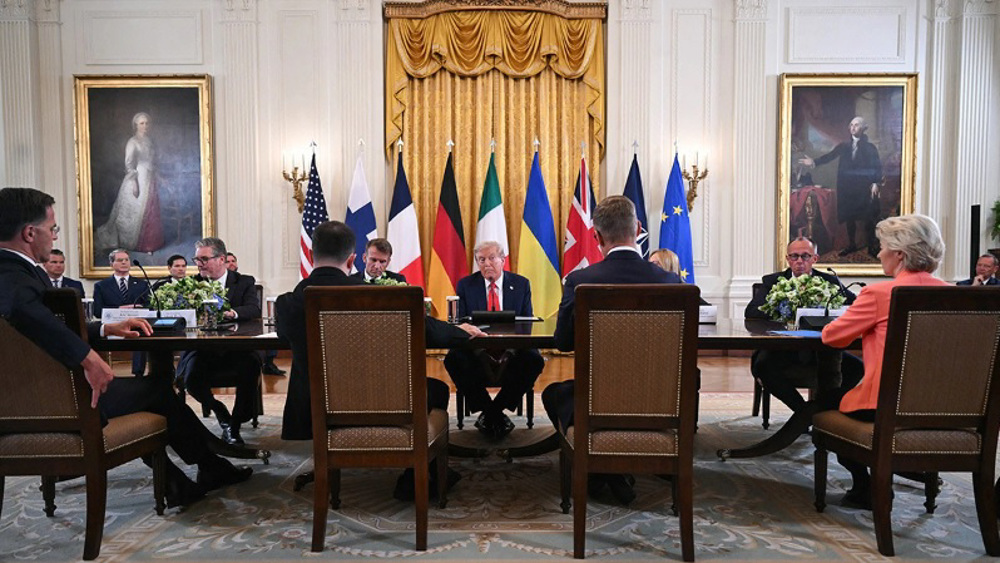
On a humid August morning in Washington, a blurry photograph began circulating online. It appeared to show Europe's top leaders, Emmanuel Macron, Ursula von der Leyen, and Frederick Merz, among others, slouched in the White House hallway, heads bowed, waiting for their turn with Donald Trump.
Was this an AI hoax or a real snapshot of Europe's posture in the 21st century?
In truth, it really doesn't matter, since the image tells a larger truth; Europe's role in the so-called Western alliance has shrunk to something more like obedient accompaniment, a junior partner awaiting instructions, and nowhere is that clearer than in the case of Iran's nuclear program.
Since World War Two, the Transatlantic Partnership has been dressed up as a strategic alliance. In reality, it's been a structure of dependence.
America rebuilt Western Europe through the Marshall Plan, but in exchange, it locked the continent into its economic orbit.
Washington pressured Europeans to shift from coal to American-supplied oil. It pushed its corporations into Europe's reconstruction, and through NATO, established in 1949, it cemented its military primacy with Europe's defense forever under US command.
Everybody was celebrating but us, and we're the ones that won the war. We won the war; and they help, but without us, they don't win the war ... We're all speaking German. You know that right? Without us, they're speaking German, maybe little Japanese, too.
US President, Donald J Trump
For decades, this arrangement worked as long as Europe's prosperity grew. But the price hasn't always been clear. When it comes to the big questions: War and Peace, sanctions and diplomacy, allies and adversaries. Europe defers to Washington.
We saw it in Iraq in 2003 when Britain went along with Washington despite massive domestic opposition, while France and Germany's dissent quickly softened.
We saw it again after 2022 in Ukraine, where sanctions on Russia devastated Europe's own energy markets and industry far more than America's.
And now, in 2025, we see it once more in the European troika's decision to activate the so-called snapback mechanism under the Iran nuclear deal.

On August 29th, Paris, Berlin, and London announced that they would move to reimpose all United Nations sanctions on Iran, sanctions that had been lifted under the 2015 JCPOA, a deal painstakingly negotiated over Tehran's nuclear program.
The timing is not accidental. Just two months earlier, in June, the United States and Israel carried out coordinated strikes on Iran's nuclear facilities; costly, dangerous, illegal and inconclusive. Iran's program, though damaged, survived, and so in a perfect division of labour, the Europeans stepped in with the legal and diplomatic hammer.
Good morning, yesterday, in accordance with UN Security Council resolution 2231 the foreign ministers of France, Germany and my own country, the United Kingdom, notified The Security Council that we believe Iran to be in significant non performance of its commitments under the Joint Comprehensive Plan of Action.
Barbara Woodward, UK Ambassador to The UN
The message to Tehran was blunt: negotiate directly with Washington, or face the return of the toughest international sanctions.
Yes, the Europeans dangle an extension of the deadline, but let's be clear that if Iran agrees to direct talks with the United States, it is no concession. It's a demand for surrender.
And perhaps more striking than the ultimatum itself is what it reveals about Europe's self-image, or the lack of one.
The European countries must act honestly and responsibly, considering the history of negotiations, considering what they have themselves agreed as part of their commitments under resolution 2231, to review their positions and strive to adopt an independent approach, free from influence from two other destructive actors, the Zionist regime and the United States of America
Ismail Baghaei, Iranian Foreign Ministry Spokesperson
Europe never lived up to its JCPOA commitments after Washington walked away in 2018.
INSTEX, the mechanism designed to shield trade with Iran from US sanctions, never worked. European companies fled Iran overnight, terrified of American penalties.
So the notion that Europe now holds leverage, that it can dictate terms, is more theater than reality.
But this theater has a director, and he sits in Washington.
Marco Rubio, Trump's Secretary of State, admitted it outright. In an August 28 statement, he confirmed that Europe's snapback move was taken under direct guidance from the White House, citing national security memorandum number two, signed by Trump in February.
In other words, the foreign ministers of France, Germany, and Britain were not making independent policy; they were executing Washington's orders.
This is not diplomacy; it is subordination, and the Iran case is hardly unique.
When the NSA was caught wiretapping Angela Merkel's phone in 2013, Europe grumbled, then swallowed the insult.
When negotiations over a transatlantic trade pact tilted heavily toward US corporations, Europe signed anyway, and when secondary American sanctions forced European banks and firms out of Iran in the past decade, Brussels could do little more than issue statements of regret.
Today, Europe finds itself once again reduced to acting as the enforcer of Washington's agenda, even as the costs mount at home.
Its energy prices soared because of US-driven sanctions on Russia, and its industries now face investment flight to the United States, where cheaper gas and subsidies lure away factories and jobs.
Strategic autonomy, the buzzword in Brussels for years, looks more like a strategic illusion. The irony is that while Europe diminishes itself, the rest of the world is moving on.
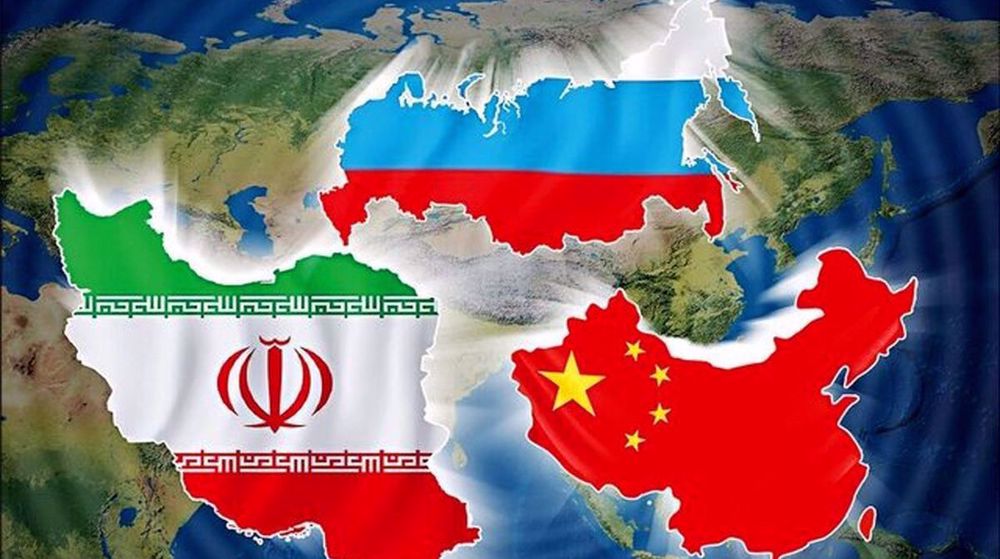
New alignments are taking shape across Eurasia, Russia, China, Iran and others are building networks of trade, Energy and Security that bypass the West entirely.
In this multipolar order, credibility is currency and on Iran, Europe has squandered its credibility.
For Tehran, the EU is no longer a trustworthy partner. Deals signed with Europeans turn to dust the moment Washington disapproves.
The commercial space once available to Airbus, Siemens or Total is now occupied by their Chinese and Russian competitors, and diplomatically, Europe is seen not as a mediator, but as an extension of US power, irrelevant as an independent player.
Donald Trump, never one to mince words, put it plainly this February from the White House. "Let's be honest. The European Union was formed to screw the United States".
His vice president, JD Vance, speaking in Munich days earlier, was even blunter. "America can do nothing for you, and there is nothing you can do for the American people".
Harsh rhetoric? Yes, but Europe's behavior almost validates the contempt,
When leaders bow, literally or figuratively, in the White House corridor, what message does that send about sovereignty, about relevance?
Europe's snapback decision against Iran is not about Iran alone. It's a symptom of something larger, a continent that no longer believes in its own capacity to shape the world, that no longer takes risks on its own principles, that no longer acts, except through the shadow of American approval.
The photograph, whether real or fake, of European leaders waiting for Trump may have been a hoax, but it captured something true. The Waiting Room has become Europe's place in global politics.
Unless Europe rediscovers autonomy, invests in its own security and reclaims diplomatic initiative, it risks becoming not a pole in a multipolar world, but a relic remembered only as Washington's loyal lieutenant.
For Iran, Russia, China, and the Global South, the conclusion has already been drawn; Europe is not an independent actor. It is an instrument.
Such is the reality behind the snapback mechanism and the story of Europe in 2025.
Despite all the talk of the Western alliance, the truth is simpler and starker. There is no West. There is America, and there are its followers.
Germany represses dissent
New PM should change UK's Israel policy
MEPs decry EU Leaders on Gaza reconstruction


Iran military: Any US attack on nuclear sites equals ‘expansion of war,’ entails extensive reprisal
Ops. Nasr-2 and Sa'eqeh: Iran's retaliatory operations against US military assets on July 21
VIDEO | ‘Any US forces targeting Iranian coastline would come under counterattack’: Commentator
IRGC disables multiple radar systems in Kuwait in ongoing retaliation
VIDEO | 'This time, it's going to be a lot worse': Political commentator
Iran Army has 'already defined precise defense scenarios' to counter any enemy incursion
Iran Army shoots down hostile suicide drone over East Azerbaijan province
Israel had ‘no right to commit genocide’ in Gaza : US Senator





 PressTV NEWSLETTER
now
PressTV NEWSLETTER
now
 This makes it easy to access the Press TV website
