How US-Israeli war on Iran tore apart alliances, fractured NATO, and buried American unilateralism
By Zainab Zakariyah
On February 28, 2026, the United States and Israel launched a large-scale military aggression against the Islamic Republic of Iran, codenamed Operation Epic Fury. Nearly 40 days later, a ceasefire requested by the United States took effect.
By then, however, the bombs had done more than destroying lives, buildings, and infrastructure. They had fractured alliances, exposed uncomfortable truths, and forced governments worldwide to take sides in ways no one had anticipated.
To understand the full fallout, we must first look back at history.
For much of the past century, Iran has fought to preserve its sovereignty against foreign empires – Rome, Britain, the Soviet Union, and now the waning American empire. Iran’s memory of these illegal assaults is long and brutal.
The millions of Iranians who fell during World War II. The occupation of Iranian cities by Soviet forces. The 1953 CIA- and MI6-backed coup that overthrew Iran’s democratically elected prime minister.
After the Islamic Revolution of 1979, Iran became a country the empire could not tolerate, and the empire has thrown everything at it since. Washington backed Iraqi dictator Saddam Hussein in a devastating war that killed hundreds of thousands of Iranians, followed by decades of unilateral sanctions that have strangled Iran’s economy.
The most recent chapter, however, began not with war but with diplomacy. A decade ago, world powers signed the Joint Comprehensive Plan of Action (JCPOA), an agreement that limited Iran’s nuclear program in exchange for sanctions relief.
In 2018, Donald Trump tore up the deal, claiming he could negotiate something better, and launched a “maximum pressure” campaign instead. When his second administration eventually called for new talks mediated by Oman, Iran responded positively.
Oman’s foreign minister at the time announced that peace was within reach. But Trump said he was “not thrilled” with the progress, and chose war instead. On February 28, for the second time in a year, the bombs fell. And with that, Tehran’s restraint came to an end.
Fractures within the GCC
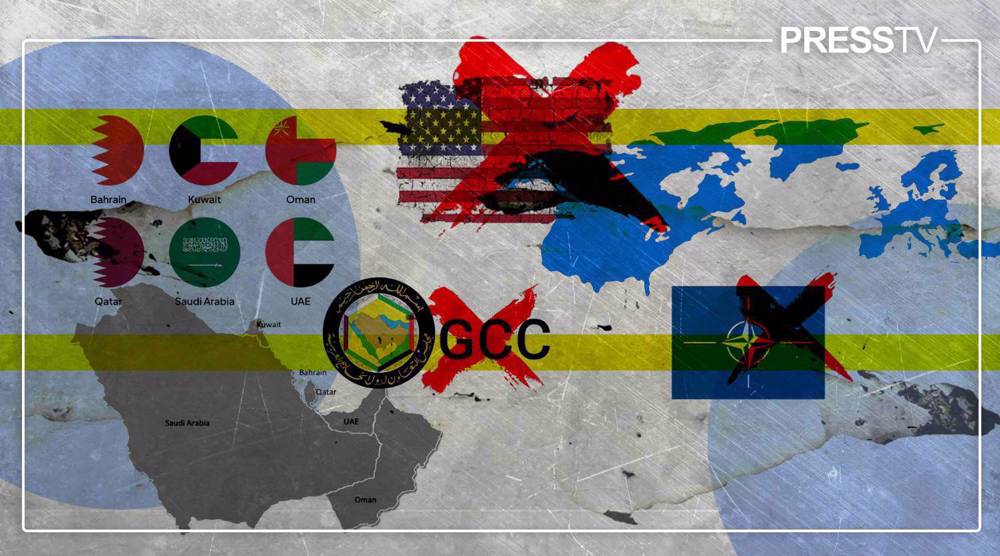
The Persian Gulf Cooperation Council – Saudi Arabia, the UAE, Qatar, Kuwait, Bahrain, and Oman – was routinely spoken of as a unified bloc. This war proved it is not.
Before the aggression was carried out against Iran, Persian Gulf states had privately assured Tehran that their territory would not be used against it. That promise collapsed within the first hour. American missiles launched from bases across the region rained down on Iranian civilian targets. The first casualties were children at a school in Minab in southern Iran along with senior Iranian leadership, including Leader of the Islamic Revolution Ayatollah Seyyed Ali Khamenei and top-ranking military commanders.
Initially, Tehran confined its response to American military installations. But as those bases became operationally untenable, CENTCOM shifted its aggression into civilian areas. Iran expanded its targeting accordingly. The war came home to the Arabs of the Persian Gulf.
Meanwhile, the GCC’s internal divisions became impossible to conceal. The UAE, Bahrain, and Kuwait emerged as the most hawkish – openly celebrating their ties with Israel and calling for further strikes. Three years of live-streamed genocide in Gaza had not been enough to cut ties with the Israeli regime. Bahrain, which never restored ties with Tehran after the 2021 Persian Gulf rapprochement, was the first Arab state Iran targeted directly in retaliation.
✍️ Analysis - Iran’s growing leverage exposes emptiness of Trump’s psychological warfare in high-stakes standoff
— Press TV 🔻 (@PressTV) May 30, 2026
By Press TV Strategic Analysis Deskhttps://t.co/TRT3NhW9tV pic.twitter.com/fANSuPdcG5
Saudi Arabia and Qatar, however, took a markedly different line, condemning Iranian strikes on their soil while keeping diplomatic channels open with Tehran and consistently pushing for a negotiated solution. Oman, with its long tradition of principled neutrality, was not targeted. It never severed communication with Iran and is now in active discussions with Tehran over joint management of the Strait of Hormuz, an arrangement the other GCC states cannot bring themselves to accept, but which may already be an emerging reality on the ground.
At an emergency summit in Jeddah on April 28, the six GCC leaders issued a declaration of unity. But a joint communiqué is not a joint strategy. The UAE wants a permanent reckoning with Iran. Saudi Arabia wants stability for its Vision 2030 economic program. Qatar and Oman want dialogue. Bahrain wants maximum pressure.
These are not variations of the same goal, but fundamentally different ones. And the war has made the differences sharper, not smaller.
GCC and the United States – A relationship under strain
For decades, the GCC-US relationship rested on a straightforward arrangement: Persian Gulf oil, petrodollar support for American currency dominance, and open access to military bases, in exchange for a US security umbrella. For years the US used them to play a good Muslim/bad Muslim game: align with Washington and prosper; resist, and end up like Iraq, Syria, or Libya. The war against Iran has put that arrangement under severe stress.
Persian Gulf states claimed they were not consulted before the aggression against Iran. This is a claim Tehran refused to accept insisting it was impossible for them not to be aware as the equipment to bomb Iranian civilians were being transported to the military bases they host.
And Iran's response to their complaints was blunt: either you acknowledge these bases are on your soil and accept responsibility for what is launched from them, or you accept they are effectively American territory, in which case you are in no position to complain when they are targeted.
From the Iranian point of view, there is no third option.
For years, the US and Israel had championed the Iron Dome as the centerpiece of regional defense. What this war has revealed, however, was something far more uncomfortable – the real Iron Dome was the GCC itself. The radar networks, the early warning systems, the naval forces across the Persian Gulf, the US bases embedded throughout Persian Gulf territory.
The Arabs were the first line of defense for Israel all along. That realization may be the most painful of all for Persian Gulf rulers and their citizens. They believed they were equal partners in a mutual arrangement. The missiles landing on their cities told a very different story.
Qatar's former prime minister gave voice to what many across the region were privately thinking. He warned that GCC states must not be dragged into a direct confrontation with Iran, cautioned that outside forces were deliberately pushing the Persian Gulf region toward open confrontation, and described the war plainly as one that "exclusively serves an Israeli agenda."
The reassessment now underway is fundamental. A US military base, once the symbol of protection, now looks like a target painted on Persian Gulf soil. What was once an asset is beginning to look very much like a liability.
From siege to sway: How Iran turned crisis into leverage
— Press TV 🔻 (@PressTV) June 1, 2026
Follow https://t.co/B3zXG73Jym pic.twitter.com/c0xvMUqt4N
Europe, NATO and the United States – The alliance that broke
Europe was not consulted. Europe was not informed. And Europe was not given a choice.
When the aggression against Iran began, European governments learned about it through the news, just like the rest of the world. But this was not the first time. Months earlier, Washington had kept its allies in the dark about the abduction of Venezuelan president Nicolás Maduro. The pattern had become unmistakable: under Trump, the United States acts unilaterally and notifies allies afterward. Europe was no longer a partner but an audience.
Yet the war against Iran did not arrive in a vacuum. European trust in Washington had been eroding steadily, and on three very specific fronts.
First is Ukraine. Europe rallied behind a war effort that Washington had encouraged, absorbing millions of refugees, imposing punishing sanctions on Russian energy, inadvertently crippling its own economy, and restructuring its entire security posture around the United States – only to watch the Trump administration pivot toward accommodation with Moscow.
After all that sacrifice, European capitals were left wondering whether Washington's commitment to their security was conditional, transactional, or simply gone.
Then came the tariff war, which laid bare how little leverage Europe actually holds when American economic nationalism takes over.
Perhaps the straw that broke the camel’s back was Greenland. Trump's repeated declarations that the United States intended to acquire Danish sovereign territory, from a NATO member, sent a message that could not be misread: American expansionism was no longer limited to adversaries. Allies were not exempt. The country that built the post-war international order was now openly threatening to redraw European borders.
And then came the war against the Iranian nation. A war launched without consultation, fought partly from bases on allied soil, with economic, diplomatic, and military consequences that Europe was left to absorb entirely alone.
Here, too, division was the order of the day. European governments did not speak with one voice, but the direction of travel was consistent: distance.
Britain attempted the most delicate balancing act, initially restricting US use of Diego Garcia before partially reversing course under pressure. The resulting compromise satisfied nobody and still drew Trump's fury regardless.
France went further, restricting military flight access and calling loudly for a diplomatic resolution. Spain went further still, barring US aircraft from its airspace entirely and refusing use of its bases for anything beyond humanitarian purposes.
🎤 Conversation - Iran now a bona fide regional power with key decisions running through Tehran: Analyst @21WIRE https://t.co/Jbha52qz0B
— Press TV 🔻 (@PressTV) April 19, 2026
Germany, meanwhile, focused on the legal dimension, a concern widely shared across the continent: international law scholars broadly agreed the strikes violated the UN Charter's prohibition on the use of force and lacked any credible self-defense justification.
While the bloc was quick to condemn Iranian retaliation, its response to the original US-Israeli aggression was confused and incoherent. Caught between its security dependence on Washington and its profound opposition to what Washington had just done, Europe could neither speak out forcefully without damaging the transatlantic relationship, nor stay silent without becoming complicit in a war its own legal experts called illegal.
During the first week of the imposed war, as Europeans busied themselves blaming Iran, they did not foresee the economic consequences. That’s because since 2022, Europe had systematically replaced Russian gas with Qatari LNG. So when Qatar declared force majeure on contracts with Belgium, Italy, and others, Europe was not facing an inconvenience, rather it was facing a second energy crisis in three years.
The closure of the Strait of Hormuz drove oil prices upward, disrupted global shipping lanes, and rattled European markets already on edge. The war Europe had not been consulted about was now living inside its economy.
NATO did not follow — And Trump did not forgive
NATO, as an institution, refused to participate. Secretary General Mark Rutte said there were absolutely no plans for alliance involvement, and NATO would not be dragged into the war. The legal reasoning was straightforward – Article 5, the mutual defense clause, exists to protect member states from attack. The United States, however, had not been attacked. It had carried out the attack. That distinction, obvious to every European government and international lawyer, was the foundation of NATO's refusal.
Trump did not accept it. He called European allies a "paper tiger," announced he was strongly considering withdrawing from NATO entirely, and directed Secretary of State Marco Rubio to question publicly whether the alliance still served American interests. Rubio went further, saying if NATO was "just about defending Europe," Washington had serious questions about its future in the military bloc.
These were not remarks made in the heat of the moment. They reflected a genuine and widening rupture, one the Iran war had finally forced into the open. Trump wanted European navies in the Strait of Hormuz. He wanted European bases opened for US operations. He wanted allies to fall in line. They refused. And in refusing, they exposed something that had been quietly building beneath the surface of Western alliance politics for years.
The US under Trump, unlike Europe, sees NATO as an instrument of global power projection, an alliance that should follow American strategic priorities wherever they lead.
Ukraine hollowed out the trust. Greenland insulted the relationship. The Iran war shattered it. What remains of the transatlantic alliance is now a question no one in Brussels, Berlin, Paris, or London can answer with confidence.
🎤 Conversation - Persian Gulf states hosting US bases true losers in US-Israeli war against Iran: Ex- diplomathttps://t.co/2eWzEb1mNy
— Press TV 🔻 (@PressTV) April 23, 2026
The wider world
The fractures, meanwhile, extend further still.
Russia and China both condemned the unprovoked US-Israeli aggression and also congratulated Iran on the election of the new Leader of the Islamic Revolution. Russia is watching a United States bogged down in a war with quiet, barely concealed interest.
China, which relies heavily on Strait of Hormuz shipping for its energy supply, is alarmed by the economic disruption but not entirely displeased to see American global credibility absorb such a visible blow. Both have become increasingly vocal in their support for Iran, having used their veto power to block a US-Bahraini resolution calling for military action to open the strategic waterway.
The petrodollar that has kept the US economy afloat for decades is slowly but surely crumbling under the weight of a new petroyuan counterbalance.
Iraq is demanding the expulsion of all foreign forces from its territory, a move that would fundamentally reshape the US military footprint across the entire region. This follows its successful expulsion of much of NATO's forces. The Persian Gulf states that once enjoyed American security guarantees are now reassessing their options.
Zainab Zakariyah is a Tehran-based writer and journalist, originally from Nigeria.
(The views expressed in this article do not necessarily reflect those of Press TV.)
Press TV’s website can also be accessed at the following alternate addresses:
Iran's armed forces: Enemy forced to accept new Iranian rules
Iranian officials call for intensified retaliation amid warning of normalized US attacks
IRGC hits enemy vessel, US Fifth Fleet HQ, American airbase after violations near Strait of Hormuz


 This makes it easy to access the Press TV website