Haj Qassem and Haj Ramazan: A brotherly bond forged on the frontlines
By Humaira Ahad
When Iran’s top anti-terror commander, Lieutenant General Qasem Soleimani, went to Aleppo, Syria, during the war against the Takfiri group Daesh, he often stayed for weeks at a time, sometimes even for two to three months.
Those who worked with him knew his rhythm. Once he entered a frontline, he disappeared into it completely.
He monitored operations at all hours, moved quietly between units, and insisted that others stay away from danger unless necessary.
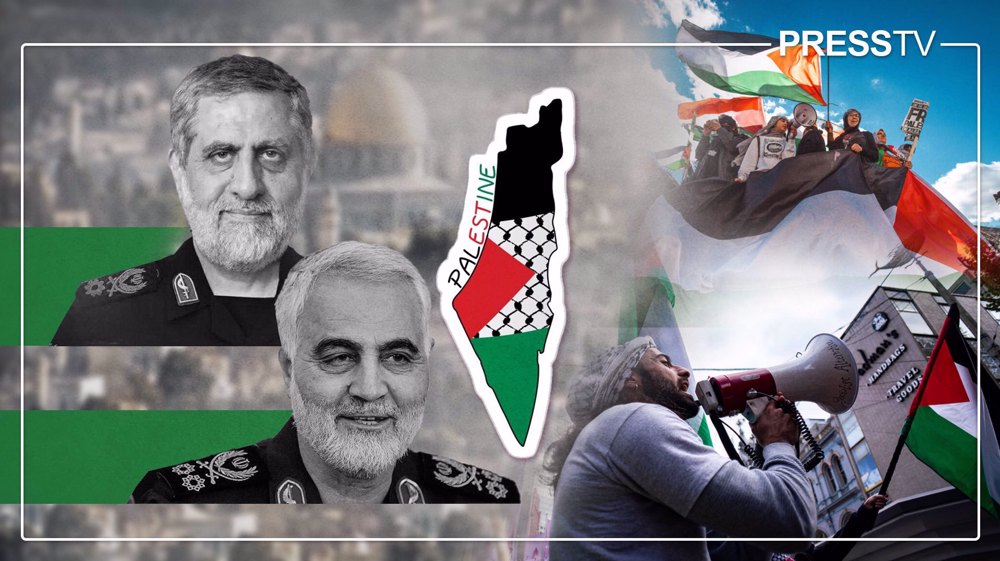
Among those he tried to protect from the city’s relentless bombardment was Brigadier General Mohammad Saeed Izadi, also known as “Hajj Ramazan,” the man responsible for the Palestine portfolio of the Islamic Revolution Guards Corps (IRGC) Quds Force, and one of the closest companions of the late commander.
General Soleimani, also known as “Haj Qassem”, was martyred in a US drone strike near Baghdad International Airport in January 2020, alongside Abu Mahdi al-Muhandis, deputy head of Iraq’s Popular Mobilisation Units (PMU), and other companions, in an attack directly authorised by US President Donald Trump.
Anger and affection
Haj Ramazan would often recall how they used to call General Soleimani from Beirut, telling him they needed to see him for some important discussions.
He refused every time. “I’ll come to Damascus,” he would say. “I’ll come to Beirut.” He never allowed them into Aleppo.
“It was protection, the instinct of a commander who carried the responsibility for everyone around him,” Haj Ramazan stated in a commemorative gathering after General Soleimani’s martyrdom.
But on one particular day, the two did meet briefly in Aleppo. And as soon as the meeting ended, General Soleimani urged Haj Ramazan to leave the city immediately.
Haj Ramazan obeyed, got into the car, and headed towards the outskirts. Yet the moment he left, he felt something tugging at him. The senior IRGC Quds Force commander insisted to his driver that they must go to the operation site.
The driver resisted, saying the road was dangerous and the area was too heavily targeted, but Haj Ramazan pushed until the man finally relented.
By the time General Soleimani himself reached the frontline later, amid relentless bombardment, he stepped inside the operation room.
The dim light of the candles hid Haj Ramazan’s face, but after a couple of minutes, when the electricity was restored, General Soleimani saw the IRGC's Palestinian unit commander standing there, still in harm’s way.
Ceremonies commemorating the sixth martyrdom anniversary of Lieutenant General Qassem Soleimani are being held in Iran and throughout the region, with large gatherings of mourners in Iraq and Iran.
— Press TV 🔻 (@PressTV) January 2, 2026
Follow Press TV on Telegram: https://t.co/LWoNSpkc2J pic.twitter.com/xR2W3tp9US
“He exploded. Didn’t I tell you to leave? Why are you here?!”
It was one of those rare, unguarded moments when the humanity of their relationship surfaced fully.
Haj Ramazan recognised the fear in the rebuke, the weight of responsibility for everyone under General Soleimani’s command.
General Soleimani was fasting. After prayers that evening, he called Haj Ramazan over to share a meal, a quiet gesture that “revealed the softness of his heart.”
Haj Ramazan later recalled the instructive conversation that followed. When asked about taking personal risks in the field, General Soleimani’s response was firm.
“If something happens to me, I have an answer before God. I am required here; my duty is here. But your work is not here... you came because your heart wanted to, the Quds Force chief told Haj Ramzan.
“What you say is true, I followed my heart to go to the operation site,” he replied.
Haj Ramazan later described the conversation as a lesson and a reassurance: “Hajji (General Soleimani) was extremely decisive and brave, yet very tender-hearted and quick to reconcile. And his words always had logic, not just emotion.”
People close to General Soleimani say that the world renowned anti-terror commander expected rationality and caution from those around him, but never sacrificed empathy in the process.
“These moments revealed the ability to command with unwavering authority, and the capacity to protect and mentor those around him,” Haj Ramazan would later recall about the incident.
Witnesses describe General Soleimani as a commander involved in multiple operations at a time. Alongside directing missions, he monitored the safety and movements of personnel under his command.
🇮🇷
— Press TV 🔻 (@PressTV) December 31, 2025
WATCH: Assassinated in Baghdad, immortalized in history: General Soleimani’s name refuses to fade. pic.twitter.com/JC3uhlFUD3
Grief of losing ‘a brother’
General Soleimani’s martyrdom left a profound void in the lives of those closest to him. Haj Ramazan was one of them.
As a long-time comrade, he felt the loss as “deeply as if he had lost a brother.”
Following Haj Ramazan’s martyrdom during the 12-day Israeli aggression against Iran, Seyed Yaser Mousavi, son of Sayyed Abbas al-Mousawi, Hezbollah’s former Secretary General and Haj Ramazan’s long-time comrade, recalles vividly the profound bond the IRGC commander shared with General Soleimani.
“I will never forget the moments when Haj Ramazan wept after the martyrdom of Haj Qassem. The two had a brotherly bond, and Hajj Ramazan felt the loss of Hajj Qassem as if he had lost a brother. With a trembling voice, he would speak to me about his personal memories with this great commander.”
Haj Ramazan’s wife, Saeedeh Salari, also echoed the depth of their connection:
“After Haj Agha’s (General Soleimani) martyrdom, whenever his name came up, Haj Ramazan would cry. They had a very close relationship. He considered Haj Agha’s words like a command.”
Sayyed Jawad Nasrallah says General Soleimani was fearless yet cautious, choosing to work in the heart of danger out of duty, even when warned not to go to Iraq.
— Press TV 🔻 (@PressTV) January 2, 2026
Follow Press TV on Telegram: https://t.co/LWoNSpkJSh pic.twitter.com/Buk9AwBIP3
Bonds beyond battlefield
Even away from the frontlines, the relationship between General Soleimani and Haj Ramazan was defined by mutual respect, consideration, and an almost familial closeness.
Haj Ramazan’s wife recalled moments that revealed the personal side of the top anti-terror commander who gave nightmares to the enemies.
On a holiday trip to Iran from Lebanon, the IRGC commander’s family spent the days accompanying General Soleimani’s foreign guests.
“We knew some Arabic, so we accompanied the guests on their visit to Iran,” Salari said in one of the interviews.
General Soleimani, recognising the effort they had made to assist the guests, insisted on thanking the family members personally.
“I tried to avoid it out of embarrassment; I hadn’t done anything substantial,” Salari said.
Yet General Soleimani made it a point to thank her and treat her with profound courtesy, acknowledging that the family had spent their personal leave helping his guests. “You spent your own leave time helping our guests,” he told her.
Another instance came during a personal tragedy that affected the family. After Salari’s father passed away, she took her mother to Lebanon for a few months.
“General Soleimani had come to Lebanon despite his extremely tight schedule, moving between Iraq, Syria, and Lebanon, always attending to operations with little time for personal visits. Still, Haj Agha made it a point to see us,” Haj Ramazan’s wife recalled.
For Salari, attending to people’s needs, “even amid urgent responsibilities were the gestures of recognition that revealed how General Soleimani’s humanity matched his strategic brilliance.”
✍️ Viewpoint -General Soleimani — Master strategist who built the architecture of Axis of Resistance
— Press TV 🔻 (@PressTV) January 2, 2026
By Shabbir Rizvihttps://t.co/pod0nQdvzs
Shared commitment to resistance cause
The unbreakable bond between General Soleimani and Haj Ramazan was also evident in their shared sense of purpose.
Khaled Qaddoumi, the representative of Hamas, the Palestinian resistance movement, in Iran, described a meeting between General Soleimani, Haj Ramazan and Ismail Haniyeh, the martyred chief of Hamas’ political bureau.
Haniyeh had concerns about some important issues regarding the resistance, but General Soleimani reassured him by pointing to Haj Ramazan.
“Mr Ismail Haniyeh, this is Haj Ramazan. He is the one who works on your issue. He is a Palestinian; he is more Palestinian than Iranian when it comes to your cause. Because of Haj Ramazan, I have no worries about Palestine. He handles everything," the Hamas representative recalled General Soleimani as saying.
“General Soleimani spoke in a way that made the layers of their relationship clear. He trusted Haj Ramazan to handle the work,” and also depended on him as someone who shared his sense of duty.
The professional confidence and personal understanding meant the mission could keep moving even when General Soleimani was not on the ground.
Witnesses confirm that he consistently recognised the efforts of those around him, guided them through operational decisions, and maintained close, trust-based relationships.
General Soleimani’s interactions with Haj Ramzan, as recalled by family and friends, reflect the balance between responsibility and human care that shaped the life and work of the celebrated anti-terror commander.
Press TV’s website can also be accessed at the following alternate addresses:

How Gen. Soleimani empowered Palestinian resistance, crushed Daesh and reshaped geopolitics
Abu Obeida: Masked Hamas spokesman who became voice of Gaza’s resistance
Iran heralds clean energy future with landmark geothermal power plant at Mount Sabalan


 This makes it easy to access the Press TV website