'World's biggest war criminals': Netizens rip into Trump, Netanyahu over Iran war rhetoric
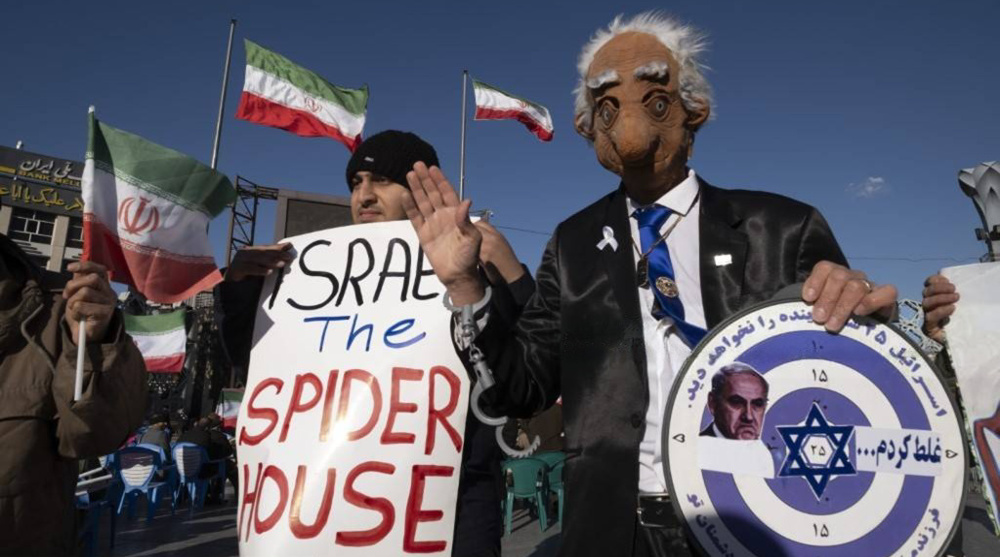
Outrage erupted online after US President Donald Trump and Israeli Prime Minister Benjamin Netanyahu renewed their threats of military action against Iran, prompting commentators to label the two as “the world’s biggest war criminals.”
Speaking alongside Netanyahu at Mar-a-Lago in Florida on Monday, Trump threatened to “eradicate” any attempt by Tehran to advance its nuclear program or bolster its ballistic missile capabilities.
“I hear that Iran is trying to build up again, and if they are, we’re going to have to knock them down," Trump said, threatening that a future US assault “may be more powerful than the last time.”
The US joined the Israeli military aggression against Iran in June, striking three peaceful nuclear sites in the country. Trump attempted to justify the aggression by repeating unverified claims that Iran could develop nuclear weapons within two months.
The rhetoric drew immediate condemnation from social media users, analysts, and journalists, criticizing the US and Israel for recklessly escalating tensions in West Asia. Some warned that Washington’s deference to Israeli interests has repeatedly drawn the US into unnecessary wars.
Jon Hoffman, a research fellow, said in a post on X that Netanyahu has lobbied for US-led regime change in Iran for decades. He said that American deference “makes sound statecraft impossible.”
Netanyahu has lobbied for US-led regime change in Iran for three decades.
— Jon Hoffman (@Hoffman8Jon) December 30, 2025
He will keep moving the goalposts until he drags the US toward his desired end.
American deference to Israeli interests in the Middle East makes sound statecraft impossible.
We need to walk away. pic.twitter.com/YGzIjZDdnt
Writer Tiberius added in a separate post that Netanyahu had misled the American public for years about Iran’s nuclear program while Israel maintains its own nuclear arsenal.
Netanyahu has lied to the American people for THIRTY YEARS about Iran building nukes WHILE Israel has nukes
— Tiberius (@tiberiusfiles) December 31, 2025
Every pro-Israel politician supports lying to their OWN citizens for a foreign government
TRAITORSpic.twitter.com/9LDkdoTHrX
Other commentators highlighted the human and geopolitical costs of renewed aggression against Iran.
X user Power to the People called Trump and Netanyahu the “world’s biggest war criminals,” warning that any aggression against Iran could result in widespread civilian casualties.
US citizen Araquel Bloss urged global action, tweeting that a US strike “for Israel” must be met with a worldwide general strike, describing Trump and Netanyahu as “the most dangerous men alive.”
If the US bombs Iran again for Israel, we must call for a global general strike.
— Araquel Bloss (@AraquelBloss) December 30, 2025
Trump and Netanyahu are the most dangerous men alive.
Journalist Tom Hennessy criticized US domestic priorities, saying that while US infrastructure lags and immigration issues persist, Trump repeatedly promises war with Iran on Israel’s behalf.
- America's infrastructure, 30 years behind where it should be.
— Tom Hennessy (@Tomhennessey69) December 30, 2025
- 40 million illegal aliens looting the nations resources.
- Third-world refugee fraud in major cities.
Trump: Meets with Netanyahu for the 5th time this year and promises to go to war with Iran (again) for Israel pic.twitter.com/zJ5tAX4kcn
A foreign policy analyst raised concerns about the legality of a potential strike, warning that international law requires formal authorization for military action. He also criticized Trump for effectively “allowing” Netanyahu to strike Iran without Congress or the UN Security Council permission.
"Since when does authorization for the use of force come from Trump rather than the Security Council? And since when is war no longer declared by Congress?"
We’ve drifted so far from Int'l law that people now speak casually of Trump “allowing” Netanyahu to strike Iran. Since when does authorization for the use of force come from Trump rather than the Security Council? And since when is war no longer declared by Congress?
— Reza Nasri (@RezaNasri1) December 30, 2025
Another X user pointed to broader regional destabilization, writing that Trump and Netanyahu’s threats signal further war in Iran, potential mass displacement in Gaza, tensions in Yemen, escalating threats against Lebanon, and a slow war against Venezuela.
She also urged resistance groups to "open up all possible fronts" across the world.
As the year ends, empire is regearing its ongoing conquests: Trump & Netanyahu are planning an imminent strike on Iran & mass displacement of Gaza; there's fascist infighting between UAE & Saudi over the separatist region they've manufactured to destabilize Yemen, which is also…
— Calla (@CallaWalsh) December 30, 2025
Netanyahu has long pushed for a military strike on Iran, citing its nuclear program as a pretext. Yet, as journalist Glenn Greenwald said, the dynamic has shifted.
Greenwald said Israel’s prime minister may no longer need to take action directly because Trump has signaled his willingness to launch the aggression on Tel Aviv’s behalf.
Even if Iran’s previously targeted facilities have been destroyed, he said, the US president appears prepared to authorize strikes if Iran "rebuilds its ballistic missile capabilities."
Netanyahu has been signaling that he wants to bomb Iran again.
— Glenn Greenwald (@ggreenwald) December 29, 2025
No need: he already has Trump promising to do it for Israel.
Not just if Iran tries to build nukes (I thought their facilities were "obliterated"?).
But even if they replace their ballistic missiles. 🇮🇱🇮🇱🇮🇱 https://t.co/JZWX12HfuH
The Islamic Republic has repeatedly declared that its missile program is strictly defensive, designed to deter attacks and protect the country.
Tehran has rejected Western calls to limit missile ranges to 500 kilometers, arguing that such restrictions would leave the nation vulnerable to long-range threats.
Observers also warn that the aggressive rhetoric from the US and Israel, combined with the threat of renewed strikes, risks destabilizing the region, heightening tensions not only with Iran but across wider West Asia.
Press TV’s website can also be accessed at the following alternate addresses:
Why Global Majority must unite against US imperialism in Iran, Venezuela, Cuba, Gaza
Trump's aides urging him in private to devise exit plan from Iran war
Iran downed 11 US MQ-9 Reaper drones worth over $330mn: report



 This makes it easy to access the Press TV website