‘Wise, courageous, farsighted’: Martyr Seyyed Ali Khamenei in the words of resistance leaders
By Press TV Website Staff
It was never about politics or politicking. The bond that united the leaders of the Axis of Resistance – from Lebanon to Iraq to Yemen and beyond – to Ayatollah Seyyed Ali Khamenei transcended the transactional calculations of conventional alliances.
It was something far deeper and meaningful – a shared vision of Islamic emancipation, an unshakeable commitment to the freedom of the oppressed, and a profound spiritual connection rooted in the principles of truth and justice.
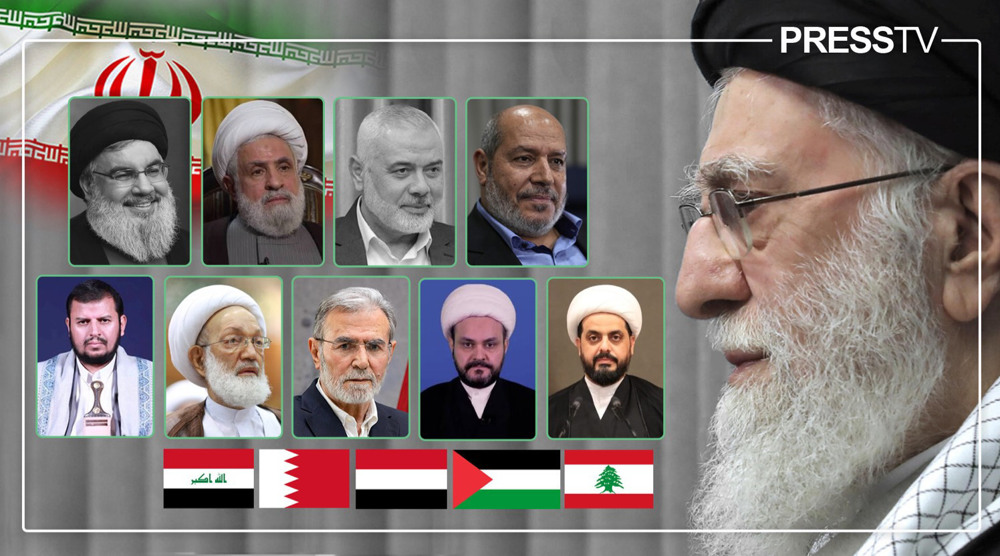
Throughout his lifetime, Ayatollah Khamenei was not simply a country’s leader; he was the revered and widely followed strategist and spiritual compass of a resistance network that stretched from the Mediterranean shores of Lebanon to the mountains of Yemen, from the battlefields of Gaza to the resistance fronts of Iraq and Bahrain.
Hezbollah, the vanguard of the resistance movement in the region, embodied this reverence with unmatched clarity. Sayyed Hassan Nasrallah, the martyred secretary-general whose name became synonymous with resistance itself, saw in Ayatollah Khamenei a guiding light.
The martyred Hezbollah leader dedicated his life to the Leader's vision. Theirs was a relationship defined by mutual respect and profound spiritual connection, a bond that transcended politics and became the very cornerstone of the resistance movement.
Nasrallah's tributes: The Leader of the Ummah
Sayyed Hassan Nasrallah regularly referred to Ayatollah Khamenei using the most exalted honorific titles. He described him as "the Leader of the Islamic Ummah," "a wise, courageous and farsighted leader," and "a source of guidance for the Resistance."
These were expressions of deep and unshakable reverence he had for the Leader of the Islamic Revolution rooted in shared beliefs and shared goals.
In countless speeches delivered from Hezbollah's strongholds in Beirut's southern suburbs, speeches that captivated millions across the Arab and Islamic worlds, Nasrallah consistently referred to Ayatollah Khamenei as the central authority of the Islamic world.
He would often begin his addresses by invoking the Leader's guidance, framing Hezbollah's resistance actions as a direct extension of the Leader's strategic vision.
For Nasrallah, Ayatollah Khamenei was not merely Iran's leader but the leader of all Muslims who stood against oppression and for justice, a figure whose authority derived not from political power alone but from his embodiment of pristine Islamic principles.
Ayatollah Seyyed Ali Khamenei: A man who stood firm for his principles and gave his life for them.
— Press TV 🔻 (@PressTV) July 5, 2026
Follow https://t.co/B3zXG73Jym pic.twitter.com/RK8mO2dBoO
Nasrallah's descriptions always emphasized qualities that defined the Leader's role in the resistance: wisdom, courage, and farsightedness. He viewed Ayatollah Khamenei as a figure who could see beyond immediate tactical challenges to the broader strategic horizon, a leader who understood that resistance was not merely a military campaign but a civilizational project for the emancipation of mankind.
The wisdom was evident in the Leader's ability to navigate the most complex geopolitical challenges while maintaining unwavering principles. The courage was demonstrated in his willingness to confront the most powerful armies on earth, refusing to bend or break under pressure. The farsightedness was reflected in his strategic vision, which anticipated the trajectory of events and positioned the resistance for success and glory.
Most significantly, Nasrallah described Ayatollah Khamenei as "a source of guidance for the Resistance." This was a profound acknowledgment of the Leader's centrality to the resistance movement spanning multiple countries in the region.
For the charismatic Hezbollah leader, the Resistance was not a collection of disparate movements acting on their own initiative but a unified front guided by the Leader's strategic and spiritual direction. Ayatollah Khamenei's guidance was the thread that connected Hezbollah, Hamas, Islamic Jihad, Ansarullah, and the Iraqi resistance groups into a cohesive force capable of confronting the US-Israeli alliance.
Ayatollah Khamenei's praise for Nasrallah: A reciprocal reverence
The reverence was entirely reciprocal. Ayatollah Khamenei described Nasrallah as "an immense treasure for the Islamic world, and not just for the Shia and for Lebanon."
It was a description that captured the impact of the man who transformed Hezbollah from a small group of resistance fighters into a formidable military and political force capable of confronting the world’s most powerful and technologically superior armies.
Following Nasrallah’s martyrdom, Leader said he himself may be gone, but the treasure he created remains, praising his "eloquent voice and brave defense of the oppressed" and his role as a "religious scholar" and "wise political leader."
In one of the meetings with the Assembly of Experts, Ayatollah Khamenei elaborated on Nasrallah's enduring legacy, stating that Hezbollah's extraordinary evolution is indebted to Nasrallah's "courage, wisdom, patience, and extraordinary trust in God."
He emphasized that "Hezbollah turned from a small group of fighters into a huge organization with such power that it can force the enemy... to retreat and defeat it."
Nasrallah's references to Ayatollah Khamenei were always infused with religious reverence. He spoke of the Leader not as a political ally but as a figure of spiritual authority, whose legitimacy derived from his embodiment of Islamic principles. It was the language of a man who had dedicated his life to a cause and found in Ayatollah Khamenei the inspiring leader who could guide that cause to victory.
✍🏻 Viewpoint - How Imam Khamenei turned Karbala's spirit of resistance and dignity into a living legacy
— Press TV 🔻 (@PressTV) July 5, 2026
By Prof. Abdullahi Danladi
Read more: https://t.co/soSdpSln83 pic.twitter.com/vyHUQcH286
Hezbollah's broader allegiance: Sheikh Naim Qassem's declaration
Sheikh Naim Qassem, who succeeded Nasrallah as Hezbollah's secretary-general, continued this tradition of reverence to the Leader with equal fervor.
In one of his first speeches as the Lebanese resistance movement leader, Qassem declared: "We reiterate support for Leader Ayatollah Seyyed Ali Khamenei and the people of Iran."
He emphasized the importance of the Guardianship of the Islamic Jurist in leading the resistance, stating that "in the absence of the Prophet (PBUH) and infallible Imams, Muslims should pledge allegiance to Leader Imam Khamenei."
It was a statement of profound theological and political commitment, one that linked the resistance's legitimacy directly to the Leader's authority.
"When Trump or anyone else threatens the Leader, they are threatening millions of people. We consider the death threat against Imam Khamenei to be directed at all Muslims," he said after the US president made threats against Ayatollah Khamenei.
Hezbollah leader described Ayatollah Khamenei as having "solidified the ideological and strategic foundations of authentic Muhammadan Islam," continuing the path laid by Imam Khomeini, the founder-leader of the Islamic Revolution.
He noted that the Leader encouraged scientific advancement, self-sufficiency, and independence from East or West, and instilled within the resistance front "the spirit of hope for ultimate victory."
The Palestinian front: Hamas and Islamic Jihad and Ayatollah Khamenei
Ismail Haniyeh, the former head of the Hamas Political Bureau who was martyred in an Israeli strike in Tehran in July 2024, shared a particularly close bond with Ayatollah Khamenei, rooted in mutual respect and shared commitment to the Palestinian cause.
Haniyeh regarded the Leader as the primary strategist and spiritual guide of the resistance front. His respect for Ayatollah Khamenei was reciprocated in the strongest possible terms.
Following Haniyeh's martyrdom, Ayatollah Khamenei issued a message of condolence in which he described Haniyeh as "the brave leader and prominent Palestinian freedom fighter" and "a distinguished fighter."
He noted that Haniyeh "devoted his precious life with great distinction in the field of honourable struggle for years and was ready for martyrdom and had offered his children and loved ones in this cause. He had no fear of martyrdom in the path of God and the salvation of God's servants."
For his part, Haniyeh consistently framed his struggle within the broader vision articulated by Ayatollah Khamenei. He viewed the Leader as the central figure of the resistance, whose strategic guidance made the achievements of the Palestinian resistance possible.
Mohammad Ismail Darwish, the incumbent head of the Hamas Leadership Council, and Khalil al-Hayya, Deputy Head of the Hamas Political Bureau, met with Ayatollah Khamenei in February 2025. Al-Hayya told the Leader: "Today, we come to meet you with pride, as we all stand victorious. This great victory is a shared triumph for us and the Islamic Republic."
Darwish described the Leader as one who "embodied the highest meanings of devotion, sacrifice, and jihad in one of the greatest battles of the Ummah," describing Ayatollah Khamenei not merely as a political leader but as a symbol of Islamic resistance against oppression, in Palestine and across the world.
🎤 Conversation - Martyred Leader’s legacy of resistance elevated Iran’s standing on global stage: Ex-deputy speaker https://t.co/NMG8kVYI4P
— Press TV 🔻 (@PressTV) July 3, 2026
Ziyad al-Nakhalah, secretary-general of Palestinian Islamic Jihad, always expressed profound gratitude for Iran's support and the guidance of Ayatollah Khamenei, viewing it as essential to the success of the Palestinian resistance. He described the Islamic Republic as "the home of resistance" and praised its "effective and constructive role" in the region.
Most notably, after the ceasefire in Gaza, al-Nakhalah said he and the Palestinian people have "confidence and certainty in the Leader of the Islamic Revolution's role in supporting the Palestinian Resistance on political and spiritual levels, as well as in other areas."
During their meetings, particularly the one on February 18, 2025, al-Nakhalah used the opportunity to express his gratitude to Ayatollah Khamenei for his leadership.
He congratulated the Leader on what he called the "magnificent victory in Gaza," attributing this success to "the continuous support of the Islamic Republic," and affirmed the resistance's unwavering commitment to the Palestinian cause.
In an interview, he linked the success to the Leader's role, saying the victory was credited to "the support of the Leader of the Islamic Revolution and Sayyed Hassan Nasrallah."
The Yemeni front: Ansarullah's support for Iran and Leader
From Yemen, Ansarullah resistance leader Sayyid Abdul-Malik al-Houthi on multiple occasions praised Iran's steadfastness against "the arrogant and oppressors" and described the Leader as a source of hope for the Muslim world. In one such statement, he emphasized that the victory of the Islamic Revolution in Iran led to the establishment of an independent Muslim country free from US hegemony.
He often praised Ayatollah Khamenei’s inspiring leadership and Iran's steadfastness against the Israeli regime's conspiracies against the Muslim world for 47 years while supporting oppressed nations, foremost among them the Palestinian people.
Following the martyrdom of Ayatollah Khamenei, al-Houthi described it as a "great loss" for the Muslim world brought about by American and Israeli aggressors. He characterized it as an attempt to remove a central obstacle to Israeli dominance in the region and to shatter the determination of the Iranian nation. Al-Houthi called for resilience and strength in the face of such aggression, asserting that "the Iranian position is cohesive and firm, and the Iranian response is strong and ongoing."

He also expressed solidarity with the new Leader, Ayatollah Seyed Mojtaba Khamenei, describing his election as a "big blow to the United States and Israel as the oppressors of the time, and a deep disappointment for them."
Ahmad al-Imam, Ansarullah's cultural representative in Iran, described Ayatollah Khamenei as "the strong fortress of the Islamic Ummah" and credited his "wise measures and war management" with maintaining stability in the region.
The Iraqi front: A loud chorus of allegiance to Leader
Iraqi resistance leaders have also always expressed their profound reverence for Ayatollah Khamenei, viewing him as the primary strategist and unifier of the resistance front.
Sheikh Akram al-Kaabi, Secretary-General of Harakat al-Nujaba, praised "the judicious leadership of the axis of resistance by Ayatollah Seyed Ali Khamenei," specifically thanking him for "his wisdom and courage, his wise leadership, and unparalleled management of the axis of goodness."
Following the Leader's martyrdom, al-Kaabi declared that the entire Axis of Resistance – its fighters and commanders alike – will remain as obedient to the new Leader’s command “as they once were to that of your martyred father."
Abu Alaa al-Walaei, Secretary-General of Kata'ib Sayyid al-Shuhada, described Ayatollah Khamenei as the "embodiment of faith in the face of global pressure."
He described the confrontation with the United States as a struggle between principled leadership and hegemonic ambition. Al-Walaei emphasized that his group maintains "complete alignment with the Leader" and asserted that Ayatollah Khamenei "represents steadfast faith" while US President Donald Trump embodies "hegemonic aggression."
Hassan al-Abbadi, the cultural representative of Kata'ib Sayyid al-Shuhada, spoke of the deep respect that Iraqi resistance fighters held for Ayatollah Khamenei.
He said the enemies of the Islamic Ummah are "deeply intimidated by the stature and powerful leadership" of the Leader. Al-Abbadi declared that "the banner of the unified Islamic Ummah is firmly held by Ayatollah Khamenei" and that it is "a source of pride for us to follow a leader whose very presence and whose words strike fear into the hearts of the enemies."
Sheikh Qais al-Khazali, Secretary-General of Asa'ib Ahl al-Haq, expressed his profound reverence in the most exalted terms. He described Ayatollah Khamenei as "the bravest leader, the most pious guardian, the pure knower, the victorious leader, the guardian of the Muslim Ummah, the master of the resistance fighters, the jewel in the crown of the mujahideen, the supporter of the oppressed, the bearer of the banner of authentic Muhammadan Islam."
Al-Khazali emphasized that the Leader's "jihadist and political journey constituted a landmark in the history of the Islamic Republic in particular, and the world in general, and was a key axis in confronting the projects of global hegemony and arrogance."
“He sets a perfect example of seeking justice”@Leelako, Assistant Professor at University of Tehran, describes the martyred Leader of Islamic Republic as a father figure who inspired patriotism, scholarship, and a universal commitment to justice. pic.twitter.com/yvdB6OMa7I
— Press TV 🔻 (@PressTV) July 6, 2026
The Bahraini front: Sheikh Issa Qassim's declaration
Sheikh Issa Qassim, the leading Shia religious authority in Bahrain and a prominent figure in the Bahraini resistance movement, was greatly influenced by Ayatollah Khamenei.
Following threats made against the Leader, Sheikh Issa Qassim issued a powerful declaration of support that reverberated across the Muslim world. He described Ayatollah Khamenei as "the great Qur'anic emblem" and "a rare leader of the age," emphasizing that his stature was rooted in his embodiment of Islamic principles.
Qassim further stated that "targeting Ayatollah Khamenei with any words of disrespect or threats is tantamount to insulting the entire Islamic Ummah, its sanctities, and the exalted position of the ruling jurist."
His declaration underscored the conviction that an attack on Ayatollah Khamenei was an attack on the entire Islamic community, a view that resonated deeply with resistance movements across the region.
For Sheikh Issa Qassim, Ayatollah Khamenei represented not merely Iran's leader but the spiritual guide of the entire Islamic Ummah, whose authority transcended national boundaries and whose guidance was essential for the resistance's survival and success.

Pezeshkian vows to advance martyred Leader's legacy of unity, progress

President Pezeshkian to attend martyred Leader’s funeral in Iraq

'Ayatollah Khamenei confronted Anglo-Zionist empire'



Yemeni officials: Ayatollah Khamenei’s martyrdom fuels resistance until final victory
Punishment of Ayatollah Khamenei’s assassins is a sovereign duty: Iran’s vice president
Hashd al-Sha’abi calls on Iraqis to attend Ayatollah Khamenei’s funeral en masse
Martyred Leader’s millions-strong funeral created ‘new equation’: Top security official
New Israeli drone strike kills four civilians in southern Lebanon
‘Wise, courageous, farsighted’: Martyr Seyyed Ali Khamenei in the words of resistance leaders
Ayatollah Khamenei’s commitment to Palestine unmatched in history: Hamas official
Israeli command system identified 850,000 targets during Gaza, Lebanon wars: Supplier


 PressTV NEWSLETTER now
  This makes it easy to access the Press TV website