Iran-US war-ending MoU ‘significant victory’ for Tehran and defeat for American Empire: Ex-US official
By Alireza Kamandi
The recent memorandum of understanding (MoU) between Iran and the US is a significant strategic victory for the Islamic Republic that managed to bring the global economy to the brink of catastrophe through economic warfare, says an analyst.
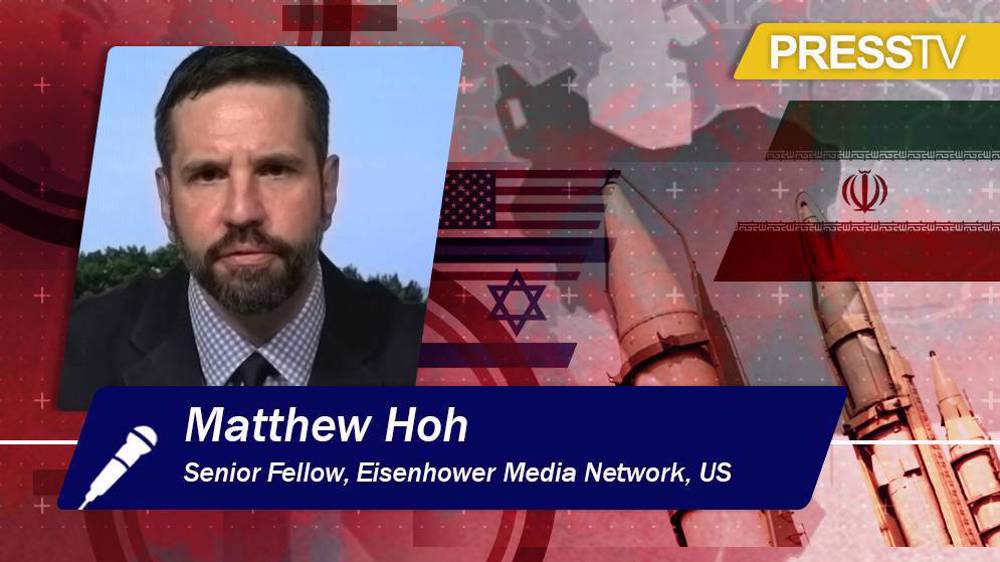
Matthew Hoh, a former US Senate candidate and a Marine Corps veteran and State Department official who resigned in protest over the wars in Iraq and Afghanistan, made these remarks in an interview with the Press TV website.
When asked whether the MoU represents a victory for Iran, given that the United States failed to achieve its objectives on the ground and was forced to return to negotiations, Hoh said it clearly is a victory for Iran and certainly a defeat for the American Empire.
He noted that the concessions being made by the United States are "breathtaking" and that among American commentators, almost none predicted this outcome.
While many analysts understood the war would be futile and counterproductive, Hoh noted, most assumed it would end in stalemate with the Iranian government surviving and the US simply biding time until the next round.
"Very few, if any, American commentators thought the war would result in these types of concessions – concessions that many of us believed were politically impossible in the US," he said.
He said Iran fought the Israelis, the Americans, and the Persian Gulf Arab states both symmetrically and asymmetrically in response to the unprovoked and illegal war, and that many Americans believe Iran “came out dominant.”
✍ Analysis - 60-day negotiation framework, seven conditions: Iran’s strategic red lines shape oversight and leverage
— Press TV 🔻 (@PressTV) June 23, 2026
By Press TV Strategic Analysis Deskhttps://t.co/fiJG5m898g
The former US State Department official and currently a senior fellow at the Eisenhower Media Network attributed President Donald Trump's capitulation to the success of Iranian economic warfare in strangling the global economy.
"The danger of the cliff the world was heading toward in July, when global oil inventories were set to be depleted, was very real. That scared the Americans; that scared the White House. And that is why the US is willing to make these concessions," he told the Press TV website.
Hoh noted that military leverage does not exist for the United States, as it cannot force Iran to do anything, and the alternative of entering a period of economic catastrophe was simply unacceptable to the White House.
However, he warned that after the midterm elections, if Americans feel the economy and markets have stabilized, there could be a return to warfare. "The Iranians should see what they can gain from this victory in terms of a negotiated agreement," he told the Press TV website.
"The question that must come back to Iran is: What do you want to do with this victory? What do you want to do with this new Middle East order—with the realization that Iran is not just a regional power, but a world power"
Addressing concerns about the MoU's requirement that the US "compel Israel to end the war in Lebanon" and Trump's concurrent threats regarding Iran's support for Hezbollah, Hoh expressed confidence that there is "not a significant risk of the United States getting involved in a larger war."
“While US support for Israel remains vast – encompassing weapons, munitions, fuel, spare parts, and intelligence – the Americans have real leverage over Israel,” he noted.
"Donald Trump, to his credit, has warned the Israelis more than any of his predecessors ever did. If Trump truly believes this deal will be his legacy, he may do what no other American president would consider: essentially cut off the Israelis from American support."
✍️ Analysis - Leader’s strategic vision leverages Iran’s post-war ascendancy to reshape regional power dynamics
— Press TV 🔻 (@PressTV) June 21, 2026
By Press TV Strategic Analysis Desk https://t.co/ldvVF1jpXg
Regarding the possibility of Trump returning to warfare, Hoh deemed it unlikely now, though he acknowledged the potential for limited engagements. "For the next two months, while negotiations are ongoing, I expect threats but not actual American military action," he predicted.
When questioned about Trump's stated "60-day option" and his claim that he can "do whatever I want" after its expiration, Hoh noted that Iranians would be "wise to get as much as they can in this current window."
Hoh reiterated the real concern that the United States cannot be trusted and might return to war after the November elections or once global energy markets have stabilized. However, he stressed that Trump views this deal as his legacy and will try to protect it for the next couple of years.
"The leverage they (Iran) have now – their established ability to dictate the terms not just of the war but also of the ceasefire and now the negotiating phase – needs to be utilized," Hoh emphasized. "They need to receive not just concessions but guarantees that these terms will be realized in whatever final deal is achieved."
Hoh praised Iran's willingness to utilize its leverage through actions like shutting down the Strait of Hormuz and walking out of negotiations. "That is exactly how Iran should be acting," he stated, while cautioning that "nobody wants to return to war" and that even with an upper hand, the price of renewed conflict should not be considered lightly.
Regarding Trump's threats over Iran's "proxies in Lebanon" and the commitment to a "permanent end to the war on all fronts," Hoh said these threats were ultimately "superficial or hollow."
🎤 Conversation - Iran-US MoU to end war a welcome development for regional security and stability: Analyst@HumbatovSamir https://t.co/Gdwl2j7NHv
— Press TV 🔻 (@PressTV) June 16, 2026
"The Americans have no real military leverage," he stressed. "They can return to bombing, they can return to war, but what can they expect to accomplish in another iteration of the war that they did not accomplish in March or April?"
Hoh described Trump's threats as "largely performative gestures meant to signal displeasure" and "temper tantrums," while acknowledging they must be taken seriously. "The United States could return to war, and that would be ruinous for Iran, ruinous for the region, and potentially ruinous for the world – especially if energy infrastructure across the Middle East is destroyed."
Asked to interpret Trump's threat to "hit Iran very hard again, just like we did last week, only harder," Hoh drew a comparison to Richard Nixon's "madman strategy" – the idea that a leader presenting themselves as irrational would cause opponents to back down.
However, Hoh added that in Trump's case, "we are not talking about a strategy or posturing. We are dealing with a president who is genuinely mad." He noted this as "the assessment of most Americans—whether they are laypeople or professional analysts."
"The problem that the Iranians have to deal with, that the Arabs have to deal with, that even the Israelis have to deal with – indeed, the whole world has to deal with it – is that you have a president, Donald Trump, who is unpredictable and irrational," Hoh stated.
"Aside from that, he is also a man with no loyalties beyond his own self-interest."
Hoh emphasized the difficulty of interpreting Trump's intentions, adding that his threats could reflect concerns that a deal might not go through, which in turn reflects his self-interest and desire for the deal to secure his presidential legacy, or could simply be "his temperament, his fickleness, this madness again."
Iran stopped Trump's 'march to reassert US global dominance': Analyst
Iran-US MoU to end war a welcome development for regional security, stability: Analyst
Iran-US MoU ‘great victory’ for Tehran as US failed to achieve war objectives: Former diplomat


Strategic dilemma of Persian Gulf states: Between American pressure and Iran's postwar leverage
Exclusive: Iran-US communication line established in Strait of Hormuz to prevent military incidents
Iran mocks US for ‘solving’ domestic hunger problem, lecturing others
Senior official: Hormuz safe passage conditional on Iran's coordination
Iran-US MoU ‘significant strategic victory’ for Tehran, defeat for American Empire: Ex-US official
Iran condemns 'meddlesome and provocative' GCC-US joint statement
Explainer: Team Melli's scenarios to reach 2026 World Cup knockout stage–and make history
Iran rejects ‘fake’ news of ban on slogans against US terrorism




 PressTV NEWSLETTER now
  This makes it easy to access the Press TV website