Iran attaches no value to EU’s ‘fraudulent’ sanctions: Gharibabadi
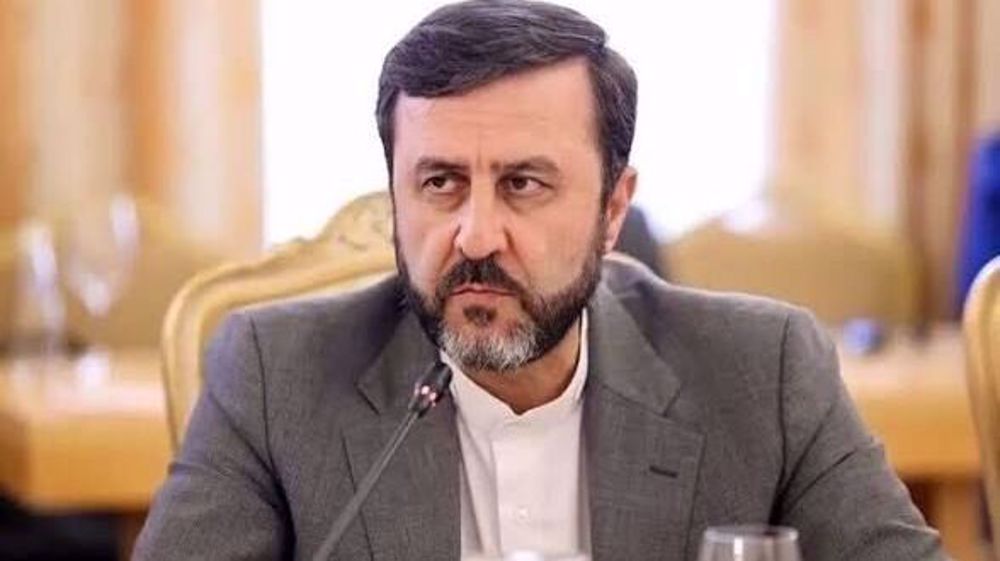
Iran’s deputy Foreign Minister Kazem Gharibabadi has decried as “fraudulent” the European Union’s move to impose sanctions on Iranian individuals and institutions over the situation in the Strait of Hormuz following the US-Israeli aggression against the Islamic Republic.
On Monday, the European Union said it had imposed sanctions on two Iranian individuals and a unit of the Islamic Revolution Guard Corps (IRGC) over the Strait of Hormuz.
"Iran's actions are unacceptable. In response member states have approved sanctions against Iranian entities and individuals involved in disrupting transit through the Strait of Hormuz," Kaja Kallas, the EU's foreign policy chief, claimed.
"This is the first time the EU has applied its new freedom of navigation regime and when necessary we will apply it again," she added.
Commenting on the decision, Iran’s deputy Foreign Minister for Legal and International Affairs Gharibabadi noted that the “fraudulent move” comes while “the member states of the Union are major violators of the rights of the Iranian people and the Union has also deliberately remained silent in the face of the US naval blockade against Iran, which is considered an act of war!”
Pointing out that Iran is not a party to the Convention on the Law of the Sea, the official stressed that “the legal regime emphasized by Iran in the Strait of Hormuz is ‘innocent passage’ based on customary international law and observance of maritime safety and security considerations of the coastal state.”
He downplayed the new EU measures, saying “Iran does not attach any value to this political and hypocritical European move and will continue its strategy of maintaining sovereignty and exercising sovereign rights over the Strait of Hormuz.”
Gharibabadi warned that “unilateral coercive measures also do not create law; rather, they can themselves be the source of international responsibility for their authors.”
Iran shut down the Strait of Hormuz to its enemies and their allies following the latest US-Israeli aggression against the country.
Iran began to swiftly retaliate against the strikes by launching barrages of missile and drone attacks on the Israeli-occupied territories as well as on US bases and interests in regional countries.
Iranian authorities introduced much stricter controls after US President Donald Trump announced a blockade targeting Iranian vessels and ports.

Tehran says the measures violate the terms of a Pakistan-brokered ceasefire that took effect on April 8 and was later extended unilaterally by Washington.
The Islamic Republic insists it will not reopen the Strait of Hormuz, through which one-fifth of the world’s oil and gas supplies pass, unless the illegal blockade is lifted and the war reaches a permanent end.
The Iranian authority controlling the Strait of Hormuz in the Persian Gulf has defined the supervisory management zone of the waterway, announcing that movement through the strategic corridor requires coordination and a permit.
The Persian Gulf Strait Authority (PGSA) said the zone is "the line connecting Mount Mubarak in Iran and southern Fujairah in the United Arab Emirates, on the eastern side of the strait, extending to the line connecting the end of Qeshm Island in Iran and Umm Al Quwain in the United Arab Emirates, on the western side of the strait."

Iran warns any mistake will turn region into ‘hell’ for US-Israeli ‘evil coalition’

Any new US-Israeli adventurism will spark trans-regional war: Iranian MP

Pezeshkian vows Iran will not retreat from any threat



Hormuz to Bab el-Mandeb: Qaani announces new resistance belt to choke Israeli aggression
Africa’s best referee denied entry to US despite being picked by FIFA for World Cup
Lebanon condemns repeated Israeli attacks on historic landmarks
Iran to pursue both war and diplomacy to defend people’s rights: Qalibaf
Senior Yemeni official: Ansarullah won't allow Netanyahu to bully West Asia
Iran upended equation of ceasefire on paper, violations in practice: Qalibaf
Iran attaches no value to EU’s ‘fraudulent’ sanctions: Gharibabadi
Hamas hails Iranian response to Israeli aggression on Lebanon


 PressTV NEWSLETTER now
  This makes it easy to access the Press TV website