The tide has turned: Iran’s strategic control of the Strait of Hormuz crushes American naval supremacy

By Press TV Strategic Analysis Desk
For decades, the Strait of Hormuz has been more than a waterway. It has functioned as the world’s most strategic chokepoint, the jugular vein of global energy flows, and the stage upon which American naval supremacy has performed its most visible and intimidating demonstrations of military force.
Through this narrow maritime corridor, linking the Persian Gulf to the Gulf of Oman, nearly one-fifth of global oil supply once moved with routine predictability. That predictability itself was the source of strategic power. Whoever could guarantee – or disrupt – that flow effectively held leverage over the global economic bloodstream.
For decades, the United States positioned itself as the ultimate arbiter of that passage. Its naval formations patrolled these waters with the implicit assumption of ownership, dictating the rules of engagement, enforcing “freedom of navigation” on its own strategic terms, and treating Iran’s legitimate maritime interests as little more than a secondary concern.
That era has effectively ended now. Renewed clashes in the Strait of Hormuz in recent days, triggered by repeated US military adventurism, are not routine maritime incidents. They represent the surface tremors of a deeper structural transformation: the steady consolidation of Iran’s sovereignty over this critical waterway.
This is no longer a question of symbolic passage rights or procedural navigation disputes. It is about effective control of one of the most consequential maritime arteries on the planet, where geography, deterrence, and power projection intersect with global energy security.
For the United States, this significant shift does not register as a diplomatic inconvenience or localized friction. It constitutes a direct erosion of its ability to assert uncontested naval dominance in a region that has long been central to its global power projection.
In strategic terms, it represents a serious and irreversible blow to its status as a maritime superpower, which has been dying a slow death since the recent war against Iran.
The unspoken contest: Sovereignty vs. symbolism
At the core of the current standoff lies a simple yet profound struggle. The American war machine persists in symbolically steering its warships through the Strait of Hormuz while refusing to abide by Iran's established rules following the recent war of aggression.
This is not merely about transit rights. It is an act of defiance, a refusal to acknowledge the practical consolidation of Iranian sovereignty over the world's most strategically vital maritime corridor and the shift in maritime dynamics in the past three months.
Washington fully grasps what Tehran has declared: the strait is no longer an open highway for hostile foreign naval forces. Iran has imposed new regulations, new protocols, and new realities. And for a superpower whose identity hinges on projecting force across global oceans, such surrender is unthinkable. Thus, the United States is trying to resist and flout new rules through presence, turning each routine crossing into a symbolic confrontation.
Yet symbolism, however resolute, cannot forever override geography. The Strait of Hormuz rests entirely within Iran's territorial waters and the Iranian leadership has clearly and categorically announced that its sovereignty is non-negotiable.
✍️ Analysis - End of 'tit-for-tat' era: Iran’s broad, asymmetric response to US attacks redraws the deterrence equation
— Press TV 🔻 (@PressTV) June 3, 2026
By Press TV Strategic Analysis Deskhttps://t.co/MVDp8qqOZQ
A heavy blow to American naval supremacy
The legitimate consolidation of Iran's sovereignty over the Strait of Hormuz delivers far more than financial or security benefits to Tehran. It strikes a devastating blow to the very foundation of American dominance at sea, which remained unquestioned not long ago.
America's military power is inherently maritime. From aircraft carriers to nuclear submarines, from the Fifth Fleet in Bahrain to patrols across the Indian Ocean, the American war machine projects influence through its mastery over the world's strategic waterways.
The Persian Gulf has anchored that strategy for half a century. It is the arena where Washington has repeatedly sought to demonstrate its ability to protect regional allies, intimidate adversaries, and secure energy flows that safeguard its own interests.
Depriving the United States of its ability to freely exploit the Persian Gulf and the Strait of Hormuz – to move with impunity, to dictate the rules, to command the waters – marks the beginning of America's decline and fall as a naval superpower.
From that decline flows a cascade of consequences: zero political leverage, shattered military credibility, and a weakened hand against major rivals such as China and Russia.
Beijing and Moscow are watching closely. If the US cannot secure compliance in a narrow strait off Iran's coast, what message does that send about its ability to contest the South China Sea or the Arctic? The blow at Hormuz resonates far beyond the Persian Gulf.
No acceptance, now or ever
Given the immense stakes, it would be naive to expect the American war machine ever to formally approve or accept Iranian sovereignty over the Strait of Hormuz.
Not in the short term, during the current fragile ceasefire. Not in the medium term, between the end of unprovoked aggression and any potential final agreement. And certainly not in the long term – even after some future deal, should one ever materialize.
For Washington, acceptance would mean surrender. It would signal to the world that a regional power has successfully challenged and shattered American maritime dominance. It would embolden other players – from the South China Sea to the Black Sea – to assert their own sovereign controls over strategic waterways. The precedent is simply far too dangerous.
Thus, American stubbornness has already manifested in localized clashes within the strait, along Iran's southern coasts, and in attacks on limited positions in Qeshm, Sirik, and Bandar Abbas. Iranian vessels around the Strait have also been struck.
These are not isolated incidents but the death throes of a superpower that refuses to accept a new geopolitical reality of Iran as a new power and the Strait as its jugular vein.
✍️ Analysis - Hybrid warfare after military defeat: Iran and resistance axis poised to thwart all enemy plots – including psyops
— Press TV 🔻 (@PressTV) June 4, 2026
By Press TV Strategic Analysis Deskhttps://t.co/OkbdkKc66B
The red line that cannot be erased
Even if the naval blockade were fully lifted – even if tensions eased elsewhere – American provocative operations and harassment in the Strait of Hormuz are unlikely to cease.
Why? Because the normalization and consolidation of Iran's exercise of sovereignty over the strait has become, and will remain, an official red line for the United States.
This is not just about oil or about Israel. It is about the fundamental architecture of global power. If Iran can close or control the Strait at will, the United States can no longer guarantee global energy security in line with its own interests.
If the United States cannot guarantee global energy security, its allies will lose confidence. If its allies lose confidence, the entire American-led international order begins to collapse.
For Washington, retreat at the Strait of Hormuz is inconceivable and in fact suicidal. Yet continued confrontation with Iran carries its own catastrophic consequences.
Iran’s objective: Victory without instability
For Iran, however, prolonged tension in the Strait of Hormuz remains undesirable in the long term. Victory on the battlefield and at the negotiating table must be sustainable.
If commercial shipping routes stay chronically insecure, shipping companies will inevitably seek or create alternative paths, bypassing the strait entirely through pipelines, overland corridors, or longer sea lanes. Iran's strategic leverage would then erode, not through military defeat, but through economic irrelevance.
Moreover, sustained tension generates pressure from other countries, including Iran's friends and allies. Even sympathetic countries may quietly urge Tehran to compromise, not because they side with Washington, but because their own economies, in one way or another, depend on predictable maritime traffic.
Iran thus faces a delicate dilemma: how to entrench sovereignty without strangling the very waterway that gives sovereignty its strategic meaning.
The logic of asymmetric action
To end tensions and impose new rules under Iranian sovereignty, there is no option but asymmetric action in response to American provocations. Symmetry, which means matching the United States ship for ship, strike for strike, is a losing proposition. Iran cannot out-build the most powerful navy in history, but it can certainly out-think and out-maneuver it.
Asymmetric action raises the cost of harassing Iran in Washington's calculus. Every American provocation must carry a price wildly disproportionate to the act itself.
Not always a military price – at least not exclusively – but a strategic, political, or reputational toll. Over time, as these costs accumulate, Washington will reluctantly conclude that unofficial submission to Iranian sovereignty is the least bad option.
Critically, even if the American war machine someday refrains from disrupting navigation in the Strait of Hormuz, the Persian Gulf, or the Sea of Oman, it retains the capacity to do so anywhere in the world's waters.
This global reach grants America coercive bargaining power. It can threaten disruption elsewhere to extract concessions on Iran's control of the strait. Asymmetric responses must therefore be imaginative, persistent, and capable of following the United States far beyond the Persian Gulf region.
✍️ Analysis - The geometry of power: Trump’s repeated retreats prove US systemic paralysis, Iran’s strategic ascent
— Press TV 🔻 (@PressTV) May 19, 2026
By Press TV Strategic Analysis Deskhttps://t.co/UnwD4fPA0U pic.twitter.com/FSqXwtMg9w
Beyond military responses: Expanding the target set
Iran's reactions to American maritime banditry and maritime terrorism are not confined to military responses or the targeting of US military bases across the region. Other domains are equally viable and very much on the table – cyber, diplomatic, economic, and covert.
Importantly, if the enemy continues to use the territory and facilities of southern Persian Gulf states to project its delusional power against Iran, then the infrastructure of those very states becomes a legitimate target as well.
This logic has been repeatedly underscored by Iranian officials. If Iran's use of the Strait of Hormuz and the Persian Gulf is restricted because the enemy operates from the soil or facilities of Persian Gulf Arab states – and if Iran's territorial integrity and security are not respected – then none of those countries will enjoy security either.
This is not a threat of indiscriminate aggression but a clear and categorical statement of strategic reality. In any prolonged confrontation, proximity becomes vulnerability.
The Persian Gulf Arab states may host American bases, but they also sit within easy reach of Iranian missiles, drones, and unconventional forces. Their prosperity depends on the very waters Iran is and has been defending. They cannot expect to facilitate pressure on Tehran while remaining insulated from the consequences.
The ultimate calculation: War as a boundary
Ultimately, the enemy must reach a single conclusion regarding the Strait of Hormuz: Iran is unwilling to abandon its sovereignty over this strait even at the cost of a full-scale war. That is the red line. That is the point beyond which American threats lose their coercive power.
But before reaching the point of war, many other measures are possible. Gradual escalation, calibrated retaliation, shadow warfare, legal maneuvering, diplomatic offensives, and economic leverage can all be deployed to make the United States understand Iran’s firm determination.
War is not a goal. It is a threshold. And the most effective deterrence is convincing the adversary that crossing that threshold will produce no victory, only unacceptable loss.
Hence, the enemy must come to terms with the new reality that governs the Strait of Hormuz in particular and the West Asia region in general. The American Empire is resisting not because it can reverse this tide, but because accepting it would mean admitting that its naval supremacy no longer exists.
The consolidation of Iran’s sovereignty over the Strait of Hormuz is a heavy blow to the United States at sea, one from which American power may never fully recover.

From manufacturing consent to masking defeat: 'Iran Intl.' in service of US-Israeli war machine
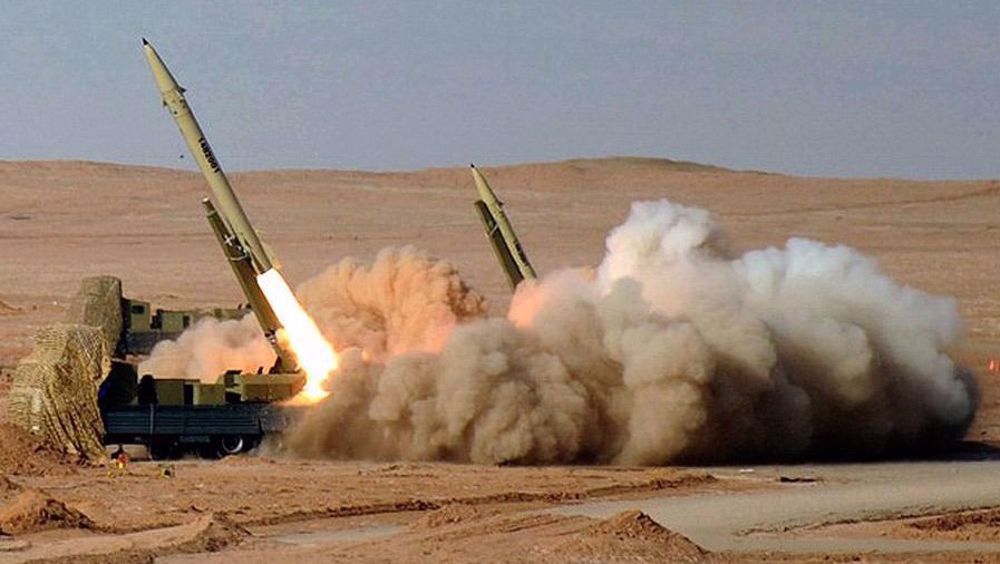
IRGC pounds US bases in Kuwait, Bahrain after drone attacks on Iranian territory

June 5: Iran slams US-Israeli 'nuclear terrorism' as warships are forced to retreat from Sea of Oman



US scrambles to replenish Reaper drones lost during war on Iran: Report
Israel would be in Beirut if it were not for Hezbollah: Iranian MP
Attacking army forces shows Israel’s hostility toward all of Lebanon: Iran
Iran urges UN to stop repeated US violations of ceasefire after attack on radar facilities
Negative views of Israel surge globally since war on Iran: Survey
The tide has turned: Iran’s strategic control of Strait of Hormuz crushes American naval supremacy
Hezbollah: Israeli attack on Lebanese army exposes Beirut's disregard for national sovereignty
Pakistan's interior minister to visit Tehran to push US-Iran mediation efforts





 PressTV NEWSLETTER now
  This makes it easy to access the Press TV website