Leader’s advisor warns against sacrificing Resistance for hollow promises

Ali Akbar Velayati, a senior advisor to the Leader of the Islamic Revolution, has warned against sacrificing the Resistance for hollow promises, saying sustainable peace grows from a balance of power rather than appeasing the enemy.
Velayati wrote in a post on his X account on Saturday that the “longstanding nightmare and historical fear of Western theorists regarding Iran’s rise to power has turned into reality, and a new geometry has taken shape.”
He added that the admission by Western media outlets Reuters and The Guardian of US President Donald Trump’s need for a temporary agreement to reopen the Strait of Hormuz indicates the “failure of the doctrine of threatening Iran” and the victory of the Resistance Front.
He maintained that an even greater strategic error is committed by those in the region who have taken comfort in the “mirage of compromise.”
“The new architecture of the balance of power will not be formed on the basis of weakening the heroic Resistance,” he said. “Diplomatic naivety carries a heavy cost, and sustainable peace grows from within a balance of power, not from the mirage of unsupported pledges.”
The criticism was apparently directed at Lebanese President Joseph Aoun, who has made numerous attempts at disarming the Hezbollah resistance movement based on the Israeli promise of halting attacks against his country.
In a CNN interview on Friday, Aoun also criticized Iran, claiming that the Islamic Republic is treating Lebanon as a “bargaining chip” in its talks with Washington.
Earlier on Saturday, Iranian Foreign Minister Abbas Araghchi sharply criticized Aoun’s claims about Tehran’s alleged influence in the Arab country, urging him to focus on Lebanon’s “real foe” rather than Iran.
It came in the wake of a US-brokered ceasefire agreement between the Lebanese government and the Tel Aviv regime.
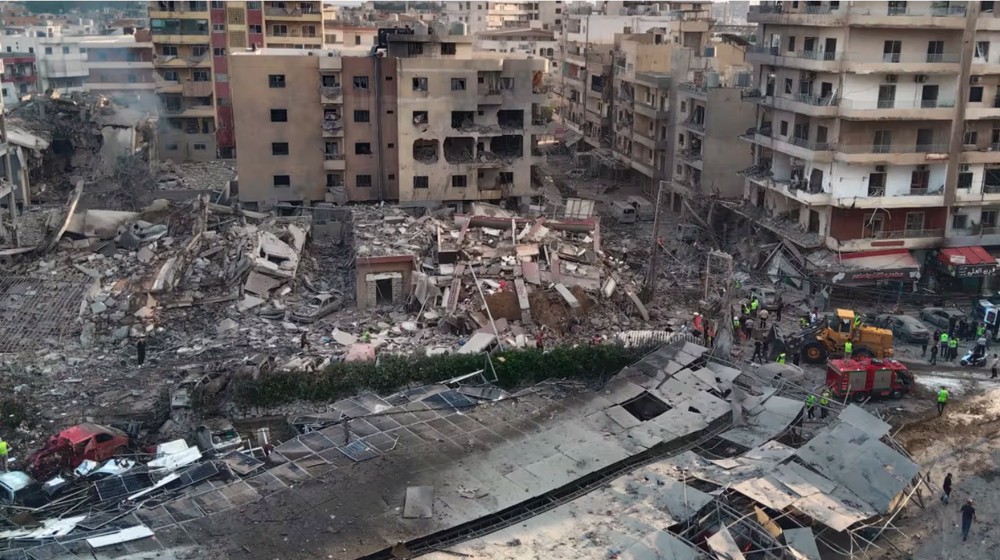
Despite the so-called ceasefire, Israeli aggression has continued unabated. The regime’s forces persist in bombing villages and towns across southern Lebanon, systematically destroying homes, public facilities, and civilian infrastructure.

Iran urges IAEA to avoid political pressure to be part of diplomatic solution

‘He sells out those who stand beside him’: Iran dismisses hostile remarks by Lebanon’s Aoun

Kuwait jails TV presenter for supporting Iran amid US-Israeli onslaught



Hamas condemns Israel’s ‘horrific massacre’ in Gaza City
Pakistan's interior minister visits Tehran to discuss Iran-US talks
Lebanese MP: Hezbollah has no direct contact with US
US-Israeli military aggression against Iran 'not a just war': Pope Leo
US scrambles to replenish Reaper drones lost during war on Iran: Report
Israel would be in Beirut if it were not for Hezbollah: Iranian MP
Attacking army forces shows Israel’s hostility toward all of Lebanon: Iran
Iran urges UN to stop repeated US violations of ceasefire after attack on radar facilities




 PressTV NEWSLETTER now
  This makes it easy to access the Press TV website