Iran says US talks focus on ending war, not Hormuz management or nuclear issue
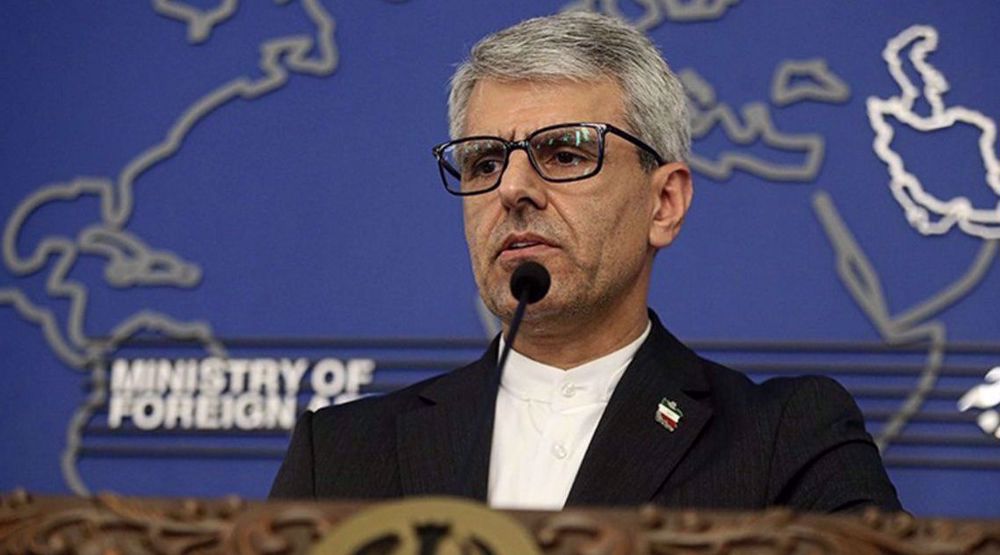
Iran's Foreign Ministry spokesman says the indirect talks with the United States are centered on ending aggression on all fronts and that the nuclear issue or the management of the Stratif of Hormuz are not part of the negotiations.
Speaking at his weekly press conference on Monday, Esmaeil Baghaei said, "The focus of the negotiations is on ending the war, and at this stage we are not discussing nuclear issues."
‼️The enemy's failure in the recent war against Iran rests on two fundamental miscalculations:
— Press TV 🔻 (@PressTV) May 24, 2026
1️⃣ It got drunk on its own crude propaganda
2️⃣ It consistently underestimated Iran's capabilities
Both were fatal errors that led to its strategic defeat.https://t.co/fKKeWo0SQH https://t.co/yaPgTToTkl
'Hormuz management not subject to negotiation'
The official also dismissed the notion that the issue of the Strait of Hormuz management was part of the negotiations.
"How this region should be managed concerns the littoral states," he asserted.
The spokesman said Iran and Oman were working on a mechanism to ensure safe transit through the Strait of Hormuz, which he described as a matter of global concern.
"We understand that the security of the Strait of Hormuz is a concern for the entire world," he said.
Baghaei added that Iran was "not seeking to impose tolls" in the strategic waterway, but noted that services and environmental protection measures naturally involve costs.
Responding to proposals by Britain and France regarding management of the Strait, he said, "No country other than Iran and Oman is present in the Strait of Hormuz. It is the responsibility of Iran and Oman to formulate the mechanism for safe transit."
Memorandum details
Baghaei said discussions linked to a 14-point memorandum of understanding would continue over a 60-day period, but reiterated that the current focus remains on ending the war.
Responding to reports about the contents of the potential memorandum of understanding, Baghaei said many of the reported details were "a combination of speculation."
The actual memorandum, he added, focuses on ending the war and ending the US's illegal naval blockade against the Islamic Republic, including Washington's efforts at complicating transit through the Strait of Hormuz.
The blockade "must stop," while Iran would adopt measures to ensure safe transit in the Strait of Hormuz, he noted.
'Agreement not imminent'
Baghaei said recent developments had followed weeks of negotiations conducted through Pakistani mediation, adding that understandings had been reached on many issues under discussion.
"It is true that we have reached understandings on many of the subjects under discussion, but no one can claim that the signing of an agreement is imminent," he said.
He also criticized the inconsistency in US policymaking, saying contradictory positions within short periods complicate negotiations.
'Iranians shattered aggressors' illusions': Iran FM spox invokes history amid prospect of MoU with UShttps://t.co/40TyZVxzAw
— Press TV 🔻 (@PressTV) May 24, 2026
'No timeline for finalizing agreement'
The official said no specific timetable has been set for finalizing the understanding.
"What matters to us is securing national interests, and whenever we reach a result, we will announce it," he said.
'No planned visits to Pakistan'
At the current stage, the official added, neither Iranian officials planned to visit Pakistan, nor Pakistani officials are scheduled to travel to Iran.
On Foreign Minister Abbas Araghchi’s planned trip to New York, Baghaei said the visit had been canceled because of visa-related issues.
Israel, regional tensions
He also said any agreement aimed at ending the war would include all fronts, including Lebanon, while warning that "one should expect nothing from Israel except the sabotage of any process."
The spokesman was referring to the Israeli regime's repeated attempts at sabotaging the potential of the realization of the ceasefire throughout the region, including through incessant violations against Lebanese sovereignty, as well as Tel Aviv's other attempts at derailing standing diplomatic processes.
Warning of stronger response
Commenting on the possibility of renewed aggression targeting the country, the spokesman said Iran will not rule out any option when it comes to defending itself.
He warned that Iran’s Armed Forces would respond "with greater intensity" to any future attack or mistake by adversaries.

Qalibaf re-elected as Iran’s Parliament speaker

Iran says 20 airports resume operations after US-Israeli aggression

Trump demands Arab states normalize with Israel in exchange for Iran ceasefire: Report



Iran clinches men's team title at 11th Asian Para Taekwondo Championships
Iran emerges as West Asia's organ transplant hub, turning adversity into hope for thousands
IRGC Navy says 32 ships have passed through Hormuz Strait in 24 hours
Millions of Hajj pilgrims flock to Mina ahead of Arafah
Iran names 2026 Asian Indoor and Martial Arts Games contingent after 'Martyred Leader'
Becoming strong not a slogan but a 'vital necessity': Leader's advisor
Zero-sum terminus: Iran’s path to ending war on its terms vs. America’s choice between bad and worse
Handala exposes identities of Israeli forces involved in Gaza flotilla attack





 PressTV NEWSLETTER now
  This makes it easy to access the Press TV website