For over 50 nights, Iranians have turned streets into another frontline against the enemy
By Humaira Ahad
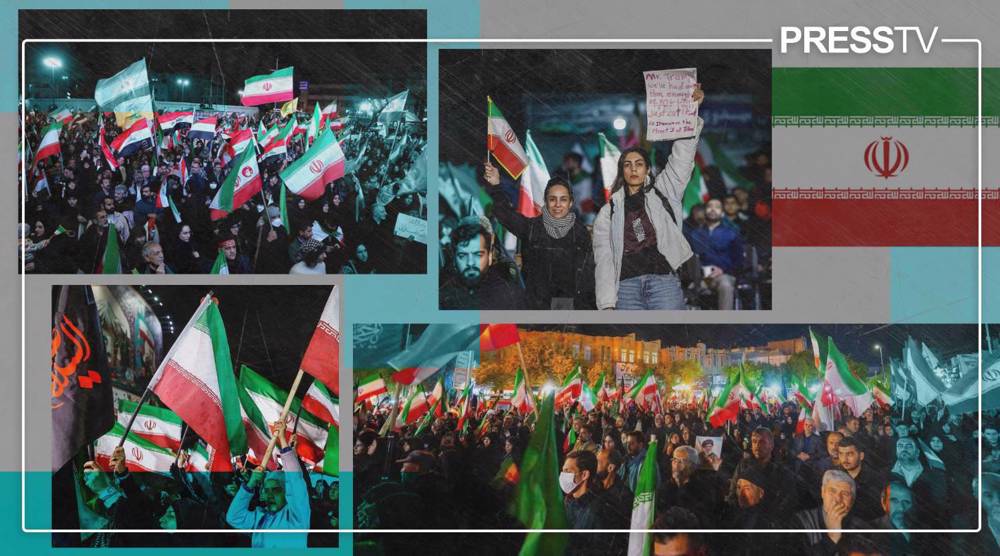
In Tehran, the streets begin to fill before the call to prayer has fully dissolved into the evening air. The first to arrive are families, parents walking with children, elderly men leaning slightly on canes, and teenagers carrying folded flags under their arms.
Across cities separated by hundreds of kilometres, Mashhad, Isfahan, Shiraz, Tabriz, the same movement unfolds with precision. People step into the streets and squares.
More than fifty days have passed since February 28, when the United States and Israel launched coordinated military aggression against Iran, assassinating the Leader of the Islamic Revolution alongside high-ranking officials and commanders.
Among those martyred were, most searingly, 168 elementary schoolchildren in Minab. This US-Israeli attack became a recurring reference point in the nightly gatherings that followed.
The total civilian death toll during the imposed war is reported to have reached 3,375.
During these gatherings, warplanes have been heard overhead. On some nights, residents described the ear-splitting sound of fighter jets carrying deadly munitions passing across the sky while gatherings continued below in the streets.
Under conditions that, in conventional military logic, would typically produce withdrawal, the pattern moved in a different direction. The expectation of fear and dispersal did not play out in the way outside observers often assume. Instead, people remained outside.
They gathered in squares and along main roads even as the sound of aircraft buzzed through the night. The response in these moments was chanting, often the repetition of religious phrases such as “God is great,” carried across crowds.
Since the early nights of US-Israeli aggression, this pattern has repeated. The streets fill, the gatherings hold, and then they disperse only to form again the following evening.
Some stay back the whole night, in the rain and cold, refusing to leave the streets, which have over the past several weeks become another frontline in this imposed war.
Iranian patriots in the western city of Ilam flood the streets for another night to express support for the government and armed forces.
— Press TV 🔻 (@PressTV) April 20, 2026
Follow: https://t.co/mLGcUTS2ei pic.twitter.com/qLAkQa1D79
A nation that does not empty its streets
In the early nights after US-Israeli strikes, the gatherings were read as mourning, black banners, Qur’anic recitations, portraits of the martyred Leader.
However, this changed as the days stretched into weeks and months, and the crowds multiplied. By the third week, the gatherings began to function as a distributed civic ritual, repeating nightly and structurally consistent.
In all districts, loudspeakers carried slogans, punctuated by prayers; shopkeepers closed early to join. In larger cities, entire neighbourhoods seemed to move outward at once.
There is a recurring habit in much external commentary to reduce public gatherings to a simple binary: either they are spontaneous, or they are organised from above.
In practice, that distinction becomes difficult to sustain when set against what is visible on the ground in Iranian cities since the start of US-Israeli aggression against the country.
Over the course of more than seven weeks, there has been no consistent evidence of a single, central call directing people into the streets on a nightly basis.
No fixed announcement that explains the timing or scale of the gatherings. People arrive at roughly the same hours, in the same public squares, often taking similar routes from surrounding neighbourhoods.
Families come together without visible instruction. Groups of young people appear in clusters, already oriented toward the same spaces as the night deepens.
In some areas, the movement into the streets has become so regular that it is now part of the city’s evening rhythm. It has almost become a part of everyday life.
This is not coordination in the institutional sense or improvisation. It works through repetition, shared expectation, and accumulated memory of previous nights.
From a distance, this can look like spontaneity. From outside Iran, it can appear structured. However, on the ground, it reads as a social behaviour that has stabilised through repetition.
“It is an unwritten understanding, a shared recognition that the street, in this moment, is not merely a space but a responsibility,” Nairay Lawasani told the Press TV website.
Before the ceasefire between Iran and the US, which came into effect on April 7, the nightly gatherings and the war itself continued in parallel, with airstrikes, retaliatory missile launches, casualty reports that moved through official channels and informal networks alike.
“The military aggression by the US and Israel, and the strikes on civilian buildings, increased my resolve to participate in the nightly gatherings,” 62-year-old Lawasani adds.
Staying at home, unable to directly confront the enemy, became increasingly difficult for her.
“After the martyrdom of the Leader, I felt my heart would burst. I had to go out, cry loudly, and give voice to my emotions. These gatherings saved me.”
Iranians take to public squares nationwide for 50th consecutive night in support of armed forces
— Press TV 🔻 (@PressTV) April 19, 2026
Follow https://t.co/B3zXG74hnU pic.twitter.com/PI8YI1jt4d
‘People do not come without reason’
Saeed Dehnavi, a political analyst based in Sistan and Baluchestan province of southeastern Iran, frames the gatherings as a continuation of an intellectual and religious tradition rather than an emotional reaction.
“People do not come into the streets without reason,” he was quoted as saying in a local Iranian media. “What we are witnessing is not impulse. It is awakening.”
He traces the concept back to discussions from 1973, when the martyred Leader of the Islamic Revolution, Ayatollah Seyyed Ali Khamenei, spoke about “baseth,” not simply as a prophetic mission, but as a universal condition, the moment when human conscience is stirred into action.
In Dehnavi’s reading, the current gatherings reflect precisely that process.
“Before the war, the phrase ‘God will awaken this nation’ was not fully understood,” he said. “But after the martyrdom of the Leader, what we saw was exactly that. An inner call. And the response to that call was not individual, it was collective.”
For Zahra Noorani, these nightly gatherings have served a similar role, prompting her to reflect on the meaning and direction of her life.
“I wasn’t a lot into religion. My life would revolve around hanging out with friends, scrolling on my phone, and just spending time in superficial things,” Noorani told the Press TV Website.
“The war has been a blessing in disguise for me. These gatherings have turned into a sacred ritual for me, where I have, for the first time, been able to ponder on the purpose of my life.”
Gatherings carry an external function
Analysts say apart from the national coherence the gatherings have created, they also carry an external function, one that becomes increasingly explicit as the war narrative expands beyond Iran’s borders.
Hamidreza Taheri, a political scientist and international relations analyst, described what he sees as a parallel information campaign accompanying the military confrontation.
“There is a deliberate effort by the Western media to construct the image of internal instability, to suggest that with the assassination of leadership, the system has lost legitimacy, that a divide exists between state and society,” he said.
In that context, he noted, the nightly gatherings operate as a counter-signal. Not just rhetorically, but visually.
“The presence of people in streets and squares, especially sustained over time, directly challenges that narrative,” Taheri said. “It complicates it. It makes it harder to sustain, and maybe it dashes it to the ground.”
The Iranian political scientist believes that the daily nightly gatherings across Iran are “not just about numbers but about repetition. One night can be dismissed. Fifty cannot.”
A group of Iranian mothers, along with their young children, joined a rally in support of the Iranian government and armed forces in the city of Qaem Shahr.
— Press TV 🔻 (@PressTV) April 18, 2026
Follow https://t.co/GKZwI4ePgj pic.twitter.com/Unf37xSfeS
Leader’s framing of public presence in wartime
This interpretation finds its clearest articulation in the statements issued by the Leader of the Islamic Revolution, Ayatollah Seyyed Mojtaba Khamenei.
Following the ceasefire, and on the fortieth day marking the martyrdom of Ayatollah Khamenei, the Leader said:
“It should not be assumed, by announcing negotiations with the enemy, that presence in the streets is no longer necessary. Rather, if it is assumed that the period of silence in the battlefield has temporarily arrived, the duty of all people who can attend public spaces, neighbourhoods, and mosques appears even heavier than before.”
The Leader’s statement linked public gatherings to outcomes beyond the streets themselves.
“Certainly, your chants in public squares influence the outcome of negotiations,” Ayatollah Khamenei stated.
In this framing, the street has come to play a central role in the imposed war against Iran, becoming the space where national cohesion in the face of external threats is made visible.
Flags appear frequently, with the Iranian flag a constant presence. In some gatherings, flags associated with resistance movements, particularly Palestine and Hezbollah, are also displayed, alongside banners carrying photographs of martyred military commanders and political leaders.
Slogans rise and fall in waves, often synchronised with moments when speakers or organisers address the crowd.
Among them, the constant are denunciations of the United States and the Israeli regime, and affirmations of national endurance.
But beneath the slogans is the collective visibility that is repeatedly emphasised in official commentary, where presence is presented as a deterrence in symbolic form.
Experts say the message, as articulated in multiple statements and analyses, is that a nation that fills its streets cannot easily be written off from the outside.
A huge crowd gathered in Tehran's Enghelab Square to show unwavering support for the government and armed forces.
— Press TV 🔻 (@PressTV) April 17, 2026
Follow https://t.co/GKZwI4ehqL pic.twitter.com/w5lJxrsgfi
Children, an inseparable part
Among the many moments that circulated through these nightly gatherings, one became widely repeated.
A young girl, her face painted with the colours of the Iranian flag, stood in one of the squares, requesting General Seyed Majid Mousavi, commander of the Islamic Revolution Guards Corps (IRGC) aerospace division.
“Hit Tel Aviv with a pink missile,” she said.
In the days that followed, IRGC personnel painted a missile pink and, in a symbolic gesture, dedicated it to her before its launch towards the Israeli-occupied territories.
The little Iranian girl, whose video asking an Iranian military commander to target Israel with a pink missile went viral, was seen in another video thanking the military commander for painting a missile pink before it was fired against Israel.
The phrasing stood out for its innocence. It carried the sense of a child absorbing adult language, war, missiles, targets, and reshaping it into something softer in form, almost surreal in its visual simplicity.
The “missile pink” phrase still circulates in retellings of the moment, and has become a symbolic fragment within a much larger and far more serious context.
The response from General Mousavi was a gentle acknowledgement of the child’s symbolic request, a gesture that recognised the presence of children within the national scene.
The moment also reflects the conditions under which children take part in prolonged public gatherings shaped by the imposed war.
Children have formed an inseparable part of these gatherings. Young kids standing with parents or moving in small groups through the edges of the gathering is a common sight.
They echo slogans they have clearly learned by heart, phrases that rise and fall with the cadence of the crowd, repeated again and again until they become part of the night’s soundscape and, in time, part of their memory.
According to Mahdi, father of a two-year-old, his son repeats the slogans at home, sometimes turning a broom into a makeshift microphone as he imitates the cadence of the crowd.
Thousands of Iranian patriots flood Tehran's Tajrish Sq. taking part in nationwide nightly rallies held in support of the Islamic Republic of Iran and the Iranian Armed Forces.
— Press TV 🔻 (@PressTV) April 16, 2026
Follow Press TV on Telegram: https://t.co/LWoNSpkc2J pic.twitter.com/qJiaylsvBf
“The slogans he hears at the gathering, my son repeats at home, sometimes even using a broom to mimic a mic,” Mahdi told the Press TV website.
“During this war, these nightly gatherings have become a space for him to express himself, and this love for Islam and Iran will stay with him and may govern his future choices.”
Children’s participation is evident throughout these public gatherings. Some hold small flags, others imitate the chants of adults with a precision that suggests familiarity.
For observers, this explains how political emotion is transmitted across generations during moments of national tension, thereby strengthening a nation's resolve. For others, it is evidence of family participation as a form of collective resistance.
However, the idea that streets become politically active during moments of national pressure is not new in Iran’s modern history.
Across earlier decades, from the Islamic Revolution and the Holy Defense war to the Tobacco Movement and the Constitutional Revolution, public space has repeatedly functioned as a site where political continuity is expressed through collective visibility.
In that sense, what is happening now is not an innovation but a continuation.
What sets the current moment apart, according to observers working within this framing, is its duration, the sustained repetition of nightly gatherings over an extended period without any visible breakdown in participation.
Each evening follows a familiar sequence: people arrive, clusters form, chants rise, and the crowds gradually disperse.
By the next night, the pattern begins again.

Iran’s Qamishloo-Dalankouh added to UNESCO Biosphere Reserve Network
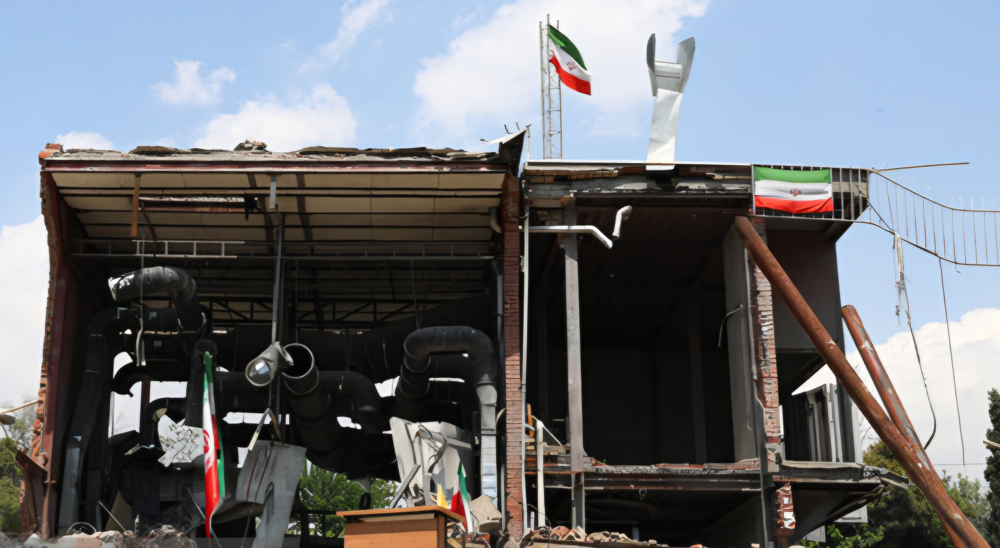
Iranian university to turn satellite facility destroyed in US-Israeli aggression into war museum

Miqan wetland nominated for Ramsar listing amid ecological recovery


Time for Lebanon to unite against Israel: Yemeni official
Hamas condemns Israel’s ‘horrific massacre’ in Gaza City
Pakistan's interior minister visits Tehran to discuss Iran-US talks
Lebanese MP: Hezbollah has no direct contact with US
US-Israeli military aggression against Iran 'not a just war': Pope Leo
US scrambles to replenish Reaper drones lost during war on Iran: Report
Israel would be in Beirut if it were not for Hezbollah: Iranian MP
Attacking army forces shows Israel’s hostility toward all of Lebanon: Iran





 PressTV NEWSLETTER now
  This makes it easy to access the Press TV website