Iran holds all the cards: Victorious on battlefield, united at home, and armed with strategic assets

By Press TV Strategic Analysis Desk
After the recent imposed war and its outcome, and with the bitter experience of previous rounds of talks between Tehran and Washington, Iran has made one thing abundantly clear this time: it will not negotiate at any cost.
As the definitive victor in the 40-day war of aggression, which was launched in the middle of nuclear talks, Tehran is now setting the terms, not the other way around.
The party requesting a ceasefire this time is not Iran. It is the United States.
After exhausting its 47-year-old arsenal of political and military options, Washington has failed to achieve any of its stated objectives. It has gained nothing. In fact, it has lost on both the military and diplomatic fronts. And it has lost the battle of narratives as well.
The Americans forfeited the right to transit the Strait of Hormuz – a right they possessed before their latest military adventure against Iran. They have lost leverage over global energy markets. They have lost their military bases across West Asia.
And perhaps most significantly, they have lost the last fragments of their hegemony.
The United States entered this war with lofty ambitions. It leaves with empty hands. That outcome is partly due to President Donald Trump's deeply flawed foreign policy priorities and miscalculations and partly due to the Zionist lobby's pressure on his administration.
As is now widely known, the "Israel First" policy has completely overshadowed "America First." The Trump administration has effectively declared itself in service to the largest American military outpost in West Asia – not to the American people.
The welfare of ordinary Americans ranks near the very bottom of this administration's agenda, more so than under any previous US administration in history.
That dynamic was on full display in Trump's social media post on Sunday. He lavished praise on the Israeli regime, calling it a "great ally" of the US – "whether people like it or not."
Trump knows Americans don't like it. That simply doesn't matter to him.
✍️ Analysis - Battlefield has spoken: Trump wants an off-ramp – concessions to Iran are the only way out
— Press TV 🔻 (@PressTV) April 19, 2026
By Press TV Strategic Analysis Deskhttps://t.co/FqoVcXvp8l
Iran: The victor that holds the upper hand
Despite the losses – both in terms of the leadership and infrastructure – Iran holds the upper hand in this war, which continues despite the smokescreen of the ceasefire.
The "regime change" fantasy, which has failed repeatedly over the past 47 years – including three times in the last year alone – was finally nipped in the bud during this war.
The martyred Leader of the Islamic Revolution's successor was elected by the Assembly of Experts in the middle of the war, despite the enemy’s attempt to bomb the gathering.
The martyred military commanders were also quickly and replaced. That is because the Islamic Republic of Iran does not depend on individuals. It depends on institutions, and the institutional framework remains untouched by assassinations.
The way Iran retaliated after the initial wave of aggression on February 28 demonstrated how the system only grows stronger and more resilient in the face of adversity. Iran not only punished the enemy – two major military powers – but forced them to seek a ceasefire.
Today, Tehran holds the initiative with full authority. It is a reality Washington refuses to fully acknowledge, even though it knows the ground realities all too well.
✍️ Viewpoint - A last-gasp bluff: Trump's 'naval blockade' threat proves US strategic defeat in West Asia
— Press TV 🔻 (@PressTV) April 16, 2026
By Mohammad Molaei https://t.co/SyU8tRpbkQ
Iran's growing power
It’s not just Iran’s significant and remarkable gains on the battlefield that have caught the attention of military and political pundits across the globe; the popular and spontaneous mobilization of people across the country has also sent a powerful message to the enemy.
For over 50 days, millions of Iranians have been taking to the streets daily and nightly in unwavering support of the Iranian armed forces and the country’s leadership. This level of sustained public solidarity has no parallel anywhere else in the world.
In the US, millions took to the streets to condemn Trump’s pro-war policies, while in the occupied territories, settlers are still refusing to leave their underground shelters.
Iran maintains – and now fully asserts – its undeniable sovereignty over the Strait of Hormuz, one of the world’s most strategic waterways, situated between the Persian Gulf and the Gulf of Oman, through which about 25 percent of global seaborne oil trade and 20 percent of global liquefied natural gas transits.
Before the 40-day war, it was free for all, including American vessels. But, as the Islamic Revolution Guards Corps (IRGC) Navy commander stated recently, it’s a “new order” in the strategic waterway now, and everyone is obliged to comply.
As American political scholar Robert Pape wrote in a recent New York Times article, Iran has emerged as one of the world’s great powers after this war. Its global and regional credibility has been enhanced, and it is now an architect of a new regional and global order.
The Iranian armed forces demonstrated their defensive and offensive power in this war with unmatched capabilities on multiple fronts. They showed how asymmetric warfare can decimate the most powerful militaries, even those with humongous military arsenals.
And unlike the US and its regional proxies, Iran still holds many unused leverage cards, assets that have not yet been played. So there are more surprises in the pipeline.
✍️ Analysis - Iran's new strategic posture ends win-win diplomacy, leaves US no choice but to concedehttps://t.co/wiDxjW9Hdp pic.twitter.com/xP86gVaY8A
— Press TV 🔻 (@PressTV) April 18, 2026
The logic of war: Winners set the conditions
The logic is simple and clear: the victorious party with the upper hand sets the conditions and defines the field. The defeated party comes to the table empty-handed, offering concessions, accepting terms, and begging for an off-ramp.
Iran understands this reality perfectly. It is the victor, both in strategic and military terms. Therefore, it will not – and should not – accept conditions from the losing side
In fact, Iran's only motivation for any future negotiation is to force the US to submit to its conditions for a final and permanent end to the war. Iran is not willing to simply extend the ceasefire and leave the window open for the aggressor. It wants the window shut.
This is why Tehran has shown no intention of hastily entering the next round of talks with the US, nor has it been swayed by American propaganda and media theatrics.
Strategic assets that are non-negotiable
Iran possesses three strategic assets that are the product of 47 years of hard work, sacrifice, and resistance to the economic and military wars imposed on the Islamic Republic.
These include nuclear capability, defensive and missile power, and regional allies across the resistance front – Lebanon, Iraq, Yemen, and beyond.
Iran has paid a heavy price for these assets through multiple imposed wars, engineered riots, economic strangulation via sanctions, and the sacred blood of its scientists.
So, Tehran is not ready to discuss these issues, let alone make concessions.
The nuclear file is effectively closed. Iran's nuclear capability is the fruit of decades of tireless effort, sacrifice, and the lives of the country's devoted scientists. It is the foundation for national progress and prosperity through the peaceful benefits of nuclear technology.
The martyred Leader of the Islamic Revolution, in remarks on September 22 last year, said the remedy for the country's progress is to become strong. And this strength comes from its knowledge, including achievements in the scientific and nuclear fields.
In remarks on May 20 last year, Ayatollah Khamenei said that for the enemy to claim, “We won’t allow Iran to enrich uranium,” is “utter nonsense.”
“We aren’t waiting for anyone’s permission. The Islamic Republic has certain policies and approaches, and it will pursue its own policy,” he declared in clear and categorical terms.
So, naturally, the Islamic Republic of Iran will not bargain over this national treasure.
All previous nuclear negotiations have led only to the stripping of Iran's inalienable rights, followed by more imposed wars, more sanctions, and more pressure.
Iran has learned its lessons. It will not put its hand back into a hole from which it has been bitten repeatedly. The nuclear issue has been removed from the negotiating table entirely.
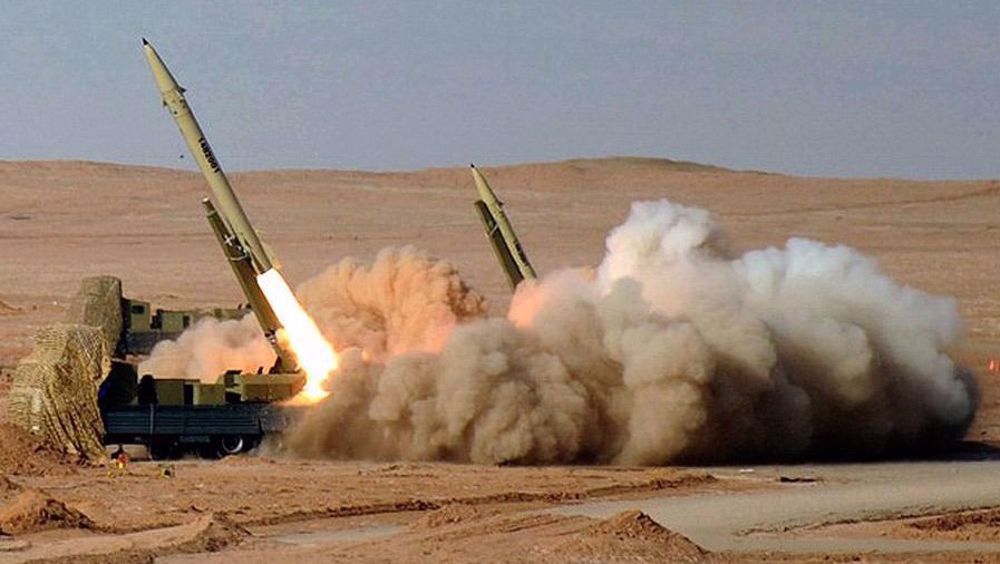
The issue of defensive power and ballistic missiles is also non-negotiable, as Iranian negotiators have repeatedly stated over the years. As the martyred Leader said on October 19 last year, these missiles are the "identity card of Iranian youth."
The question of regional alliances is likewise not up for discussion. Iran will continue to support its allies in the Axis of Resistance, from Lebanon to Iraq to Yemen and beyond. It will continue to support the people of these countries as they defend their rights.
✍️ Viewpoint - End of American exceptionalism: How MAGA foreign policy collided with reality in war on Iran
— Press TV 🔻 (@PressTV) April 13, 2026
By Y. P. Rāzihttps://t.co/HDJ291jlIS pic.twitter.com/q2MgLy4jGI
The home front: A government and the united people
Behind Iran's battlefield strength lies a resilient home front. The government's dedicated, tireless efforts to meet the people's livelihood needs have been highly commendable.
Provincial visits by President Masoud Pezeshkian and his ministers – conducted amidst war and bombings – have been crucial in addressing and resolving the issues people face.
The round-the-clock work of all ministers and all government departments has been equally noteworthy. Each has managed their portfolio with indefatigable efforts, often risking their own safety and security to ensure the job is done.
These efforts complement the steadfastness of the armed forces on the battlefield and the resilience of the loyal Iranian people in the streets, around the clock.
And when the war ends, it will be the same people – with their unique capacities and unmatched popular strength – who will run the country and help it make progress across different fields and defeat all plots and conspiracies against the country’s progress.

The tide has turned: Iran’s strategic control of Strait of Hormuz crushes American naval supremacy

From manufacturing consent to masking defeat: 'Iran Intl.' in service of US-Israeli war machine
IRGC pounds US bases in Kuwait, Bahrain after drone attacks on Iranian territory



Time for Lebanon to unite against Israel: Yemeni official
Hamas condemns Israel’s ‘horrific massacre’ in Gaza City
Pakistan's interior minister visits Tehran to discuss Iran-US talks
Lebanese MP: Hezbollah has no direct contact with US
US-Israeli military aggression against Iran 'not a just war': Pope Leo
US scrambles to replenish Reaper drones lost during war on Iran: Report
Israel would be in Beirut if it were not for Hezbollah: Iranian MP
Attacking army forces shows Israel’s hostility toward all of Lebanon: Iran





 PressTV NEWSLETTER now
  This makes it easy to access the Press TV website