Russia, China lambast adoption of unilateral resolution against Iran at UNSC amid US-Israeli aggression
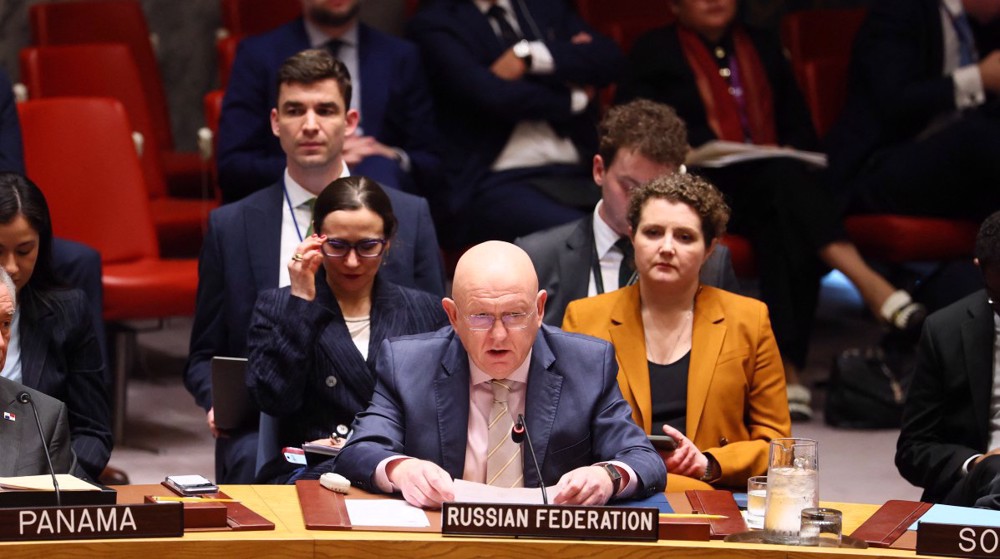
Russia and China have lambasted the adoption of a unilateral resolution against Iran at the United Nations Security Council, as an unprovoked war of aggression by a US-Israeli military coalition on the Islamic Republic enters its 13th day.
The United Nations Security Council on Wednesday adopted a draft resolution by Bahrain, representing the Persian Gulf Cooperation Council (GCC), which condemned Iran’s retaliatory missile and drone attacks on US military bases in Jordan and the Arab states of the Persian Gulf, demanding that Tehran immediately halt such aerial attacks.
Thirteen members of the UNSC voted in favor while the two remaining members – Russia and China – abstained.
The United States and Israel launched a war against Iran on February 28, assassinating Leader of the Islamic Revolution Ayatollah Seyyed Ali Khamenei and top military commanders, while Washington and Tehran were involved in indirect nuclear negotiations.
The aggressors have also killed more than 1,300 civilians, including children, and attacked non-military sites, among them schools and hospitals.
Iran’s retaliatory attacks have successfully targeted many locations in the Israeli-occupied territories, insisting that it has exercised restraint since the onset of the imposed war by limiting its attacks to US military bases and assets particularly in the Arab States of the Persian Gulf.
During the UNSC session on Wednesday, Russian Ambassador to the UN Vasily Nebenzya said that a UNSC resolution condemning the Islamic Republic would not help bring peace to West Asia.
“The adopted resolution is incapable of achieving peace in [West Asia]. It will only exacerbate disagreements between key players in the region,” Nebenzya told the council, arguing that the document ignores the “unprovoked” nature of the ongoing “aggression” by the US and Israel.
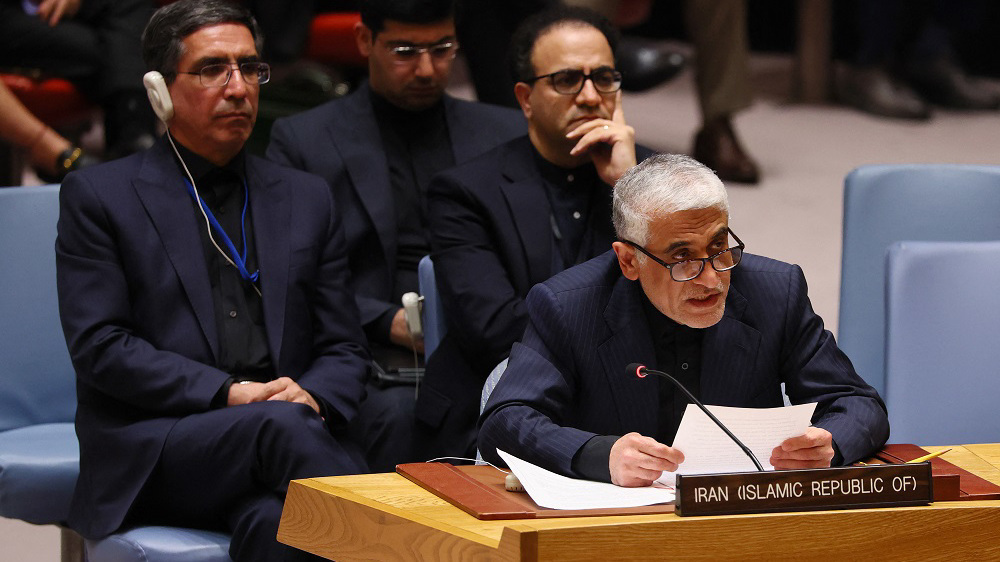
“A positive decision by the council on this document could be interpreted by unscrupulous players, and above all by those who unleashed this war, as a ‘blessing’ for continued aggressive actions against Iran,” the Russian envoy stressed.
Nebenzya further emphasized that the so-called resolution disrupts the relation between cause and effect so much so that if one who is not familiar enough with international affairs reads the document, he may wrongly believe that Tehran, on its own initiative and out of hostility, has launched unprovoked attacks against its Arab neighbors.
China’s Ambassador to the UN Zhang Jun also told the council that the conflict had “neither legitimacy nor legal basis” and that the US and Israel must halt their attacks to prevent further deterioration of the regional situation.
Both Nebenzya and Zhang stressed that they tried to convince Bahrain and the US to add a part to the draft specifying the US and Israel as those that waged the war, but all to no avail.
Earlier on Wednesday, Iranian President Masoud Pezeshkian, during a telephone conversation with Pakistan’s Prime Minister Shahbaz Sharif, emphasized that “Only bases from which attacks are launched against our soil will be targeted, within the framework of legitimate self-defense.”

China warns Israel against obstructing Iran-US understanding

China backs Iran-US MoU, offers to help facilitate implementation

Iran, China will be at heart of any emerging regional bloc: Qalibaf


Iran condemns French FM's meddlesome remarks as 'height of hypocrisy, duplicity'
US emerged from war ‘desperate, defeated': Leader's advisor
US intl. warns: Netanyahu may sabotage Iran-US MoU to prolong aggression
‘Hand on trigger’: Army stresses readiness to defend Iran against any violation
Key Parliament commission hails Leader’s MoU message, says continued victories hinges on unity
UK PM advised to prepare for 'dignified, orderly exit'
UNICEF: Ceasefire in besieged Gaza is a ‘deadly illusion’ for Palestinian children
Iran rules out IAEA inspections of war-damaged nuclear sites


 PressTV NEWSLETTER now
  This makes it easy to access the Press TV website