Iran welcomes, awaits US escort of oil tankers through Strait of Hormuz: IRGC spox

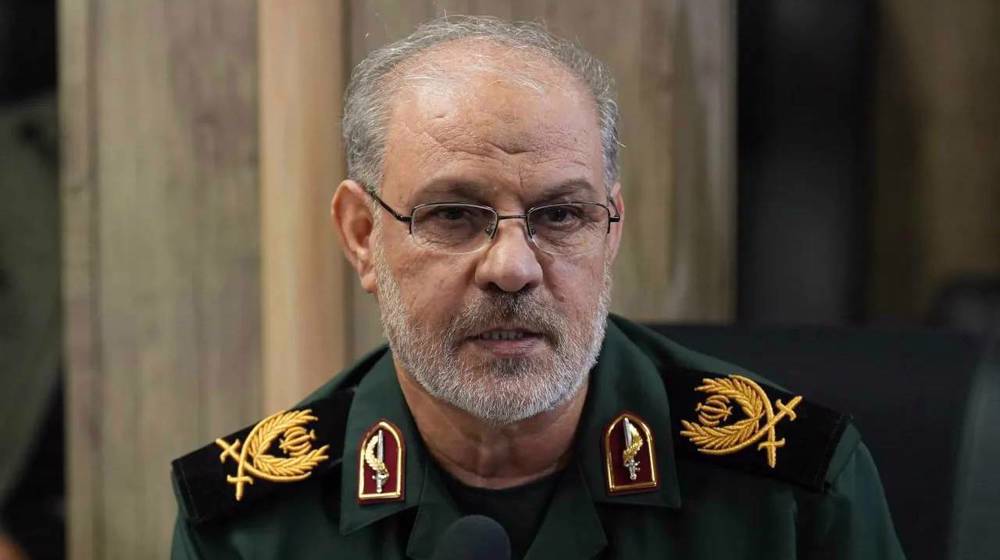
Iran strongly welcomes the escorting of oil tankers and the claimed presence of US forces to ensure passage through the Strait of Hormuz, a spokesperson for the Islamic Revolution Guards Corps (IRGC) has said.
Brigadier General Ali Mohammad Naeini made the remarks on Thursday, responding to recent statements by the US president and the White House spokesperson.
“Iran strongly welcomes the escorting of oil tankers and the claimed presence of US forces to facilitate passage through the Strait of Hormuz,” he remarked.
“In fact, we are awaiting their arrival.”
Brigadier General Naeini further said Iran recommends that before taking such a decision, Americans recall the incident in 1987 when the American supertanker Bridgeton struck a mine and caught fire, as well as tankers that have been targeted recently.
US President Donald Trump said on Thursday that the US Navy will escort tankers through the Strait of Hormuz if necessary to help restore the flow of oil exports amid heightened regional tensions sparked by the US-Israeli war of aggression against Iran.
He even offered political risk insurance for oil and gas tankers transiting the Strait of Hormuz to help ease rapidly surging energy prices amid the war against Iran.
“Effective IMMEDIATELY, I have ordered the United States Development Finance Corporation (DFC) to provide, at a very reasonable price, political risk insurance and guarantees for the Financial Security of ALL Maritime Trade, especially Energy, traveling through the Gulf,” Trump wrote in a social media post.
“This will be available to all Shipping Lines. If necessary, the United States Navy will begin escorting tankers through the Strait of Hormuz as soon as possible.”
🔺IRGC Spokesman: Iran strongly welcomes the escort of oil tankers and the claim of a US military presence to transit the Strait of Hormuz; in fact, we are waiting for their presence. pic.twitter.com/2YDa12C5AT
— Press TV 🔻 (@PressTV) March 6, 2026
With hundreds of vessels currently stranded in the Persian Gulf, analysts wonder whether the US has sufficient naval assets in the region to ensure their safe passage at a time when the Iranian Navy has asserted its complete dominance in the regional waters.
Iran has not yet closed the strategic waterway lying between the Persian Gulf and the Gulf of Oman, but has targeted some oil tankers affiliated with the US and the Israeli regime.
The US and the Israeli regime launched an unprovoked military aggression against the Islamic Republic of Iran on Saturday, which led to the assassination of the Leader of the Islamic Revolution, Ayatollah Seyyed Ali Khamenei, and some top-ranking military commanders.
The aggression came in the middle of nuclear talks between Tehran and Washington mediated by the Omani government and was widely condemned.
In response, Iranian armed forces have carried out multiple waves of retaliatory operations against the Israeli military sites deep inside the occupied territories as well as US military bases across the region using advanced missiles and drones.
According to media reports, US oil prices have jumped 28 percent this week to top $86 a barrel following Iranian retaliatory strikes on oil tankers affiliated with the US and the Israeli regime that have brought ship traffic through the Strait of Hormuz to a near standstill.
The narrow waterway serves as the only maritime passage in and out of the Persian Gulf.
Iran’s Islamic Revolution Guard Corps launched military drills in which the IRGC’s naval forces exercised control over the strategic Strait of Hormuz.
— Press TV 🔻 (@PressTV) February 16, 2026
Follow: https://t.co/mLGcUTSA3Q pic.twitter.com/IJIX9AQtIY
According to energy consulting firm Kpler, more than 14 million barrels of crude passed through it daily in 2025, accounting for roughly one-third of all oil exported by ship worldwide.
Earlier on Thursday, in a TV interview, Brigadier General Abolfazl Shekarchi, spokesperson for the Iranian armed forces, affirmed that Iran has not closed the Strait of Hormuz.
He said Iranian naval forces will not prevent any ship from passing through the strategic waterway, but those affiliated with the US and the Israeli regime “will definitely be struck.”
IRGC on Monday said two Iranian drones hit a US-allied Athens Nova fuel tanker, setting it ablaze in the waters of the Strait of Hormuz in response to the US-Israeli aggression.
The Trump administration has refused to comment on when the Strait of Hormuz will be safe for commercial shipping again, with White House press secretary Karoline Leavitt giving vague answers to questions from reporters on Wednesday.
“I don’t want to commit to a timeline, but certainly it’s something that is being calculated actively by both the Department of War and the Department of Energy,” she said.
Tensions at sea have further escalated after the US Navy attacked an Iranian warship in international waters near Sri Lanka on Thursday, in a cowardly act of terrorism.
The frigate Dena was en route to Iran after taking part in a naval exercise in India on the invitation of the Indian government when the incident occurred.

Iran marks 39th anniversary of Sardasht chemical massacre, demands accountability from Western enabl
Mission unaccomplished – Part V: US war goal of Iran’s 'zero enrichment' produces zero results
IRGC warns of stronger response to any US-Israeli ceasefire violations



President Pezeshkian says Iran will stand by deal only if US does
Mission unaccomplished – Part VI: US sought Iran’s surrender but got a new regional superpower
Tensions flare in Washington as Vance, Rubio clash over Persian Gulf policy, 2028 ambitions: Report
Oman backs Iran’s plan to charge Strait of Hormuz ‘service fees’
Iran says talks with US contingent on implementation of key MoU provisions
Child among 3 killed after Israel bombs tent in central Gaza
Iran says only it can demine Strait of Hormuz under MoU with US
Advanced lymphoma treatment technology under development at Iran's Royan Institute


 PressTV NEWSLETTER now
  This makes it easy to access the Press TV website