US, Israel begin another foolhardy military adventure, but it’s Iran that will end it
By Mohammad Molaei
In its long history of strategic miscalculations around the world, few of Washington’s errors have proven as persistent as its policy toward the Islamic Republic of Iran and its defense doctrine.
American policymakers, military planners, and intelligence analysts have repeatedly interpreted Iran’s restrained, calibrated, and often indirect responses to provocations as evidence of weakness, seeing them as proof that coercive pressure works.
This American conventional wisdom is not merely incorrect; it is highly dangerous. The deep-rooted misconception, along with the foolish belief that Tehran ultimately lacks the stomach for direct, large-scale military confrontations, has driven Washington toward an extremely irrational and potentially disastrous path with far-reaching regional and international consequences.
We saw it in June last year and we saw it again on Saturday – both happening in the middle of nuclear negotiations mediated by an Arab country seen as friendly by Washington.
Although Iranian strategic culture has not historically favored overdramatic, immediate retaliation in the Western sense, Iran is far from a passive actor. It has built a multi-layered, resilient, and formidable response architecture designed to inflict unacceptable costs on any aggressor.
By subscribing to the Zionist-sponsored view of supposed Iranian weakness and a “Window of Opportunity,” the US underestimated the resolve of a nation facing an existential threat and the sophistication of a defense doctrine that has been refined over four decades to withstand and cripple the world’s most powerful military.
The strong Iranian response following the unprovoked and illegal American-Israeli aggression on Saturday has again established the fact that Iran is a formidable military power that is capable of defending itself against any form of aggression single-handedly.
If the Israeli-American aggression continues, Iran has several options at its disposal to force the aggressors into submission, like during the 12-day war in June last year.
Tier one: Deniable and sub-threshold responses
At the lowest rung of Iran’s escalation ladder sit options that are deliberately designed to fall below the threshold of a full-blown military engagement. The initial wave of Iranian retaliation has focused on providing plausible deniability while imposing immediate, meaningful, and sustained political and economic costs, signaling resolve without triggering full-scale war.
These options leverage Iran’s extensive network of partnerships across the region as well as its advanced non-kinetic capabilities.
If the enemy escalates, Iran can tap into asymmetric, electronic, or digital domains. In addition to deterring follow-up escalatory actions, such moves can even continue after a cessation of hostilities should any future war evolve into a multi-stage confrontation.
▶️Video shows an Iranian drone scoring a direct hit on a radar installation at the U.S. Naval Base in Bahrain, completely destroying the target.
— Press TV 🔻 (@PressTV) February 28, 2026
Follow https://t.co/B3zXG73Jym pic.twitter.com/IZL9fAlXUb
Low-level maritime and regional escalations
Intense electronic warfare and navigational jamming across the Persian Gulf, and the imposition of other limitations on maritime energy routes within the region that fall short of fully blocking the Strait of Hormuz, could constitute a low-level Iranian response if the aggressors don’t step back.
Iran’s partners in the Axis of Resistance have already stated that they would not remain on the sidelines of any war, as they did during the 12-Day War. Thus, maritime actions could simultaneously extend to the Red Sea and Bab el-Mandeb, signaling that the escalation can disrupt global trade even beyond the Strait of Hormuz.
Iran could also seize or begin regularly inspecting tankers in the Persian Gulf on lawful grounds. Such actions would result in significant spikes in insurance premiums and hydrocarbon shipping costs, demonstrating a glimpse of the global economic consequences of attacking Iran while increasing political pressure on its adversaries.
We saw large-scale retaliatory attacks on US military bases and assets in the West Asia region on Saturday. More sophisticated attacks could target US convoys or logistics nodes. The goal at this stage is not to inflict maximum casualties but to increase the political cost of the US presence and military buildup.
These actions would allow Iran to tie down adversary resources and maintain pressure across multiple theaters simultaneously, stretching US forces thin while reinforcing the message that attacking Iran only brings violence to the aggressors through unpredictable pathways.
Cyber operations
Tehran has developed one of the world’s most capable cyber and electronic warfare apparatuses. Iran’s cyber forces will most likely target several categories of systems.
Critical infrastructure in the United States, Israeli-occupied territories, and countries hosting the US bases represent the primary target set. More sophisticated variants of such attacks could target the industrial control systems governing oil and gas production and export infrastructure throughout the region, should Iran decide to tighten its grip on the flow of energy out of the region.
Military networks represent a second target category. Iran’s cyber forces would seek to degrade communications systems (C4ISR), logistics, and command-and-control systems supporting US military operations in the region.
IRGC Navy pounds US MST ship with a volley of missiles after Israeli-US aggressionhttps://t.co/kd3nDzTkgk
— Press TV 🔻 (@PressTV) February 28, 2026
Tier two: Regional escalation and direct kinetic strikes
Should tier one responses prove insufficient to deter further aggression, Iran possesses both the capability and the will to escalate to direct, attributable kinetic strikes.
The next stage of the escalation spectrum would represent a low-intensity confrontation and a significant proliferation of the war across the region, opening multiple simultaneous fronts and exhausting Israeli and American military resources.
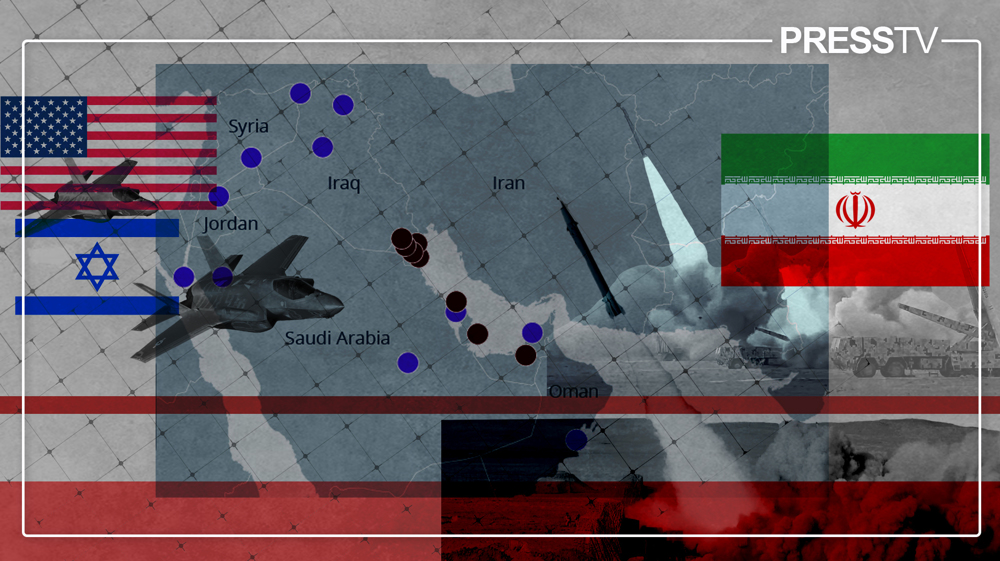
The Islamic Revolution Guards Corps (IRGC) carried out massive missile strikes against major US military installations across the region on Saturday. Al-Udeid Air Base (Qatar), Al-Dhafra Air Base (UAE), Ali Al Salem Air Base (Kuwait), Prince Sultan Air Base (Saudi Arabia), Muwaffaq Salti Air Base (Jordan), and facilities in Bahrain were the primary targets.
Systems such as the Fajr family, operated by the ground forces of the IRGC and the Iranian Army, could easily be utilized to put further pressure on American targets south of the Persian Gulf and deplete preciously limited defensive missile stockpiles.
It must be noted that, unlike the occupied territories during the 12-Day War, American bases across the Persian Gulf region do not benefit from the defensive shield provided by American ship-based Aegis systems and their Standard missiles. This lack of seaborne air defenses, coupled with the much shorter response times inherent in short-range attacks, has left American bases in a precarious defensive position against mass attacks by projectiles with ballistic trajectories.
Many areas in the occupied territories also came under the barrage of Iranian missiles and drones on Saturday and these strikes are likely to continue in the coming days. In all likelihood, Israel has not meaningfully replenished its Arrow-2 and Arrow-3 interceptor stockpiles since the 12-Day War of June 2025. Those stocks were drawn down significantly during that war, and the industrial timelines for producing Arrow-3 interceptors make rapid replenishment implausible within months.
In the coming days, Iran would almost certainly exploit this by deploying more advanced members of the Fateh ballistic missile family, such as the Kheibar Shekan 1 and 2, which have demonstrated their capability to evade American and Israeli defenses, as seen in the attack on the Haifa refinery.
Given the existential nature of a large-scale war involving direct strikes on Iranian infrastructure or leadership, Iran has every incentive to deploy its most capable systems rather than conserving them, as it did during the 12-Day War.
UAV and cruise missile saturation
Iran would, of course, simultaneously utilize its extensive cruise missile, loitering munition, and one-way attack drone arsenal. During the 12-Day War, Iranian drones largely followed anticipated corridors from Iranian territory toward the Israeli-occupied territories, allowing interceptors to manage their engagements with reasonable predictability.
The goal then was essentially to tie down enemy aircraft with kamikaze drones to free up attack windows for ballistic missile launchers. A broader retaliatory campaign eliminates that predictability entirely. Drones launched simultaneously at various geographically diverse targets represent a multi-azimuth threat that is significantly different from a single-axis attack.
Defense systems optimized for a known threat axis, such as radar orientations, interceptor positioning, and early warning timelines, will perform significantly worse when the same volume of threats arrives from four or five directions simultaneously.
The implication is that even a limited Iranian strike using only a fraction of the available arsenal could achieve devastating penetration rates and target coverage, while tying down aircraft in interception missions and thus reducing possible air-to-ground strike capacities.
Iran’s retaliatory attacks will continue uninterruptedly: Senior commanderhttps://t.co/2FfXtu816m
— Press TV 🔻 (@PressTV) February 28, 2026
Naval control and carrier strike group denial
The United States boasts the most powerful navy on the planet, a force that cannot be conventionally matched in a classic naval engagement.
Iran has never had any delusions about this fact and has built a sophisticated naval doctrine centered around sea denial through simultaneous, mutually reinforcing threats designed to force the US Navy to operate at standoff distances that degrade its effectiveness, while Iranian light forces and submarines contest control of the shallow Persian Gulf waters.
Iran has invested heavily in land-launched anti-ship missile systems, including specialized Fateh family members such as the Hormuz, C-802 derivatives and domestic KH-55 cruise missile variants capable of engaging naval targets at ranges up to 1,000 kilometers.
Critically, some of these systems can be deployed and operated from mountainous terrain in central Iran, making them extremely difficult to locate and suppress without a sustained, long-term, and costly deep-strike campaign against hardened inland positions.
Launching anti-ship missiles from the Zagros mountain ranges and Iran’s elevated interior will allow these systems to threaten targets across the Persian Gulf, the Gulf of Oman, and into the Arabian Sea while remaining outside the effective engagement range of most weapons.
A US strike group attempting to operate within strike range of Iranian territory must manage the threat of anti-ship missiles arriving from inland positions that it cannot easily neutralize.
The primary objective of these missile attacks would be to force American ships to remain at extended distances, which would meaningfully reduce the operational capability of carrier air wing strikes, shrink the coverage envelope of escort vessels, and increase the complexity of sustained air operations against Iranian targets.
Another dimension of Iran’s naval response would be the IRGC’s fleet of fast attack craft, which represents a genuine area-denial mechanism. Operating in coordinated swarms, these vessels can mass rapidly and execute hit-and-run attacks before an effective response can be organized.
The Strait of Hormuz and the northern Persian Gulf particularly favor this approach, where geographic compression neutralizes some of the technological advantages of the United States.
Iran’s submarine fleet, consisting of Kilo-class boats and its domestically produced Fateh and Ghadir midget submarines, contributes differently. In the shallow Persian Gulf environment, submarine detection is genuinely difficult. The primary operational value of large-scale submarine deployment would be persistent uncertainty. The United States would be forced to allocate significant anti-submarine warfare resources to a threat it cannot confidently locate, degrading the attention and assets available for offensive operations.
Regional escalation
Leader of the Islamic Revolution Ayatollah Seyyed Ali Khamenei had previously warned that any direct military strike on Iran would not remain a bilateral confrontation. His framing was clear: an attack on Iran will draw in the Axis of Resistance, transforming a localized war into a regional war across multiple fronts.
Iraqi resistance faction leadership has been explicit in echoing this posture, with commanders from Kataib Hezbollah publicly stating their readiness to enter any war involving a direct strike on Iranian territory. They reiterated it on Saturday, vowing to target US bases in the region.
The operational question is not whether these groups would act, but how they would calibrate their initial entry to maximize pressure while preserving escalation options.
Yemen’s Ansarullah movement could also directly enter the fray with a demonstrated operational record. A limited entry would likely begin with an intensification of Red Sea interdiction, targeting US naval assets and commercial shipping with anti-ship missiles and drone swarms. Yemeni performance throughout 2024 established that their systems can complicate naval operations even against defended targets.
More significantly, Camp Lemonnier in Djibouti, the primary US military base in the Horn of Africa and a critical logistics node for regional operations, sits within range of Ansarullah missiles. An attack on Lemonnier would represent a genuine strategic disruption, threatening the UAV and ISR operations that US Central Command would depend on to conduct its campaign.
Ansarullah strikes on Israeli-controlled territories, already conducted during previous escalation cycles, could resume with even greater intensity, forcing the regime to split its air defense allocation across a southern axis simultaneously with Iranian and potential Lebanese threats.
Unlike Yemen, Iraqi resistance groups operate from territory that places US forces in Iraq, Jordan, and Syria under direct, short-range threat. Once again, this would eliminate the flight time and detection windows that give air defenses meaningful response times.
Jordan and Syria are particularly exposed. US facilities in Jordan, including Muwaffaq Salti, sit within range of Iraqi faction drone and rocket arsenals. Critically, several Iraqi factions are known to possess short-range ballistic missiles as well. A coordinated attack combining ballistic missiles with drone saturation against Jordanian and Syrian-based US assets would challenge defenses that were never designed for simultaneous multi-vector engagement.
A full-scale Hezbollah engagement is unlikely in the opening phase. Instead, Hezbollah’s contribution would more likely involve deploying its guided munitions against high-value targets rather than conducting mass rocket fire. Even a limited Hezbollah action would lead Israel to reactivate its northern defensive posture, consuming interceptor stocks and military attention at precisely the moment Israeli defenses are managing Iranian ballistic missiles and Houthi strikes.
IRGC pounds US bases across West Asia following US, Israeli aggressionhttps://t.co/ydLc9LpgIO
— Press TV 🔻 (@PressTV) February 28, 2026
Tier three: All-out regional war and closing the Strait of Hormuz
A full-scale war between Iran and a combined US-Israeli coalition would shatter any previous precedent entirely. Iran’s total ballistic and cruise missile inventory, combined with its vast drone arsenal, represents a destructive capacity that would overwhelm any regional air defense architecture through sheer mass.
The October 2024 strikes and the 12-Day War both involved Iran deploying carefully selected portions of its capability under conditions of deliberate self-restraint. In an existential conflict with no remaining diplomatic pathway, that restraint disappears entirely.
In an all-out war, Iran would have both the capability and the strategic imperative to close the Strait of Hormuz. Using a combination of extensive minefields, shore-based anti-ship missile coverage, and fast attack craft, Iran would make any unauthorized transit a legitimate target of missile, torpedo, and swarm attacks.
Approximately 20 to 25 percent of the world’s oil supply and a significant portion of global LNG exports transit the strategic Strait. A sustained, multi-month blockade would trigger immediate global energy price spikes and supply chain disruptions on a scale not seen since the 1970s oil crisis. Such a development could potentially impose economic damage on the global economy measured in trillions of dollars.
Iran’s capacity to substantially disrupt the Strait transits rests on several systems. It possesses thousands of naval mines of various types, including sophisticated bottom mines, which could render the Strait’s navigable channels hazardous to commercial shipping almost immediately.
Even if the United States manages to suppress Iranian anti-ship systems, submarines, and fast attack craft following a lengthy and costly aerial campaign, clearing a mined strait is a slow, dangerous, and technically demanding operation.
Even a partial minefield would drive insurance rates to prohibitive levels and deter commercial transit. The critical constraint on this option is that Iran’s own oil exports would be halted by a Strait closure as well. For this reason, Iran has historically treated the Strait closure option as a last resort. However, a last resort would seem exceedingly logical in response to strikes that aim to threaten the survival of the Iranian state and its people.
A Region in Flame
In addition to the Strait of Strait closure, a full-scale war would place extraordinary pressure on the world’s most concentrated energy infrastructure system. The 2019 Abqaiq incident, at the height of the Saudi invasion of Yemen, demonstrated that a single event can temporarily remove a significant fraction of global oil supply within minutes.
A sustained, large-scale war across the region creates conditions in which infrastructure across the Persian Gulf, including oil facilities, LNG terminals, desalination plants, and port facilities, faces a serious risk of damage with cascading consequences for global markets that no single government could fully manage.
An all-out war could remove the tactical calculus constraining actors within the Axis of Resistance.
Hezbollah could commit its full arsenal to systematically exhausting Israeli interceptor stocks. Iraqi resistance factions could shift from low-key warfare to sustained interdiction of US logistics and basing. Ansarullah could escalate to maximum intensity across Red Sea, Arabian Sea, and Persian Gulf targets. The compounding effect of simultaneous full-intensity operations across all fronts would potentially create a regional war that no single military could manage at once.
Israelis take shelter amid Iran's retaliatory strikes against occupied territories
— Press TV 🔻 (@PressTV) February 28, 2026
Follow https://t.co/B3zXG73Jym pic.twitter.com/4uXYQryqvQ
A war no one should want
The Strait of Hormuz closure, combined with potentially significant damage to Persian Gulf energy infrastructure and the collapse of Red Sea shipping routes, would trigger the most severe global energy supply shock in decades.
Oil prices would spike within hours, insurance markets for regional shipping would collapse, and emerging market economies would face immediate balance-of-payments crises. Such as severe fallout would be felt in economies with no direct stake in the military confrontation.
Iran does not seek this outcome. Its entire asymmetric defense architecture is designed to make attacking the country prohibitively costly, not to initiate all-out war. But deterrence fails when the deterred party miscalculates, as it did again on Saturday.
Washington’s consistent pattern of misreading Iranian restraint as weakness and interpreting Tehran’s deliberate calibration as an absence of resolve creates exactly the conditions in which the escalation ladder gets fully climbed.
The question is not whether Iran has the capability and will to impose these costs and defend its people at any price. The question is whether American decision-makers fully understand the consequences of reckless action. As the Iranian military leadership warned on Saturday, Israel and the US started it, and it will again be Iran that will end it the way it deems right.
Mohammad Molaei is a Tehran-based military affairs analyst.
(The views expressed in this article do not necessarily reflect those of Press TV)
IRGC Navy warns against use of unauthorized routes for transit through Strait of Hormuz
Mission unaccomplished – Part I: America failed to achieve every war objective against Iran

Iran's Armed Forces created an 'epic' that exceeded aggressors' expectations: President Pezeshkian



Netanyahu and Katz Israel vow indefinite occupation of southern Lebanon, Syria, and Gaza
Germany, Israel hold joint naval drill off Haifa amid Gaza genocide
Hezbollah chief: Iran support helped resistance break Israeli project
Iran warns ships off unauthorized Hormuz routes amid talk with Oman
Al-Houthi: Iran's 'great victory' over US is triumph for resistance axis
Iran rejects US plan to spend frozen assets on American farmers
Araghchi urges formal Italian rejection of bases used by US against Iran
Lebanese MPs say Iran forced US, Israel to halt aggression




 PressTV NEWSLETTER now
  This makes it easy to access the Press TV website