FBI chief vows to ‘hunt down’ those who kill American citizens – except Israel
By Maryam Qarehgozlou
US Attorney General Pam Bondi announced on Friday that Zubayr al-Bakoush, a suspect in the 2012 attack on the US embassy in Benghazi, Libya, has been arrested and transferred to the United States.
Bondi claimed that al-Bakoush played a central role in the attack that killed four Americans and will face charges including murder, arson, and terrorism-related offenses.
He is the third individual to be criminally charged in connection with the Benghazi attack.
Two others – Ahmed Abu Khatallah and Mustafa al-Imam – are currently serving lengthy prison sentences, while another suspect, Ali Awni al-Harzi, was killed in a US airstrike in Iraq in 2015.
Al-Bakoush faces an eight-count indictment, including murder, attempted murder, arson, and conspiracy to support terrorism, according to Jeanine Pirro, the top US prosecutor in the District of Columbia.
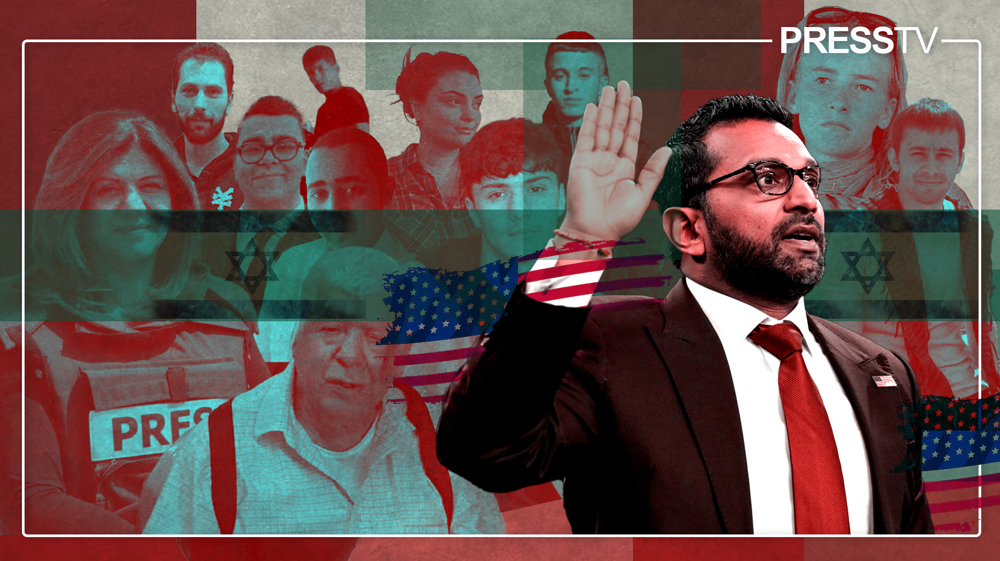
Following al-Bakoush’s arrest, FBI Director Kash Patel said that killing an American citizen is an act of terrorism, and perpetrators will be prosecuted in the United States.
“I’m extremely thankful to the CIA and director [John] Ratcliffe and our other law enforcement partners for making sure that the world knows that if you kill an American citizen in an act of terrorism, we will hunt you down, we will bring you to justice, and you will face justice here in America, not in another court, and not in any other proceeding around the world, but here,” he said.
After Patel shared a video of his remarks on X, formerly Twitter, users quickly pointed out a glaring exception: the Israeli regime.
From Rachel Corrie, crushed by an Israeli military bulldozer in 2003, to Khamis Ayyad, who died from smoke inhalation during a settler arson attack in 2025, at least thirteen American citizens have been killed by Israeli regime forces over the past two decades.
These victims included journalists reporting from the field, aid workers delivering food, peace activists protesting home demolitions, teenagers shot at checkpoints, and a 78-year-old grandfather detained and left to die.
Yet in cases involving Israeli forces, the US government has consistently deferred to Israeli military investigations – probes that human rights organizations have long condemned as whitewashes.
Rights groups have repeatedly documented that Israeli occupation forces are almost never held accountable within the regime’s legal system when they kill or seriously harm Palestinians.
To date, no one has been charged or held accountable for the killing of any American citizen by Israeli forces, and the successive US administrations have chosen not to take up the issue.
US citizenship, according to activists, offers no protection from violence at the hands of the Israeli regime – and no guarantee of justice when that violence proves fatal.
Nor are Palestinian Americans the only ones at risk. Several US citizens who are not Palestinian have also been subjected to lethal force by Israeli forces and illegal settlers on Palestinian land.
For decades, Washington has shielded Israel from international scrutiny. It has never seriously engaged with mounting evidence of Israel’s systematic violations of international law, including the killing of American citizens.
The mounting record suggests that the United States prioritizes its strategic relationship with Israel over the lives and rights of its own citizens, as activists note.
What follows are the names, stories, and circumstances of American citizens killed by Israeli forces – and the complete absence of accountability that followed.
Rachel Corrie

On March 16, 2003, an Israeli military bulldozer crushed to death 23-year-old US peace activist Rachel Corrie as she attempted to prevent the demolition of Palestinian homes in Rafah, southern Gaza Strip.
She was wearing a clearly marked fluorescent vest when she was attacked.
Corrie grew up in Olympia, Washington. While in college, she joined the Olympia Movement for Justice and Peace and later the International Solidarity Movement (ISM).
She traveled to Rafah in January 2003 and received two days of nonviolent resistance training to assist in ISM activities.
Corrie was horrified by what she witnessed in Gaza: widespread home demolitions, arbitrary detentions, and daily killings.
In an interview just days before her killing, she said, “I feel like what I’m witnessing here is a very systematic destruction of people’s ability to survive. And that is incredibly horrifying.”
She also documented her experiences in letters and emails to her family.
In one email, she wrote, “Now the Israeli army has actually dug up the road to Gaza, and both of the major checkpoints are closed. This means that Palestinians who want to go and register for their next quarter at university can’t. People can’t get to their jobs, and those who are trapped on the other side can’t get home; and internationals, who have a meeting tomorrow in the West Bank, won’t make it.”
An Israeli military investigation in 2003 absolved its forces of responsibility, blaming Corrie for her own death and claiming the bulldozer operators did not see her. The army refused to release key evidence.
In 2012, an Israeli sham court ruled that Israel was not at fault, rejecting a civil negligence lawsuit brought by Corrie’s parents against the Israeli ministry of military affairs.
The Israeli Supreme Court upheld the ruling in 2015. The US government merely criticized the investigation but refused to take any concrete measures to ensure justice and accountability.
Furkan Dogan

Furkan Dogan was just 19 years old when Israeli forces killed him on May 31, 2010, during the attack on the Mavi Marmara, a Turkish humanitarian aid ship sailing in international waters.
The Mavi Marmara was the largest vessel in a six-ship flotilla attempting to deliver food, medicine, and school supplies to Israel-besieged Gaza.
Dogan was filming the Israeli military raid when an Israeli commando shot him point-blank in the face. Four additional bullets were fired into his body, leaving him dead and severely disfigured.
He was one of ten civilians killed in the attack, all of them Turkish nationals.
Dogan was a high school student studying social sciences in Kayseri, Turkey. He was born in Troy, New York, and moved to Turkey at the age of two.
The US government dismissed the killing, blocked efforts toward an independent investigation, and accepted the conclusions of an Israeli inquiry that found no wrongdoing by any of the soldiers involved.
In 2015, Dogan’s parents filed a lawsuit in California under the Alien Tort Statute (ATS) and the Torture Victim Protection Act (TVPA) against Ehud Barak, Israel’s former minister of military affairs.
In 2016, a US district court dismissed the claims of extrajudicial killing and torture, despite findings by the International Criminal Court (ICC) that war crimes had been committed during the raid.
The dismissal followed a formal request from the Israeli regime urging the US State Department to submit a “suggestion of immunity” on Barak’s behalf. Washington complied.
Nearly three years later, the 9th Circuit Court of Appeals dismissed the appeal, ruling in Barak’s favor.
Orwah Hammad

Orwah Hammad, a 14-year-old Palestinian American from New Orleans, Louisiana, was killed by Israeli forces on October 24, 2014, in the village of Silwad near Ramallah in the occupied West Bank.
Hammad was shot in the neck and head during a demonstration protesting the killing of another Palestinian earlier that week.
The US State Department called for a “speedy and transparent investigation” into Hammad’s killing and expressed muted concern, but ultimately took no action.
The Israeli military announced it would investigate the shooting. Soldiers later justified the killing by claiming Hammad had been armed, though no evidence was provided.
An internal Israeli investigation subsequently cleared the military of any wrongdoing.
Mahmoud Shaalan

Mahmoud Shaalan was a 16-year-old high school student born and raised in Florida.
On February 26, 2016, Israeli soldiers shot him four times at a checkpoint near the Beit El settlement, close to the occupied West Bank city of Ramallah.
After shooting Shaalan, soldiers stripped his body, left him bleeding on the road for more than two hours, and prevented a Palestinian ambulance from taking him to a hospital.
The Israeli military claimed Shaalan had stabbed a soldier and continued trying to attack other troops after being shot.
However, Israeli media later reported that eyewitnesses told activists Shaalan had been shot in the back following an apparent verbal dispute with soldiers at the checkpoint.
Later that year, Israeli authorities informed US officials that they found no criminal wrongdoing by the soldiers involved and would not pursue the case further.
Shaalan’s uncle, Salman Shaalan, said at the time that the Obama administration had failed to pressure Israel to conduct a serious investigation.
Mahmoud hoped to study medicine in college but his dreams were shattered by the Israeli barbarism.
Omar Assad

Omar Assad, a 78-year-old Palestinian American, died on January 12, 2022, after being detained by Israeli soldiers at a checkpoint in his home village of Jiljilya, near Ramallah in the occupied West Bank.
According to witnesses and his family, Assad was forced out of his car, gagged, blindfolded, and dragged along the ground. He became unresponsive, and soldiers left him in the cold at a construction site without medical assistance.
An autopsy later concluded that Assad died of a heart attack “due to the external violence he was exposed to” by the Israeli forces that held him.
Assad had spent four decades living in Milwaukee, Wisconsin, where he raised his children. In 2009, he returned to Palestine to spend his final years.
His death drew widespread condemnation. The Assad family and Palestinian rights advocates called on the Biden administration to conduct an independent investigation and hold Israel accountable.
In 2023, the Israeli army announced that soldiers involved in the incident had been disciplined but that none would face criminal charges.
In April 2024, the US State Department said it was considering sanctions against the Netzah Yehuda Battalion, the Israeli unit involved in Assad’s detention and one long been notorious for systematic abuses in the West Bank.
Nearly four months later, however, the department said Secretary of State Antony Blinken had determined the battalion’s issues had been “remediated,” allowing it to continue receiving US funding.
Shireen Abu Akleh

Veteran Palestinian journalist Shireen Abu Akleh was killed by a single shot to the head on May 11, 2022, while covering an Israeli military raid on the Jenin refugee camp in the occupied West Bank.
After she was shot, Israeli soldiers prevented bystanders from reaching her, ensuring that she bled to death. Abu Akleh was wearing a clearly marked press vest and standing with a group of journalists when she was killed in cold blood.
Eyewitness testimony and video evidence showed she was targeted deliberately.
In an interview with the Press TV website, Shatha Hanaysha, who was with her at the time of the incident, described it as “the hardest experience” of her life, not because she had a narrow escape but because she and other young Palestinian journalists lost their friend, philosopher, and guide.
“I know who shot Shireen and who tried to kill the rest of us, they were Israeli troops and not anyone else,” the 29-year-old reporter told Press TV. “It was not at all a case of mistaken identity.”
Initially, the Israeli military claimed Palestinian gunmen were responsible. It later revised its account, saying Abu Akleh was likely killed by Israeli soldiers but “by mistake.”
In a rare move, the US government announced it would investigate her killing, a decision publicly rejected by then Israeli minister of military affairs, Benny Gantz.
“I have delivered a message to US representatives that we stand by [Israeli] soldiers, that we will not cooperate with an external investigation, and will not enable intervention in internal investigations,” Gantz said.
Israel refused to allow US investigators to interview the soldier or even to disclose his identity. A subsequent investigation by The Guardian identified the soldier, who was later killed in Jenin and buried as a “hero.”
The investigation also revealed that fellow soldiers had used images of Abu Akleh for target practice.
In July 2022, the Biden administration endorsed Israel’s account, stating it “found no reason to believe” Abu Akleh had been intentionally targeted.
However, in October 2025, retired US Army Colonel Steve Gabavics, the senior US officer who examined the scene, said he had concluded at the time that Abu Akleh, despite clearly wearing a press vest, was deliberately shot.
Gabavics said his findings were softened for political reasons to avoid harming US-Israel relations.
Tony Abu Akleh, Shireen’s brother, described the administration’s response as a “whitewash,” saying it entrenched impunity for Israeli forces and failed to deter further killings of journalists in Gaza.
Tawfiq Ajaq

Tawfiq Ajaq, a 17-year-old Palestinian American born and raised in Gretna, Louisiana, was killed on January 19, 2024, in the occupied West Bank village of al-Mazra’a ash-Sharqiya.
Ajaq had traveled to Palestine in May 2023 to visit family near Ramallah and to “reconnect with their roots.”
According to his family and Defense for Children International–Palestine (DCI-P), Ajaq was riding in a truck with a friend near a highway when gunfire erupted.
The shots came from an Israeli settler in a vehicle roughly 100 meters away. As Ajaq and his friend tried to drive off, the settler pursued them.
An Israeli military vehicle then “appeared from the opposite direction” and began firing from a distance of 50 to 70 meters, according to DCI-P documentation.
As Ajaq lay bleeding, Israeli forces blocked emergency responders for approximately 15 minutes. He was later taken to a hospital in Silwad, where he was pronounced dead from a gunshot wound to the head.
Israeli forces claimed they were targeting individuals “believed to be throwing rocks along Highway 60,” a claim rejected by Ajaq’s family, who said the teens were planning a barbecue.
Ajaq was the first American killed in the West Bank since the start of Israel’s genocidal war on Gaza in October 2023, which has until now killed over 72,000 Palestinians.
The US State Department called for “an urgent investigation” and said it was “devastated.”
Officials from the US Office of Palestinian Affairs visited Ajaq’s family and pledged to push Israel to conduct a “full and transparent investigation and bring the killer to justice.”
Representative Rashida Tlaib urged the US State Department to open its own investigation “into the murder of another American” by the Israeli regime.
Although Biden issued an executive order on February 1, 2024, imposing sanctions on four violent Israeli settlers, the order was repealed by Donald Trump in January 2025.
As of October 2024, Israeli authorities had not collected eyewitness testimony for Ajaq’s case. As of July 2025, no findings had been released, and no suspects charged.
Ajaq’s uncle, Mohammad Abdeljabbar, said justice for Americans killed in Palestine was routinely denied, citing Washington’s unwillingness to pressure its “ironclad ally.”
“They are using our tax dollars in the US to support the weapons to kill our own children,” his father said.
A high-performing student, Ajaq planned to attend the University of New Orleans. He had not yet decided whether to study business or engineering.
Mohammad Khdour

Less than a month later, on February 10, 2024, 17-year-old Palestinian American Mohammad Khdour, born in Florida, was shot in the head and killed by an Israeli soldier.
Khdour was killed west of the Palestinian town of Biddu, northwest of occupied al-Quds.
Israeli forces opened fire on a car in which Mohammad was traveling with a relative in a wooded area near the town of Qattana. As gunfire erupted, the vehicle overturned while attempting to flee.
Mohammad sustained gunshot wounds to the head. He was transported by ambulance to the Palestine Medical Complex in Ramallah, where medical staff attempted to resuscitate him.
He was later pronounced dead.
According to his family, Khdour and his cousin were driving home from a picnic when a gunman on the Israeli side of a nearby border fence, whom they described as a guard, opened fire on their car. The cousin was unharmed.
Blinken offered his “deepest condolences” to the families of the two Palestinian-American teenagers killed in the occupied West Bank and said there must be an investigation into their deaths.
“We’ve made clear that with regard to the incidents you’ve alluded to, there needs to be an investigation. We need to get the facts. And if appropriate, there needs to be accountability,” Blinken said at a news conference in Albania in response to a CNN question.
Mohammad’s uncle dismissed the statement as empty rhetoric. “We don’t need talking, man. We need something. We want to see something.”
The family said they later received a call from a US Embassy official, who told them the Israeli investigation into Mohammad’s killing was progressing.
No official announcement has been made, and Israel has not reported arresting any suspects.
Mohammad’s family described him as a gentle teenager who loved cars. He hoped to finish high school and then attend college in the United States to study law.
Jacob Flickinger

Jacob Flickinger, a dual US-Canadian citizen, was among the humanitarian workers killed on April 1, 2024, when Israeli forces bombed a World Central Kitchen convoy in Gaza amid Israel’s genocidal war.
Flickinger, 33, and six other aid workers were killed shortly after delivering humanitarian food assistance to the people in Gaza.
Israel’s military apologized, described the attack as a mistake, and promised a full investigation.
Flickinger’s parents rejected the apology and described their son’s killing as a “crime.”
John Flickinger and Sylvia Labrecque said there was a “hole in their hearts,” and that Jacob’s wife, Sandy, and their 18-month-old son, Jasper, were left without a husband and father.
John Flickinger said the US Department of Justice never contacted the family following the attack.
“It’s very frustrating. It’s very disheartening…you would think as a US citizen, the United States would take more of an interest in his killing,” he said.
Ayşenur Ezgi Eygi

Ayşenur Ezgi Eygi, a 26-year-old American Turkish woman and resident of Seattle, Washington, was shot in the head by an Israeli sniper on September 6, 2024, in the occupied West Bank.
Eygi had been participating in a peaceful protest against settlement expansion near Nablus, a town in the occupied West Bank.
She had arrived in the occupied West Bank just three days earlier to volunteer with Palestinian communities facing violence from Israeli soldiers and settlers.
An Israeli military investigation concluded within days that it was “highly likely” Eygi had been struck “indirectly and unintentionally by [the Israeli military] fire which was not aimed at her,” claiming the soldiers had been targeting others, allegedly throwing rocks.
A subsequent Washington Post investigation found that Eygi was shot roughly half an hour after any clashes had ended and that she was standing approximately 200 yards from Israeli soldiers at the time she was killed.
US officials described the killing as “unprovoked and unjustified,” but despite repeated requests from Eygi’s family, the United States declined to open its own investigation.
The Turkish government investigated the killing and concluded that Eygi had been “deliberately targeted.”
Ankara submitted evidence to the United Nations Security Council, the International Court of Justice, and the International Criminal Court.
The absence of accountability, Eygi’s family said, was not due to a lack of effort.
When the family met with Blinken in December 2024, they asked him directly: “What can you do?” recalled Eygi’s husband, Hamid Ali.
He said the response amounted to “a lot of shoulder shrugging.”
“He [Blinken] was very deferential to the Israelis. It felt like he was saying his hands were tied and they weren’t able to really do much.”
The State Department told the family that launching an investigation would be the responsibility of the Justice Department, which later wrote that it would “carefully review” their request. No follow-up ever came.
Amer Rabee

On April 6, near the West Bank village of Turmus Aya, where many residents hold US citizenship, Israeli soldiers killed Amer Rabee, a 14-year-old Palestinian American born in New Jersey.
According to his family, Israeli regime forces handed over Amer’s naked, bullet-riddled body several hours later in a blue body bag.
Amer had been shot at least 11 times, his father, Mohammed Rabee, said.
Photographs taken on a cellphone by a family friend who accompanied the family to retrieve Amer’s body appeared to show multiple entry wounds, including one in the center of his forehead and others in his neck and upper torso.
The Israeli military claimed Amer and two friends were throwing rocks at a highway and described the boys as “terrorists,” saying soldiers had “eliminated” one and shot the others.
Amer’s family and one of the surviving boys rejected the claim, saying the children had been picking almonds and jokingly throwing dried almonds at each other.
Even if stones had been thrown, Rabee said, soldiers could have fired warning shots or detained the boys.
“He was 14 years old,” he said. “It takes no special training to catch a little kid.”
At the time, US Senators Andy Kim and Cory Booker called for an American-led investigation into Amer’s killing, but the Trump administration declined to commit to any such action.
US State Department spokeswoman Tammy Bruce said at an April press briefing that the Israeli military believed it had been preventing an act of terrorism.
“We need to learn more about the nature of what happened on the ground,” she added.
Sayfollah Musallet

On July 11, 2025, Sayfollah Musallet, a 20-year-old Palestinian-American from Florida, was beaten to death by illegal Israeli settlers while visiting relatives in his village near occupied al-Quds.
The attack took place on land belonging to his family’s farm.
According to witnesses and family members, Israeli soldiers blocked ambulances from reaching Musallet for three hours.
During that time, Sayfollah, known as Saif to his family, remained conscious, gasping for air and vomiting as he was held in the arms of his younger brother.
Another young man, 23-year-old Razek Hussein al-Shalabi, was shot during the same attack and left to bleed to death. When ambulances finally arrived, settlers attacked the medics.
Saif was pronounced dead before reaching the hospital. He died in his brother’s arms.
The Israeli military claimed the incident began after stones were thrown at Israeli settlers and said it was investigating the attack.
For Musallet’s family, the devastation has been compounded by what they describe as indifference from the US government to the killing of a US citizen.
Mike Huckabee, the US ambassador to Israeli-occupied territories, called on Israel to investigate the killing but offered no public support to the family.
The family is acutely aware that the arrest and prosecution of violent settlers is rare, considering the Trump administration's rescission of the Biden-era sanctions on Israeli settler groups for attacking Palestinians in the occupied West Bank.
Despite this record, Musallet’s family has called on the US State Department to open its own investigation into Saif’s killing. There has been no follow-up.
The killing was not the family’s only ordeal.
Saif’s 16-year-old cousin, Mohammed Zaher Ibrahim—also an American citizen—has been held for months in Israel’s Megiddo prison. His family says he has been accused of throwing stones, an allegation they reject.
They say he has lost nearly 30 pounds and developed a severe skin infection while incarcerated, with no family visits or phone calls permitted.
Khamis al-Ayyad

Khamis al-Ayyad, a 40-year-old father of five and a resident of Chicago, died from smoke inhalation on July 31, 2025, after Israeli settlers attacked the town of Silwad, east of Ramallah.
The assault took place around 2:30 a.m., when approximately ten settlers set homes and cars on fire.
Residents rushed outside to extinguish the flames but were met with tear gas fired by Israeli soldiers, according to Silwad’s mayor, Raed Hamed.
The Israeli military acknowledged that an attack had occurred but said it was unable to identify any suspects. Israeli police said an investigation had been opened.
No one has been held accountable for Ayyad’s death.
“The government should protect citizens, this is what is written on the American passport. Why do they do nothing when it comes to their own citizens who live in the West Bank?” said Ayyad’s brother, Anas al-Ayyad, 39.
Ayyad was the latest Palestinian American killed in the occupied West Bank. Since October 7, 2023, five US citizens have been killed there, with Ayyad the second in July alone.
The killings have taken place amid a surge in violence in the occupied West Bank, where more than 1,000 Palestinians have been killed by Israeli soldiers and settlers since the start of Israel’s war on Gaza.
Senator Chris Van Hollen said the Trump administration’s repeal of US sanctions on violent Israeli settlers has “sent a message that violent settlers can literally get away with murder.”
‘Accountability never arrives’
US law is unambiguous: Any proven extrajudicial killing should result in the termination of US military and financial assistance to the unit responsible.
Multiple statutes, including the Leahy Law, prohibit the United States from providing military aid to foreign security forces implicated in gross human rights violations.
Yet despite extensive documentation of apparent extrajudicial killings and systemic abuses in the occupied Palestinian territory, Israel continues to receive billions of dollars in US military assistance each year.
In October, DAWN, a US nonprofit organization working to reform US policy in West Asia and North Africa and to hold human rights abusers accountable, urged Congress to introduce a resolution under Section 502B(c) of the Foreign Assistance Act.
The resolution would compel the State Department to conduct a comprehensive investigation and issue a report on the killings of thirteen American citizens by Israeli forces and settlers since 2003.
“Congress should force the State Department to investigate and report on these shocking killings of Americans by Israeli forces, for which not a single person has been held accountable,” said Sarah Leah Whitson, executive director of DAWN.
“When Israeli forces kill thirteen Americans, including a 78-year-old grandfather, teenage boys, a celebrated journalist, and aid workers, over two decades and not one person is held accountable, that’s not a series of tragic accidents—that’s systematic impunity.”
Under Section 502B(c), Congress has the authority to compel the State Department to provide detailed findings on the human rights record of any country receiving US military aid.
The department must respond within 30 days or face an automatic suspension of security assistance.
“This is not a series of tragic accidents. This is systematic impunity—a decades-long pattern in which American lives are taken with complete disregard, and the US government fails to demand justice,” DAWN said.
“When Israeli forces kill Americans, our State Department issues statements expressing concern and promises investigations. But the investigations never come. The accountability never arrives. The pattern continues, emboldened by American silence and the flow of billions of dollars in US military aid with no conditions, no consequences, and no regard for American lives,” it added.
Palestinian rights group calls for release of pregnant women held by Israel

Israeli minister Ben-Gvir: ‘All of Lebanon should be our playground,’ no ceasefire

Hamas denounces Israel's policy of 'systematic killing' in West Bank



Speaker Qalibaf: Strait of Hormuz will never return to pre-war status
Pakistan defense minister: Iran-US agreement marks demise of Netanyahu
Palestinian rights group calls for release of pregnant women held by Israel
Iran committed to diplomacy under international law, Pezeshkian tells Erdogan
Iran to continue IAEA cooperation under existing framework, SNSC decision: Baghaei
Iran top negotiator departs for Muscat to discuss Hormuz Strait cooperation
Qatar urges end to Israeli occupation of Lebanon, condemns attacks
Israeli minister Ben-Gvir: ‘All of Lebanon should be our playground,’ no ceasefire




 PressTV NEWSLETTER now
  This makes it easy to access the Press TV website