Decades of broken promises, aggression, Israeli pressure leave Iran no reason to trust US: Analyst
By Press TV Website Staff
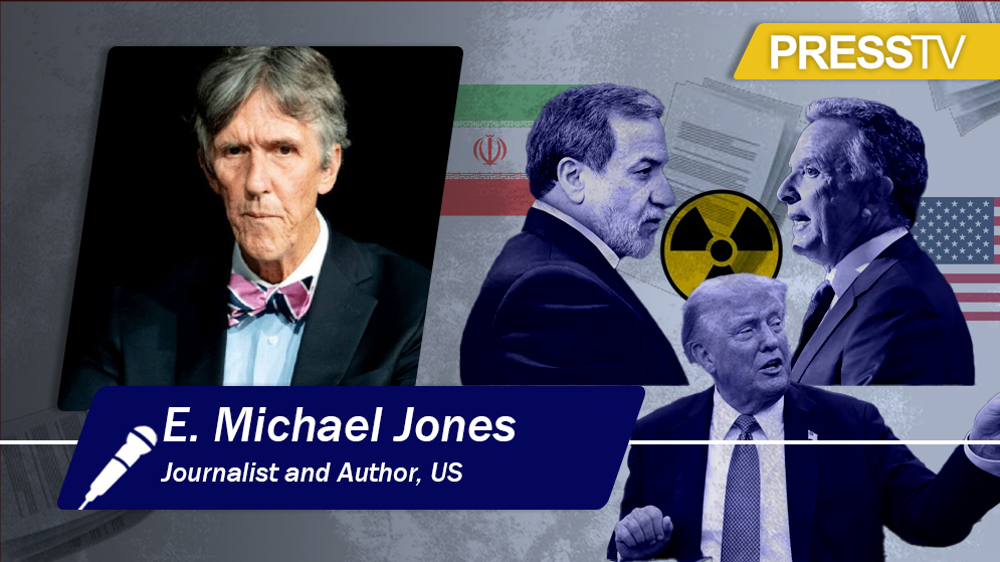
Decades of broken promises, military aggression, and Israeli pressure have left Tehran with no reason to trust Washington, says a US-based analyst.
In an interview with the Press TV website, E. Michael Jones, author and editor of Culture Wars Magazine, said it would be “foolish” to put “trust in a regime which violates its own word repeatedly,” referring to the Donald Trump administration.
“Iranians have learned their lesson and will not put themselves in jeopardy again. The US cannot be trusted,” he noted.
Mistrust is not a tactical posture but the logical outcome of experience, Jones said, adding that the United States, particularly under Trump, has demonstrated “again and again” that it does not feel bound by its own international commitments.
That mistrust is sharpened by Trump’s record on international obligations, he remarked.
The US-based journalist and commentator pointed to the unilateral withdrawal of the US from the Joint Comprehensive Plan of Action in May 2018.
“Trump has already torn up the JCPOA. He would not feel bound by any agreement,” he said, adding that this piece of history alone makes any future deal “inherently fragile.”
Jones also dismissed Israeli-backed demands to restrict Iran’s missile range, calling them knowingly unrealistic.
“A 300 km limitation on Iranian missiles is an impossible demand,” he stated, adding that Israel is fully aware Iran would never accept such terms.
According to the analyst, these conditions are not designed to advance negotiations but to manufacture justification for war.
"The enemies try to instill an atmosphere of fear but our people have their trust in their armed forces"
— Press TV 🔻 (@PressTV) February 9, 2026
▶️Exclusive: Full Interview with Iranian Armed Forces Spokesman Brigadier General Abolfazl Shekarchi
Follow https://t.co/B3zXG73Jym pic.twitter.com/7PKfikXxqW
“They are making the demand because it provides a pretext for war,” he told the Press TV website, as indirect Iran-US talks have recently resumed in Muscat under Omani mediation.
The discussions, facilitated by Omani Foreign Minister Badr bin Hamad Al Busaidi, allowed the two sides to exchange views indirectly almost eight months after the previous round of talks was suspended due to Israeli-American military aggression against Iran.
Iranian Foreign Minister Abbas Araghchi described the latest round of talks as a “good start,” saying Iran’s positions and concerns were clearly conveyed.
More than a week into the June war, the United States bombed Iran’s nuclear facilities. Between June 13 and 27, 2025, at least 1,064 people were killed in Iran, including military commanders, nuclear scientists, and ordinary civilians.
Against this backdrop, claims that talks could once again serve as cover for military action resonate strongly. Jones believes Iranians “learned their lesson” there.
This distrust is further reinforced by Washington’s expanding military footprint and repeated threats. Despite Trump’s campaign rhetoric about ending US wars, his administration has bombed several countries and repeatedly edged toward confrontation with Iran.
In his assessment, Trump’s preferred military option remains limited and performative. “Trump's preferred option at this point is a symbolic strike at targets pre-arranged with the Iranian government,” Jones says, claiming that this approach was already used in June.
Such strikes, he explained, are designed to create the illusion of victory. Trump can declare success, “satisfying the Israelis, who ordered him to attack Iran, and the Iranians, who lose nothing in the attack.”
But the analyst argued that this balancing act is collapsing. “Unfortunately, neither Iran nor Israel is willing to accept Trump's solution,” he noted.
Israeli pressure, Jones added, is now the central driver of escalation. With Trump set to meet Benjamin Netanyahu on Wednesday, the analyst expects an ultimatum by the latter: “if you don't attack Iran, we will.”
“If Trump is smart, he will let Israel attack Iran on its own, hoping that the Iranian response will obliterate Israel once and for all, releasing him from Netanyahu's constant pressure,” Jones remarked.
"The US does not do diplomacy with weak nations"
— Press TV 🔻 (@PressTV) February 6, 2026
Reporting from the heart of Tehran, Azadi Square, Press TV's Maryam Azarchehr explains why the US has resorted to diplomacy with Iran.@TillDLastBreath
Follow https://t.co/B3zXG74hnU pic.twitter.com/ELiaq4lsAI
Still, he believes Netanyahu’s threats mask a deeper constraint. “Netanyahu is bluffing. He knows he can't attack Iran by itself,” he said, adding that “many here speculate that Netanyahu is blackmailing Trump with the Epstein files.”
Despite the rhetoric, the analyst insists the US is fully aware of the risks of war with Iran.
Iranian officials have warned that any attack would be met with an immediate response, and Iran’s missile capabilities have already demonstrated their ability to penetrate layered defenses. According to the author, this reality is well understood within the US military.
“The American military has always claimed that the US cannot win a war with Iran,” he noted.
Yet, he hastened to add, such assessments rarely determine policy. “Their verdict invariably gets overturned by Israeli pressure,” Jones stressed, explaining why Trump continues to favor prearranged and symbolic strikes rather than full-scale war.
“American forces are now operating according to Israeli rules,” he stated, noting that the US power in the region no longer operates according to international norms.
He cited the assassination of top anti-terror commander General Qassem Soleimani, carried out while he was on a peace mission in Iraq, as a defining moment.
For Jones, it marked Washington’s abandonment of its own claims to a “rules-based order,” as well as its disregard for institutions such as the United Nations.
He recalled Trump’s own words when questioned by the New York Times. Asked whether he followed international law, Trump said no. Asked what he did follow, Trump replied, “My morality, my mind.”
The analyst described this as a direct reference to John Milton’s Paradise Lost, when Satan said, “The mind is its own place.”
The symbolism, he noted, is unmistakable, adding that it confirms that Imam Khomeini—the founder of the Islamic Revolution—was right when he referred to America as the “Great Satan.”
Iran stopped Trump's 'march to reassert US global dominance': Analyst
Iran-US MoU to end war a welcome development for regional security, stability: Analyst
Iran-US MoU ‘great victory’ for Tehran as US failed to achieve war objectives: Former diplomat


Iran def. minister warns of 'heavy, regretful' response to any violation of US MoU
“This is how we protect our land": parl. speaker hails Iran's World Cup defense amid US threats
Iran hold Belgium to goalless draw as World Cup campaign gains momentum
Leave southern Lebanon or be kicked out: IRGC Quds Force chief warns Israel
VIDEO | Trump’s derogatory comments about PM Giorgia Meloni spark political backlash in Italy
VIDEO | Anti-fascist rally held in Bogotá ahead of presidential election
VIDEO | Gaza's hospital power shortages leave patients at risk
VIDEO | Yemenis call Iran–US MOU victory for resistance


 PressTV NEWSLETTER
now
PressTV NEWSLETTER
now
 This makes it easy to access the Press TV website
