Iran unveils three homegrown strategic projects on National Space Technology Day
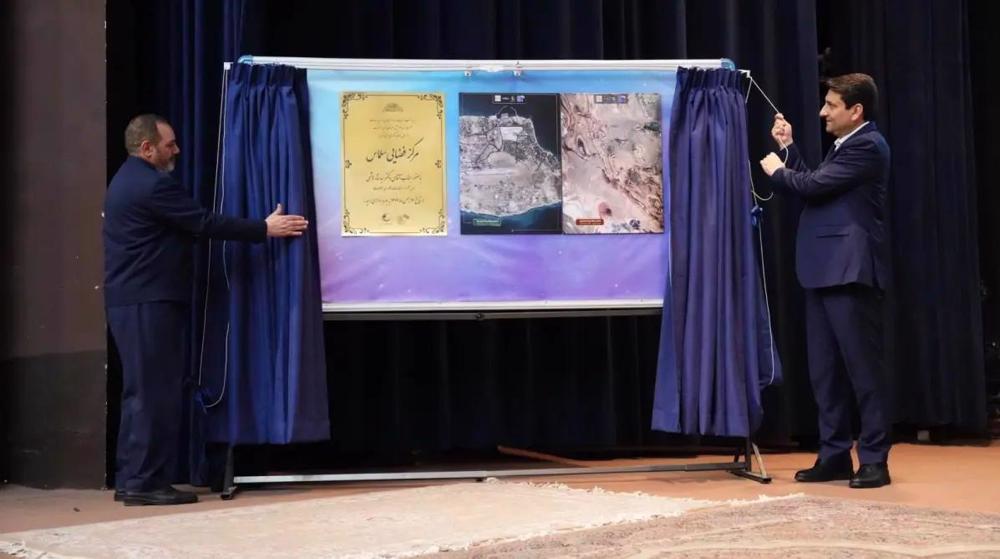
Iran has unveiled and inaugurated three domestically developed and strategic achievements in the fields of infrastructure, communications, and satellite imagery as it commemorates National Space Technology Day.
Iranian Minister of Communications and Information Technology Sattar Hashemi and Defense Minister Brigadier General Aziz Nasirzadeh attended the ceremony in the capital Tehran on Tuesday.
The main prototype of the first satellite system project, named after top anti-terror commander Lieutenant General Qassem Soleimani, as well as the first images captured by the recently launched Paya satellite, were put on display during the event, while a new space facility was launched.
Salmas Space Center, one of the country's important space installations, was inaugurated in northwestern Iran. The center is among the main bases for operating satellites, controlling space missions, and receiving satellite data and images.
It features communication infrastructure, energy supply systems, and satellite mission control equipment, and has several platforms for the installation and operation of antennas at different frequencies.
The geographical location of Salmas Space Center enables it to cover satellite passes in the western regions of the country up to a depth of several hundred kilometers beyond the frontier.
Its inauguration has now extended the duration for accessing satellite data and transmitting commands, and reduced the time for stabilizing and controlling satellites – an issue that plays an effective role in improving the efficiency of space missions.
Iran's defense minister unveils images received from domestically-made Paya satellite and announces the establishment of the Salmas and Chenaran Space Centers.
— Press TV 🔻 (@PressTV) February 3, 2026
Follow: https://t.co/mLGcUTS2ei pic.twitter.com/Ci53sLJBEU
In the ceremony, the first prototype of the Martyr Soleimani satellite constellation was also unveiled with its real and original dimensions and specifications.
The system has been developed entirely by Iranian specialists and consists of nearly 24 satellites. It is designed to establish wide-ranging narrow-band communications.
According to the Iranian Space Agency (ISA), the Martyr Soleimani satellite constellation will be placed in a low Earth orbit (LEO).
The system can be used to transmit low-volume data in critical conditions, and also to exchange sensor data with the aim of developing Internet of Things (IOT) services in space.
In another part of the ceremony, the first images captured by the recently launched Paya satellite were also released.
Paya is said to be the heaviest Iranian satellite launched to date, with a weight of 150 kilograms, representing a newer class of Iranian satellite technology. It employs advanced telescopic camera technology with a base resolution of 5 meters per pixel, which can be enhanced to approximately 3 meters using onboard artificial intelligence algorithms.
Iran unveils Hatef-3, the flight model satellite of the Martyr Soleimani satellite constellation.
— Press TV 🔻 (@PressTV) February 3, 2026
Follow: https://t.co/mLGcUTS2ei pic.twitter.com/IszSprDxy0
Defense minister: Iran should not be dependent on others in space sector
Meanwhile, the Iranian defense minister underlined that the Islamic Republic should not be dependent on others in the space sector.
“We must definitely stabilize our presence in space. New laws are currently being enacted in the world, and orbit maintenance is not an easy task. From now on, both obtaining and maintaining orbits will be more difficult, because the private sector has entered the field and competition has become fairly stiff,” Nasirzadeh pointed out.
He added, “We have made great progress in the area of transfer, whether orbital transfer or other relevant forms. We have made noteworthy achievements concerning the development of launch pads, as was the case with the Tolou-3 satellite. More endeavors must be undertaken in the field of the development of launch vehicles. Thank God the Ministry of Defense and the Islamic Revolution Guards Corps (IRGC) Aerospace Force have made good progress in this regard.”
Iran first entered the global space arena in February 2009, when it launched its first domestically produced satellite, Omid (Hope), aboard a Safir rocket. Designed for research and telecommunications, Omid marked the country’s initial step in satellite data processing.
Since then, Iran has made significant advances and managed to take giant strides in its civilian space program, successfully launching several more satellites despite sanctions imposed by Western countries in recent years.

Iran leads Islamic world in microelectronics science, ranks among world's top 16

‘Stronger than before’: Inside Tehran’s bombed Laser and Plasma Institute that resumed work in days

Iran joins six nations capable of designing, manufacturing advanced cryogenic equipment



‘We will never withdraw:’ Israeli minister vows endless occupation of Lebanon
Eight killed in US Air Force B-52 Stratofortress bomber crash
Quds commander: Imposed war discredited US, accelerated collapse of Israel
June 15: Iran-US MoU to end imposed war is widely welcomed as US lifts naval blockade
Iran’s army: Any violation of MoU will be met with swift response
Exclusive: Iranian oil tankers, cargo vessels sail through as US naval blockade officially lifted
Iran-US MoU ‘great victory’ for Tehran as US failed to achieve war objectives: Former diplomat
Iran says talks with US to start right after signing of MoU in Switzerland


 PressTV NEWSLETTER now
  This makes it easy to access the Press TV website