Iran riots: Why Trump’s ‘rescue’ rhetoric backfired, uniting Iranians against external meddling
By Hamid Javadi
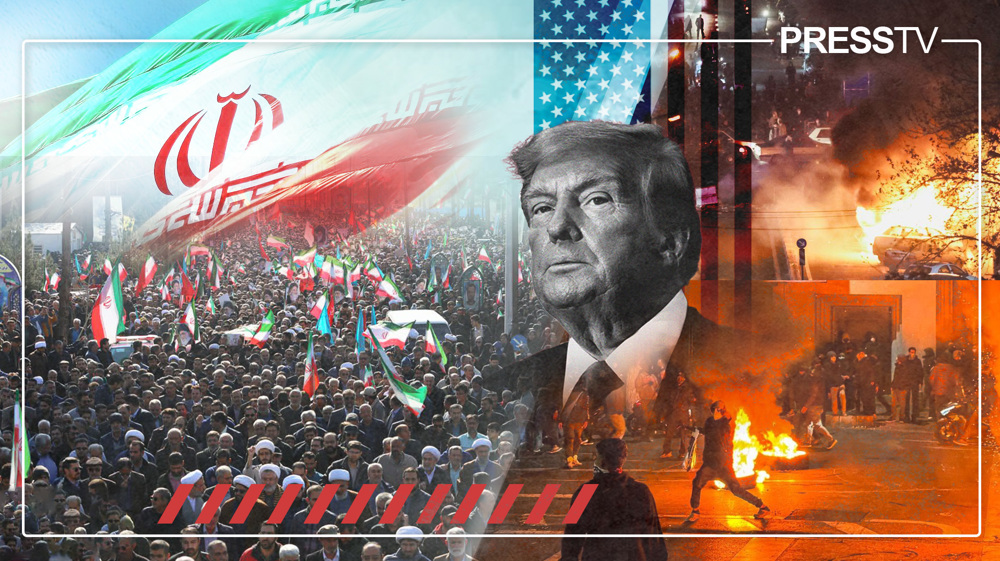
At no point during his erratic presidency did Donald Trump exhibit the level of indecisiveness he showed during the recent foreign-engineered unrest in Iran.
His infamous “we’re locked and loaded” rhetoric gave way to the admission that he had “convinced himself” against a military strike as the riots and acts of terror he helped incite fizzled out and died.
This is not to say the mercurial and unpredictable occupant of the White House will not commit a catastrophic miscalculation against Iran in the future, one that could possibly have unimaginable consequences for the entire region.
What began late last month as peaceful protests in Tehran’s Grand Bazaar – a call for economic reform amid spiraling inflation and currency depreciation – was quickly hijacked. Agents trained by the CIA and Mossad infiltrated the crowds to agitate protesters and incite violence.
Trump was quick to step into the fray. In a January 2 post, he claimed that the US was “locked and loaded” and if Iran killed “peaceful protesters”, the US would “come to their rescue.”
With every such message, the armed rioters, who even former CIA director Mike Pompeo admitted were being accompanied by Mossad agents on the streets, became more violent.
“The USA stands ready to help!!!” Trump posted on January 10. His threats escalated from rooting for the rioters to openly calling for regime change.
“TAKE OVER YOUR INSTITUTIONS!!!... HELP IS ON ITS WAY,” he wrote later.
The US and Israel have incited unrest in Iran before, but they escalated it to an unprecedented level in this most recent episode. For Iranians like me, born after the 1979 Islamic Revolution, the violence was a shocking new precedent.
We were horrified by scenes of trained, armed agents wreaking havoc in our streets. Members of the security forces were shot, stabbed, and in some cases, burned alive. Public and private property, including mosques, hospitals, ambulances, police vehicles, shops, and personal cars, was systematically torched and vandalized.
Iranian officials described the violence as worse than the atrocities committed by the Daesh (ISIL) terrorist group – itself propped up and trained by the US and Israel – in Iraq and Syria.
The terrorist elements used “bloody” tactics to maximize casualties among both policemen and civilians. Children as young as three were shot and killed. Women and the elderly were also not spared. Authorities said that more than two-thirds of the thousands killed were innocent civilians, including many children.
The legitimate demands of those calling for economic reform were drowned out in the chaos. The protest was hijacked and turned into a violent foreign-backed push for “regime change.
✍️ Feature -How Mossad and CIA sabotaged economic protests in Iran to stir up chaos – but failed https://t.co/TzVMGY7YBc
— Press TV 🔻 (@PressTV) January 21, 2026
By Yousef Ramazani
Follow: https://t.co/mLGcUTS2ei pic.twitter.com/zwvvHUuZRL
There is broad consensus, including among the political leadership in Tehran, on the need for economic reform. However, meaningful reform becomes intrinsically impossible when a state finds itself under a constant, and at times even potentially existential, threat from the outside.
Real change can only happen when the political establishment feels secure enough to lower its guard and pivot toward addressing the domestic issues that matter most to the people, above all, the economy.
Decades of attempts by the US and Israel to engineer “regime change” in Iran, through sanctions, sabotage, assassinations, and, more recently, military aggression, have drained the Islamic Republic's energy and resources and locked its focus on confronting the external threats.
Even US Treasury Secretary Scott Bessent, speaking to Fox Business at Davos on Wednesday, admitted that the primary objective of sanctions is to push people in Iran into desperation, in the hope that they will rise against their government – in other words, to bring about “regime change.”
In such a political climate, calls for meaningful reform are often relegated. This explains the recurring and increasingly violent episodes of unrest in Iran. Peaceful protests that reflect legitimate public grievances are systematically hijacked by foreign operatives and their agents within the country to fan the flames of chaos and disorder.
The strategy is ripped straight from the playbook of the CIA and Mossad on orchestrating regime change: impose sanctions to cripple the economy and create dire conditions, incite public anger against the state through disinformation, exploit that anger when people take to the streets with legitimate grievances, infiltrate protests with trained operatives to turn them violent, and finally, deliver the final blow through military aggression.
The plan was working, until it wasn’t. The Iranian nation rose to the occasion, as it has countless times before. Millions took to the streets on January 12 to condemn the wanton violence and terrorism, demonstrating resolute support for the Islamic Republic.
Washington and Tel Aviv received the message loud and clear: however unhappy with economic hardships, the Iranian people will never submit to foreign intervention.
On the contrary, the Iranian people do realize that those who claim to want to “rescue” them are precisely the ones behind their hardship. Iran faces the most draconian sanctions regime any country has faced in modern times.
While American officials have long claimed that the sanctions have been designed to weaken the Iranian government, it has been the ordinary people who have suffered the most. Even humanitarian goods such as medicine have not been exempted. Tens of thousands of patients have died or developed critical ailments because of the same draconian sanctions.
The memories of the US and Israeli aggression last June are still fresh for the Iranians. More than a thousand innocent lives were cut short at the same time as their government was negotiating with Washington over the Iranian nuclear program.
US ‘must be held accountable’ for interference, support for terrorism in Iran: Araghchihttps://t.co/BU5jWiyKQw
— Press TV 🔻 (@PressTV) January 21, 2026
The timing of the unjustified and unprovoked attack, coupled with the deception surrounding it, was enough to expose the hand of Trump and Netanyahu. The aggression produced the opposite outcome from what the aggressors had anticipated. The Iranian people rallied behind the flag, demonstrating a unique sense of unity and solidarity with the Islamic Republic.
The humiliation, added to the destructive power of Iranian ballistic missiles raining down on towns and cities in the occupied territories, compelled them to seek a ceasefire within 12 days.
Throughout the years, the Islamic Republic has shown a remarkable ability to adapt and respond to emerging threats. Its enemies have also proven to have many tools in their toolbox, as was evident in the latest episode of engineered unrest in Iran.
Those who fell for Trump’s and Netanyahu’s conspiracy must know that they do not care about them and their concerns, not even a little bit. If the genocide in Gaza is not proof, what is?
They have slaughtered more than 70,000 Palestinians, mostly women and children, with the international community watching in horror. They have displaced an entire population to realize Trump’s dream of turning Gaza into the “Riviera of the Middle East.”
The US history of pursuing “regime change” in the region is riddled with examples that end in failed states, where people have been trapped in a cycle of violence and destitution as their countries erode and sink further into chaos.
The collapse of any state is highly disruptive. It opens the door to civil war, terror attacks, foreign intervention, and the plundering of national wealth. This creates a vicious cycle of attrition, where violence and extremism become a fact of life that swallows the entire society.
Needless to say, the possibility of “regime change” in Iran is nothing but a pipe dream. The US and Israel have pursued such a policy against the Islamic Republic for decades to no avail.
Any other political establishment would have buckled under such pressure. The Islamic Revolution of 1979 was borne out of a centuries-old longing for independence and freedom from the yoke of corrupt and self-serving monarchies and their foreign masters.
Despite calls for internal reform and some for systemic change, these should not be mistaken by the outside world for a national consensus in favor of “regime change.”
The Islamic Republic maintains broad popular support and commands a large, dedicated base that stands firmly behind it through thick and thin.
Trump must have realized this by now, and so must those still falling for his hollow rhetoric.
Hamid Javadi is a senior Iranian journalist and commentator based in Tehran.
(The views expressed in this article do not necessarily reflect those of Press TV)
With Israeli boots on the ground in Lebanon, Iran-US war-end deal remains fundamentally incomplete
From battlefield superiority to strategic leverage: Iran’s new post-war doctrine takes shape
How Iran turned battlefield gains and regional power into strategic postwar leverage against US


Iranian nation learned from martyred Leader never to submit to humiliation: Pres. Pezeshkian
Mass rallies in Yemen hail Iran’s victory, denounce Trump's comments on Mecca
US to waive sanctions on Iranian oil sales after signing MoU: Report
Ansarullah leader congratulates Iran on 'great victory' over US, Israel
Trump considers ousting officials who opposed Iran agreement: Report
Iran warns of ‘harsh response’ as Israel violates ceasefire 84 times in Lebanon
Iran, Russia to complete integration of banking networks within two months: CBI chief
Palestinian groups warn against Israeli move to strip al-Khalil of municipal powers





 PressTV NEWSLETTER now
  This makes it easy to access the Press TV website